Battery Solution for Elevator and Escalator Backup
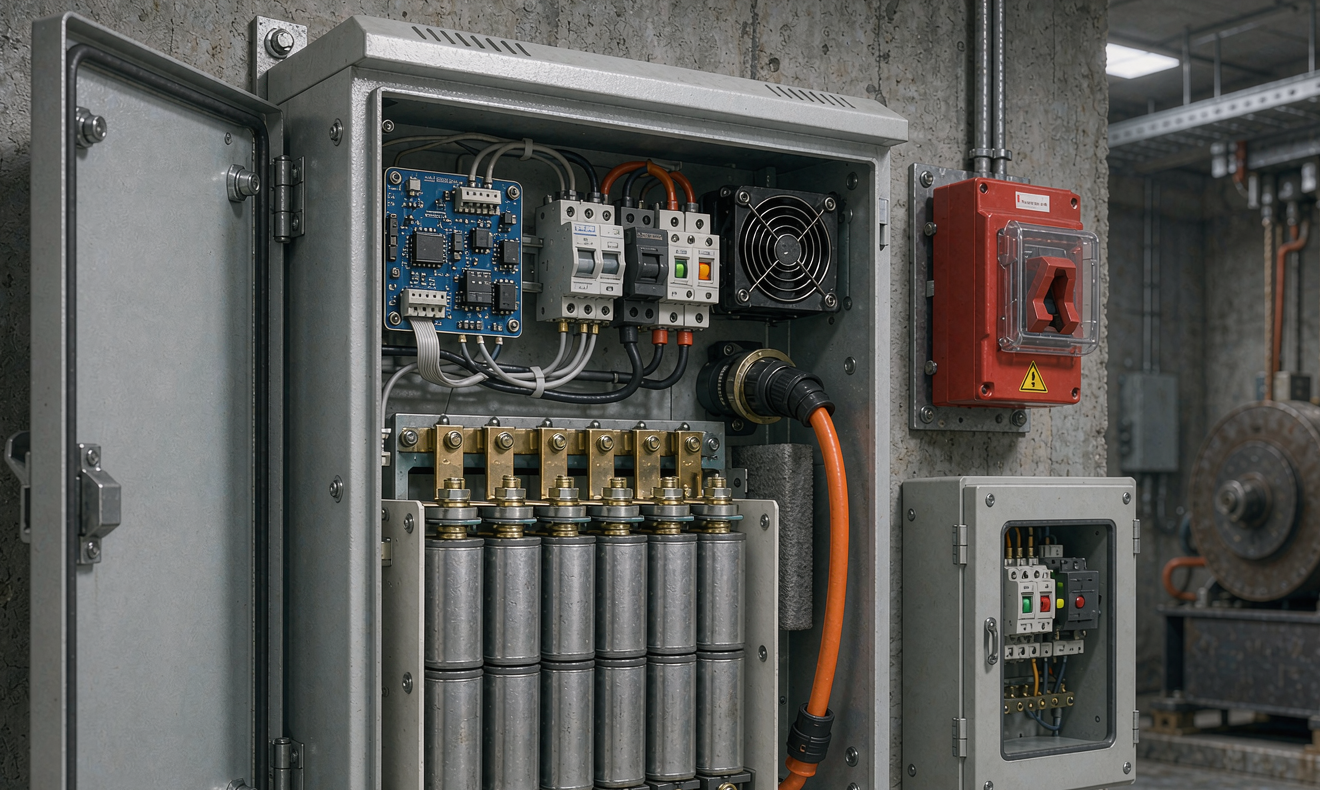
I have spent a good part of twelve years standing in elevator machine rooms that nobody visits until something goes wrong: a concrete box at the top of a shaft, 38 °C in August, a 1980s disconnect switch on the wall, and a rack of valve-regulated lead-acid blocks last replaced during a renovation nobody can date. When the utility feed drops, that rack is the only thing between a cab full of people and a very long wait.
Specifying an elevator backup battery solution looks simple on a one-line drawing and is genuinely subtle in the field. The load is not a steady kilowatt draw. It is a violently pulsed, partly regenerative, code-constrained load that has to perform a very specific job: bring the car to a landing, open the doors, let people out, and do it again maybe thirty times before the battery is done. This guide is the version I wish someone had handed me before my first hospital retrofit, written from the commissioning side of the clipboard rather than the sales side.
What an Elevator Backup Battery Is Actually Required to Do
The most expensive mistake in this application is sizing for “run the elevator” when the requirement is “rescue the passengers.” Read the duty carefully — the two numbers can differ by a factor of ten.
Under ASME A17.1/CSA B44 in North America and EN 81-20 in Europe, emergency or standby operation means the car is brought to a designated landing, the doors open, and — where the code requires it — the car then runs a controlled sequence, one car at a time, until the building is evacuated. IBC 3003 and the fire service requirements in IBC 403.6.1 layer on top of this: in buildings with an occupiable floor more than 120 ft above the fire service access level, firefighter’s emergency operation elevators need standby power that qualifies as Level 1, Type 60 under NFPA 110. That is sixty seconds to pick up the load and sixty minutes of carrying it.
Practically, I spec to three scenarios and take the worst. A single rescue trip — car from anywhere in the hoistway to the next landing, doors cycled once — costs 0.10–0.30 kWh on a 1000 kg, 1.6 m/s gearless machine, because the counterweight does most of the work and the drive regenerates on the overbalanced direction. Sequential evacuation of forty trips over an hour, plus controller, cab lighting and fan load, lands at 6–10 kWh for a mid-rise car. Continuous standby operation, where an owner wants normal service through the outage, runs 8–20 kWh per hour for traction and 25–45 kWh per hour for hydraulic — and if that is the real requirement, a battery is the wrong tool and a generator is the right one.
Write the scenario into the submittal. Every disagreement I have had with an authority having jurisdiction came down to an unclear statement of which of those three the design actually delivers.
Sizing the Pack: Peak Surge Matters More Than Amp-Hours
An elevator backup battery bank almost never fails on energy. It fails on instantaneous power, and the failure mode is ugly: the inverter hits its current limit, the DC bus sags, the drive trips on undervoltage, and the car stops between floors — precisely the outcome the system was bought to prevent.
Three numbers you must extract from the elevator manufacturer before ordering anything:
- Rated drive input. A 1000 kg / 1.6 m/s gearless machine typically sits at 11–18 kVA; a geared machine at 15–25 kVA; a roped hydraulic or a traditional hole-less hydraulic at 20–45 kVA. Hydraulic is the brute of the family because the pump only works in one direction.
- Acceleration surge. Variable frequency drives commonly ask for 150 % of rated current for 10 s and 200 % for 2 s. Direct-on-line hydraulic pump motors draw 5–7× full load amps for 100–300 ms. My rule is an inverter that holds 200 % for 3 s and 300 % for 0.5 s without folding back, plus a ride-through capacitor bank sized for the precharge inrush.
- Transfer time. NFPA 110 Type 10 permits ten seconds, but most modern elevator drives fault out in under 100 ms of lost input. Use a double-conversion online topology or a static transfer switch with a measured break of under 8 ms. I have never regretted measuring this with a scope on site; I have regretted assuming it.
Once power is settled, energy is straightforward. Take the worst-case scenario energy, then divide by depth of discharge, round-trip efficiency and end-of-life margin:
Usable requirement 8 kWh ÷ (0.90 DoD × 0.93 RTE × 0.80 EOL) = 11.9 kWh nameplate. Round up to the next module size and add 15 % if the machine room runs above 35 °C. That last step is not padding — it is the difference between a system that still passes its annual capacity test in year nine and one that does not.
Chemistry: LFP, NMC, Sodium-Ion or VRLA in the Machine Room
The default in this application should be lithium iron phosphate, and the reason is thermal, not energy density. Nobody cares that a machine room cabinet is 40 kg lighter. Everyone cares that LFP onset of thermal runaway sits near 250 °C while NMC811 sits near 110–140 °C, and that a machine room with no air conditioning reaches 40 °C every summer without anybody noticing.
- LFP: 150–180 Wh/kg, 4000–6000 cycles at 25 °C and 80 % DoD, calendar fade of 1.5–2.5 % per year at 50 % state of charge, and a third to a fifth the volume of an equivalent VRLA string. My default.
- NMC: 240–280 Wh/kg, 2000–3000 cycles. Only where the footprint is genuinely fixed and small, and even then with a gas vent path and a room temperature interlock.
- Sodium-ion: 100–160 Wh/kg, 200–230 °C thermal onset, 2000–4000 cycles, and it still charges at −20 °C — good for unheated machine rooms, at the cost of a cabinet 25–40 % larger.
- VRLA: 25–40 Wh/kg, 300–500 cycles at 80 % DoD, three to five years float life at 25 °C, and that life halves for every 8–10 °C rise. The one real advantage: it will accept charge below 0 °C, which lithium will not.
One operational difference trips up maintenance teams. A VRLA string wants to sit at float — 2.25–2.27 V per cell at 25 °C with −3 mV/°C compensation — and at 100 % state of charge constantly. A lithium pack is the opposite. Holding LFP at 100 % and 40 °C costs 9–11 % capacity in the first year; holding it at 30–60 % and 25 °C costs 1.5–2.5 % per year. Program the standby window accordingly and let the BMS top up on a schedule, not continuously.
Escalators Are a Different Machine Entirely
Escalator backup is usually mis-specified because people assume it mirrors elevator backup. It does not. An escalator has no counterweight, no rescue duty, and no enclosed cab. When power fails, a mechanical brake applies and the step band stops. On a 6 m rise with a crowd on it, a hard stop is a casualty event; the whole point of a battery solution here is a controlled deceleration and continued step lighting, not continued transport.
Budget 30–60 s of rated motor power for a controlled stop: on a 11 kW escalator that is roughly 0.1–0.2 kWh, plus 0.3–0.6 kW of step and comb lighting for the egress period. If an owner genuinely wants continued operation at full load — transit authorities sometimes do — you are sizing 8–15 kW continuous and the battery conversation becomes an energy storage conversation.
Watch the regenerative case in transit hubs: a heavily loaded down-running escalator regenerates, and the drive will either push that onto the DC link and trip on overvoltage or dump it into a braking resistor. Confirm which, and size the resistor for full regen power rather than motoring power.
Siting the Cabinet: Machine Room, Hoistway, and the Temperature Clause
Elevator codes have had a machine room temperature clause for decades — ASME A17.1 requires the space be maintained between roughly 5 °C and 40 °C, with ventilation or cooling where equipment rejects heat. That clause is written for the controller, but it is the number your battery lives under too. I have logged 44 °C at ceiling height in a machine room in Phoenix with the door closed, and 41 °C in an unventilated machine-room-less closet in Singapore.
Rules I hold to:
- Mount on an interior wall out of any solar gain path, never on the roof deck parapet side.
- Keep 900 mm clear in front for service, out of the controller’s exhaust air stream.
- IP54 minimum indoors, IP65 / NEMA 3R if shared with a garage, 316 stainless and conformally coated boards within 1 km of salt water.
- Above the flood line. I once found a basement rack with a tide mark 200 mm up the case from a sprinkler main break.
- Never in the hoistway — vibration, hydraulic oil mist, and a lift outage for every service call.
Where the room runs hot, the cheapest 8–12 K of relief is a light-coloured cabinet, a radiation barrier and a filtered positive-pressure fan at 20–40 W. Compressor cooling only pays above about 45 °C ambient, and it adds a maintenance item nobody will notice failing.
BMS, Monitoring, and a Self-Test That Proves Readiness
An emergency system that has not been exercised is a rumour. NFPA 111 requires stored-energy standby systems to be tested monthly, and I push owners to automated monthly discharge rather than a manual walkthrough, because a manual test gets skipped the moment the building is busy.
What I specify:
- Cell voltage at 1 Hz or better, pack current at 1 kHz, temperature at 10 Hz, contactor open under 5 ms on any hard fault.
- Automated monthly discharge to 80 % depth at the real elevator load, not a resistive load bank, with results logged and emailed; a 30-minute full-load run each quarter.
- State of health from coulomb counting cross-checked against 1 kHz impedance. The 25–30 % impedance rise shows up 300–500 cycles before the capacity knee — that is your early warning.
- Clear annunciation of the two conditions that actually strand people: state of charge below the reserve floor, and any cell delta above 50 mV after a rest.
- Dry contacts to the building management system for “ready” and “fault.” One relay to the fire alarm panel pays for the whole package at the first inspection.
Also decide in advance what happens when the pack hits its reserve floor during an evacuation. My preference is a hard reserve at 10 % that keeps controller and cab power alive for signalling but disables further runs — a car parked at a landing with lights and a working intercom is a survivable situation; a car stalled between floors is not.
Retrofit: Cutting Over From VRLA Without Losing Service
Most of this work is retrofit, and the constraint is always the same: the elevator must stay available. Measure the existing load for a week with a power analyser clamped on the drive input — never from the nameplate, which routinely overstates reality by 30 %. Install the new lithium cabinet and transfer gear in parallel with the existing VRLA rack on a temporary feed and commission it fully while the old rack still carries the car. Run two scripted rescue cycles under real load, then transfer during a planned 20-minute outage, verify transfer time and ride quality, and only then de-energise and remove the old rack. Keep the recycling manifests; two of my projects needed them for the owner’s sustainability reporting.
Codes, Standards, and the AHJ Conversation
Have this list in the submittal before the meeting:
- ASME A17.1 / CSA B44 and EN 81-20 / EN 81-50 — elevator emergency and standby operation.
- NFPA 110 — Type and Level classification for emergency and standby power.
- NFPA 111 — stored electrical energy emergency and standby power systems; the battery-specific one that people forget.
- NEC Article 620 plus Articles 700, 701 or 702 as applicable; NFPA 72 for firefighter’s elevators.
- UL 1973 for stationary batteries, UL 9540 / UL 9540A where the AHJ treats the cabinet as an energy storage system, IEC 62619 and IEC 62133-2 internationally, and UN 38.3 with state of charge at or below 30 % for shipping.
- IEC 62040 if anyone in the room calls it a UPS, which they will.
Bringing the AHJ in at design stage rather than at final inspection has never once cost me a schedule.
Commissioning Checks I Will Not Sign Off Without
- Insulation resistance at 500 V above 100 MΩ on DC and AC; under 10 MΩ does not get energised.
- Cell delta under 30 mV after a 2-hour rest at full charge.
- A timed full rescue cycle from the top and bottom terminals under load, with transfer time captured on a scope.
- Three consecutive rescue trips at rated load to prove surge capability and to check the regen path does not trip the bus.
- Thirty minutes of continuous loaded operation, ending with an infrared scan. Any joint more than 15 K above its neighbours gets re-torqued and re-scanned.
- Verified low-temperature charge lockout: below 0 °C the pack refuses charge, and any heater must bring cells above 5 °C at 0.05 C before charging is permitted.
Lifecycle Cost: Where the Money Actually Goes
A VRLA bank for a mid-rise car costs $2,500–4,000 installed and gets replaced every four to six years, sooner in a hot machine room. Over fifteen years that is three to four replacements, three disposal cycles and three rounds of emergency procurement. An LFP cabinet of equivalent capability costs two to three times as much up front and — held at 30–60 % state of charge in a room that stays under 35 °C — should reach ten to fifteen years with only annual testing. The hidden saving is space: a machine room that gives up a third of a rack can often accept another controller, or simply become a room a technician can work in safely.
FAQ
How much battery capacity does one elevator need for code-compliant rescue operation?
For a mid-rise gearless traction car, budget 6–10 kWh of usable energy to deliver roughly forty rescue trips plus one hour of controller, cab lighting and fan load. Derive it from a measured load profile rather than the drive nameplate, then divide by depth of discharge, round-trip efficiency and an 80 % end-of-life margin to get the nameplate figure.
Can a lithium battery solution replace an existing VRLA elevator backup rack directly?
Almost always yes, but the charging regime must change. Lead-acid wants continuous float near 100 % state of charge; lithium wants a 30–60 % standby window with scheduled top-up. Expect to reconfigure the charger settings, add a low-temperature charge lockout, and confirm the transfer gear meets the drive’s ride-through requirement.
How long must an elevator backup battery run during an outage?
Most jurisdictions land on one hour, and firefighter’s emergency operation elevators in tall buildings reference NFPA 110 Level 1, Type 60 — sixty seconds to pick up, sixty minutes of runtime. Always confirm the local amendment, because some authorities require only a single rescue trip while others require continuous standby service.
Why do elevator drives trip even when the battery has plenty of capacity?
Because the failure is power, not energy. Drive acceleration demands 150–200 % of rated current for several seconds and hydraulic pump motors pull 5–7× inrush. Size the inverter for surge, verify the transfer break is under 8–10 ms, and confirm the regenerative path either absorbs or dissipates overhauled-load energy.
Is it safe to install a lithium battery cabinet in an elevator machine room?
Yes, with LFP chemistry and sensible siting. LFP thermal runaway onset is near 250 °C versus 110–140 °C for NMC. Keep the cabinet off solar-gain walls, maintain clearance for service, keep the room near or below 35 °C, and design to UL 1973 and UL 9540A where the authority treats the assembly as an energy storage system.
Do escalators need battery backup the same way elevators do?
Usually not. The purpose is a controlled stop and continued step lighting rather than continued transport, because an abrupt stop of a loaded step band is a crowd-safety hazard. Budget 30–60 s of rated motor power plus lighting, which is typically 0.1–0.2 kWh for a controlled stop on an 11 kW unit.
How often should an elevator backup battery be tested?
NFPA 111 calls for monthly testing. I prefer an automated monthly discharge to about 80 % depth at the real elevator load with logged results, plus a 30-minute full-load run each quarter and an annual capacity verification at 0.2 C.
Which standards apply to an elevator backup battery installation?
ASME A17.1 or EN 81-20 for the elevator itself, NFPA 110 for system classification, NFPA 111 for stored-energy systems, NEC Article 620 plus Articles 700–702, UL 1973 and IEC 62619 for the battery, IEC 62133-2 for cells, and UN 38.3 for transport at 30 % state of charge or less.
Further Reading
References