Battery Solution for Kiosks: Power Budget and Uptime
Why Kiosk Power Is Its Own Engineering Problem
A self-service kiosk looks simple from the sidewalk. Inside, it is a small data center bolted to the street, running through grid flickers, brownouts, winter mornings and July afternoons that cook the electronics. After years of specifying packs for unmanned equipment, I rate kiosks among the least forgiving loads: continuous 24/7 draw, a sealed outdoor enclosure, and no staff to notice a problem before a customer does.

A well-designed battery solution for kiosks is not a generic “put a battery in the cabinet” exercise. It is a layered decision: real daily consumption, grid backup versus off-grid duty, the temperature range the compartment sees, a chemistry that survives it, and ten-year total cost of ownership. Get one layer wrong and the kiosk becomes a support-ticket generator instead of a revenue asset. This guide walks through each layer with the numbers I use to defend the choice to a client’s finance department.
What a Self-Service Kiosk Actually Draws
Every sizing exercise starts with a load audit. The display dominates: a 32-inch panel draws 60 to 90 watts, while a 55-inch outdoor unit built for 2,000-plus nits of sunlight readability pulls 180 to 350 watts continuously. The computing module adds 15 to 45 watts, payment terminals and readers 5 to 20, the 4G router 8 to 20, a thermal receipt printer 10 to 30 with spiky peaks, and LED cabin lighting another 10 to 25 after dark.
Then comes the item that breaks naive calculations: climate control. A passively ventilated kiosk in a temperate climate may need nothing beyond filtered fans totaling 20 to 40 watts. A sealed unit in a hot climate, or any kiosk with a high-brightness screen under direct sun, often carries a thermoelectric unit drawing 100 to 200 watts, or a small DC air conditioner pulling 250 to 500 watts at peak. In my audits, passively cooled kiosks land at 120 to 220 watts continuous, 3 to 5 kWh per day; climate-controlled units reach 350 to 600 watts average, or 8 to 14 kWh. Until you log your own configuration for 48 hours, treat every estimate as a placeholder.
Grid-Tied Backup Versus Off-Grid: Two Different Battery Problems
Before sizing anything, decide which problem the battery is solving; the two cases diverge fast. A grid-tied kiosk battery is a ride-through and graceful-shutdown device. The grid is up 99.5 percent of the time in most regions, so the battery only covers outages of minutes to a few hours. The goals are narrow: keep the payment from dying mid-authorization, keep the PC from corrupting its file system, and either ride through the event or shut down in an orderly, recoverable state. For most grid-tied kiosks, 1 to 3 kWh of usable storage covers this.
An off-grid or solar-assisted kiosk is a different animal: the battery is the primary energy source, recharged by PV or a generator, and must carry the full daily consumption through a multi-day stretch of bad weather. Design practice guarantees three to five days of autonomy at the worst-month consumption figure, which for a 5 kWh-per-day kiosk means 15 to 25 kWh usable, and proportionally more for climate-controlled units. The battery also becomes the dominant cost line, often exceeding the array itself. I have reviewed failed deployments where the array was sized for average annual insolation, and the system limped into deep discharge every January until the BMS cut the load.
Sizing the Pack: Runtime Math That Survives the Worst Month
The arithmetic is straightforward, but the loss factors are where inexperienced designs fail. For a grid-tied kiosk drawing 180 watts continuous, daily consumption is 4.3 kWh. Take a four-hour ride-through target, a common contract figure: 180 watts times 4 hours gives 0.72 kWh. Now divide by the inverter efficiency, typically 90 to 93 percent, and by the usable depth of discharge, usually 80 to 90 percent for lithium iron phosphate: 0.72 divided by 0.92 divided by 0.85 gives roughly 0.92 kWh nominal. A single 48 V 25 Ah LFP pack delivers about 1.2 kWh and fits with margin.
Off-grid, the same math scales up and adds the PV side. A 5 kWh-per-day kiosk with four days of autonomy needs 20 kWh usable, about 23.5 kWh nominal at 85 percent depth. The array must replace the daily draw at the worst-month peak sun hours: in much of central and northern Europe that is 1.0 to 1.5 full-sun hours in December, so 5 kWh divided by 1.2 PSH divided by a system efficiency of 0.7 demands a 6 kW array. That number shocks clients who assumed two panels would suffice, which is why it belongs in the proposal rather than the commissioning report. Undersized off-grid systems do not fail loudly; they fail as chronic winter deep discharges that quietly halve battery life.
Thermal Management: The Compartment Sets the Real Limits
Battery datasheets are written for 23 degrees Celsius, and almost no kiosk lives there; compartment temperature is the single most underestimated factor in this work. A steel cabinet in full summer sun with a 300-watt backlight running inside can reach 60 to 75 degrees C internally in hot climates. LFP cells tolerate that short-term, but calendar aging roughly doubles for every 10 degrees C of sustained elevation, so a pack that would lose 2 percent capacity per year at 25 degrees can lose 6 to 8 percent parked year after year at 55 degrees. I ask for the site’s sun exposure and insist on passive mitigation first: shaded or north-facing placement, a reflective coating, and a battery bay separated from the screen electronics.
Cold is the harder constraint because it is electrical rather than statistical. Below 0 degrees C, charging plates lithium metal on the anode and permanently degrades the cell, so the BMS must block charge currents below freezing. A kiosk in Chicago or Oslo that must charge in January needs a 40 to 80 watt film heater fed from line power ahead of the BMS lockout, consuming 0.5 to 2 percent of daily energy in the coldest months. Discharge capability also drops: a healthy pack delivers 70 to 80 percent of rated capacity at minus 20 degrees C. If your ride-through budget was computed at room temperature, January runtime falls short, and a backup that dies at hour three instead of hour four is a warranty conversation waiting to happen.
Choosing the Chemistry: LFP Default, LTO and NMC at the Edges
For the overwhelming majority of kiosk projects I specify lithium iron phosphate, and the reasoning is boring in the best way. LFP offers 3,000 to 6,000 cycles at 80 percent depth of discharge, excellent calendar life, thermal stability that simplifies certification, and a price that has fallen for a decade. Kiosk duty is shallow and continuous, rarely exceeding 30 percent daily depth of discharge in backup applications, which plays directly to LFP’s longevity. The flat discharge curve around 3.2 volts per cell means pack voltage reveals almost nothing about state of charge, so the BMS must use coulomb counting rather than voltage-based estimation.
The edge cases justify the alternatives. Lithium titanate, with 15,000-plus cycle life and charging at minus 30 degrees C, suits extreme-cold or fully-cycling off-grid sites; the tradeoff is roughly half the energy density and two to three times the cost per kWh, usually fatal for a budget-driven program. NMC delivers 30 to 40 percent more energy per liter, which matters in a compact cabinet where every centimeter of the bay was already promised to the display module, but it ages faster in heat and demands stricter certification, precisely the condition kiosks create. When a client pushes for NMC on size grounds, I ask for the ten-year temperature profile first; redesigning the bay geometry to fit LFP is cheaper than buying the thermal risk.
Safety, Enclosures and Compliance for Public-Facing Cabinets
A kiosk stands in an unguarded public space, often beside a fuel station or inside a transit concourse, and the compliance bar reflects that. I expect UN 38.3 for any shipped pack, IEC 62133-2 at the cell level, and either UL 1973 or IEC 62619 for the stationary pack; where capacity approaches code thresholds, UL 9540 listing and in some jurisdictions a UL 9540A thermal-runaway report join the permit conversation. Vandal and ingress protection are equally non-negotiable: the battery bay sits behind a lockable door rated NEMA 3R at minimum, IP65 where wash-down or dust exposure is expected, and IK10 where the kiosk lives on an open sidewalk. I also require a DC-rated fuse or breaker, typically a Class T device sized to the pack’s short-circuit current, because an LFP pack can deliver thousands of amps into a dead short and an AC-rated breaker will not clear it safely.
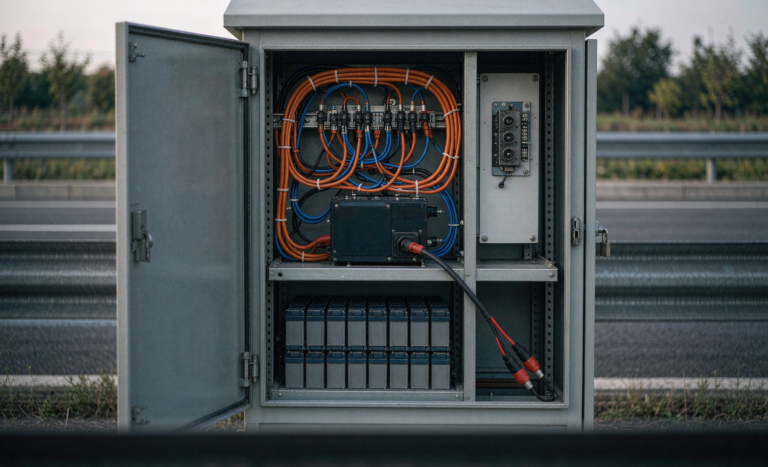
Installation details finish the job: torque terminals to specification, secure cables against traffic vibration, and plan drainage so the bay never pools condensation. Venting deserves attention: a BMS fault or external fire can release effluent even though LFP normally does not, and the enclosure should direct it away from the customer side. None of this is exotic; it is the discipline I apply to telecom cabinets, adapted to a product the public touches a thousand times a day.
Telemetry, Remote Recovery and Truck-Roll Economics
Unattended means failures surface the expensive way, so the battery should be as observable as the kiosk itself. At minimum the BMS should expose state of charge, state of health, temperature, currents and protective-event history over an industrial interface, with a gateway pushing the data over 4G or Ethernet to your monitoring stack. The payoff is measured in truck rolls: a field visit costs 150 to 400 dollars once technician time, travel and site access are counted, and most are power-cycle resets or breaker checks that telemetry resolves remotely. On fleets above a few dozen units, it pays for itself within the first year.
Design the recovery paths deliberately: a remotely switchable maintenance load or BMS-initiated controlled shutdown lets an operator clear a latched protection state without a site visit. Alert thresholds should catch trends, not just faults: a pack that keeps hitting high-temperature charge lockout on summer afternoons is telling you the cooling is undersized, and capacity fade above 3 percent per year is telling you to budget the replacement while you can still schedule it. In my experience the fleets that instrument well replace batteries on their own schedule, and the fleets that do not replace them after the customer calls.
Total Cost of Ownership Over a Ten-Year Service Life
Kiosk purchasing decisions are usually made on unit price, and that is where sealed lead-acid still wins the first invoice. The ten-year picture is different. An AGM battery cycled daily to 50 percent depth lasts 500 to 800 cycles, roughly 18 months to two years in kiosk duty, so ten years of service means three to five replacements plus a scheduled truck roll for each swap. A quality LFP pack at the same duty delivers 3,000-plus cycles to 80 percent depth, the full ten years on one unit, with lower charge losses as a bonus: round-trip efficiency near 95 percent versus roughly 80 percent for lead-acid shaves a measurable slice of the electricity or array budget. Even before counting the avoided site visits, LFP total cost of ownership typically lands 40 to 60 percent below AGM over a decade, and the gap widens in hot climates where lead-acid ages faster still.
The remaining cost drivers are thermal and contractual. Budget heater or heat-exchanger power as an operating cost, because in a solar installation it directly sizes the array. And hold suppliers to the datasheet: ask for cycle-life test conditions, BMS firmware policy, and a warranty that references capacity retention rather than years; a ten-year claim without a retention figure is marketing, not engineering.
Frequently Asked Questions
How large should a backup battery for a grid-connected kiosk be?
For most grid-tied kiosks, 1 to 3 kWh of nominal lithium capacity covers a four-hour ride-through. Compute it from measured load: multiply watts by target hours, then divide by 0.92 for conversion efficiency and 0.85 for usable depth of discharge. A 180-watt kiosk needs about 0.9 kWh, which a single 48 V 25 Ah LFP pack satisfies.
Can a kiosk run entirely on solar power and batteries?
Yes, but only with worst-month sizing. The array must produce the daily consumption at December peak sun hours, and the battery must carry three to five days of autonomy. A 5 kWh-per-day kiosk in a northern European winter needs roughly a 6 kW array and about 23 kWh of storage, which is why off-grid projects succeed or fail at the design stage.
What happens if a lithium kiosk battery freezes?
Discharge below freezing is survivable at 70 to 80 percent of rated capacity, but charging below 0 degrees C plates lithium onto the anode and permanently damages the cell. The BMS must block sub-zero charging, and cold-climate deployments need a 40 to 80 watt heater so the pack can accept winter charge.
How hot is too hot for a battery inside an outdoor kiosk?
Above 45 degrees C, calendar aging roughly doubles for every additional 10 degrees, so a pack parked at 55 to 60 degrees C can lose two to three times its normal annual capacity. Shade the cabinet, apply reflective coatings, and separate the battery bay from screen electronics to keep cells below 40 degrees C most of the year.
Which certifications does a kiosk battery need?
Plan on UN 38.3 for transport, IEC 62133-2 at the cell level, and UL 1973 or IEC 62619 for the pack; larger installations may require UL 9540 listing and a UL 9540A test report for permitting. The enclosure should meet NEMA 3R or IP65 and IK10 for public placement, with a DC-rated Class T fuse on the pack output.
Why choose lithium iron phosphate instead of NMC for kiosks?
LFP offers 3,000 to 6,000 cycles at 80 percent depth of discharge with superior thermal stability and calendar life, matching shallow, continuous kiosk duty. NMC saves 30 to 40 percent of the volume but ages faster in heat and demands stricter certification, and most cabinets fit LFP once the bay is designed deliberately.
How long do kiosk batteries last in real deployments?
A quality LFP pack in a thermally managed compartment routinely exceeds ten years of shallow daily cycling, while AGM alternatives need replacement every 18 to 24 months under the same duty. Heat is the dominant variable: shaded, ventilated bays in temperate climates outlast the kiosk’s own refresh cycle, while packs parked at 55 degrees C may need replacement at year six.
What does the battery add to kiosk maintenance costs?
With proper telemetry, little beyond periodic terminal inspections, because alarms catch thermal and capacity trends before they become failures. Without telemetry, expect one to two truck rolls per year at 150 to 400 dollars each for resets and breaker checks; remote visibility typically pays for itself within the first year on fleets above a few dozen units.
Further Reading
References