Battery Solution Performance for Clinics
In my years as a senior lithium battery engineer at Horizon Power, I have commissioned battery solutions for clinics where a 30-second blackout is not an inconvenience but a clinical event. Ventilators stall, surgical lighting drops, vaccine refrigerators begin a slow climb toward spoilage, and patient monitors lose the trend lines a physician was reading seconds earlier. A battery solution for clinics is therefore never just a larger UPS. It is a layered power architecture that protects life-safety loads first, keeps critical care running through the longest realistic outage, and degrades gracefully when something fails. This guide walks through the performance engineering we apply when we design clinic backup power: how we size critical loads, choose chemistry, build redundancy, and meet the healthcare standards that govern every connection.
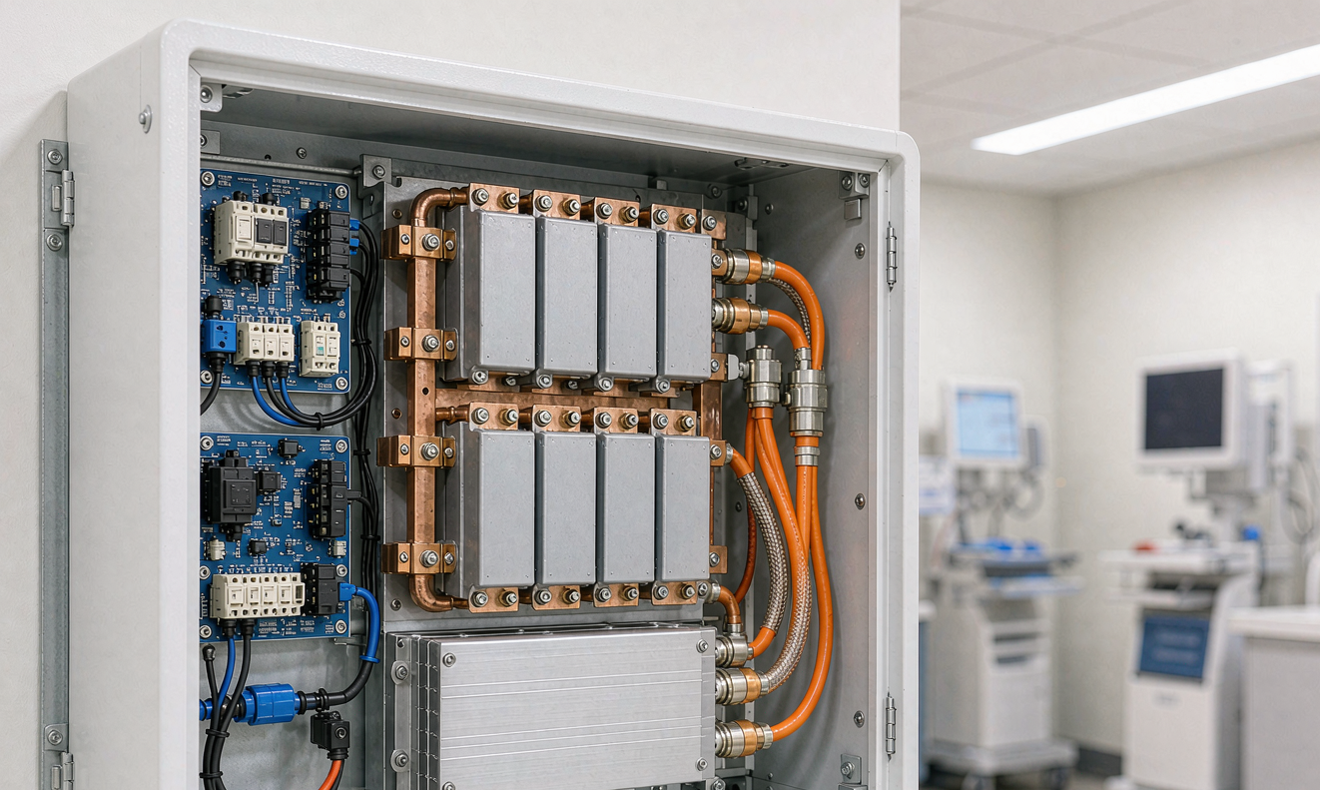
Understanding Critical Loads in a Clinic
The first mistake teams make is treating a clinic like an office. A clinic’s electrical system is legally divided into branches by risk to life, and your battery solution must mirror that hierarchy rather than simply backing up the whole panel. In the United States this structure comes from NFPA 99, which defines the Essential Electrical System; in international projects we map the same idea onto IEC 60364-7-710 for medical locations.
Life-safety branch loads are non-negotiable: fire alarms, emergency lighting, and nurse call systems. The critical branch covers the loads whose loss would immediately endanger patients: ICU ventilators, anesthesia machines, dialysis units, and operating-room equipment. The equipment branch covers everything else, from waiting-room displays to laundry.
- ICU ventilators: 300 to 800 W each, often running 24/7.
- Patient monitors: 50 to 150 W, with networked telemetry drawing additional IT load.
- Surgical LED lights: 80 to 150 W per fixture, but sensitive to even brief dips.
- Vaccine and pharmacy refrigerators: 80 to 200 W, with strict -2 to 8 degrees C holdings.
- IT and network core: 200 to 500 W, the backbone for electronic health records.
A small outpatient clinic might carry 3 to 8 kW of true critical load; a surgical or dialysis clinic regularly reaches 10 to 25 kW. The battery solution performance for clinics lives or dies on getting this inventory right before a single cell is specified.
Sizing Runtime and Usable Capacity
Runtime is not a single number. IT systems need only 10 to 15 minutes to ride through a transfer to generator, but a vaccine refrigerator must hold temperature for hours if the grid stays down. We size each load by its required duration, then sum energy in watt-hours.
As a worked example, suppose a critical load of 8 kW must be supported for 2 hours. That is 16 kWh of delivered energy. Accounting for inverter efficiency near 0.90 and a recommended depth of discharge near 0.90 for lithium, the nameplate battery capacity lands around 20 kWh. We then check the discharge rate: 8 kW against 20 kWh is a 0.4 C rate, comfortably inside the 0.5 C continuous window most lithium battery packs are rated for.
Motor-driven loads hide a trap. Refrigeration compressors and some pumps draw 3 to 7 times their running current for a few hundred milliseconds at startup. A custom battery solution must size the inverter and the bus to absorb that inrush without tripping, which is why we never size purely on the nameplate running wattage.
Choosing the Right Battery Chemistry
For clinics, safety near patients outweighs raw energy density, and that single fact points almost every design toward lithium iron phosphate, or LFP. In accelerated rate calorimetry, LFP begins self-heating near 250 degrees C, compared with 110 to 140 degrees C for nickel-manganese-cobalt chemistries, and it releases far less total energy when it does fail. LFP also delivers 4,000 to 6,000 cycles at 25 degrees C and stays stable across partial states of charge, which suits a battery that floats at high state of charge and rarely fully cycles.
Sodium-ion is an emerging option for clinics in unheated buildings. It retains 85 to 92 percent of capacity at -20 degrees C where lithium would sag, though its energy density of 100 to 160 Wh/kg is lower, so the cabinet grows. For the majority of conditioned clinics, a lithium battery built on LFP remains the pragmatic default, and a custom battery solution lets us tune cell format, thermal path, and enclosure to the room it sits in.
Building Redundancy With N+1 Architecture
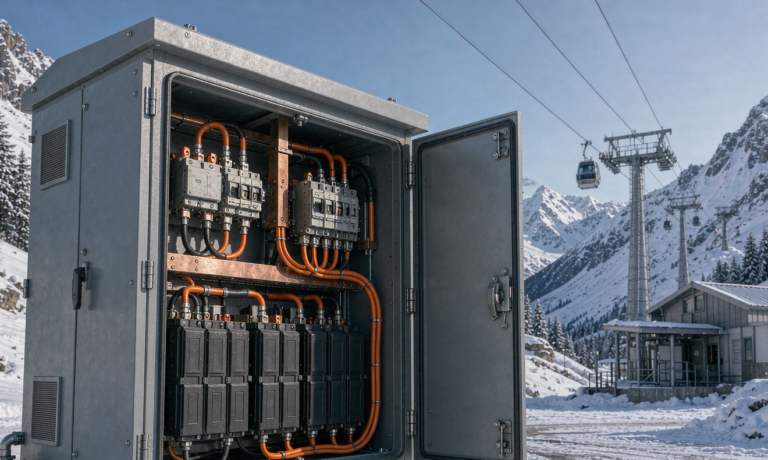
A single point of failure in a clinic is unacceptable, so we design in layers. An online double-conversion UPS (IEC 62040-3 Class 1) cleans the incoming supply and carries the load with zero transfer break. Behind it sits the lithium battery bank, and behind that an automatic transfer switch that can bring a generator online within 8 to 20 milliseconds if the outage persists.
Within the battery system itself we apply N+1 module redundancy so one failed power module does not take the clinic offline. The battery management system uses a dual-redundant analog front end and dual CAN bus, with contactors that open within 5 milliseconds on a fault. Critical loads feed from an isolated critical load panel, physically separated from the equipment branch, so a fault downstream of the panel cannot drag down life-safety circuits.
Standards and Compliance That Govern Clinic Power
Healthcare power is the most regulated corner of stationary storage, and a battery solution for clinics must be documented against several codes before commissioning. NFPA 99 sets the essential electrical system tiers and mandates monthly and annual testing of the emergency power supply. IEC 60601-1 governs the safety of medical electrical equipment and limits leakage current that a backup source could introduce.
On the storage side, UL 1973 covers stationary batteries, UL 9540 and UL 9540A cover energy storage systems and their fire propagation testing, and IEC 62040 defines UPS performance and classification. For sites pursuing grid interaction, IEEE 1100, the Emerald Book, guides power quality, while UN38.3 remains the transport test every lithium cell must clear. We hand the commissioning team a compliance matrix mapping each subassembly to its standard so the inspection is a checklist, not a debate.
Thermal Management, Maintenance, and Monitoring
Battery life is a function of temperature, and clinics are no exception. LFP rated for 6,000 cycles at 25 degrees C typically falls to about 3,500 cycles at 35 degrees C and below 2,000 at 45 degrees C. We keep enclosures in the 20 to 30 degrees C band with natural or forced airflow, maintain a 900 mm service aisle and a 450 mm floor elevation to avoid flood and heat pooling, and specify at least IP65 where cleaning protocols create spray.
Operationally, the battery management system reports state of health continuously, but standards still require discipline: a weekly no-load self-test, a monthly loaded test, and an annual capacity verification. Remote monitoring lets our service desk catch a drifting cell before it becomes a runtime shortfall, which is the difference between a battery solution that performs on paper and one that performs during the next storm.
How long should a clinic battery backup last?
Runtime depends on the load tier. IT and monitoring loads typically need 10 to 15 minutes to bridge a generator transfer, while vaccine refrigerators and critical care may require 2 to 8 hours. We size each load by its own duration and sum the energy, then add inverter and depth-of-discharge margins, so a clinic battery solution is built around a profile rather than a single blanket number.
Which battery chemistry is safest for clinics?
Lithium iron phosphate, or LFP, is the safest mainstream choice for clinics because its thermal runaway onset sits near 250 degrees C with low energy release, and it offers 4,000 to 6,000 cycles at room temperature. Its lower energy density than NMC is a worthwhile trade next to patients. Sodium-ion suits cold, unheated clinics but needs more cabinet volume for the same energy.
What standards apply to clinic battery systems?
The core set includes NFPA 99 for essential electrical systems, IEC 60601-1 for medical equipment safety, IEC 62040 for UPS classification, and UL 1973, UL 9540, and UL 9540A for stationary batteries and storage systems. IEEE 1100 guides power quality, and UN38.3 covers cell transport. A compliant battery solution for clinics maps every subassembly to one of these standards.
Do vaccine refrigerators need separate backup?
In practice, yes. Vaccine and pharmacy refrigerators must hold -2 to 8 degrees C for hours, far longer than IT loads, so they are usually placed on the critical branch with their own runtime budget inside the clinic battery solution. We often give the cold-chain load a dedicated breaker and verify temperature hold during the annual capacity test rather than assuming it rides with the general critical load.
How often should clinic batteries be tested?
Standards and good engineering agree on a cadence: a weekly no-load self-test, a monthly loaded test, and a full annual capacity verification. Continuous state-of-health monitoring flags weak cells early. This discipline is what turns a lithium battery installation from a one-day commissioning event into a decade of dependable clinic power.
Can a battery solution replace a generator?
For short outages of minutes to a few hours, a lithium battery solution can fully replace a generator and responds faster with no fuel or emissions. For extended multi-day grid loss, most clinics keep a generator as the final layer and use the battery as the instant, silent bridge. The two are complementary, not mutually exclusive, in a resilient clinic power design.
Further Reading
References