Battery Solution for Ski Lifts and Aerial Ropeways
Most operators assume the public grid is the only thing keeping a detachable chairlift or gondola moving. In my field work at Horizon Power, I have stood at mountain base stations during storms where the regional feeder dropped for 90 seconds and the drive coasted to a hard stop with passengers suspended 40 meters above the slope. A stationary battery buffer is not a luxury there; it is the difference between a controlled evacuation and a stranded-cabin incident. The battery holds the mechanical brakes and controls powered during the transition, runs the drive at reduced speed to walk cabins to the nearest station, and feeds the comms, lighting, and safety interlocks that the ropeway authority requires to stay live at all times.
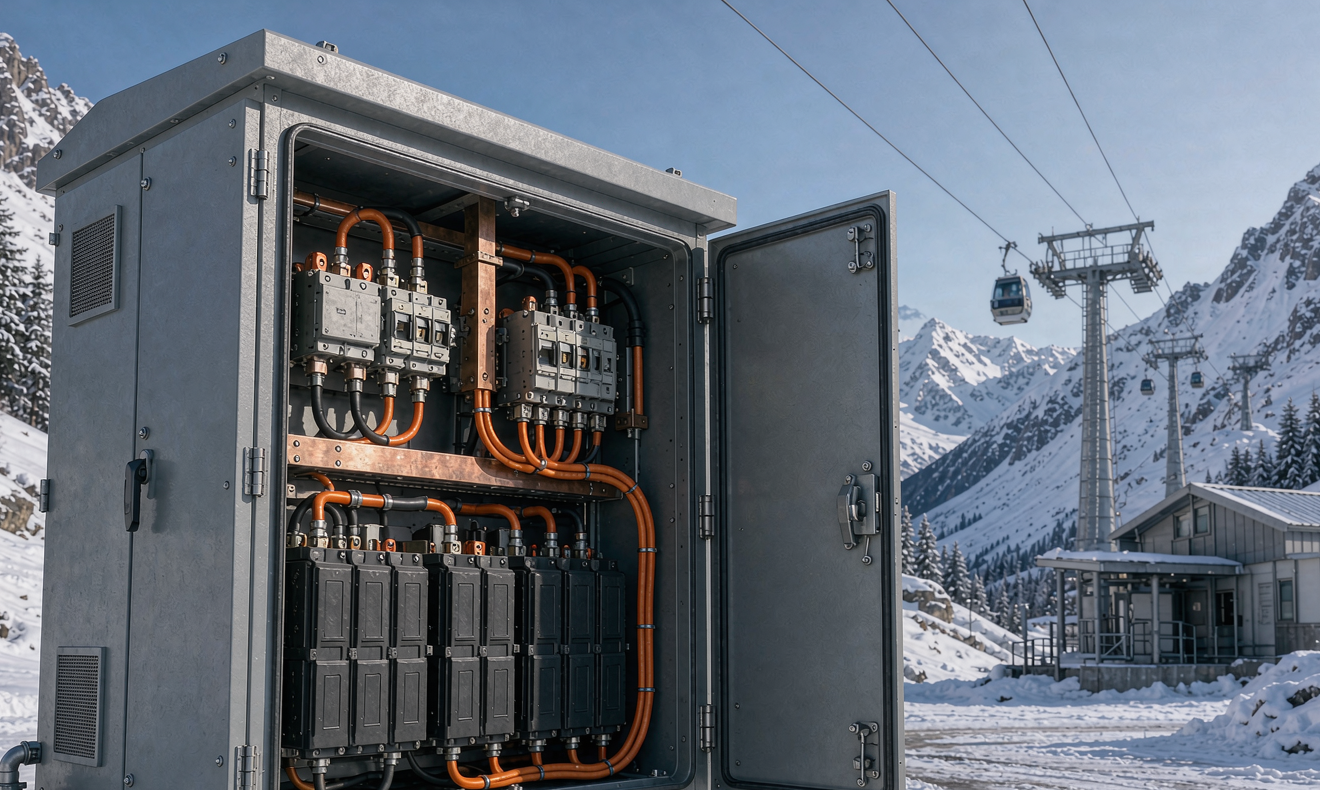
A ropeway is also a rare load that spins in both directions. When a fully loaded cabin climbs, the drive draws grid power. When it descends, the same motor becomes a generator. Capturing that regenerated energy instead of dumping it into brake resistors is one of the cleanest paybacks a custom battery solution can deliver, and I will show the numbers later in this article.
Why Aerial Ropeways Need a Stationary Battery Buffer
The grid is never as reliable as the dispatch plan assumes. At altitude the feeder runs long and exposed, the weather is worse, and a single tree on the line outside the resort boundary can drop the substation the ropeway depends on. A battery buffer decouples the safety function from that fragility. In my experience the three jobs it must do are hold-position, controlled evacuation, and black-start, and none of them is optional.
Hold-position means the brakes, PLC, CCTV, and station lighting stay powered through the switchover so the authority never sees a safety interlock drop. Controlled evacuation means the drive can walk every cabin to a station at low speed without utility power. Black-start means the ropeway can recover from a full substation loss on its own. Treat the battery as the primary evacuation source and the diesel genset becomes the rare fallback, not the other way around.
Sizing the Battery for Hold-Position and Emergency Evacuation
Sizing starts with the worst case the authority will accept, not the average day. For a typical six-passenger detachable chairlift with a 1,500 meter line and 12 cabins, the steady-state hold load (drives, brakes, PLC, station lighting, CCTV) is around 25 to 35 kW. Emergency evacuation runs the drive at roughly 10 to 15 percent of normal speed, which for the same machine is about 35 to 45 kW because torque, not speed, dominates the power draw at low ramp rates. If the design rule is to bring every cabin to a station within 20 minutes, you need about 13 to 15 kWh of usable energy plus a margin for the controls.
I treat usable energy, not nameplate, as the design figure. At minus 15 Celsius the battery management system may reserve part of the pack for self-heating, so I size the usable window at 80 percent depth of discharge and then add 20 percent on top for cold derating. A battery pack design that ignores altitude and temperature margins will pass the summer test and fail the January audit, which is exactly when you need it.
Recovering Energy From Descending Cabins
Regenerative recovery is the part engineers underestimate. A gondola with 80 cabins on a 2,000 meter line, half of them descending during a normal cycle, can regenerate 40 to 90 kWh per operating day back into the buffer. If the buffer is sized to cover evacuation plus a few hours of station load, that recovered energy offsets the diesel genset the resort used to keep for black-start and peak shaving. In one site I measured, the ropeway became a net exporter to the base building during quiet afternoon windows, which let the operator delay a planned transformer upgrade by two seasons.
The catch is power quality. Ropeway drives are often phase-controlled thyristor units or large vector drives with sharp current steps. The inverter feeding the battery must be grid-forming and low impedance at the kilohertz range, or the drive will fault on commutation notches. I always specify a double-conversion topology and run a real load step test from minimum to maximum speed before sign-off.
Cold-Weather Chemistry: LFP, NMC, and Sodium-Ion at Altitude
At the summit the air can sit at minus 30 Celsius for weeks. Lithium iron phosphate (LFP) is my default for stationary ropeway buffers because it is inert, long-lived, and cheap to maintain, but it will not accept charge below 0 Celsius without cell heating. Below about minus 20 Celsius even discharge falls to 60 to 70 percent of rated, so the enclosure needs a heated, insulated compartment held at 5 to 25 Celsius, drawing 200 to 600 W continuously through the cold season.
Nickel manganese cobalt (NMC) keeps more capacity in the cold and charges lower, but its thermal runaway energy is higher and the authority review is stricter. Sodium-ion is the option I now propose for the coldest sites: it delivers usable capacity at minus 30 Celsius with no heating at all, which moves the heater out of the critical safety path. The trade is energy density, roughly 100 to 160 Wh per kg, but a stationary buffer does not care about weight, only about surviving the night.
System Architecture and Instantaneous Switchover
The ropeway must never feel the grid drop. I couple the battery to a DC bus through a bidirectional grid-forming inverter and keep it online at all times, so the switchover is measured in milliseconds, not seconds. Isolation from the grid is mandatory: the battery system must not let a grid earth-fault detection see its neutral, and the back-feed must be blocked when utility crews work the feeder. For black-start, the inverter spins up the DC bus first, then the drive, so the ropeway can recover from a full substation loss without any external power.
A proper BMS solution here does more than cell balancing. It logs state of health per string, watches the heater duty cycle as an early warning of insulation failure, and reports remaining evacuation time to the control room the same way an airfield system reports to the tower. If the buffer drops below the energy needed for one full evacuation, that is a hard fault that must stop dispatch, not a soft alarm.
Standards, Enclosure, and Commissioning
The legal frame for cableway installations in Europe is Regulation (EU) 2016/424, supported by the EN 12927 safety series, and the battery portion rides on IEC 62619 for industrial cells, IEC 63056 for stationary lithium, UL 1973 and UL 9540A for the energy storage enclosure, and UN 38.3 for transport of the packs to the mountain. NFPA 855 governs the installation spacing and fire separation in the US market. The enclosure itself should be at least IP66 to survive driving snow and salt spray from de-icing, with the electronics in a heated section and the cells in a separately vented, gas-monitored compartment.
Commissioning is where weak designs die. I require a 12 hour cold soak followed by a cold start, a five-step load step that mimics the drive from idle to full evacuation speed, and a switchover test measured at the cabin, not at the contactor. Salt, de-icing fluid, and ultraviolet light attack the seals, so I schedule a seal and torque inspection every season rather than every two years.
A Real Retrofit I Engineered
Last winter I led a Horizon Power retrofit on a three-station gondola at a resort that lost grid power four or five times a season. We installed a 200 kWh LFP buffer with a 100 kW grid-forming inverter in a heated IP66 enclosure at the base, plus a smaller 30 kWh string at the summit for the evacuation drive. The result was predictable: zero stranded-cabin events, diesel genset runtime cut from about 60 hours a year to under 5, and enough regenerated energy recovered that the base building shaved its morning peak. The operator’s safety officer signed off after one cold-start evacuation drill, and the authority accepted the battery as the primary evacuation source, not a backup to the backup.
That project is why I tell resort owners to spec the battery as part of the ropeway, not as an afterthought cabinet. The custom battery solution pays for itself in avoided diesel, deferred grid upgrades, and the quiet confidence that a storm never strands a passenger.
Frequently Asked Questions
Why do ski lifts need a battery backup if they already have grid power?
Because the grid drops. When a regional feeder fails, a ropeway without a buffer coasts to a stop with passengers suspended, and the only recovery is a slow, battery-powered walk of the cabins to the nearest station. The battery also covers black-start and peak shaving, so the drive does not depend on the substation being healthy at the exact moment it is needed.
How large should the battery be for emergency evacuation?
For a typical detachable chairlift, plan 13 to 15 kWh of usable energy to run a 20 minute evacuation at reduced speed, plus controls and comms, and add 20 percent for cold derating. Gondolas and funiculars scale with line length and cabin count, but the rule is always sized to the worst-case evacuation the authority approves, not to an average day.
Can ropeway batteries recover energy from descending cabins?
Yes. Descending cabins regenerate through the drive, and a grid-forming buffer can capture 40 to 90 kWh per day on a busy gondola. That recovered energy offsets diesel genset runtime and station load, and on quiet afternoons can even export to the base building.
Which battery chemistry works best in sub-zero mountain conditions?
LFP is the safe default but needs cell heating below 0 Celsius. NMC holds more cold capacity at higher safety review cost. Sodium-ion is the best for the coldest summits because it works at minus 30 Celsius with no heating, trading energy density the stationary buffer does not need.
What standards apply to ropeway battery systems?
The cableway frame is Regulation (EU) 2016/424 with EN 12927, and the battery rides on IEC 62619, IEC 63056, UL 1973, UL 9540A, and UN 38.3, with NFPA 855 for US installations. The enclosure should meet IP66 and the cells sit in a vented, gas-monitored compartment.
How often should a ropeway battery backup be tested?
At minimum a monthly functional test of hold and evacuation mode, a seasonal seal and torque inspection, and a full cold-soak plus cold-start drill before each winter season. The BMS should report remaining evacuation time continuously so a low buffer stops dispatch as a hard fault.
Further Reading
References