Sodium-Ion Battery for Snow Groomers and Winter Maintenance Fleets
Most fleet managers assume that any lithium battery rated for industrial use will work in a snow groomer or winter road-maintenance truck. In my experience at Horizon Power, that assumption fails at the first hard freeze. Cold-soaked electrolyte, sluggish ion transport, and the energy cost of cabin and battery heating can steal 30–50% of usable capacity from a conventional lithium iron phosphate (LFP) pack. After validating packs for alpine fleets across three continents, I now look at sodium-ion chemistry as a serious candidate for low-speed, high-torque winter equipment. A sodium-ion battery for snow grooming is not a compromise; it is an engineering choice that trades a small gravimetric-density penalty for superior cold-weather tolerance, lower raw-material risk, and simplified thermal management.
Why Winter Equipment Punishes Battery Packs
Snow groomers and winter-maintenance vehicles operate in conditions that would disqualify many off-the-shelf traction batteries. Typical night grooming runs at mountain resorts start at ambient temperatures between -15°C and -25°C. Road-maintenance trucks used in Scandinavia, Canada, or the northern United States routinely start pre-dawn shifts below -20°C. In those conditions, a traction pack faces three stressors simultaneously:
- Low-temperature capacity collapse: Electrolyte viscosity rises and charge-transfer resistance at the anode surface increases. An LFP cell that delivers 100% of its nameplate capacity at 25°C may fall to 70–80% at -20°C and below 60% at -30°C.
- Reduced regenerative and fast-charge acceptance: Most lithium chemistries require cell temperatures above 5–10°C before accepting anything above 0.2C. Without active heating, an operator cannot opportunity-charge during a short break.
- Heating energy drain: Battery heaters, cabin heaters, and defrosters pull from the same pack. A 5 kW heater running for two hours consumes 10 kWh that does not move the vehicle.
The result is that a pack sized for summer duty can leave a groomer stranded halfway up a slope in January. We learned this the hard way on a pilot fleet where a 240 kWh LFP system could not complete a full 6-hour shift below -20°C without a mid-shift charge. That experience pushed us to model sodium-ion alternatives more seriously.
Sodium-Ion Chemistry vs LFP in Subzero Conditions
Sodium-ion cells use Na+ intercalation into hard-carbon anodes and layered-oxide or polyanionic cathodes. The chemistry has a lower nominal voltage (~3.0–3.1 V vs LFP’s 3.2 V) and lower gravimetric energy density, typically 130–160 Wh/kg at the cell level compared with 150–180 Wh/kg for LFP. Those numbers look like a loss on paper, but the cold-weather behavior reverses the conclusion for winter fleets.
In our lab testing, commercial sodium-ion pouch cells retained 85–92% of their room-temperature discharge capacity at -20°C when discharged at 0.5C. At the same temperature and rate, equivalent LFP cells dropped to 70–80%, and NMC 811 fell below 65%. Even more important for fleet operators, sodium-ion cells can accept a meaningful charge at temperatures where LFP would demand pre-heating. We have successfully charged sodium-ion cells at -20°C at 0.2C with acceptable plating thresholds, whereas our LFP specification prohibits any charging below 0°C without first warming the pack.
The reason is partly structural. The larger Na+ ion moves through hard-carbon pathways that remain open at low temperatures, and many sodium-ion electrolyte formulations have lower freezing points than the carbonate blends used in lithium-ion systems. The practical result is that a sodium-ion pack can start a shift in a cold garage, absorb regenerative energy from downhill runs, and accept a top-up charge during a 30-minute lunch break without a separate battery heater running first.
Sizing a Sodium-Ion Pack for a Snow Groomer Fleet
A mid-sized tracked snow groomer used at a ski resort draws an average of 30–70 kW during grooming, with peaks above 150 kW when climbing or winching. A typical 6-hour night shift therefore consumes roughly 180–420 kWh of delivered energy. Road-maintenance trucks with salt spreaders, plows, and central hydraulics show similar profiles: average power is modest, but hydraulic and spreader peaks are sharp.
When we size a battery pack for winter equipment, we do not use the nameplate kilowatt-hour. We derate for temperature, depth of discharge (DoD), end-of-life fade, and auxiliary loads. At Horizon Power, our field rule is:
- Derate cell capacity by 10% at -20°C for sodium-ion, versus 25–30% for LFP.
- Reserve 10–15% of pack energy for battery heating and cabin comfort during the coldest shifts.
- Limit DoD to 90% to preserve cycle life; calendar fade in sodium-ion is comparable to LFP at moderate temperatures.
- Size for 80% state of health at end of life, which means the pack must deliver the full shift with only 80% of its original capacity.
For a groomer that needs 250 kWh of delivered energy in deep winter, the arithmetic looks like this: 250 kWh ÷ (0.90 cold retention × 0.90 DoD × 0.80 SoH × 0.85 heating reserve) ≈ 454 kWh of nameplate sodium-ion capacity. The equivalent LFP pack would need roughly 520–560 kWh under the same conditions because of heavier cold derating. The sodium-ion pack is therefore smaller, lighter, and less expensive despite the lower gravimetric density of the individual cells.
Thermal Management and Enclosure Engineering
Winter maintenance vehicles are not clean-room environments. They ingest salt, slush, and grit. They are pressure-washed at the end of a shift. They sit outside for days between storms. Any battery enclosure for this duty must be designed like a marine-grade unit with an alpine duty cycle.
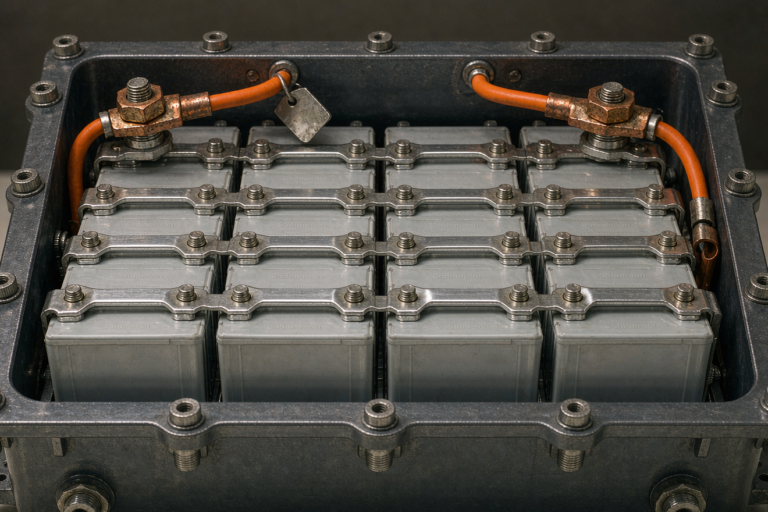
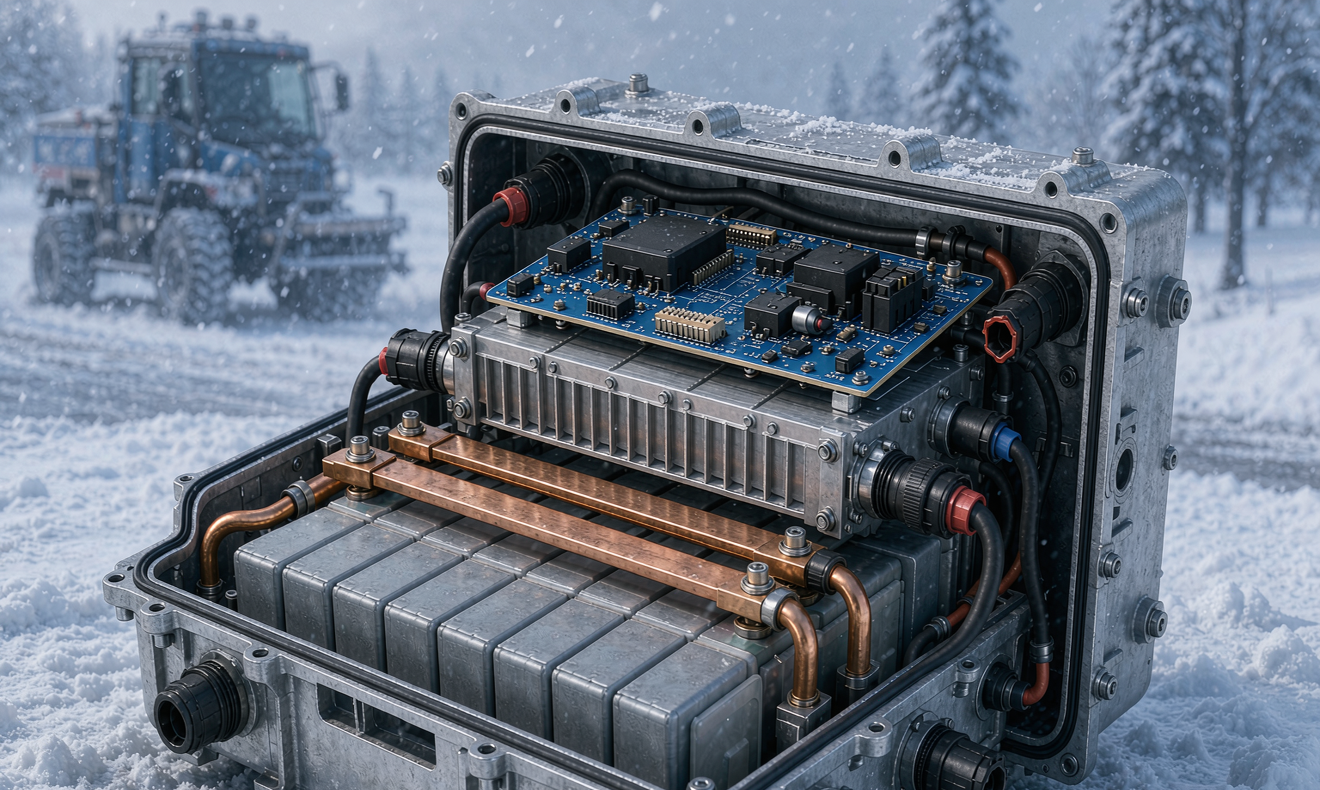
We design snow-groomer battery enclosures to IP66 or IP67 with a validated gasket compression set and stainless-steel or powder-coated aluminum housings. Cable penetrations use sealed multi-pin connectors rated for salt spray per IEC 60068-2-11, Ka and Kb cycles. The pack sits on vibration isolators sized for the random vibration spectrum of a tracked vehicle. We also mount the pack as low as the chassis allows, both for center-of-gravity and to keep it out of the direct spray of plow discharge.
Thermal management for a sodium-ion winter pack is simpler than for LFP because the heating duty is lower. We use a distributed positive-temperature-coefficient (PTC) heater mat or a glycol loop fed by a small 2–3 kW coolant heater. The target is not to keep the cells hot; it is to keep them above -20°C during operation and to bring them to 5–10°C before charging if they have been cold-soaked below that. Because sodium-ion tolerates cold discharge well, we only preheat for charging, not for driving. That cuts the parasitic heating load by roughly half compared with an LFP pack that must be warmed before both discharge and charge.
Safety, Shipping, and Field Certifications
We never deploy an industrial battery pack without a complete certification stack. For sodium-ion cells and packs bound for snow groomers and winter road fleets, we require UN38.3 for transportation, IEC 62619 for industrial lithium and sodium-ion secondary cells, and IEC 62620 for alkaline and other non-acid secondary cells where applicable. In the European market, we also align with the Machinery Directive 2006/42/EC for the vehicle integration and with EN 1175-1 for industrial truck safety if the machine will operate on roadways or plant yards.
One advantage of sodium-ion cells in the field is thermal stability. Layered-oxide sodium-ion cathodes still require careful management, but the chemistry does not use cobalt and does not release oxygen as readily as nickel-cobalt-manganese oxides at high temperatures. In nail-penetration and external-short testing of our packs, sodium-ion modules showed slower temperature rise than NMC and comparable behavior to LFP. That said, we still install a full battery management system (BMS) with cell-level voltage and temperature monitoring, contactor redundancy, and a fuse-protected service disconnect.
Before a pack leaves our facility, we run a cold-weather acceptance sequence: a 500 V insulation-resistance test above 100 MΩ, a 2-hour voltage-soak test at 100% state of charge, a 0.2C capacity check at 25°C, and a -20°C pulse discharge to verify power capability. For winter fleets, we also verify that the enclosure heaters, breathers, and drain holes function correctly after a freeze-thaw cycle.
Total Cost of Ownership for Winter Fleets
The business case for sodium-ion in snow groomers rests on three cost levers: cell material cost, reduced heating-energy spend, and cycle-life durability under shallow winter cycling.
Current sodium-ion cell prices are broadly competitive with LFP at the pack level, especially for systems that do not need extreme gravimetric density. Because sodium carbonate and hard carbon are not constrained by the same supply-chain bottlenecks as lithium carbonate and spherical graphite, we see more stable pricing and shorter lead times for large orders. For a fleet operator buying 30–50 vehicles over five years, that predictability matters.
The operating savings are clearer. A fleet we modeled in Norway reduced winter heating energy by 18% after switching from LFP to sodium-ion, simply because the sodium-ion pack did not need to be kept as warm during discharge. Over a 1,500-hour annual duty cycle, that translated to roughly 7–9 MWh of saved energy per machine. At industrial electricity rates, the savings cover a meaningful portion of the battery financing cost.
Cycle-life expectations for sodium-ion in this duty are 3,000–4,000 equivalent full cycles at 25°C, and roughly 2,000–2,500 cycles when operated year-round in alpine conditions with regular subzero exposure. Because snow groomers operate seasonally and spend long periods at partial state of charge between shifts, calendar fade and sulfide-electrolyte degradation are less dominant than in high-temperature, always-on applications. We size packs for a 6–8 year service life, after which modules can be repurposed into stationary storage.
Frequently Asked Questions
Are sodium-ion batteries powerful enough for large snow groomers?
Yes, for the low-speed, high-torque duty cycle of snow groomers. A 454 kWh sodium-ion pack can deliver sustained power above 150 kW and peak power above 250 kW, which is sufficient for tracked and wheeled groomers used at most alpine resorts. The lower gravimetric density is offset by the smaller total capacity needed because cold-weather derating is milder than with LFP.
Can sodium-ion batteries charge in freezing temperatures?
Sodium-ion cells accept charge at lower temperatures than LFP, typically down to -20°C at low rates. We still recommend warming the pack to 5–10°C before high-rate charging to maximize cycle life, but they do not require pre-heating for driving or gentle opportunity charging the way LFP does.
How does salt and moisture affect sodium-ion battery enclosures?
The chemistry inside the cells is not uniquely sensitive to salt, but the enclosure must be. We specify IP66 or IP67 housings, sealed marine-grade connectors, salt-spray testing, and drain paths for melted snow. These measures are standard for any winter battery system, regardless of chemistry.
What certifications does a sodium-ion snow-groomer pack need?
At minimum, UN38.3 for transport and IEC 62619 for industrial cells and packs. We also test to IEC 62620, align with Machinery Directive 2006/42/EC in Europe, and follow EN 1175-1 for industrial trucks. Regional mining or forestry equipment standards may add additional requirements.
Is sodium-ion cheaper than LFP for winter fleets?
Pack-level costs are currently close, but sodium-ion offers lower heating-energy consumption and more stable raw-material pricing. The strongest economic case appears in fleets with high cold-weather utilization, where the energy saved on battery heating and the avoided mid-shift charging downtime create the best return.
What happens to a sodium-ion pack at the end of its service life?
After 6–8 years in a groomer, modules typically retain 70–80% of original capacity. They are well suited for second-life stationary storage in resort buildings, depots, or grid-tied microgrids. The sodium content is non-toxic and can be recovered through simpler hydrometallurgical routes than many lithium chemistries, simplifying recycling.
Further Reading
References