Drone Battery Weight Capacity Tradeoff
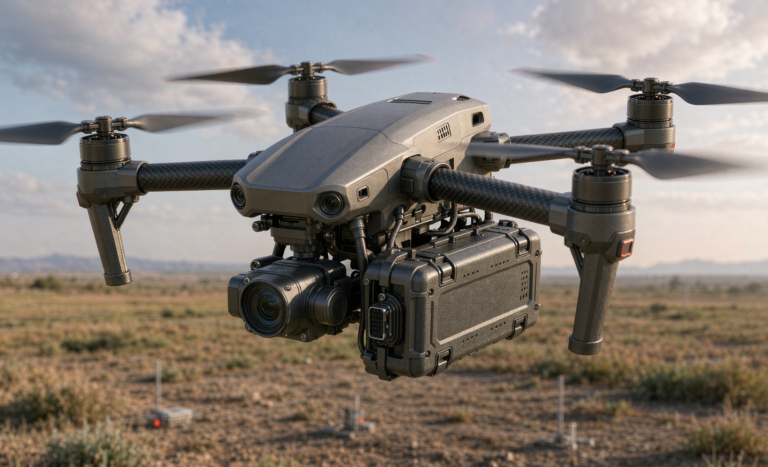
When a customer asks me to “just give us more flight time,” the first thing I do is pull out a calculator, not a catalog. I’m Karl Huang, a senior lithium battery engineer, and after more than a decade designing drone battery packs for everything from agricultural sprayers to fixed-wing survey aircraft, I can tell you the single most misunderstood number in our industry is mass. A heavier pack does not simply cost you payload — it compounds. Every extra gram in the airframe demands more lift, which demands more power, which demands a bigger drone lithium battery, which adds even more grams. If you don’t manage the weight-versus-capacity tradeoff deliberately, you end up with an aircraft that flies forever but carries nothing.
This article is the method I use on the bench and inside customer RFQs to size a pack against a real payload budget. No fluff — just the engineering levers that decide whether your drone battery weight capacity tradeoff lands on a useful aircraft or a flying paperweight.
Why Every Gram of Drone Battery Mass Matters
The reason weight dominates drone design is the lift-to-power relationship. A multirotor hovering in still air burns roughly 60-70% of its total power just holding itself up. Add mass and the hover throttle rises almost linearly, while available thrust margin falls. Because endurance scales with energy divided by power draw, and power draw rises with mass, the endurance benefit of a bigger pack is partly eaten by the pack’s own weight.
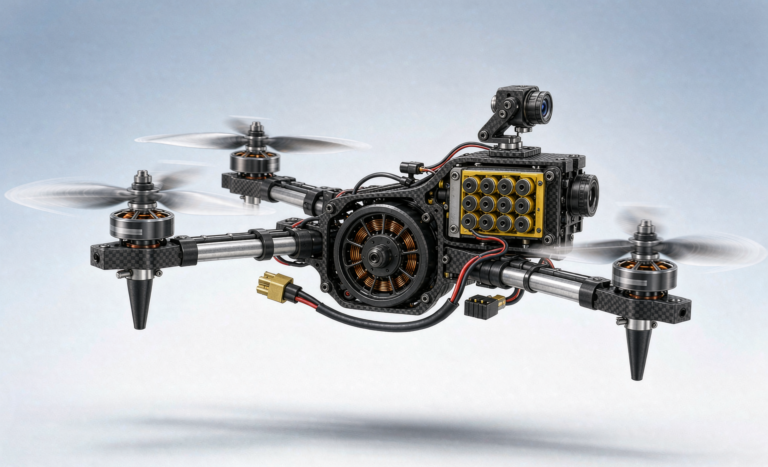
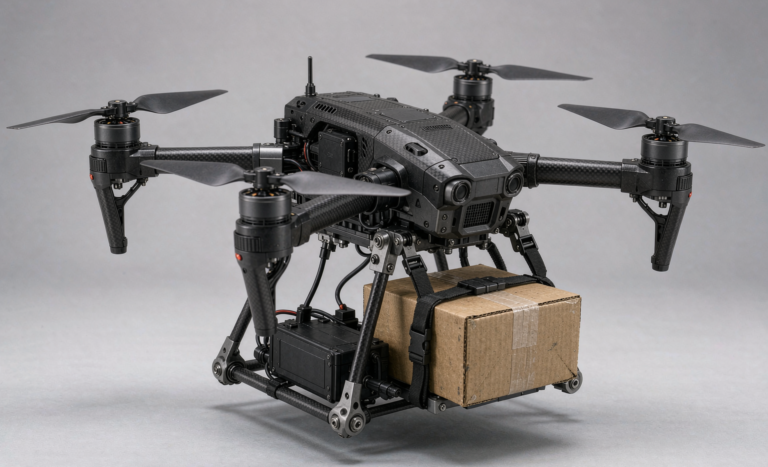
I teach customers a simple rule of thumb: on a typical quadcopter, every 100 g added to the battery costs about 80-120 g of usable payload once you account for the extra structure and margin needed to keep it airborne safely. So a 1,000 g pack upgrade might only net you 400-600 g of real-world payload headroom. That is the core drone battery weight capacity tradeoff in one sentence, and it is why I almost never recommend “just add cells” as the first move.
Reading the Spec Sheet: Energy vs Usable Capacity
The number printed on a pack is nominal capacity, usually in watt-hours (Wh) or amp-hours (Ah). But the number that flies is usable capacity, and it is always smaller. Three factors cut into it:
- Discharge floor: Most drone lithium battery packs should not drop below 3.0 V per cell to protect cycle life, so you forfeit the bottom 10-15% of the rated energy.
- Rate penalty: At high C-rates, internal resistance wastes energy as heat. A 6S pack delivering 20C to a heavy-lift rotor can lose 5-8% to I²R losses compared with a gentle 5C draw.
- Temperature: Below 10°C, lithium cells deliver less and the BMS may derate to protect them, trimming another few percent.
When I size a pack, I multiply the label Wh by a usable factor of about 0.82 for warm-weather multirotor work, and as low as 0.70 for cold-climate or sustained high-discharge missions. Missing this step is the most common reason a lithium battery “meets spec on paper” but fails in the field.
How Cell Chemistry Reshapes the Weight–Capacity Curve
Chemistry is the second big lever, because energy density (Wh/kg) sets how many watt-hours you get per gram of pack. The three chemistries I specify most often tell very different stories:
- NMC (nickel manganese cobalt): ~200-250 Wh/kg at cell level, up to ~180 Wh/kg at pack level once you add the enclosure, BMS, and cabling. Great when every gram counts, but it carries more thermal-risk baggage.
- LFP (lithium iron phosphate): ~160-180 Wh/kg cell, ~130-150 Wh/kg pack. Heavier, but far more cycle life (2,000-4,000 cycles) and a much safer abuse profile. The default for industrial and indoor work.
- Semi-solid-state: Emerging at 280-320 Wh/kg cell level. On a weight-constrained airframe this can recover 15-25% of payload versus LFP for the same flight time — but cost and supply maturity are still real constraints in 2026.
I ran a comparison last year for a mapping customer: switching a 6S 22,000 mAh pack from LFP to NMC saved 310 g. That 310 g went straight back into a larger sensor gimbal. Same flight time, dramatically more useful aircraft. That is the chemistry lever doing real work on the drone battery weight capacity tradeoff.
A Field Method for Sizing the Pack
Here is the four-step method I hand to every new OEM customer. It keeps the tradeoff visible instead of hidden in a spreadsheet:
- Fix the payload first. Write down the exact mass of the payload, gimbal, and cables. This is the non-negotiable number.
- Fix the target hover time. Endurance you actually need, not the endurance you dream about. Most surveying missions need 25-35 min, not 60.
- Back-calculate pack energy. Use your airframe’s known W/g hover power (I measure this on a thrust stand) to derive required Wh, then divide by usable factor 0.82.
- Convert to mass, then check the loop. Pack mass = required Wh / pack-level Wh/kg. Add it to airframe dry mass plus payload, confirm thrust margin stays above 1.5x hover weight, and iterate if not.
This loop is why a custom battery solution beats an off-the-shelf brick for serious programs: we tune cell count, format, and enclosure to land exactly on your payload budget rather than rounding up to the nearest catalog size and paying weight for margin you don’t need.
Real-World Tradeoffs: Three Mission Profiles
The “right” answer depends entirely on the mission, so I design to the profile:
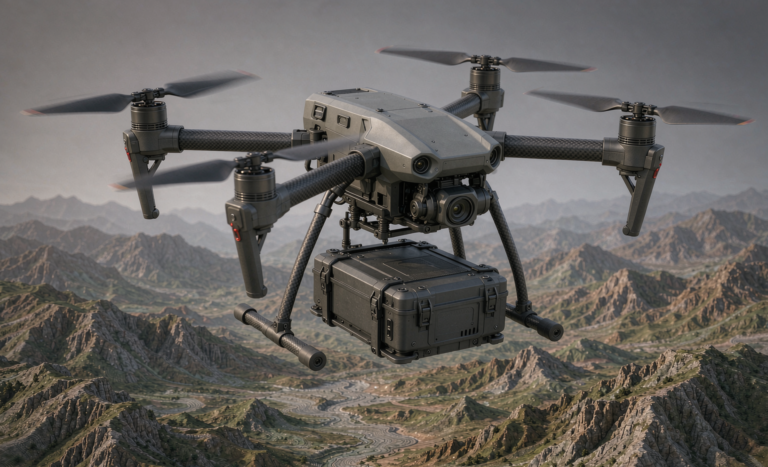
- Heavy-lift agriculture: Payload dominates (10-40 kg of liquid). Here I accept lower Wh/kg LFP for safety and cycle life, and I over-spec discharge C-rating so voltage doesn’t sag under load. Weight is managed by structure, not by shrinking the battery.
- Long-endurance mapping: Payload is light (a small optical sensor). This is where NMC or semi-solid wins — every gram saved on the pack extends cruise time. I push usable factor higher because discharge is gentle.
- Cinematic: Balance is everything. A gimbal is sensitive to vibration and CG, so I place the drone lithium battery for center-of-gravity control and accept a moderate capacity to keep the airframe agile.
Notice none of these say “maximum capacity.” The tradeoff is always against something: payload, safety, agility, or cost.
Certification, Safety Margin, and the Enclosure Tax
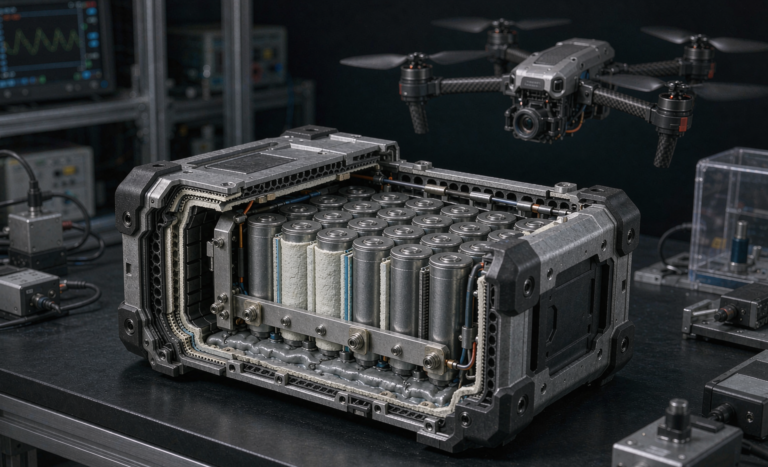
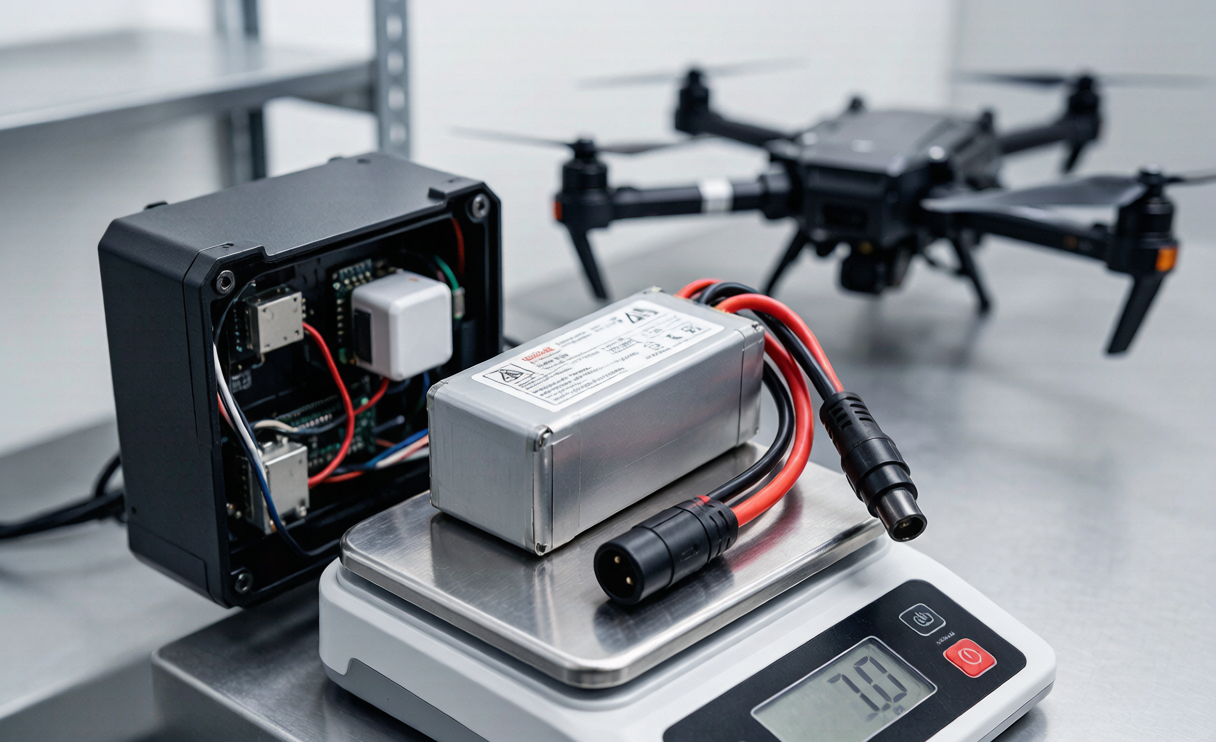
Finally, don’t forget the enclosure. A bare cell stack is light; a flight-ready pack is not. Hard cases, potting for vibration, IP-rated seals, and the BMS board all add mass — typically 8-12% of total pack weight. But they are non-negotiable for compliance.
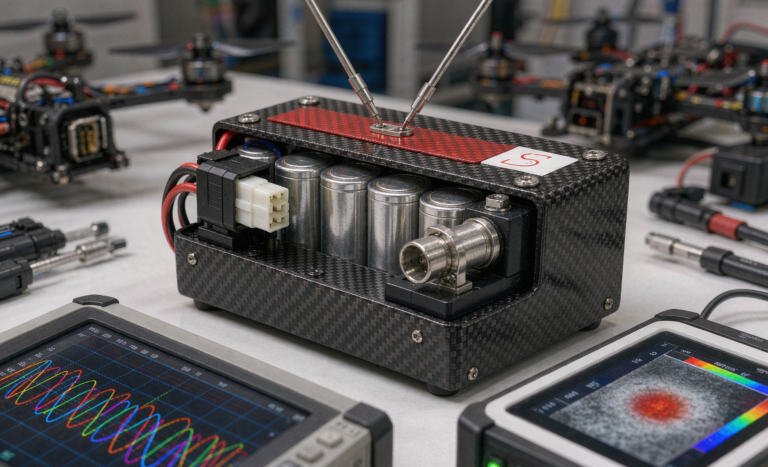
For any aircraft crossing borders, the pack must pass UN38.3 (transport simulation: altitude, thermal, vibration, shock, external short, impact, overcharge, forced discharge). For the cells and pack design I reference IEC 62133 for safety construction and abuse testing. And for the aircraft itself, operators in most markets work inside FAA Part 107 (US) or EASA UAS rules (EU), both of which indirectly constrain how much battery mass and energy you can practically carry and still certify the operation.
I always build in a 15-20% mass reserve against the thrust-margin line. That reserve is what keeps a pack within safe operating envelope when a rotor takes a hit or a cold front drops the air density. Skipping it to squeeze out payload is the kind of optimization that ends in a crashed airframe and an angry customer.
Putting the Tradeoff to Work
The drone battery weight capacity tradeoff is not a problem to “solve” once — it is a dial you turn for every new airframe and every new mission. Start from payload and endurance, pick chemistry by the mission profile, run the sizing loop until thrust margin holds, and respect the enclosure and certification tax. Do that, and your battery stops being the heaviest thing on the aircraft and starts being the reason the aircraft is useful.
If your current program is fighting weight, send me the airframe dry mass, target endurance, and payload. I’ll run the loop and show you exactly where the grams are hiding.
FAQ: Drone Battery Weight vs Capacity
How much payload do I lose for every 100 g of battery?
On a typical multirotor, plan on losing roughly 80-120 g of usable payload for every 100 g added to the battery, because the airframe needs extra lift, structure, and safety margin to carry the heavier pack. That is why simply adding cells is rarely the best fix.
Does a higher Wh rating always mean longer flight?
No. Endurance depends on usable watt-hours, which is label capacity minus discharge floor, rate losses, and temperature derating. A pack rated 20% higher can deliver far less if it is discharged hard or flown cold. I size to usable factor, not label number.
Which chemistry is lightest for a drone battery?
NMC and emerging semi-solid-state chemistries offer the highest pack-level Wh/kg (roughly 180 and 280-320 at cell level respectively), so they win on weight-constrained airframes. LFP is heavier but safer and longer-lived, which is why I still specify it for industrial and indoor drones.
Why does my pack need an enclosure if it adds weight?
The enclosure, potting, seals, and BMS typically add 8-12% of pack mass, but they provide vibration protection, environmental sealing, and the structure needed to pass UN38.3 and IEC 62133. Skipping them risks both compliance failure and in-field pack failure.
Can a custom battery solution really save weight over a standard pack?
Yes. Off-the-shelf packs are built to round catalog sizes, so you often carry extra mass as margin you don’t need. A custom battery solution tunes cell format, count, and enclosure to your exact payload and endurance targets, frequently recovering 200-400 g on a mid-size airframe.
How do I know if my thrust margin is safe?
I keep total installed thrust at or above 1.5x the all-up hover weight, and I hold a 15-20% mass reserve below that line for cold air, rotor wear, and wind. If your loop lands under 1.5x, you need a lighter pack, a more efficient rotor, or a smaller payload — not a bigger battery.