Drone Battery Cost Optimization for Delivery Drones: A (3)
drone battery Cost Optimization for Delivery Drones: A Senior Engineer’s TCO Playbook
When a logistics operator asks me to “make the drone battery cheaper,” I always push back on the word cheaper. In a delivery fleet, the sticker price of a pack is maybe 20–30% of what that energy actually costs over three years. The rest is hidden in cycle life, charge infrastructure, certification amortization, and the downtime you eat every time a pack retires early. Over the last decade building lithium packs for commercial UAVs, I have learned that drone battery cost optimization for delivery drones is not about buying the lowest-cost cell — it is about lowering cost per successful delivery. This article is the playbook I hand to fleet operators and procurement leads.
Why Delivery-Drone Battery Economics Are Different
A consumer quadcopter flies for fun. A delivery drone flies for profit, on a fixed route, multiple times per day, in weather. That changes the math completely. The unit you should optimize is not “dollars per watt-hour” but “dollars per delivery.” I compute it as:
- Pack price ÷ (usable cycles × deliveries per cycle) = pack amortization per delivery.
- Charging energy cost + charging labor/infrastructure depreciation = energy cost per delivery.
- Failure and swap downtime = reliability cost per delivery.
- Certification and compliance overhead, amortized across the fleet.
A drone lithium battery built with premium cells that lasts 1,200 cycles will almost always beat a bargain pack that dies at 400 cycles, even if the premium pack costs 40% more upfront. I have watched operators save 18% on pack purchase and then lose 35% on total cost of ownership. The lithium battery chemistry decision is therefore a financial decision first and an engineering decision second.
Right-Sizing Energy and C-Rate to Cut Cost per Delivery
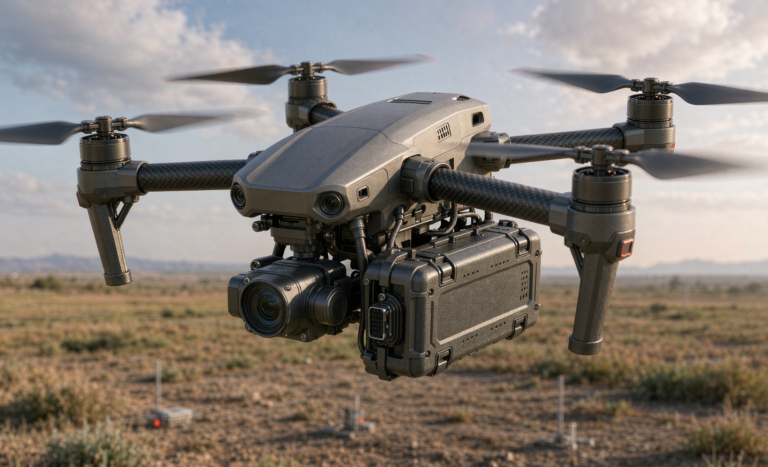
The single most common mistake I see is over-specification. An operator defines a 6 km route with a 0.8 kg payload, then buys a pack rated for 12 km and 2 kg “just in case.” That safety margin is paid for in every single pack, every single day. Right-sizing is the fastest win in drone battery cost optimization for delivery drones.
On a typical last-mile quadcopter, payload is the dominant energy consumer. Carrying 200 g of unused battery margin can cost 8–12% more energy per flight. I run a margin model: design for the 95th-percentile route plus a fixed 15% state-of-charge reserve, not the absolute worst case. That alone trims pack capacity 10–18% versus conservative sizing, and the smaller pack is lighter, cheaper, and faster to charge.
C-rate matters too. A pack discharged at 2C heats more and ages faster than one at 1.2C. If your route only needs 1.5C peak, do not pay for a 5C cell. Match the cell’s continuous and pulse ratings to the real mission profile, and you buy a cheaper cell without sacrificing safety.
Cycle Life and Pack Replacement Cadence
This is where the money is. A commodity 18650-grade NMC cell might give you 400–600 full-equivalent cycles; a properly engineered pouch or cylindrical pack with balanced cells and a good BMS routinely delivers 800–1,200. Doubling cycle life roughly halves pack amortization per delivery.
I design for a defined retirement rule rather than “fly until it dies.” In our fleet program, a pack is retired at 80% state-of-health (SoH) or when its direct current internal resistance (DCIR) drifts more than 25% above the fresh baseline — whichever comes first. Pulling packs at 80% SoH avoids the steep end-of-life failure rate and the costly in-flight incidents that follow. The retirement schedule is predictable, so procurement can forecast pack purchases a quarter ahead and negotiate volume pricing.
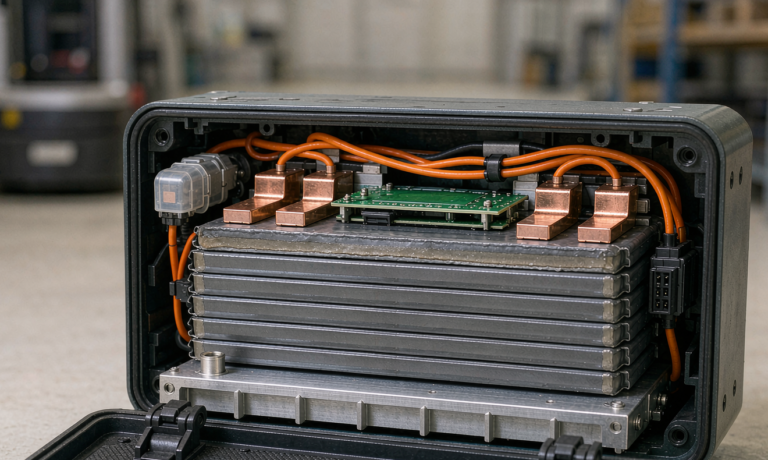
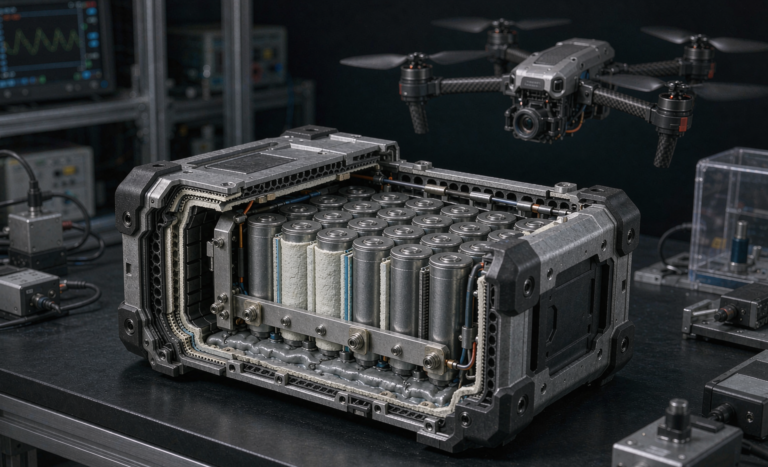
A custom battery solution tuned to your exact discharge curve will almost always out-cycle a generic off-the-shelf pack, because generic packs are built for a broad market and rarely for your specific thermal and C-rate envelope. I also insist on matched-cell builds: cells binned by capacity and internal resistance within 1–2% of each other. Mismatched cells force the BMS to over-protect the weakest cell, quietly cutting usable capacity and accelerating the whole pack’s retirement. Binning costs almost nothing at the assembly stage and pays back across the entire service life.
Standardization: One Platform Across the Fleet
Every distinct pack shape, connector, and BMS firmware is a separate inventory line, a separate spare-part commitment, and a separate certification burden. I push operators toward a custom battery solution that becomes a single common platform — one pack family, scalable in parallel modules, serving multiple airframes.
The savings are not just in unit cost. A standardized pack means:
- One charger type across the depot (lower capital and training cost).
- One spare-parts SKU (less dead inventory, better bulk discounts).
- One firmware update path for the BMS (lower maintenance overhead).
- Faster operator training and fewer mishandling failures.
I have seen standardization cut total battery-related operating cost by 12–20% before we touched a single cell parameter. For a drone battery fleet doing thousands of deliveries a month, that is a material line on the P&L.
Charging Infrastructure and Turnaround
Downtime is the cost nobody budgets. If a pack takes 90 minutes to charge and a route needs a pack every 25 minutes, you are buying 3–4 packs per aircraft just to keep one flying. Reducing charge time from 1C to 2C (with thermally managed charging) can cut the required pack count per drone by a third.
I spec opportunity charging: shallow top-ups between flights rather than deep 0–100% cycles. Lithium cells prefer partial cycles — charging 30%→80% repeatedly extends calendar life versus daily full discharges. Combined with a depot charger farm sized to peak throughput, this lowers both pack count and energy waste from cooling losses.
Critically, charge infrastructure must be planned with the pack, not bolted on after. A drone lithium battery with a BMS that supports balanced fast charging will unlock depot savings that a dumb pack cannot.
Amortizing Certification and Compliance Cost
Commercial delivery drones cross borders and operate over people, so compliance is non-negotiable. The big three for a lithium pack are UN38.3 (transport safety), IEC 62133-2 (secondary cell safety), and airworthiness alignment with FAA (e.g., Part 135 operations in the US) and EASA (e.g., SORA risk framework in Europe).
Certification is expensive — often $15k–$60k per pack variant depending on testing scope. The optimization lever is to certify once for a platform and reuse it across airframes and regions with delta testing only. Designing the pack to a single certified architecture from day one avoids the ruinous cost of re-certifying after a mid-program cell change. I always tell clients: the cheapest certification is the one you do not have to repeat.
Thermal Management Without Overspending
Cold weather is brutal on delivery economics. At 0°C, a lithium pack can lose 15–25% usable capacity and age faster if charged cold. The cheap answer is “don’t fly in winter”; the engineered answer is passive pre-conditioning — warming packs in the depot before flight and using insulated enclosures. Active heating is rarely worth the weight; a well-insulated pack plus depot pre-heat recovers most of the winter range at a fraction of the mass penalty.
On the hot end, a pack that runs 10°C cooler lasts meaningfully longer. Simple airflow routing and cell spacing — design choices, not expensive materials — extend life and defer replacement. That is drone battery cost optimization for delivery drones in its purest form: physics, not purchases.
Fleet Telemetry: Measuring What You Optimize
You cannot optimize what you do not measure. Every pack in our programs reports per-cell voltage, temperature, cycle count, and DCIR trend to a fleet dashboard. That telemetry turns cost optimization from guesswork into a closed loop. When a depot’s packs age 20% faster than another’s, the data points straight at a charger setpoint or a climate-control gap — not at the battery chemistry. I have caught two separate “bad batch” complaints that were actually charger misconfiguration, saving the operator from an unnecessary and expensive pack requalification.
The telemetry also feeds the retirement model. Instead of retiring on a fixed calendar date, we retire on measured SoH, which means healthy packs stay in service longer and only genuinely degraded packs are pulled. Across a 200-pack fleet, shifting from calendar-based to condition-based retirement typically extracts 8–15% more useful cycles from the same inventory — pure margin with no new hardware.
FAQ
What is the real cost driver in delivery-drone battery programs?
It is almost never the cell purchase price. Cycle life, charge infrastructure, certification amortization, and failure downtime dominate total cost of ownership. I optimize cost per delivery, not cost per watt-hour.
How much can right-sizing the pack actually save?
In my programs, removing unnecessary capacity margin and matching C-rate to the real mission typically cuts pack size 10–18% and can lower total battery operating cost 12–20% once standardization and charging are included.
When should a delivery pack be retired?
I retire at 80% state-of-health or when DCIR drifts more than 25% above the fresh baseline. That predictable schedule avoids end-of-life in-flight failures and lets procurement forecast pack buys a quarter ahead.
Is a custom battery solution worth the upfront cost?
For fleets above roughly 50 aircraft, yes. A custom pack tuned to your discharge and thermal envelope out-cycles generic packs and enables platform standardization, which pays back the design cost quickly through volume discounts and lower spares inventory.
Do I really need UN38.3 and IEC 62133-2 certification?
Yes, for commercial transport and safe operation. The optimization is to certify a single platform once and reuse it across airframes and regions with only delta testing, rather than re-certifying after every cell change.
How does cold weather affect delivery-drone battery cost?
At 0°C a lithium pack can lose 15–25% usable capacity and age faster if charged cold. Depot pre-conditioning plus insulation recovers most winter range cheaply, avoiding both range loss and premature retirement.
By treating the lithium battery as a system — cells, BMS, charging, certification, and retirement policy together — operators stop optimizing isolated line items and start lowering the only number that matters: cost per successful delivery. That is how a drone battery program goes from a cost center to a competitive advantage.