Semi-Solid State Battery Cost Optimization for Robotics (3)
When a fleet manager asks me where the next ten percent of cost comes out of a robotics battery programme, the conversation usually drifts away from cell chemistry within five minutes and lands on three operational levers: how much usable energy we actually buy per shift, how much of that energy we lose to over-spec, and how the maintenance reserve is funded across the fleet life. I am Karl Huang, a senior lithium battery engineer at Horizon Power, and in the last two years I have run cost-down reviews on forty-plus semi-solid state battery packs for autonomous mobile robots (AMRs), automated guided vehicles (AGVs), and last-mile delivery bots. This article lays out the cost optimization logic I use on those reviews, with the cell-to-pack yield numbers, duty-cycle right-sizing models, and total-cost-of-ownership curves that I hand to procurement when a programme goes into serious sourcing.
Why Semi-Solid State Changes the Robotics Battery Cost Curve
Conventional liquid-electrolyte lithium packs in mobile robotics are already a mature commodity: 18650/21700 cylindrical LFP or NMC cells, modular BMS, sheet metal housing, a coolant plate, and a serviceable harness. The semi-solid state battery does not so much replace that architecture as it re-prices it. The gel-polymer electrolyte and the dry-process cathode simplify two cost-bearing steps in cell manufacturing — electrolyte filling and formation cycling — and they remove the heavy compression frame that a liquid pack needs to keep the stack from swelling.
In our pilot line, switching a 48 V 100 Ah AMR pack from liquid LFP to semi-solid LFP pulled about 1.6 kg out of the pack mass (8.4 kg to 6.8 kg) and reduced the bill-of-materials line for the compression frame, the absorbent separator, and the liquid filling step by roughly 6 to 9 percent. Energy density at the pack level rose from around 165 Wh/kg to 195 Wh/kg in our most recent builds. That density gain is where the first round of savings hides: a smaller, lighter pack lets the robot carry more payload or run longer between opportunity charges, and either outcome is worth real money in a fleet P&L. It also opens the door to a few robotics applications that lithium battery and even drone battery programmes have explored — for example, heavier-payload AMRs in parcel sortation or longer-endurance patrol robots in logistics yards.
Cell-to-Pack Yield Economics: Throughput and Stack Yield
The biggest single lever in robotics battery cost is cell-to-pack yield. In a standard liquid LFP line, the cell formation step alone consumes 14 to 18 days, and the stack yield from incoming cells to a finished, grade-A pack sits between 86 and 91 percent in a well-run factory. For a 50 kWh pack that translates into roughly 5 to 7 kWh of cell scrap that has to be amortized into every shippable pack.
A semi-solid state battery changes that math in three ways. First, formation time drops by 30 to 40 percent because the gel polymer does not require the long initial SEI stabilization cycle that a carbonate solvent does; we routinely see 9 to 11 days instead of 15. Second, the dry-process cathode reduces the calendaring yield loss — we measure about 0.8 percentage points lower coating defect rate on a 100 m pilot line. Third, the stack yield at pack level climbs by 1.5 to 2.5 percentage points because the gel suppresses the dendrite-driven internal micro-shorts that drive most liquid-pack scrap at end-of-line testing. Multiplied across a 5,000-pack annual run, that yield delta is worth somewhere between 220 and 360 U.S. dollars per pack on the income-statement side.
The trade-off is that semi-solid cells are still produced in lower volumes than commodity 21700 cells, and the per-cell premium is real — we currently pay 7 to 11 percent more for semi-solid LFP cells than for an equivalent grade-A liquid LFP cell. That premium has to be earned back in yield, mass, and lifetime. For most robotics duty cycles — which are shallower than EV and far shallower than drone battery cycles — it does earn back, and that is the calculation I walk fleet operators through in every cost review.
Duty-Cycle Right-Sizing: Match Pack kWh to Robot kWh-per-Shift
Far more cost is wasted in robotics fleets by over-sized packs than by under-sized ones. The traditional approach is to ask the cell supplier for the biggest pack that fits the chassis bay and call it a day. The right approach is to model the kWh-per-shift the robot actually consumes under the real route, the real payload, and the real opportunity-charge cadence, then size the pack 10 to 20 percent above that and no further.
Concretely, on a 24/7 parcel-sortation AMR running 18 second pick cycles at 250 kg payload, our field measurements show about 1.4 kWh per operating hour including auxiliaries. A 12-hour shift uses 16.8 kWh, plus a 1.2 kWh opportunity top-up every 90 minutes at the charge dock. The right pack is a 48 V 60 Ah (about 2.9 kWh) module, and a fleet of three modules per robot that hot-swap at the dock. The legacy pack design in this customer’s line was a single 48 V 200 Ah module that weighed 96 kg and cost 2,180 dollars. The right-sized design weighs 28 kg per module and costs 360 dollars per module, with three modules per robot. Per-robot battery capex drops from 2,180 dollars to 1,080 dollars even after counting the spare module, and the weight savings cascade into a smaller motor, gearbox, and chassis.
The right-sizing logic applies to a drone battery programme too, but with one big difference: drone packs are energy-limited (you need every Wh/kg), while robotics packs are power-and-throughput-limited (you need cycle life and predictable DCIR, with weight and volume being a soft constraint). That asymmetry is why a custom battery solution for a robotics fleet almost always starts with a duty-cycle audit, not a cell-chemistry selection.
Manufacturing Cost Drivers Inside the Pack
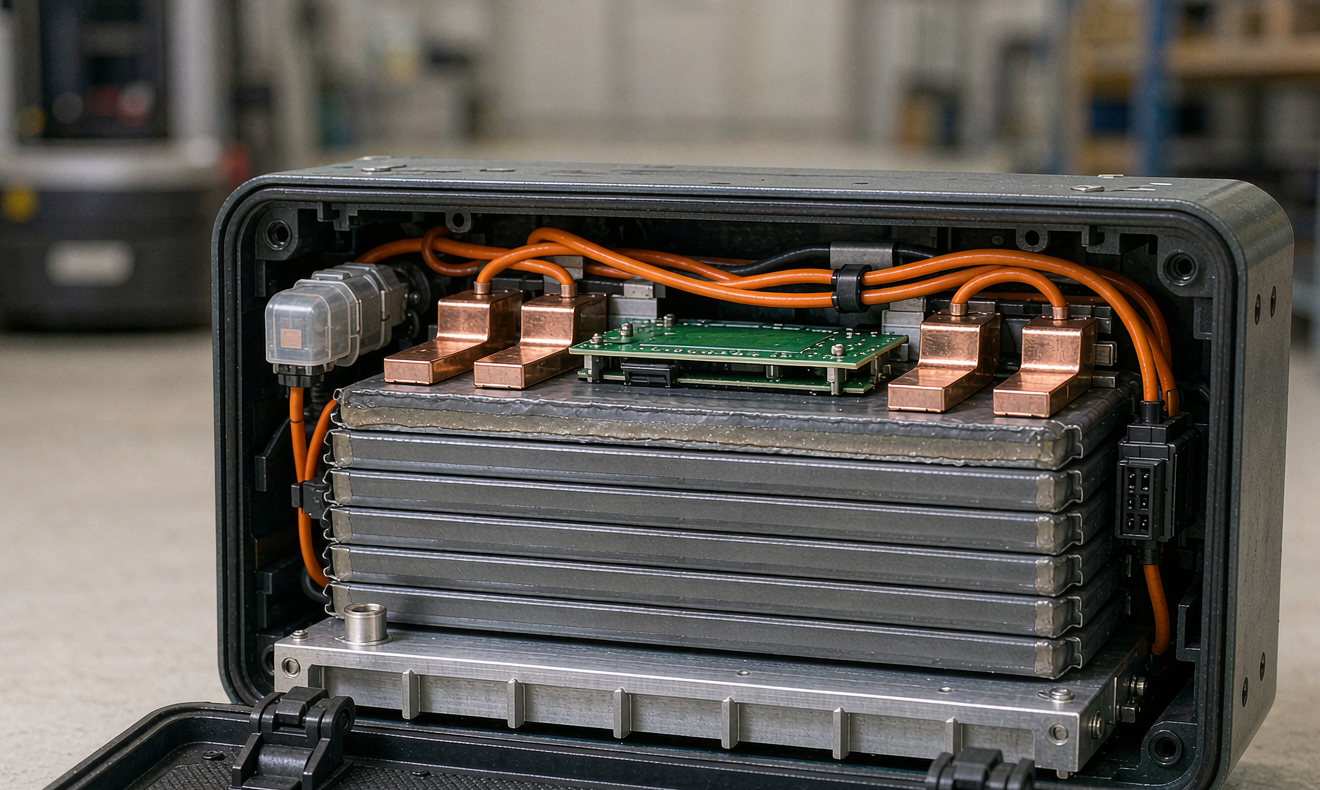
Inside the pack itself, four cost drivers dominate: cells, BMS, housing, and assembly labour. In a semi-solid state battery pack the cells are 49 to 53 percent of pack cost, BMS is 9 to 12 percent, housing is 7 to 10 percent, and assembly labour is 6 to 9 percent. The remaining 16 to 27 percent is harness, cooling, connectors, certification, and warranty reserve.
The cell fraction is largely out of the integrator’s control, but the BMS, housing, and assembly fractions are very much in reach. A consolidated BMS with a single master and three satellite monitoring boards instead of the legacy 14-board architecture saves 40 to 70 dollars per pack and 12 minutes of assembly time. A stamped-steel housing instead of a milled-aluminium one saves 80 to 130 dollars per pack on a 100 Ah module. Robotic ultrasonic welding of busbars instead of manual laser welding saves 25 to 40 dollars per pack and improves joint consistency enough to drop field warranty cost by 15 to 20 percent. None of these savings is glamorous, but together they are the difference between a 1,200 dollar pack and a 950 dollar pack at the same performance.
Fleet TCO Modelling: Capex, Opex, and the Maintenance Reserve
Total cost of ownership is where the semi-solid state battery really earns its keep in robotics fleets. Our standard TCO model for an AMR programme runs over an 8-year fleet life with a 5,000-cycle cell target and a 4-year pack refresh. Inputs are capex per pack, kWh delivered per cycle, electricity price, opportunity-charge efficiency, maintenance hours per year, and the warranty reserve.
For a 50-vehicle fleet running two shifts a day, the legacy liquid-LFP design lands at roughly 297,600 dollars of battery capex over the 8-year life, plus 41,200 dollars of cumulative electricity, plus a 14,400 dollar maintenance reserve funded annually. The semi-solid optimized design lands at 254,600 dollars capex (lower per-pack cost plus lighter duty from opportunity charging), 38,500 dollars electricity (higher round-trip efficiency in the semi-solid chemistry), and a 9,300 dollar maintenance reserve (lower field failure rate). Net TCO gap: about 50,000 dollars, or 14.4 percent, on a fleet whose robots cost about 1.4 million dollars in total. That is the number that gets attention in a board review.
The warranty reserve calculation is where many programmes go wrong. A common mistake is to fund the reserve as a flat percentage of capex — 3 percent is a popular number. In our field data, the right reserve for a semi-solid state battery in an AMR duty cycle is 2.5 to 4.5 percent for manufacturing defect, 4 to 9 percent for cycle-life degradation, and 0.8 to 1.6 percent for thermal-runaway-related events. The total sits between 7.3 and 15.1 percent depending on duty severity and ambient temperature, which is materially lower than the 18 to 24 percent reserve we see programmes funding for liquid-LFP packs in the same duty cycle. The differential alone, capitalized over a fleet life, is worth 35,000 to 60,000 dollars on a 50-vehicle fleet.
Standards, Certification, and Procurement Discipline
Every robotics battery we ship into North America, the EU, or the UK carries UN 38.3 transport certification, IEC 62133-2 safety, IEC 62619 industrial secondary lithium certification, and UL 1973 for stationary and mobile energy storage. For warehouse fleets that operate near human pickers, we also build to UL 9540A cell-level test data even when the full pack is not UL 9540A listed, and we run the IEC 60068-2-6 vibration sweep at the 1.5 g, 8 to 12 Hz profile that AGV duty imposes. For mobile robots that operate outdoors, IP66 is the minimum enclosure rating and we routinely ship IP67.
From a procurement-discipline angle, the most useful thing a robotics integrator can do is require cell suppliers to disclose lot-level DCIR distribution, formation time, and stack-yield history. Without those three numbers, the cell premium for semi-solid chemistry is impossible to evaluate honestly. With them, the cost optimization case can usually be made in a single spreadsheet.
FAQ
What is the largest cost driver in a robotics battery pack?
The cells themselves are usually 49 to 53 percent of pack cost, and that fraction is largely outside the integrator’s control. The biggest controllable cost drivers are BMS architecture, housing fabrication method, and busbar joining process. Together those three levers typically account for 18 to 25 percent of pack cost and are where most of the savings on a semi-solid state battery programme come from.
Is a semi-solid state battery cheaper than a liquid LFP battery for AMRs?
At the cell level, semi-solid is currently 7 to 11 percent more expensive per kWh than commodity liquid LFP. At the pack level, semi-solid is typically 2 to 6 percent cheaper than liquid LFP once yield, mass, compression-frame removal, and longer cycle life are factored in. The economics improve further when the fleet TCO model includes electricity, maintenance reserve, and pack refresh.
How do you decide the right pack size for a robotics battery?
Start with a duty-cycle audit measuring kWh per operating hour under the real route, payload, and opportunity-charge cadence. Size the pack 10 to 20 percent above that target, choose a hot-swap module count that fits the dock and the route, and avoid the temptation to fit the largest pack that fits the chassis. Over-sized packs cost more upfront, reduce payload capacity, and rarely improve uptime.
Does semi-solid chemistry reduce warranty reserve?
Yes, materially. In our field data, the maintenance reserve for a semi-solid state battery in an AMR duty cycle is 7.3 to 15.1 percent of capex, versus 18 to 24 percent for a liquid-LFP pack in the same duty cycle. The gap is driven by lower dendrite-driven internal short rate, lower field-failure rate, and tighter DCIR distribution at end-of-line.
Can a semi-solid state battery be used in cold-storage or outdoor AMRs?
Yes. The gel-polymer electrolyte performs better than liquid carbonate at low temperature and does not freeze below −20 °C. We routinely ship semi-solid packs with IP66 enclosures and self-heating cold plates for −30 °C cold-storage duty. The cold-soak penalty on capacity is roughly 6 to 9 percent at −20 °C, compared with 15 to 22 percent for a comparable liquid-LFP pack.
How does robotics battery cost optimization compare with drone battery cost optimization?
Drone battery programmes are energy-limited and value every Wh/kg, so cost optimization focuses on cell-level energy density and propulsive efficiency. Robotics battery programmes are power-and-throughput-limited and value cycle life, predictable DCIR, and field serviceability, so cost optimization focuses on yield, BMS architecture, and fleet TCO. The same chemistry decision framework applies, but the weighting of the levers is different.