Drone Battery Performance for Racing Drones: An Engineer’s Guide
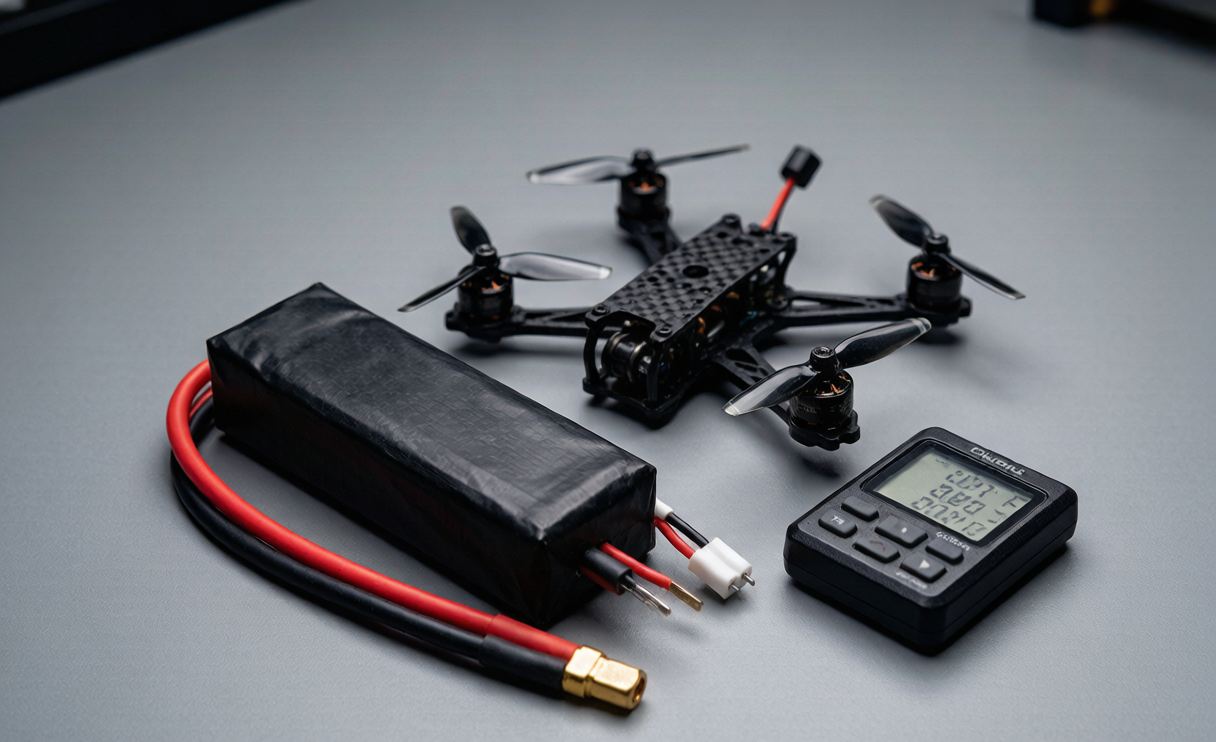
I have spent the better part of fifteen years designing and validating lithium packs, and nothing punishes a bad cell choice faster than a racing quadcopter. In an inspection drone, a 10% error in internal resistance shows up as a slightly shorter mission. On a 5-inch race frame pulling 150 A out of a 6S pack through a gate at 130 km/h, that same 10% shows up as a voltage sag below the flight controller’s brownout threshold, a dead stick mid-corner, and a pile of carbon fiber. That gap between “adequate” and “raceable” is what this article is about.
Over three seasons my team has cycled, dissected, and thermally imaged several hundred packs for racing customers. What follows is the engineering reality behind drone battery performance racing drones depend on: the physics of voltage sag, why label C-ratings are mostly marketing, and the routine that keeps a pack competitive for 150 flights instead of 30.
Why Racing Packs Live in a Different Physics Regime
A survey or delivery aircraft draws 0.6 C to 1.5 C in cruise. A racing quadcopter spends its entire flight oscillating between 2 C on a straight and 60 C or more on a punch-out. That single difference reshapes every design decision in the pack.
The governing equation is unromantic: the voltage your electronic speed controllers actually see is the open-circuit voltage minus the product of current and total internal resistance. On a 6S pack of high-power lithium polymer cells, a good cell sits around 1.6 to 2.2 milliohms at 25 degrees Celsius. Multiply by six cells in series, add roughly 0.8 to 1.5 milliohms of interconnect, connector, and lead resistance, and you land near 12 to 15 milliohms total. Pull 150 A through 13 milliohms and you lose about 2.0 volts instantly. A pack sitting at 24.6 V open-circuit delivers about 22.6 V under that punch — that is 3.77 V per cell, still healthy.
Now take a tired pack whose cells have drifted to 3.4 milliohms each. Total resistance climbs past 21 milliohms, sag at 150 A becomes 3.15 V, and the ESC sees 3.57 V per cell. Add a cold morning and you are near the 3.2 V floor where flight controllers reboot. The pack did not lose capacity — it lost the ability to deliver it, and that is the most misunderstood point in racing drone battery selection.
Every serious racing drone lithium battery specification we write therefore leads with a resistance ceiling, not a milliamp-hour number. For a 6S 1300 mAh race pack we specify 2.2 milliohms maximum per cell at 50% state of charge and 25 degrees Celsius, measured with a 1 kHz AC method, and we reject cells with more than 8% spread across the pack.
Reading C-Ratings Without Being Fooled
The number printed on the wrap is the least reliable figure in this industry. I have tested packs labeled 150 C that could not sustain 40 C without collapsing below 3.0 V per cell. No binding standard forces a manufacturer to define the test conditions behind a C-rating, so the label becomes marketing.
Use this method instead. Charge to 4.20 V per cell, rest ten minutes, then apply a constant-current discharge at the current you actually fly — for most 5-inch builds a 40 C to 60 C burst. Record the voltage exactly ten seconds into the pulse. That ten-second loaded voltage correlates with race performance better than anything else we measure.
For a 6S 1300 mAh pack pulled at 60 C, which is 78 A, we consider these thresholds meaningful:
- Above 3.85 V per cell at ten seconds — genuinely competitive, suitable for open-class racing.
- 3.70 to 3.85 V per cell — good spec-class or freestyle performance, acceptable for most pilots.
- 3.55 to 3.70 V per cell — training and practice only; the pack will sag noticeably out of corners.
- Below 3.55 V per cell — retire from racing duty regardless of remaining capacity.
We also track recovery: a healthy cell rebounds to within 60 to 90 millivolts of its pre-pulse open-circuit voltage in about three seconds, while a degrading cell takes eight seconds or more. That lag is exactly the mushy throttle response pilots describe but cannot quantify.
Energy Density Versus Power Density: The Trade You Cannot Escape
Racing pilots always ask for both more capacity and more punch. Cell chemistry does not permit it. The electrode design choices that raise energy density — thicker coatings, higher areal loading, less conductive additive — are precisely the choices that raise internal resistance and lower power density.
A modern high-energy lithium polymer cell for endurance work reaches 260 to 275 Wh/kg but tops out around 15 C to 20 C continuous. A dedicated racing cell with thin electrodes and heavy tab conduction sits closer to 180 to 205 Wh/kg but sustains 45 C to 60 C continuous with acceptable heating. That is roughly a 30% energy penalty in exchange for a 3x power capability.
The correct way to resolve this is to size against flight profile rather than chasing headline numbers. For a 5-inch race build averaging 32 A over a two-and-a-half minute heat, the pack delivers about 1.33 Ah. A 1300 mAh pack finishes that heat at roughly 3.65 V per cell resting — right at the sweet spot. Going to 1800 mAh adds 70 grams, raises the frame’s moment of inertia, slows rotational response, and leaves 30% of the energy unused at the finish line. The heavier pack is objectively worse despite storing more energy. For freestyle and long-range builds the calculation inverts, and we recommend lithium-ion 21700 cells at 4000 to 5000 mAh — a different mission that deserves a different custom battery solution.
Thermal Behavior: The Hidden Cycle-Life Killer
Heat is where racing packs quietly die. Ohmic heating scales with the square of current, so a pack generating 1 W of waste heat at 25 A generates 36 W at 150 A. A two-second punch-out is a manageable 72 joules, but fifteen of them plus sustained 40 A cruise adds up fast.
We instrument test packs with thermocouples between the center cells, where heat rejection is worst. Typical results on a well-built 6S 1300 mAh pack after a hard two-and-a-half minute heat at 22 degrees Celsius ambient: surface temperature 41 to 46 degrees, core temperature 52 to 58 degrees. That is acceptable. The trouble starts when pilots land at 55 degrees core and immediately put the pack on a 2 C charger.
Cycling a lithium polymer cell that is already above 45 degrees accelerates solid electrolyte interphase growth roughly according to an Arrhenius relationship — every 10 degrees above 30 degrees Celsius approximately doubles the rate of resistance growth. In our controlled testing, packs charged immediately after landing while still above 50 degrees reached the 3.55 V ten-second threshold after 42 to 55 cycles. Identical packs rested until below 35 degrees before charging reached that threshold at 130 to 165 cycles. Same cells, same pilot, same track — a three-fold difference in service life from one habit.
My standing rule for every racing customer: no pack goes on a charger above 40 degrees Celsius core, and no pack goes into an aircraft below 15 degrees Celsius. Below 10 degrees, high-rate discharge on a cold lithium battery drives lithium plating on the anode, which is both irreversible and a genuine safety concern because plated metallic lithium can eventually form dendrites.
Charging Strategy That Preserves Punch
Racing culture loves fast charging between heats, and there is a defensible version of it. The damage comes from combining high current with high temperature and full termination voltage — all three at once.
Our field protocol, refined across three competitive seasons, looks like this:
- Rest before charge. Minimum eight minutes, or until core temperature drops below 40 degrees Celsius. A small 12 V fan across a rack of packs cuts this to under five minutes.
- 1 C to 2 C bulk charge is fine on a cool pack. A 1300 mAh pack at 2 C is 2.6 A. Beyond 3 C the marginal time saving is small while the resistance penalty is real.
- Terminate at 4.20 V per cell for race day only. For practice, charging to 4.15 V costs roughly 4% of usable energy and buys 25 to 40% additional cycle life.
- Balance every third cycle, not every cycle. Balancing adds time at high voltage. If the pack’s cell spread stays under 20 millivolts at full charge, skip it.
- Storage at 3.80 to 3.85 V per cell if the pack will sit for more than 48 hours. This is the lowest-stress state of charge and the single cheapest life extension available.
Cell spread is your diagnostic dashboard. A healthy race pack shows under 20 millivolts at full charge and under 50 millivolts after a hard heat. Once it consistently shows 80 millivolts post-flight, one cell has degraded ahead of the group and the pack should leave competition — the weak cell hits cutoff first and gets driven deeper every flight thereafter.
Connectors, Leads, and the Millivolts People Ignore
Pilots obsess over cells and then throw the advantage away in the wiring. A worn XT60 contact can add 1.5 to 2.5 milliohms — comparable to an entire cell’s internal resistance. At 150 A that connector alone burns 225 to 375 millivolts and dissipates over 30 W, which is why burnt housings are so common at race sites.
Bench numbers:
- A fresh XT60 in good condition: 0.5 to 0.8 milliohms per pole.
- After roughly 400 mating cycles with field dust: 1.8 to 2.6 milliohms per pole.
- XT90 or 6 mm bullet connectors for open-class current: 0.25 to 0.4 milliohms per pole.
- Upgrading 14 AWG leads to 12 AWG over a 90 mm run: saves roughly 0.6 milliohms.
Treat connectors as consumables: replace them every season or every 300 cycles, and check the female contacts for discoloration. Keep leads as short as the frame allows — every 10 mm of extra 12 AWG adds roughly 0.05 milliohms plus inductance that worsens ESC ripple — and always fit a capacitor across the ESC power input.
Safety, Certification, and Getting Packs to the Race
Racing packs are among the most energetic devices hobbyists handle, and the regulatory framework exists for good reason. Every pack we ship is tested to UN 38.3, which covers altitude simulation (T.1), thermal cycling (T.2), vibration (T.3), shock (T.4), external short circuit (T.5), impact or crush (T.6), overcharge (T.7), and forced discharge (T.8). Without that test report the pack legally cannot travel by air or, in most jurisdictions, by commercial road freight.
For cell-level safety we work to IEC 62133-2:2017, and for larger multi-pack systems and charging carts to IEC 62619 and UL 1973. Air transport follows IATA Packing Instruction 965, which caps lithium-ion shipments at 30% state of charge — plan for this, because arriving at an international event with packs at storage voltage rather than race voltage is normal and correct. Packs under 100 Wh generally travel in carry-on baggage; 100 to 160 Wh needs airline approval. A 6S 1300 mAh pack is about 28.9 Wh, comfortably inside the limit.
Operationally, commercial or televised events in the United States need FAA Part 107 coverage, while EASA open-category rules govern most European club racing, with SORA applying to higher-risk operations. Neither regulates the pack directly, but insurers increasingly ask for UN 38.3 documentation and a written charging-area safety plan.
On site the non-negotiables are simple: charge on a non-combustible surface, never leave a charging pack unattended, quarantine any pack that has crashed or swollen beyond 2 mm, and keep dry sand within reach. A damaged pack can enter thermal runaway hours later, so it goes in a metal container outdoors for 24 hours before disposal.
Frequently Asked Questions
How many flights should a good racing drone battery last?
With disciplined thermal management and storage charging, a quality 6S race pack should stay competitive for 120 to 180 cycles before its ten-second loaded voltage drops below the 3.55 V per cell threshold. Abused packs — hot charging, full-voltage storage, deep discharges below 3.2 V per cell resting — commonly fail at 40 to 60 cycles. The cells are rarely the variable; the handling is.
Is a higher C-rating always better for racing?
No. Beyond the current your build actually draws, a higher C-rating typically means thinner electrodes and lower energy density, so you carry the same weight for less flight time. Match the rating to your measured peak draw with roughly 30% headroom. For most 5-inch builds pulling 120 to 150 A peak from a 1300 mAh pack, a genuine 60 C to 75 C cell is the right target, and anything labeled above 120 C should be verified by pulse test rather than trusted.
Should I use lithium polymer or lithium-ion cells for racing?
Lithium polymer, without hesitation, for competitive racing. Cylindrical lithium-ion cells such as 21700 formats offer far better energy density but cannot sustain the 40 C-plus bursts racing demands, and their higher internal resistance produces unacceptable voltage sag. Reserve lithium-ion for long-range cruising and freestyle builds where average current stays below 15 C.
Why does my pack feel weak on cold mornings?
Internal resistance roughly doubles between 25 and 0 degrees Celsius, so sag under load roughly doubles as well. Usable capacity at 0 degrees typically falls to 84 to 88% of the 25-degree figure. Warm packs to at least 20 degrees Celsius before a race heat — an insulated bag with a chemical hand warmer works well — and never apply high-rate discharge below 10 degrees, since that is where lithium plating begins.
When should a racing pack be retired?
Retire it when any of these appear: ten-second loaded voltage below 3.55 V per cell at your normal race current, cell spread above 80 millivolts after a flight, internal resistance more than 25% above the pack’s as-new measurement, visible swelling beyond 2 mm, or any physical damage to the wrap or tabs from a crash. Capacity fade alone is a poor retirement criterion for racing, because a pack loses punch long before it loses milliamp-hours.
Does balance charging every flight help?
Not necessarily. Balancing holds cells at elevated voltage longer, which adds calendar stress. If the cell spread at full charge stays under 20 millivolts, balance every third cycle. If it exceeds 30 millivolts routinely, balance every cycle and start planning the pack’s retirement, because growing spread is the earliest reliable indicator of a cell diverging from the group.
Closing Notes from the Bench
The teams that win consistently rarely have the most exotic packs. They have a log book: date, flight count, resting voltage after landing, cell spread, and core temperature at the charger. Twenty minutes of record-keeping per weekend flags a declining pack weeks before a pilot feels it.
If you are specifying packs for a team or an event series, start with the resistance ceiling and the ten-second loaded voltage target, then work backwards to capacity and weight. Build thermal discipline into the pit routine rather than treating it as an afterthought — it remains the cheapest performance and safety upgrade available to any racing program.