Drone Battery Storage and Long-Term Care
Over the past eleven years as a senior lithium battery engineer at Horizon Power, I have probably inspected more “dead” drone batteries than most people have flown drones. Here is the uncomfortable truth I tell every commercial operator who calls me: most drone batteries do not die from flying. They die from sitting. A brand-new drone battery left in a hot car, fully charged, for three months will often arrive at its first real mission already 15–25% weaker than its label suggests. The chemistry has not failed—it has simply aged on the shelf.
This guide is the exact storage and long-term care routine we use for our own drone lithium battery packs and recommend to survey, inspection, and agriculture clients. It is written for people who depend on their aircraft to earn a living, not for the occasional weekend flyer. If you store dozens of packs between seasons, the discipline below is the difference between a fleet that lasts 400 cycles and one that swells after 120.
Why Storage Conditions Matter More Than You Think
The lithium-ion cells inside every lithium battery chemistry—whether NMC, LFP, or high-discharge LiPo—are subject to calendar aging. Unlike cycle aging (wear from charging and discharging), calendar aging happens while the pack just sits there. Two variables dominate it: state of charge and temperature.
The mechanism is electrochemical. At high state of charge, the cathode material is under maximum stress and the electrolyte slowly oxidizes. At high temperature, those side reactions accelerate exponentially—roughly doubling in rate for every 10°C rise (a rule of thumb known as the Arrhenius relationship). I have measured packs stored at 40°C and 100% charge losing 20–35% of usable capacity in a single year. Identical cells stored at 22°C and 40% charge lost under 5%. Same cells, same factory, completely different lifespan. Storage is not neutral. It is an active wear process you can control.
The Ideal Storage State of Charge: The 30%–60% Rule
If you remember one number from this article, make it this: store at 30%–60% state of charge, and for most packs we target 40%–50%. This is not a Horizon Power opinion; it aligns with how cell manufacturers like Molicel, Samsung SDI, and LG Energy Solution specify long-term storage, and it is baked into how we build our custom battery solution firmware for self-discharging “storage mode.”
- Below 30% for months: risk of deep discharge. Once a Li-ion cell drops below ~2.5 V per cell, copper dendrite growth can make it unsafe to recharge.
- Above 60% for months: accelerated calendar aging and higher swelling risk, especially in hot environments.
- Fully charged (100%) should only ever be a temporary state, right before a flight. Never leave a drone battery at 100% between missions.
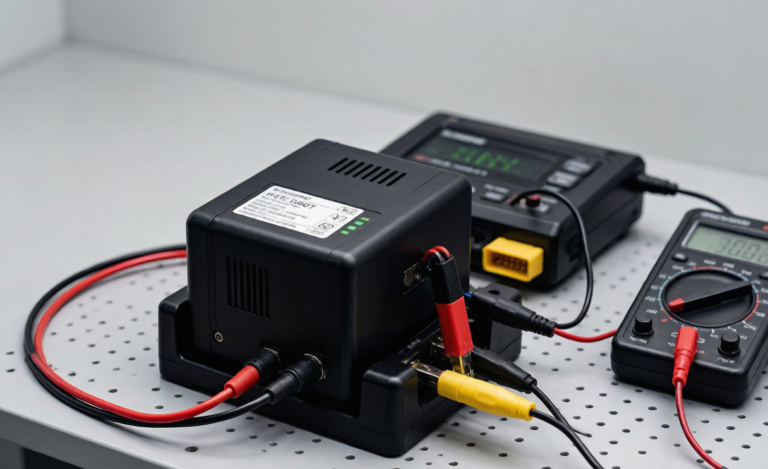
Our smart packs log the date they entered storage and will nudge the user (or automatically trickle to 45%) if they drift outside the window. For “dumb” LiPo packs, a good balance charger with a storage function does the job in under ten minutes per battery.
Temperature and Humidity: The Two Enemies
Temperature is the first enemy; humidity is the quiet second. The target envelope we use for warehouse and vehicle storage is 15–25°C (59–77°F), ideally a steady 20°C, with relative humidity kept below 65% RH.
Why humidity matters: condensation on terminals drives corrosion, and corrosion drives contact resistance, which drives heat, which drives failure. In coastal or tropical operation zones I have seen terminal greening within a single humid season. We spec nickel-plated or gold-flash contacts and recommend silica gel canisters inside sealed storage bins for any site above 70% ambient RH.
- Avoid attics, car trunks in summer, and direct sun. Surface temperatures there routinely exceed 50°C.
- Avoid unheated sheds in winter if you are below freezing—charging a cold cell below 0°C causes lithium plating, a permanent capacity killer.
- Use a thermometer-hygrometer with a logged history. If you cannot measure it, you cannot manage it.
Physical Storage: Fireproof, Anti-Static, Organized
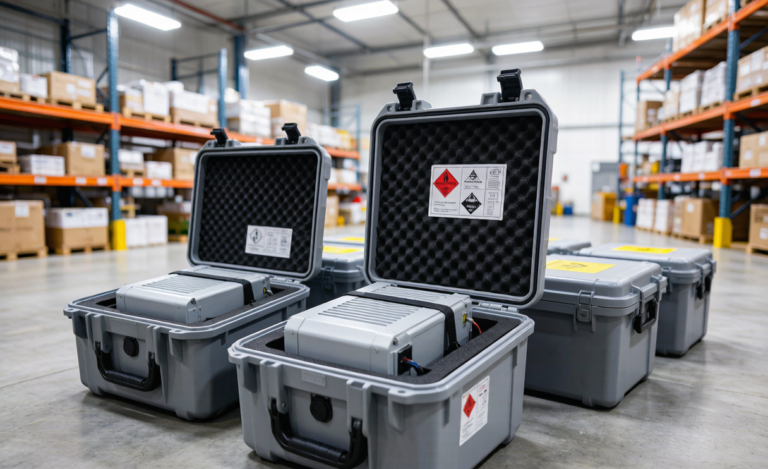
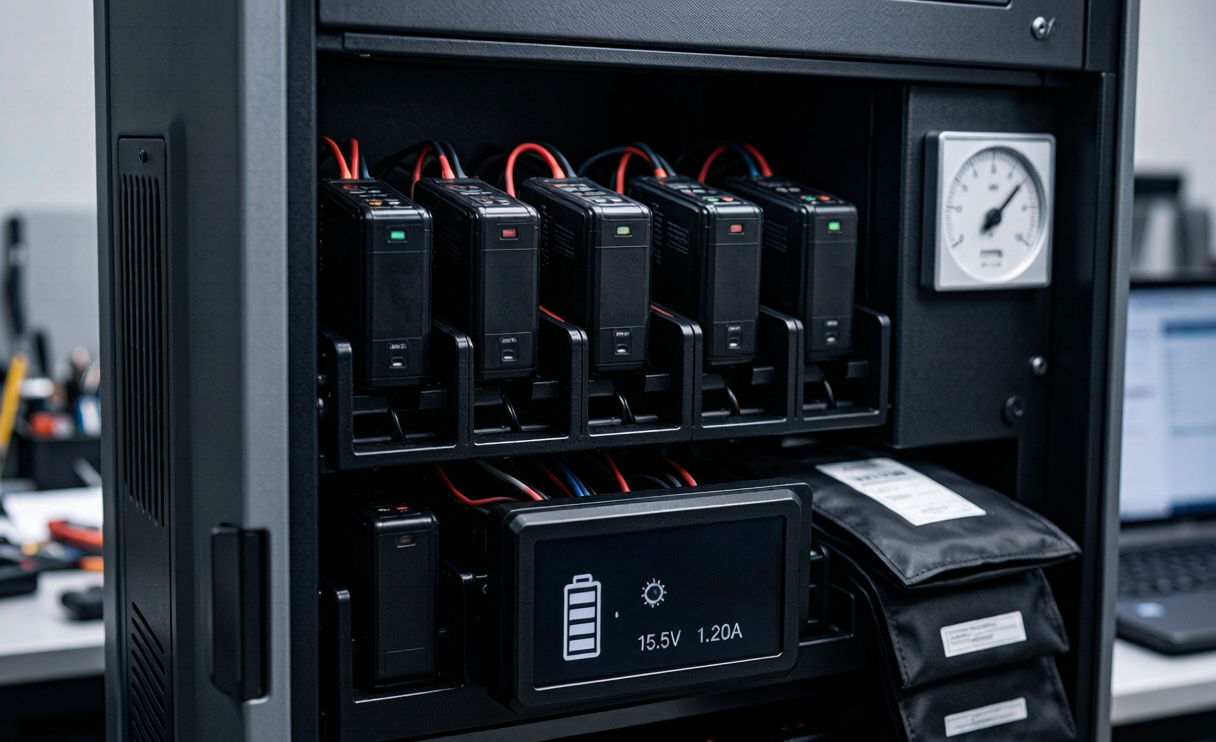
Storage is also a物理 safety problem. A damaged or over-stressed drone lithium battery can enter thermal runaway, and runaway is self-sustaining—it does not need outside oxygen. That is why our storage cabinets are metal, lip-sealed, and lined with fireproof bags, never stacked loose in a cardboard box.
- Fireproof LiPo bags or metal cabinets: one barrier between a fault and your building. We use cabinets rated to contain a single-cell event.
- Anti-static racks: ESD-safe shelving prevents stray discharge through the balance lead. We have seen a static zap cook a BMS protection IC.
- Organized and labeled: every pack gets a label with purchase date, cycle count, and last storage charge. If you cannot tell your freshest pack from your most abused one, your rotation discipline does not exist.
- Terminal protection: cover exposed XT60/EC5 connectors with caps or electrical tape. A dropped metal tool across terminals is an instant short.
A Long-Term Care Routine You Can Actually Keep
Care is a schedule, not a feeling. For fleets in seasonal storage (agriculture, surveying off-season), here is the routine we hand to clients:
- Monthly: visually inspect every pack for swelling, punctures, or terminal corrosion. Check storage voltage; top up or bleed down to the 40–50% window if it drifted.
- Quarterly: do a capacity check on a representative sample (every 5th pack). If capacity has fallen below 80% of rated, flag for retirement. Run a full charge-discharge cycle on packs that will stay in storage another season to “exercise” the cells.
- Before re-activation: charge to mission level only after a capacity verification. Never assume a stored pack is flight-ready.
Self-discharge on a healthy Li-ion cell is about 1–3% per month at room temperature, so a 45% pack will still be in the safe window months later. But aged or slightly damaged cells self-discharge far faster—which is exactly why the monthly check exists.
Shipping and Handling Stored Batteries: UN38.3, IATA, and FAA/EASA
If your stored packs ever move—between sites, to a client, or by air—the rules change from “good practice” to “regulation.” Every lithium cell we ship complies with UN38.3 testing (altitude simulation, thermal, vibration, shock, external short, impact, overcharge, and forced discharge). That certification is what makes the battery legal to transport at all.
For air travel under IATA Dangerous Goods Rules and the guidance from the FAA and EASA:
- Spare (uninstalled) batteries travel in carry-on luggage only, never checked baggage.
- Pack at 30% or less state of charge for air transport of large quantities—lower than the storage window, because regulators prioritize fire risk over calendar aging during transit.
- Consumer-sized packs up to 100 Wh need no airline approval (typically 2–4 cells). Packs from 101–160 Wh require airline approval and are limited to two per passenger. Above 160 Wh, cargo-only rules apply.
- Terminals must be protected against short circuit, and packs should be in inner packaging that prevents movement.
Compliance with IEC 62133 (the international safety standard for portable sealed secondary cells) is the baseline we design to; it is what auditors and corporate buyers ask for on the spec sheet. If a vendor cannot show IEC 62133 and UN38.3 paperwork, walk away.
When to Retire a Stored Battery
Storage cannot reverse chemistry. Retire a pack—recycle it through a proper lithium battery channel—when any of these are true:
- Visible swelling or a “puffy” feel. Stop using it immediately; swelling means gas generation inside the cell.
- Capacity below 80% of rated on two consecutive checks.
- Any puncture, crush, or heat exposure event, even if it still “works.”
- Internal resistance has climbed more than ~30% above its new-pack baseline.
A retired drone lithium battery is not garbage you toss in the bin—it is a fire and environmental hazard. We run a take-back program and ship end-of-life packs to certified recyclers. Treat retirement as the final step of care, not an afterthought.
Conclusion
Long-term care of a drone battery is mostly boring discipline: the right charge, the right temperature, the right container, and a calendar you actually follow. The packs that outlast their warranty are almost never the most expensive ones—they are the ones stored by someone who respected the chemistry. If your operation spans seasons or multiple sites, talk to us about a custom battery solution with storage-mode firmware and fleet logging; the automation pays for itself in packs that do not quietly die on the shelf.
Frequently Asked Questions
What is the best state of charge to store a drone lithium battery long term?
The safest long-term window is 30%–60% state of charge, with 40%–50% being our standard recommendation. This minimizes calendar aging and avoids the deep-discharge risk you get below 30%. Never store a pack at 100% between flights.
Can I store drone batteries in a normal garage or shed?
Only if the temperature stays in the 15–25°C range and humidity stays below 65% RH year-round. Most garages and sheds fail that test in summer and winter, so we recommend a climate-stable indoor cabinet with fireproof LiPo bags and a logged thermometer-hygrometer.
How often should I check stored drone batteries?
Inspect visually every month and verify the storage charge sits in the 40%–50% window. Run a capacity check on a sample every quarter, and do a full verification before putting any pack back into flight service after long storage.
Is it safe to store drone batteries fully charged for a few days?
A few days at 100% is acceptable and normal between missions. The problem is weeks or months. Calendar aging and swelling risk climb sharply with both time-at-high-charge and temperature, so drop to storage charge as soon as you know a pack will sit.
Do stored drone batteries need to comply with shipping regulations if I mail them?
Yes. Any transport of lithium batteries must meet UN38.3, IATA DGR, and FAA/EASA rules: carry-on only, terminals protected, and for air transport pack at 30% or less state of charge, with Wh limits (100 Wh no approval, 101–160 Wh with airline approval). Keep the UN38.3 and IEC 62133 documentation on hand.