Drone Battery Testing for Racing Drones: A Field Engineer’s
Over the past decade at Horizon Power, where I serve as a Senior lithium battery Engineer, I have qualified hundreds of high-discharge packs for FPV racing drones. The demands placed on a racing drone battery are brutal and unforgiving: a 6S pack can be pulled from a resting 22.2 V to a sagging 16 V in under two seconds during a full-throttle punch-out, and the cells must survive that abuse for an entire race day. Drone battery testing for racing drones is not a box-ticking exercise—it is the difference between a podium finish and a mid-air voltage collapse. In this article I will walk you through the exact electrical, thermal, and regulatory tests we run before any pack earns a place in a competitive airframe.
Why Racing Drones Demand a Different Testing Mindset
Most consumer lithium batteries are validated for energy density and calendar life. A racing drone lithium battery is validated for power delivery under extreme and repeated stress. Where a home energy pack might see a 1C discharge once per day, a racing pack sees 80–150C bursts dozens of times per flight. That shift in duty cycle changes every test threshold we apply.
When I receive a new cell chemistry from our lab, the first question is never “how many watt-hours?” It is “what is the DC internal resistance at 50% state of charge, and how stable is it across temperature?” For a 1300–1800 mAh 4S or 6S pack, we expect total pack internal resistance below 20 mΩ and per-cell resistance below 5 mΩ when new. Anything higher and the voltage sag alone will cost a pilot the throttle authority they need on a gate-splitting turn.
The Core Electrical Tests Every Drone Battery Must Pass
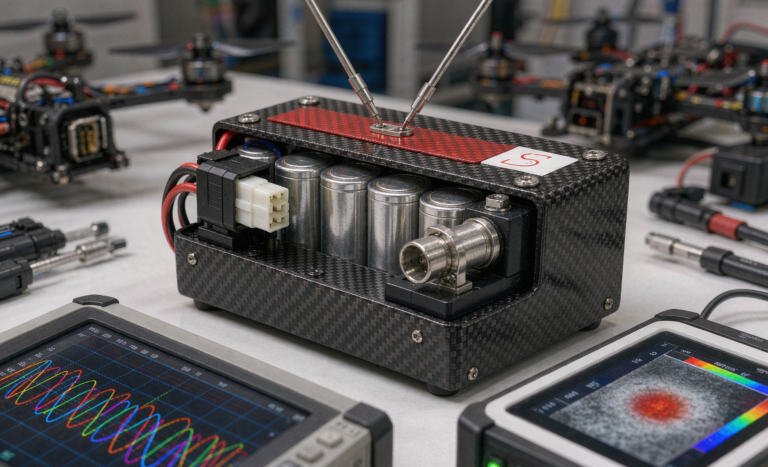
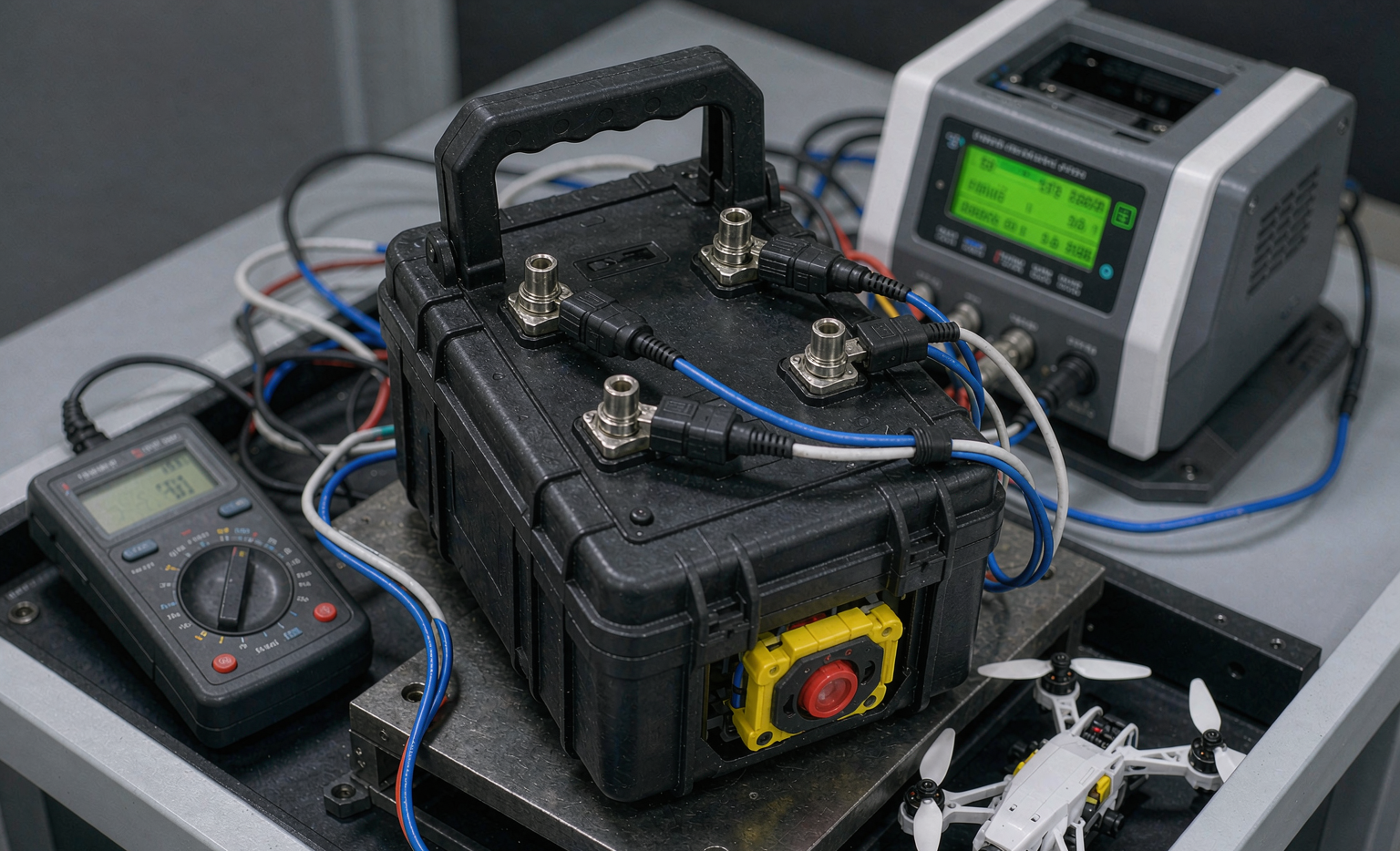
Our electrical qualification runs on a programmable charge–discharge cycler with 1 mV / 1 mA resolution. The baseline suite for any racing drone battery includes:
- Capacity verification at 1C between 4.20 V and 3.00 V per cell, repeated three times to confirm the rated mAh is real and not a marketing figure.
- Internal resistance mapping using a 1 kHz AC impedance sweep plus a DC pulse method, logged at 0%, 25%, 50%, 75%, and 100% state of charge.
- Peak C-rate discharge at the pack’s rated burst (typically 100–150C) for 5–10 seconds, measuring terminal voltage sag and pack temperature rise.
- Voltage sag profiling across a simulated race throttle curve, so we can predict sag at the exact moment a pilot demands full power.
- Cycle life to 80% capacity, which for racing packs usually lands between 200 and 350 cycles depending on how aggressively the pilot flies.
I treat the AC impedance sweep as the single most predictive test. A cell that climbs from 3 mΩ to 6 mΩ after only 50 cycles is telling you its electrodes are degrading—long before capacity loss becomes visible on the race clock.
Thermal and Mechanical Stress Validation
Racing happens outdoors, in heat, in cold, and occasionally after a hard landing. We therefore validate thermal behavior across the full operating window. Charge is restricted to 0–45 °C and discharge to −20–60 °C, but we actively test at the edges: a pack that performs beautifully at 25 °C but sags 30% at 5 °C is a liability for a morning race.
Mechanically, every drone battery we ship is drop-tested from 1.5 m onto concrete, vibration-tested on a shaker table across 5–500 Hz, and crush-checked against the IEC 62133 nail and crush scenarios. A swelling pack after a crash is not just a performance problem—it is a safety event. We also log surface temperature during sustained 100C bursts; if any cell exceeds 70 °C we reject the batch.
Regulatory Compliance: UN38.3, IEC 62133, and Air Transport
No racing pack leaves our facility without passing the full UN38.3 transportation test series—T.1 altitude simulation, T.2 thermal test, T.3 vibration, T.4 shock, T.5 external short circuit, T.6 impact, T.7 overcharge, and T.8 forced discharge. These are the same tests that govern whether a battery can legally move by air or road, and they are non-negotiable for any serious drone battery manufacturer.
On top of transport safety, IEC 62133 governs the cell-level safety construction, and we keep full test dossiers for customer audits. For pilots flying internationally, the air-travel rules matter: under FAA and EASA guidance, spare lithium batteries must travel in carry-on baggage, and packs must stay below the 100 Wh threshold for undeclared carriage. A typical 6S 1500 mAh racing pack sits around 33 Wh, so most racers are fine—but a custom 8S build can cross the line, and we always flag that to the customer.
Building a Custom Test Plan with a Drone Battery Manufacturer
Off-the-shelf packs are a starting point, not a destination. When a team comes to us for a custom drone battery, the first meeting is about the throttle profile, not the sticker specs. We log a representative flight on the customer’s airframe, extract the real discharge curve, and then design the test plan around it.
A custom drone battery built for a 120C burst racer is validated differently from one built for a freestyle pilot who prioritizes cycle life over raw punch. We set bespoke pass/fail limits, document them in a shared qualification report, and re-run the suite after any cell-supplier change. This traceability is what separates a true drone battery manufacturer from a reseller: every pack can be traced back to the exact test lot that qualified it.
Field Data: What 1,000 Charge Cycles Taught Us
Across a longitudinal study of more than 1,000 charge cycles on our racing line, three patterns emerged that no bench spec sheet revealed. First, packs stored at 3.80 V per cell between race days retained 12% more capacity at 200 cycles than packs stored fully charged. Second, pilots who warmed packs to 20 °C before a flight saw measurably lower sag than those who flew cold. Third, internal-resistance growth—not capacity loss—was the earliest and most reliable predictor of a pack about to fail on the line.
That last finding reshaped our entire outgoing inspection. Today every drone lithium battery we ship is IR-graded, and any unit whose resistance has drifted more than 15% from its lot median is diverted to R&D rather than sale. It is a small cost that has eliminated the single most common race-day failure we used to see returned.
FAQ
How many cycles should a racing drone battery last?
For a pack flown hard at 80–150C bursts, expect 200–350 full cycles to 80% remaining capacity. Pilots who manage storage voltage and avoid deep discharge can push toward the upper end, while aggressive racers will see the lower end. Track internal resistance, not just cycle count.
What C-rating do I really need for FPV racing?
Most competitive 4S/6S FPV racers run packs rated 100–150C burst. The continuous C-rating matters less than the burst rating and the real-world voltage sag at that burst. A honest 120C pack with low internal resistance will outperform a inflated 150C pack with high resistance every time.
Can I ship racing drone batteries by air?
Yes, but with rules. Spare lithium batteries must be in carry-on baggage under FAA and EASA guidance, terminals protected, and packs below 100 Wh for undeclared transport. A standard 6S 1300–1800 mAh racing pack is typically 28–35 Wh, so it qualifies, but always confirm the watt-hour rating printed on the label.
How do I spot a failing pack before a race?
Measure DC internal resistance and compare it to the pack’s new baseline. A 15% or greater increase, visible cell swelling, or a pack that sags below 3.3 V per cell under a familiar throttle input are all red flags. When in doubt, bench-test capacity at 1C before trusting it on the start line.