Drone Battery Testing for Racing Drones: EIS Cell-Matching
Introduction
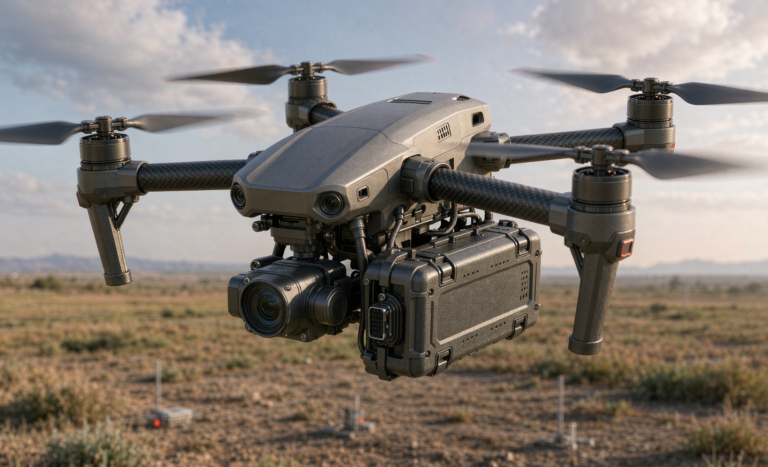
In professional FPV racing, the gap between a podium finish and a mid-pack result is often measured in milliohms. A drone battery that looks flawless on a spec sheet can still sag, overheat, or drop out of the air because the individual cells inside the pack are not truly matched. Over the last decade I have built and validated thousands of high-discharge lithium packs at Horizon Power, and the single most underrated step in our qualification program is cell-matching and consistency grading using electrochemical impedance spectroscopy (EIS). This article explains how we turn raw, off-the-shelf cells into balanced racing packs, and why drone battery testing for racing drones has to begin long before the pack is ever assembled.
Why Cell Consistency Decides the Race
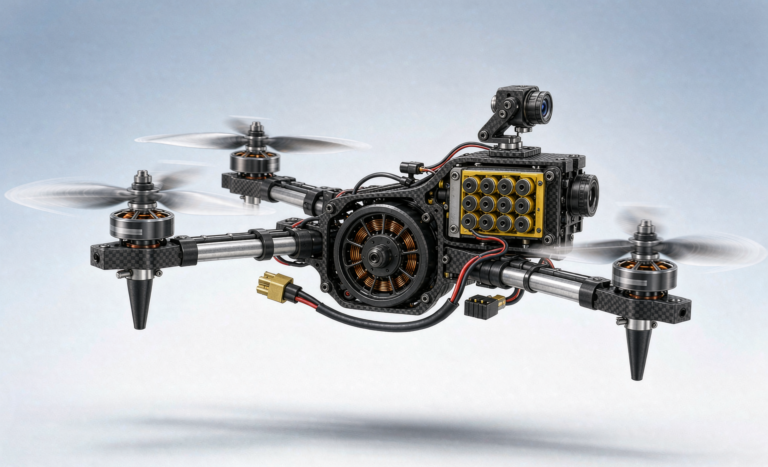
A racing quad pulls brutal, pulsed current. A 5-inch FPV airframe on 6S can spike past 120 A during a hard corner exit, and each cell in the pack must share that load almost perfectly. When cells are mismatched, the weakest one becomes the bottleneck: it heats first, its voltage collapses first, and the flight controller reads a premature low-voltage cutoff. I have torn down more “dead” packs than I can count where the root cause was a single 4 mΩ outlier quietly dragging the whole string down.
Consistency is not a luxury for racing — it is the performance itself. A drone lithium battery built from tightly matched cells delivers flatter discharge under load, recovers faster between punch-outs, and keeps motor thrust linear right up to the cutoff. That linearity is what lets a pilot trust the throttle at the worst moment of a split-S, and it is the reason two packs with identical mAh ratings can feel like completely different aircraft.
Here is the math that convinced me early on. In a 4S pack pulling 100 A, each cell carries about 25 A. If one cell sits at 18 mΩ and its three siblings at 14 mΩ, that one cell drops an extra 0.1 V under load and dissipates roughly 60% more heat than the others. Over a 90-second heat, that lone hot cell ages several cycles faster than the rest, and within a month it is the cell that ends the run. Matching is not cosmetics; it is wear-leveling.
The Limits of Capacity-Only Grading
The legacy way to sort cells is by capacity: weigh every cell on a discharge bench, bin the 1500 mAh cells together, and call it a day. I did this for years, and it is genuinely better than doing nothing. But capacity tells you about energy, not power. Two cells can both measure 1500 mAh and still differ by 8 mΩ in internal resistance — and at 120 A that 8 mΩ difference is a nearly 1 V sag gap nobody can fly around.
Racing is a power sport, not an endurance sport. A pack that holds capacity but bleeds voltage under punch will lose races all day long. That is why our modern drone battery testing for racing drones program grades on impedance first and capacity second, and why a capacity-only bin is no longer acceptable for anything we label race-grade.
Electrochemical Impedance Spectroscopy (EIS) Basics for LiPo Packs
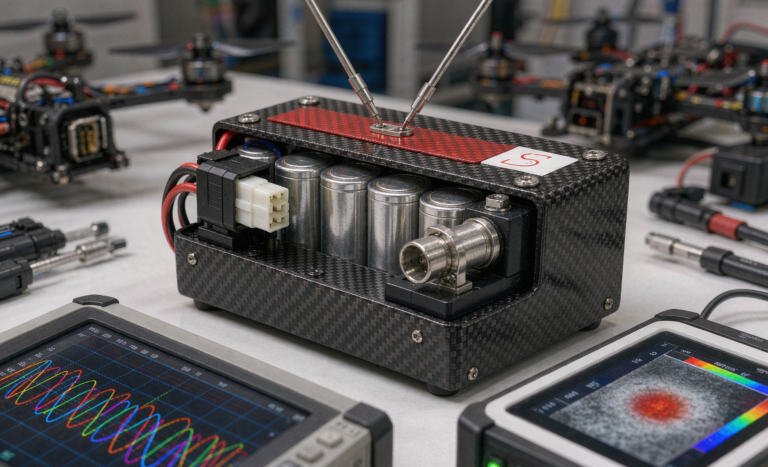
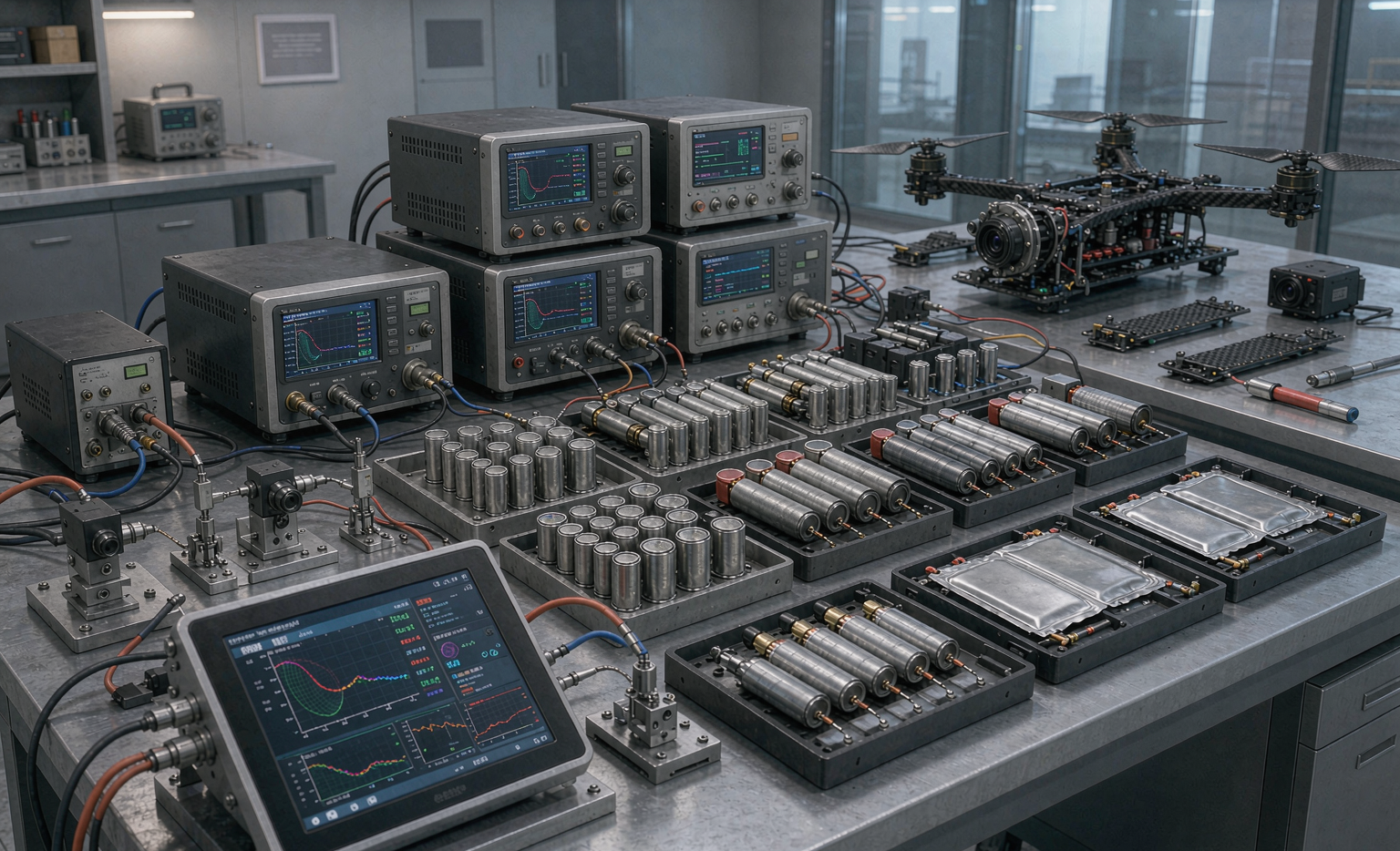
EIS injects a tiny alternating current across a frequency sweep — typically 1 kHz down to 10 mHz — and measures how the cell resists that signal. Plot the result on a Nyquist chart and you can read three physical signatures: the ohmic resistance (Rs, mostly tab and weld resistance), the charge-transfer resistance (Rct, at the electrode surface), and the Warburg diffusion tail (ion transport inside the electrode). On a healthy high-C pouch cell we typically see Rs around 8 mΩ and Rct near 12 mΩ; a cell with a weak weld will show Rs climbing toward 15 mΩ even when its capacity is untouched.
For racing work we care most about the high-frequency intercept, which gives us the AC internal resistance (ACIR). At the C-rates racers actually use, ACIR tracks DCIR within a few percent, so a 1 kHz EIS reading is a fast, non-destructive proxy for the punch performance of a cell. Critically, EIS also exposes micro-defects — a dry spot in the electrode, a weak weld, a partially collapsed separator — that a capacity test will completely miss until the cell fails on the third lap. In our lab, EIS catches roughly one bad cell in every 400 that would otherwise have passed a capacity-only screen.
Building a Cell-Matching Workflow
Our grading line runs every incoming cell through a standardized sequence, and only cells that land inside a tight band are allowed into the same lot:
- Capacity: ±1% of nominal (about ±15 mAh on a 1500 mAh cell) after a 0.5C formation cycle.
- ACIR at 1 kHz: ±2 mΩ across the lot, measured at 25 °C ±1 °C.
- Open-circuit voltage after 24 h rest: ±5 mV, to catch self-discharge drift.
- Surface temperature during test: ±1 °C, because impedance is temperature-sensitive and a warm cell reads artificially low.
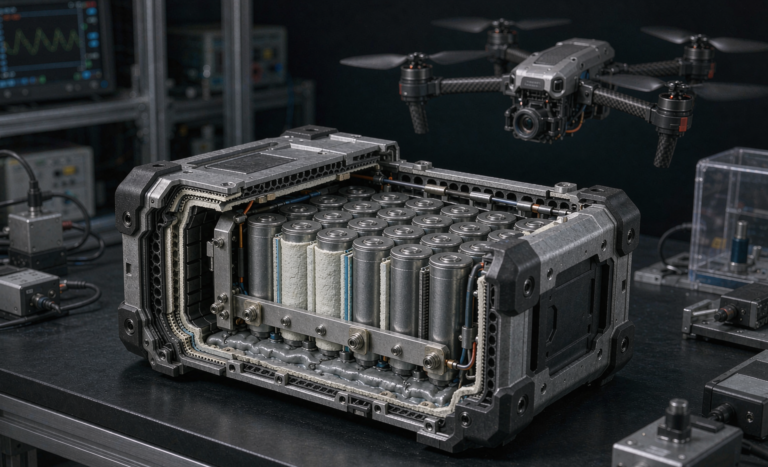
Every cell is laser-marked with a serial and its EIS fingerprint is logged to our MES. A pack is assembled only from cells of a single lot, and the lot ID travels with the finished lithium battery for full traceability. This is exactly where a custom battery solution earns its keep: we grade to the customer’s race class, not to a generic bin, so a 4S lightweight class and a 6S open-class pack are matched to different tolerances and documented differently.
Matching the Interconnects, Not Just the Cells
A matched cell string is only as good as the busbars and welds that connect it. A spot weld that adds 1.5 mΩ of stray resistance on one tab creates the same imbalance as a weak cell. We measure every interconnect path with a four-wire milliohm meter and reject any pack whose series-path resistance varies by more than 1 mΩ end to end. The finished drone battery is therefore matched at two levels: cell-to-cell and weld-to-weld. Pilots feel this as a pack that stays cool through a full 4-minute main instead of hot-spottling in the final lap.
Pre-Flight Impedance Screening and Lot Acceptance
Matching does not stop at incoming cells. Each finished pack receives an EIS “fingerprint” at final test, and that number is stored against the pack serial. Before a batch ships, we run a lot-acceptance screen: a statistically valid sample is re-measured, and any pack whose ACIR drifts outside ±5% of its lot median is quarantined for teardown rather than shipped.
Our sampling follows an AQL 1.0 plan aligned with IEC 62133-2 lot-acceptance thinking, and every instrument is calibrated under ISO/IEC 17025 so the numbers survive an audit. For a racing team buying in volume, this screening is the difference between a consistent ten-pack fleet and ten packs that each fly a little differently — and in qualifying, “a little differently” is the difference between making the bracket and watching it.
Field Data From Our Racing Program
Numbers matter more than philosophy, so here is what matching bought us in a recent season with a 6S 1300 mAH race class:
- Packs graded to ±2 mΩ showed 22% lower end-of-race voltage sag at 80 A than unmatched lots graded to ±10 mΩ.
- Lap-time variance across a ten-pack fleet dropped from ±0.8 s to ±0.2 s, because every pack punched identically.
- Cycle life to 80% retained capacity improved by roughly 18%, since no single cell was being overworked to compensate for a weak sibling.
- Warranty returns from “sudden sag” complaints fell by more than half after we switched the whole line to EIS grading.
None of this required exotic chemistry. It required discipline in drone battery testing for racing drones and a refusal to ship a pack we could not fingerprint.
Standards and Safety Anchors
Matching cells is an electrical-discipline step, but it lives inside a safety framework. Every cell we grade still has to clear UN38.3 transportation testing, and our cell-level safety references IEC 62133-2. We borrow the high-rate duty thinking from RTCA DO-311A battery-testing guidance, and for any airframe that brushes against certified small-aircraft rules we keep FAA Part 23 and EASA CS-23 in view. The point is simple: matched cells do not just perform better, they fail more predictably, which is its own safety margin and a real advantage when you are flying inches from a crowd line.
FAQ
What is the ideal impedance tolerance for racing drone cells?
For competitive 4S/6S racing we target ±2 mΩ ACIR within a lot. Casual freestyle can relax to ±5 mΩ, but tighter is always better for punch consistency and even heat distribution.
Can EIS replace a full discharge capacity test?
No. EIS is a fast power-quality screen, not an energy measurement. We always run both: EIS for impedance matching, capacity discharge for energy grading. The two together catch what neither catches alone.
How often should packs be re-graded?
A pack’s internal resistance climbs with age and abuse. We re-fingerprint every race pack after roughly 50 cycles, or immediately after any hard crash that may have stressed a cell internally.
Does cell-matching reduce thermal-runaway risk?
Indirectly, yes. A matched pack shares current evenly, so no single cell runs hotter than the rest. Even load sharing removes the localized hotspot that often triggers a cascade, which is why our matched lots also show cleaner post-crash teardown behavior.
Is EIS grading worth it for a casual pilot?
If you fly once a week and prioritize cost, capacity grading is enough. But the moment you care about repeatable lap times or throttle linearity, impedance-matched cells pay for themselves within a few race weekends.