Home Energy Storage Inverter Sizing and Selection: How to Match Power Electronics to Your Battery
When a homeowner asks me to specify a home energy storage system, the battery usually gets all the attention. Capacity in kilowatt-hours, chemistry, warranty, cycle life – those are the numbers people compare side by side. But in my fifteen years as a lithium battery engineer, I have seen far more residential systems underperform because of a poorly matched inverter than because of the cells themselves. The inverter is the brain and the muscles of the whole setup: it converts the DC energy stored in your battery into the AC power your home actually uses, and it has to do that without tripping, overheating, or quietly clipping your peak loads. Getting home energy storage inverter sizing selection right is the difference between a system that simply works and one that leaves you in the dark during the exact outage you bought it for.
What a Home Energy Storage Inverter Actually Does
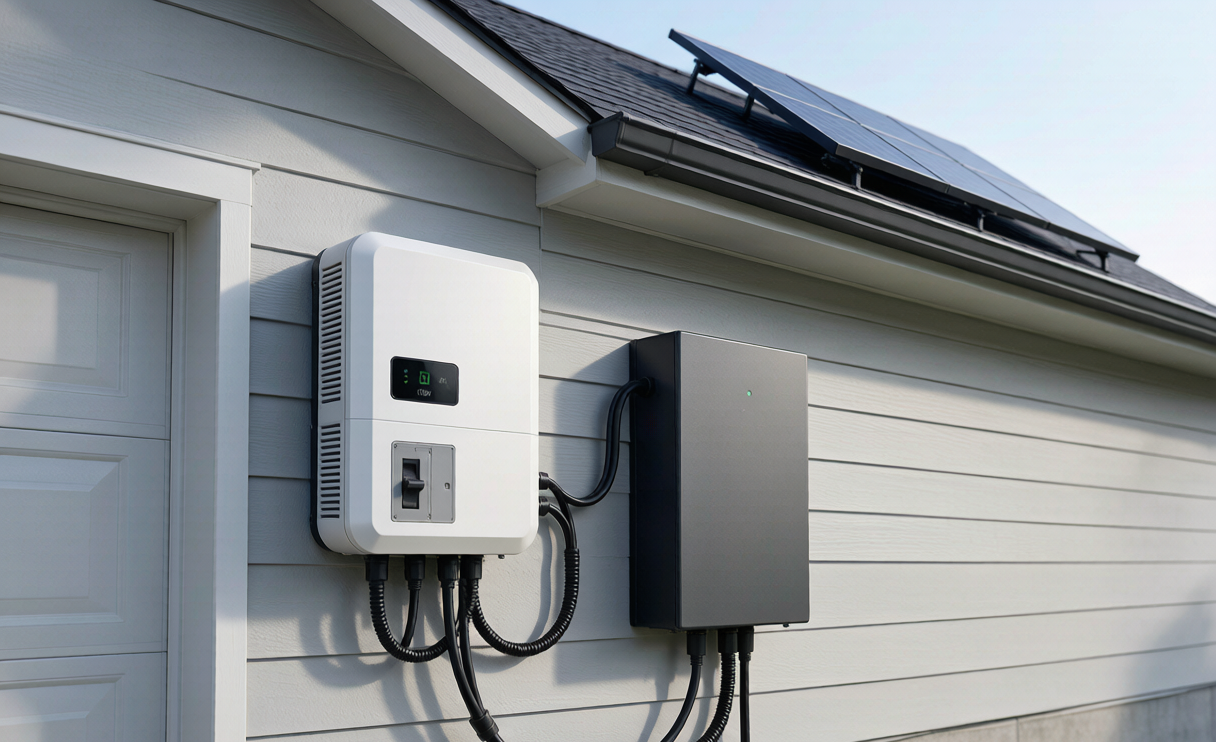
Let’s strip away the marketing. A home energy storage inverter performs three jobs at once. First, it is a battery inverter: it takes the nominal 48V or 51.2V DC bus from a lithium battery pack and converts it to clean 120/240V AC at 50 or 60 Hz for your loads. Second, in a hybrid unit, it is a solar charge controller that manages DC from the PV array and decides whether that energy charges the battery, powers the house, or exports to the grid. Third, and most importantly for reliability, it is a system controller that sequences transfer between grid, battery, and loads in under 20 milliseconds when the utility drops.
I explain it to clients this way: the battery is the fuel tank, but the inverter is the engine, the transmission, and the driver. If you undersize any of those, the car does not move, no matter how full the tank is. A well-specified home energy storage deployment treats the inverter as a first-class engineering decision, not an afterthought bolted to the battery datasheet.
Continuous vs Surge Power: Sizing for Real Loads
The single most common mistake I see is sizing the inverter to the battery’s energy (kWh) instead of the home’s power demand (kW). These are different units and different problems. Energy is how long you can run; power is how much you can run at once.
Two numbers matter on every inverter nameplate:
- Continuous rated power – the load it can carry indefinitely, typically 30 minutes to continuous, without exceeding safe temperature rise.
- Surge (peak) power – the short burst (usually 3-10 seconds, sometimes 30 seconds for motor loads) it can deliver to start compressors, pumps, and power tools.
In North America, inverters intended for grid interactive use must comply with UL 1741 and IEEE 1547-2018, while the balance of the installation falls under NEC Articles 706 and 710. I always tell buyers to add up the running watts of everything they expect to run simultaneously, then add a 25% derate for inverter losses and future load growth. If your real-time load is 4.5 kW, do not buy a 5 kW inverter – specify 6 kW continuous and verify the surge rating covers your largest motor start, which can be 3 to 7 times running power for a few seconds.
Matching Inverter Capacity to Your Battery Bank
Once you know your load profile, the next check is whether the battery can actually feed the inverter. A home energy storage system built on a 51.2V 100Ah LFP pack delivers roughly 5.1 kWh and a maximum continuous discharge around 100A, or about 5.1 kW before the BMS current limit kicks in. If you pair that pack with an 8 kW inverter, you will never reach 8 kW because the battery’s BMS will clamp the current first. The result is a frustrated client and a tripped breaker.
As an engineer I match the inverter continuous rating to roughly 1.0x to 1.5x the pack’s sustained discharge capability, never more. For stationary residential battery storage, the relevant cell and pack safety standards are IEC 62619 for industrial cells and IEC 62133-2 for the smaller modules; the pack BMS must publish a clear continuous and peak discharge current, and that number – not the inverter’s marketing number – is your true ceiling. UN38.3 transport testing (T.1-T.8) is the baseline every reputable pack clears before it ships.
Efficiency Ratings and Why They Matter
Inverter efficiency is not a vanity spec. Every point of loss is energy you paid for and then threw away as heat. Look for the CEC (California Energy Commission) weighted efficiency, which better reflects real partial-load operation than the peak number on the front of the box. A good hybrid inverter runs 96-98% CEC efficiency. Drop to 92% and on a 10 kWh daily throughput you lose roughly 0.8 kWh every single day – over a year that is nearly 300 kWh, real money on a home battery backup system that was supposed to save you money.
Round-trip efficiency is the full chain: DC battery to AC out and back to DC when charging. I budget 88-92% round-trip for a clean LFP plus quality inverter pairing. If a vendor cannot tell you their round-trip number, that is a red flag. Efficiency also has a thermal side: wasted energy becomes heat inside the enclosure, so a cooler-running, higher-efficiency unit lasts longer and needs less ventilation.
Grid-Forming vs Grid-Tied: The 2026 Choice
The industry shifted hard toward grid-forming inverters in 2025 and 2026. A traditional grid-tied inverter waits for the utility sine wave and synchronizes to it; the moment the grid fails, it shuts down for safety. A grid-forming inverter can synthesize its own stable voltage and frequency, so it keeps your home energy storage running as a microgrid the instant the grid drops, then seamlessly re-synchronizes when power returns.
For any homeowner who wants backup during outages, grid-forming is now the default I recommend. It is also what utilities increasingly require for interconnection, because thousands of grid-forming inverters can collectively support grid stability during disturbances. Verify the unit is listed to UL 1741 SB (the supplement that covers grid-support functions) and that its settings match your local IEEE 1547-2018 ride-through requirements.
Protection, Grounding, and the Codes That Keep You Safe
Sizing is only half the job; the other half is not burning the house down. A battery inverter installation must satisfy UL 9540 (energy storage system safety) and UL 9540A (fire propagation testing) at the system level, plus UL 1741 at the inverter level. The enclosure, bonding, and overcurrent protection follow NEC Articles 706 (energy storage) and 710 (microgrid interconnect), and many jurisdictions now also reference NFPA 855 for stationary storage spacing.
In my field commissioning checklist, I verify: proper DC and AC disconnects within sight, torque on every lug (I use a calibrated torque driver, not guesswork), a bonded ground electrode system, and arc-fault and ground-fault protection on the DC side. A 51.2V battery can push hundreds of amps into a fault, and only correct fusing and a well-grounded inverter chassis keep that energy from finding a path through a person or a wall.
A Practical Sizing Worksheet
Here is the sequence I walk every client through. Start with a load list: refrigeration 0.4 kW, lighting 0.3 kW, internet and networking 0.15 kW, well pump surge 2.5 kW for 5 seconds, HVAC fan 0.75 kW, plus a margin. Running total around 1.6 kW, but the pump surge dominates the peak. I would specify a 5 kW continuous / 10 kW surge hybrid inverter on a 10 kWh LFP bank – that gives roughly six hours of critical-load runtime and absorbs the pump start without clipping.
If the goal is whole-house backup rather than critical loads, multiply accordingly and consider stacking two residential battery storage modules with a matching parallel inverter. The key is to size the inverter to the load’s real power and surge, then size the battery to the hours of autonomy you need, and only then confirm the battery’s BMS current limit supports the inverter’s continuous draw.
Frequently Asked Questions
Can I just oversize the inverter to be safe?
You can, but it costs you twice: a larger inverter is more expensive and, because inverters are least efficient at low load, a wildly oversized unit runs your small overnight loads at a worse efficiency point. I cap the inverter at about 1.5x your realistic continuous demand. Oversizing beyond that buys little reliability and quietly erodes the round-trip efficiency you paid for.
Do I need a separate inverter for home battery backup?
Not necessarily. A hybrid inverter handles solar, battery, grid, and backup loads in one box and is what I specify for most retrofits. A separate backup loads panel (often called a critical loads subpanel) lets the single inverter back up only the circuits you choose, which is usually cheaper and simpler than whole-house coverage. The decision is about which loads you must keep alive, not about buying two inverters.
How do I size for an electric vehicle charger?
A 7.2 kW or 11 kW EV charger is a massive sudden load, and adding it to your backup set can double the inverter requirement. In practice most homeowners do not need to charge the car during an outage; I either exclude the EV from the backed-up loads or specify a managed charger that the inverter can throttle. If true whole-home including EV is the requirement, budget a 12 kW-plus inverter and a proportionally larger battery bank.
What certifications should I verify before buying?
At minimum: UL 1741 (and UL 1741 SB for grid-forming) for the inverter, UL 9540 / UL 9540A for the system, IEC 62619 and IEC 62133-2 for the battery cells and modules, and UN38.3 transport clearance on the pack. Pair those with local NEC 706/710 compliance and an IEEE 1547-2018 conformance letter, and you have a system an inspector and an insurer will both accept.
Does temperature affect inverter sizing?
Indirectly, yes. Inverters derate in high ambient heat – a unit rated 6 kW at 25C may deliver only 5 kW at 45C. If you install in a hot garage or an unventilated enclosure, I add a thermal derate margin of 10-15% to the size. The battery itself also loses power capability in cold, so a home energy storage site in a cold climate needs both the inverter and the pack evaluated at the real minimum operating temperature, not the lab default.