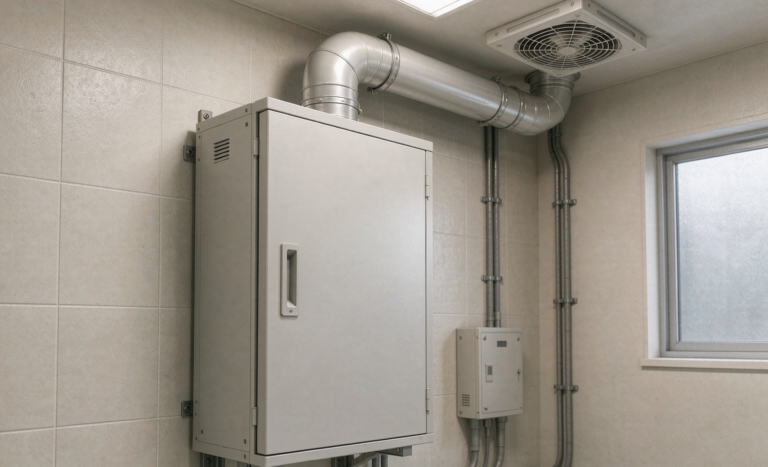
Home Energy Storage Sizing for Whole Home Backup
I have lost count of how many times a homeowner has called me after buying a home energy storage
system that turned out to be the wrong size. The pattern is almost always the same: someone looked at a
brochure, picked the biggest round number that fit the budget, and discovered during the first real outage that
the battery either ran out at 2 a.m. or tripped the moment the well pump kicked on. My name is Karl Huang and
I have spent more than a decade as a senior lithium battery engineer specifying packs for everything from
drone lithium battery-class UAV modules to 100 kWh residential walls. Sizing a
whole home backup system is not a guessing game — it is arithmetic applied to a load audit,
and it takes about an afternoon to do properly.
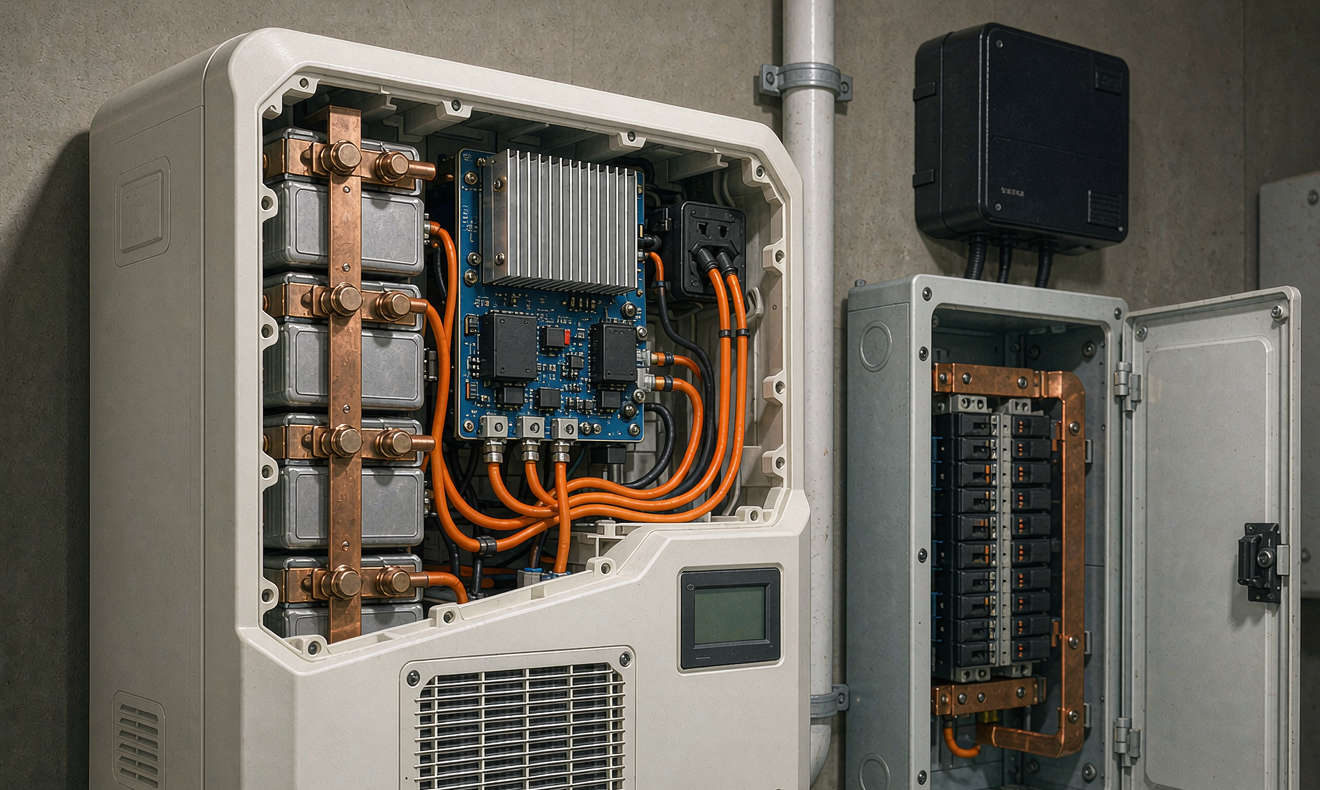
This guide walks through the method I use with installers: how to audit loads, how to convert kilowatt-hours
into real hours of runtime, how to size the inverter for motor starting surge rather than nameplate watts, how
chemistry choice changes the answer, and which codes will decide where the equipment is allowed to live. I will
finish with a worked example and the commissioning checklist I sign off on before a system goes live.
Start With a Load Audit, Not a Battery Catalog
Every correct battery sizing exercise starts with a load list. Energy (kWh) tells you how
long you can run; power (kW) tells you what you can run at all. Confusing the two is the single most common
error in residential storage design.
There are three ways to build the list, in ascending order of accuracy:
- Nameplate survey. Walk the house and record the rating plate on every motor and heating
element. Appliance nameplates are worst-case numbers, so this method systematically oversizes by 30–60%. - Clamp-meter measurement. Measure actual current at the panel on each branch circuit with
the loads running. A 15 A breaker feeding LED lighting typically draws 2–3 A, not 15 A. - Utility interval data. Most North American and EU utilities expose 15-minute or
1-hour consumption data through the customer portal. A full 12-month export shows seasonal peaks, base load and
the difference between a weekday and a Sunday. This is the gold standard, and it is free.
From that data I extract three numbers: average continuous load (kW), peak 15-minute demand (kW), and daily
energy (kWh). For reference, the average US household consumes roughly 10,500 kWh per year, about 29 kWh/day
— but the average is nearly useless for backup design, because the distribution is extremely peaky.
A 3-ton central air conditioner alone can account for 30–50% of summer consumption.
Typical Critical-Load Figures I Work From
When I cannot get interval data, these measured ranges are a reasonable starting point for a North American
suburban home. Average running watts, with starting surge in parentheses:
- Refrigerator / freezer: 150–250 W average, 800–1,200 W during defrost or compressor start
- Well pump, 1/2 to 1 hp: 750–1,500 W running, 3,000–5,000 W locked-rotor surge for 1–3 seconds
- Sump pump, 1/3 hp: 500–800 W running, 1,800–2,400 W surge
- Gas furnace fan / air handler: 400–800 W running, 1,200–1,800 W surge
- LED lighting, whole house: 300–600 W
- Internet modem, router, Wi-Fi: 30–60 W continuous
- Microwave: 1,000–1,500 W while heating
- Central AC, 3 ton: 3,000–4,500 W running, 12,000–18,000 W surge (LRA 60–90 A at 240 V)
- Electric water heater: 4,500 W resistive, no surge
- Electric range / oven: 3,000–8,000 W depending on elements
- Clothes dryer (electric): 3,000–5,000 W
- Level 2 EV charger: 6,600–11,500 W continuous for hours — usually excluded from backup entirely
Note the asymmetry. A refrigerator is a trivial energy load (about 1.5 kWh/day) but its
compressor start is a meaningful power event. A resistive water heater is the opposite: enormous
energy, zero surge.
Decide the Scope: Critical Loads Panel or True Whole Home
Before any math, decide what “backup” means for this household. In my experience only about one client in
five genuinely needs true whole home backup, and the cost delta is usually 2.5–4×.
Critical Loads Sub-Panel
A separate 60–100 A sub-panel feeds 6–12 selected circuits: refrigeration, well pump, some lighting,
internet, a couple of convenience receptacles, and possibly the furnace. Typical average draw is
0.8–1.5 kW. A 10–20 kWh home battery backup with a 5–7 kW inverter covers 8–16 hours, which
covers the overwhelming majority of grid outages. This is the configuration I recommend most often.
Whole Home Backup
Everything stays live, including the range, dryer and central AC. You are now designing for a 2–3 kW
average summer load with 7–12 kW peaks and 15–20 kW motor-starting transients. That pushes you to a
10–15 kW continuous inverter and 40–80 kWh of home energy storage, plus — in most
jurisdictions — a service upgrade or a mid-circuit disconnect. It is achievable, but it should be a conscious
choice, not a default.
Energy Sizing: The Runtime Equation
Here is the equation I put in every proposal, because it makes the trade-offs visible:
Usable AC energy (kWh) = Nameplate DC kWh × usable DOD × inverter efficiency × aging factor
With a modern LFP system the practical values are:
- Usable depth of discharge (DOD): 0.90–0.95. LiFePO4 tolerates 100% DOD electrically, but
most manufacturers warranty 90% usable and reserve a buffer for BMS balancing and low-temperature protection. - Inverter efficiency: 0.95–0.97 at 30–70% load, dropping to 0.90–0.93 near full load and
below 0.85 under 5% load. This is why a 15 kW inverter running a 400 W overnight load is a bad design. - Aging factor: 0.70–0.80. A pack warranted to 70% capacity at end of life delivers only
70% of its day-one capacity in year ten or fifteen. If the requirement is “10 hours of backup in year 12”,
you must size for the aged pack, not the fresh one.
Combined, a 20 kWh nameplate LFP system delivers roughly 20 × 0.92 × 0.96 × 0.75 ≈ 13.2 kWh
of guaranteed AC energy at end of warranty — about 66% of the number on the box. Any quote that quotes runtime
off nameplate capacity is selling you a number you will never see.
Worked Example
A 3,000 sq ft home in a cold climate. Critical loads sub-panel with a measured average of 1.15 kW and a
recorded 15-minute peak of 4.2 kW (well pump + refrigerator defrost + furnace fan coincident). The owner wants
10 hours of autonomy.
- Energy required (AC): 1.15 kW × 10 h = 11.5 kWh
- Add inverter loss (÷0.96): 12.0 kWh DC
- Add usable DOD (÷0.92): 13.0 kWh nameplate
- Add aging margin (÷0.75): 17.3 kWh nameplate
- Power check: 4.2 kW peak running, plus 3 kW well-pump surge for 2 s → inverter must
handle ~7 kW transient. A 7.6 kW continuous / 11.4 kW 3-second surge unit clears it with margin. - Selection: two stacked 10 kWh LFP modules (20 kWh, 51.2 V nominal, 16S, 200 Ah) give
10.4–11.5 hours of real runtime when new and about 8 hours at end of warranty. Comfortable.
Notice that step 4 alone inflated the requirement by 33%. Skipping it is the reason so many systems
underperform in year eight.
Power Sizing: Inverter kW and Motor Starting
Energy gets the headlines; power gets the callbacks. An inverter has three ratings that matter:
- Continuous: sustainable output at 40–50 °C ambient, often lower than the headline
number. A “10 kW” hybrid inverter may be rated 10 kW at 25 °C and 8 kW at 45 °C. - Surge / peak: typically 1.5–2× continuous for 3–10 seconds, sometimes 3× for 1 second.
This is what starts the well pump. - Transfer time: 10–20 ms for a modern hybrid with a mid-circuit disconnect. Anything
under 20 ms keeps IT equipment and most variable-speed motor drives alive; older automatic transfer switches
at 100–500 ms will drop a desktop PC unless it sits on a UPS.
If a single large motor dominates the surge, a soft starter is almost always cheaper than a bigger
inverter. A 1 hp submersible well pump with a locked-rotor current of 5–6× full load drops to roughly 2×
with a soft starter — a $300–500 part that can save $3,000–5,000 of inverter capacity. I have specified
soft starters on probably 200 pump circuits for exactly this reason.
DC-Coupled or AC-Coupled
DC-coupled (battery and PV through a common hybrid inverter) gives a round-trip efficiency of about
94–96% and lets PV charge the battery during an outage without a frequency-shift dance. AC-coupled
(battery inverter on the AC bus alongside the PV inverter) measures 88–90% round trip because you pay two
conversion stages, but it is dramatically easier to retrofit onto an existing solar installation. For new
construction I specify DC coupling; for retrofit whole home backup I usually accept the
6–8 point efficiency penalty for the simpler install.
Chemistry: LFP, NMC and Sodium-Ion
Sizing is not chemistry-neutral — the usable energy per nameplate kWh and the degradation curve differ.
- LiFePO4 (LFP): 3.2 V nominal, 90–160 Wh/kg at cell level, 3,000–6,000 cycles to 80%
capacity at 25 °C and 0.5C, thermal runaway onset around 270 °C. Flat discharge plateau between roughly 20%
and 90% SoC means voltage-based SoC estimation is unreliable — the BMS must coulomb-count and
periodically recalibrate at full charge. This is the default choice for residential storage and what I
recommend in about 90% of cases. - NMC / NCA: 3.6–3.7 V nominal, 200–260 Wh/kg, 1,500–3,000 cycles, lower thermal stability.
Higher energy density matters when wall space is tight, but for a garage wall it rarely justifies the shorter
cycle life. - Sodium-ion: 3.0 V nominal, 100–160 Wh/kg at cell level, 3,000–6,000 cycles, and notably
better cold-weather behaviour — 85–92% of rated discharge capacity at −20 °C versus 60–75% for LFP without
heating. The steep OCV-SoC slope also makes voltage-based SoC estimation accurate to within about 3%.
Energy density is 20–30% lower, so the cabinet is bigger for the same kWh.
If the installation is in an unheated garage or a northern climate, run the numbers on a heated enclosure
first. Below 0 °C, LFP must not be charged at all — the BMS will block charging and, on packs with a self-heating
feature, divert 100–300 W to warm the cells before accepting current. That heater draw comes straight out of
your backup runtime.
Where the Equipment Is Allowed to Go: Codes and Standards
Sizing also has a spatial dimension. The standards that govern a residential home energy
storage installation in North America include:
- NEC Article 706 — energy storage systems, covering disconnecting means, overcurrent
protection and marking. - NEC 705.12 — busbar and conductor ampacity with the 120% rule, which is what usually
forces a panel upgrade when you add a large backup inverter to a 200 A service. - UL 9540 / UL 9540A — system-level and cell-level thermal runaway propagation
evaluation. Your AHJ will ask for these listings; if the equipment does not have them, the permit stops. - UL 1973 — battery system safety for stationary applications.
- UL 1741 SA / IEEE 1547-2018 — grid-interactive inverter functions: volt-VAR,
frequency-watt, ride-through. - NFPA 855 — installation of stationary ESS, with tiered capacity limits and separation
distances for attached garages and dwelling interiors. Limits are set by edition and by AHJ amendment; verify
against the edition adopted locally before you promise a 60 kWh wall in a garage. - UN 38.3, IEC 62619, IEC 62477-1 — transport, industrial battery safety and power
conversion safety, typically evidenced in the manufacturer’s file rather than inspected on site.
Practical rule of thumb from the field: budget for a panel upgrade or a supply-side tap on roughly half of
whole-home retrofits, and confirm the ESS capacity allowance with the building department before the
order is placed. I have seen two projects where a 40 kWh design had to be re-engineered to 20 kWh because of a
local amendment — an expensive lesson in permitting order of operations.
Commissioning and Acceptance Testing
A correctly sized system can still fail for mechanical reasons. This is the five-step sequence I run before
signing off, adapted from the same protocol we use on industrial packs:
- Insulation resistance: 500 V megger between each polarity and chassis, >1 MΩ
(preferably >10 MΩ). Below 1 MΩ, stop and find the moisture path or pinched harness. - Torque verification: every DC terminal re-torqued to the manufacturer’s value with a
calibrated wrench and marked. Loosening from thermal cycling is the leading cause of DC arc faults in year
two or three. - Cell balance: full charge, 2-hour rest, cell-to-cell delta <30 mV (I aim for
<20 mV on LFP). A larger spread means the BMS has not completed a balance cycle and usable capacity will
be short by 5–15%. - Capacity verification: 0.2C discharge to BMS cut-off, measured capacity ≥95% of
nameplate. Anything less is either a balance problem or a bad module. - Transfer and runtime test: open the main breaker under load, confirm transfer within
20 ms and no dropout on a monitored reference load, then run the design load for at least one hour and log
SoC slope to confirm the runtime model matches reality.
Deliver the commissioning log to the owner. It is the baseline every future warranty claim will be measured
against, and it is also the document that convinces an inspector at final sign-off.
FAQ
How many kWh do I need for whole home backup?
For a typical 2,500–3,500 sq ft North American home without electric resistance heat, plan on 30–50 kWh of
nameplate capacity for 12–24 hours of true whole-home operation, sized against an average draw of 2–2.5 kW.
If you limit the air conditioning and the range, 20 kWh will carry a critical-loads sub-panel for 10–14 hours.
How long will a 10 kWh battery actually run my house?
Divide usable AC energy by average load. A 10 kWh LFP system delivers roughly 6.5 kWh at end of warranty
after DOD, inverter and aging losses. At 1.0 kW average that is about 6.5 hours; at 2.5 kW it is under three
hours. Hardware that is five years old and lightly cycled sits between those figures.
Can a home battery run central air conditioning?
Yes, but it dominates the design. A 3-ton unit draws 3–4.5 kW running with a 12–18 kW locked-rotor surge.
You need a 10 kW-class inverter with strong surge capability, or a soft starter on the compressor. Expect a
3-ton AC alone to consume 15–25 kWh over a hot summer day.
Do I need solar panels to use home energy storage?
No. A battery with a grid charger works as a standalone UPS for the house, and in areas with time-of-use
rates it can still pay for itself by charging off-peak and discharging at peak. Solar simply makes multi-day
outages survivable, because without it a depleted battery stays depleted until the grid returns.
Can I add more capacity later?
Usually yes if you plan for it. Stackable LFP modules in 2.5–5 kWh increments are the norm, but the inverter
must be sized for the final capacity, and mixing module vintages can leave 5–10% of capacity stranded because
the BMS limits the pack to the weakest module. Buy the inverter for the system you will have in five years.
Does cold weather reduce battery capacity?
Charge ability is affected more than discharge. Below 0 °C an LFP pack must not be charged at all — the BMS
blocks it to prevent lithium plating, which permanently consumes active lithium and creates dendrite risk.
Discharge capacity at −10 °C is typically 70–85% of rated. Install in a conditioned or insulated space, or
specify a pack with self-heating and budget 100–300 W for it.
How long will the system last?
LFP residential packs are commonly warranted for 6,000 cycles or 10 years at 70% retained capacity. Cycled
once daily that is 15+ years of calendar life; on aggressive time-of-use arbitrage with two cycles a day,
expect 10–12 years. Calendar ageing at 25 °C is roughly 1–2% per year and roughly doubles for every 10 °C
rise in average cell temperature — which is why a shaded, ventilated wall beats a hot garage.
Should I keep a generator instead?
They solve different problems. A generator handles multi-day outages and multi-kW loads for a fraction of
the cost per kWh; a battery is silent, instant, needs no fuel and works with solar. For properties with
frequent multi-day outages or a large well pump, I often specify a small generator as the long-duration
backstop and let the battery handle the first 6–12 hours.
The Short Version
Audit the loads, separate energy from power, size the inverter for surge rather than running watts, apply
the three derating factors (DOD, inverter efficiency, aging), and confirm the code envelope before you buy.
Do that and a home energy storage system sized for whole home backup will
deliver the hours the owner expects on day one and in year twelve. Skip it and the first storm will
tell you what the spreadsheet would have.