Lithium Battery Deep Cycle vs Starter Applications
Most battery bank failures I investigate come down to one thing: the wrong architecture. Not a bad brand, not a defective batch — the wrong build. A cranking battery asked to run a trolling motor, a deep cycle battery asked to turn over a diesel at minus ten degrees, a lithium pack dropped into a system whose charger was designed for flooded lead acid. All of it predictable on paper.
The deep cycle versus starter question did not disappear when lithium arrived; it changed shape. Lead acid made the trade-off physical — thick plates or many thin plates, pick one. A modern deep cycle lithium battery blurs that line, because LFP cells deliver both respectable energy and very high pulse power in the same can. That is why buyers now get it wrong more often: the chemistry did not erase the trade-off, it moved it into the BMS, the charge profile, and the thermal path.
Here is the framework I use on real programs.
Why the Deep-Cycle vs Starter Distinction Still Matters in the Lithium Era
Every electrochemical cell sits somewhere on a Ragone curve. Push it toward specific energy (Wh/kg) and you give up specific power (W/kg). Nothing is simultaneously best at storing energy for eight hours and best at dumping it in three seconds, because the two requirements demand opposite electrode structures.
A starter battery — SLI, for starting, lighting, ignition — delivers 300 to 1000 A for half a second to three seconds, then is recharged by the alternator. It lives at 98 to 100 percent SoC with under 3 percent DoD per event, and may see 10,000 events while moving only a few amp-hours cumulatively. A deep cycle battery does the opposite: 20 to 100 A for two to twenty hours, routinely down to 50 or 80 percent DoD, then a multi-hour recharge, for 500 to 5000 equivalent cycles.
Those are different machines. Lithium did not abolish the distinction — the electrode physics is unchanged, only the crossover point moved. An LFP cell with a moderately thick electrode holds 150 to 180 Wh/kg and still delivers 5C pulses for three seconds, more power than most small engines need. Dual-purpose lithium is real, but only when the BMS limits were chosen for the cranking pulse rather than the house load.
What Each Build Is Actually Optimized For
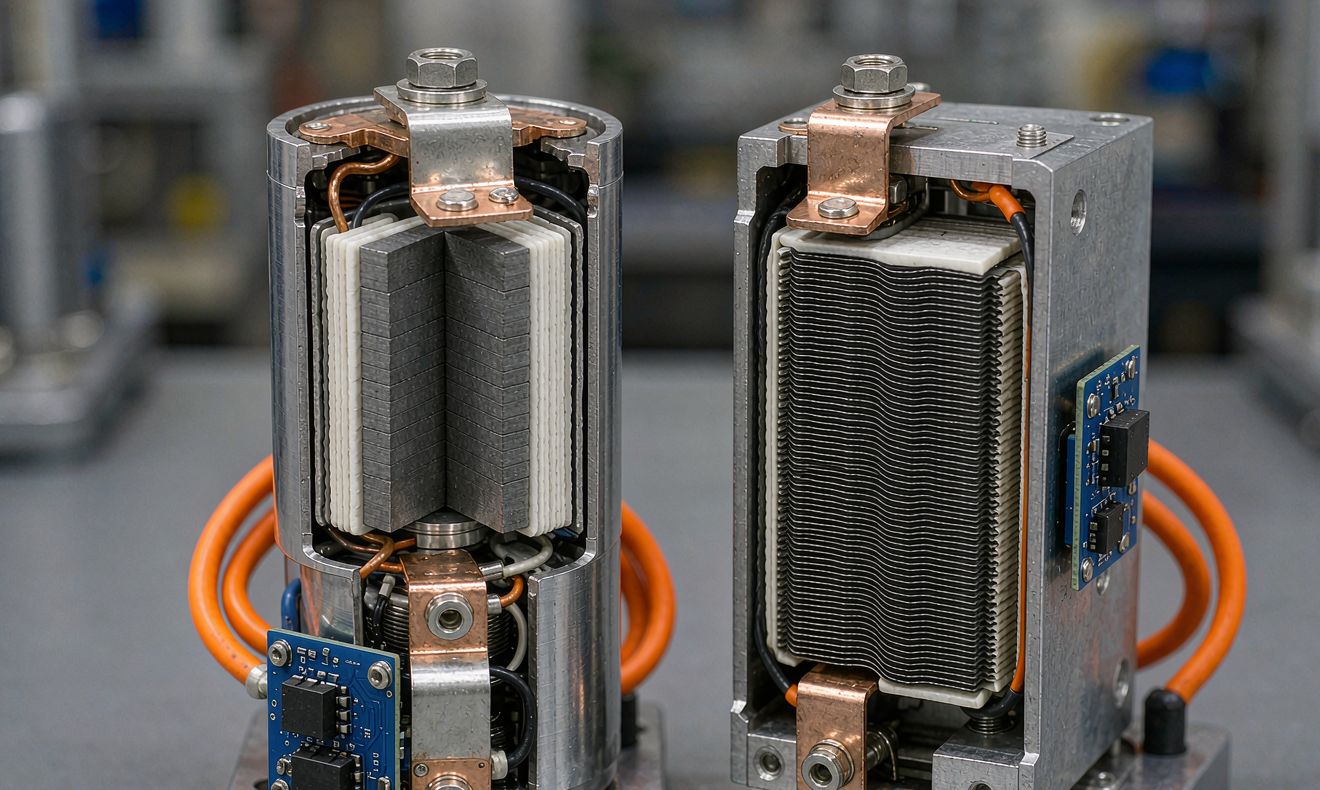
The difference starts at the electrode. A lead-acid starter cell carries 10 to 20 thin plates, 0.6 to 1.2 mm, of highly porous sponge lead — that surface area is what supports cranking current. A flooded deep cycle cell carries 4 to 8 plates, 2.5 to 6.0 mm thick, with denser active material and heavier antimony or calcium-tin grids that resist shedding and corrosion.
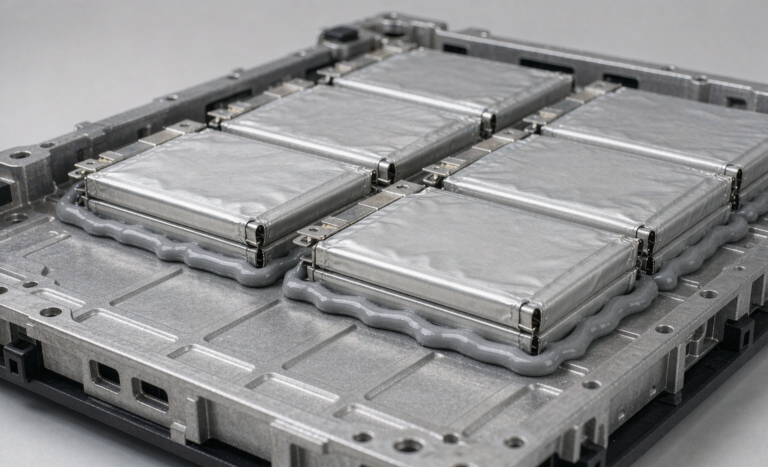
The lithium analogue is coating thickness and porosity. A power-oriented LFP cell uses a 40 to 60 µm single-side coating at 38 to 45 percent porosity with higher conductive-carbon loading; an energy cell uses 90 to 150 µm at 30 to 35 percent. Thicker coating means more active material per area — higher energy — but longer diffusion paths and higher ionic resistance, so lower power.
The measurable consequence is internal resistance. On my bench at 25 °C, 1 kHz:
- Flooded starter, 12 V / 60 Ah: 3 to 5 mΩ
- AGM deep cycle, 12 V / 100 Ah: 4 to 7 mΩ
- Flooded deep cycle, 12 V / 100 Ah: 6 to 10 mΩ
- LFP prismatic energy cell, 100 Ah: 0.4 to 0.8 mΩ per cell, so 1.6 to 3.2 mΩ for a 4S pack
That is why a small lithium jump pack can start a V8: pack resistance stays low enough to hold terminal voltage above the 9.6 V ECU browout threshold even at 400 A.
Reading the Spec Sheet Without Getting Fooled
Nearly every sizing error I review traces back to a capacity rating quoted at a different discharge rate than the application.
Capacity Ratings and the Peukert Effect
A lead-acid 100 Ah rating is conventionally quoted at C/20 — 5 A for 20 hours to 10.5 V. Pull 45 A from that same battery, a realistic trolling motor load, and you will not get 2.2 hours. With a Peukert exponent of 1.15 to 1.35 for lead acid, at 0.45C you typically get 70 to 80 Ah, so about 1.6 to 1.8 hours.
Lithium is nearly immune: measured Peukert exponents for LFP are 1.01 to 1.05, so a 100 Ah lithium battery delivers close to 100 Ah whether you draw it in two hours or twenty. That is why a lithium bank outruns a lead-acid bank of the same nameplate by 25 to 40 percent in real service — and why people who over-sized lead acid later find lithium “oversized”.
CCA, CA, MCA, and Reserve Capacity
Cold cranking amps, per SAE J537, is the current a 12 V battery delivers for 30 seconds at minus 18 °C while staying at or above 7.2 V. Marine cranking amps is the same test at 0 °C, so MCA runs 1.25 to 1.35 times CCA. If a datasheet quotes only CA or MCA, divide by roughly 1.3 to compare honestly against a CCA requirement.
Reserve capacity is the deep-cycle-side metric: minutes a battery supplies 25 A at 25 °C before falling to 10.5 V. Convert with Ah ≈ RC × 25 ÷ 60, so RC 180 is about 75 Ah. RC is more honest than a marketing C/100 rating, and I always ask for it.
Cycle Life versus Depth of Discharge
Cycle life is meaningless without the DoD attached. At 25 °C:
- Flooded deep cycle lead acid: 80 percent DoD gives 250 to 350 cycles; 50 percent DoD gives 500 to 800; 20 percent DoD gives 1200 to 1800
- AGM deep cycle: 50 percent DoD gives 400 to 700 cycles
- LFP: 100 percent DoD gives 3000 to 5000 cycles to 80 percent state of health; 80 percent DoD gives 4000 to 6000; 50 percent DoD gives 6000 to 8000
Per kilowatt-hour of throughput, a flooded golf-cart bank lands around 0.15 to 0.30 USD, AGM around 0.20 to 0.40, and LFP around 0.03 to 0.06. That is why a lithium battery pack costs three to four times more up front and still wins over five years.
Two cautions. Calendar ageing is independent of cycling: LFP loses 1 to 2 percent capacity per year at 25 °C and 30 to 60 percent SoC, but 5 to 8 percent per year stored full at 35 °C. And the cycle-life figure assumes the manufacturer’s own cutoffs — ask for the protocol.
Where Lithium Genuinely Changes the Answer
A dual-purpose claim is legitimate only when three things are true at once.
The pulse rating is documented. Engine starting needs the 3-second or 10-second pulse current, not the continuous rating. I specify cranking packs at 8C to 12C for 3 s and verify at minus 18 °C in a chamber, where resistance roughly doubles.
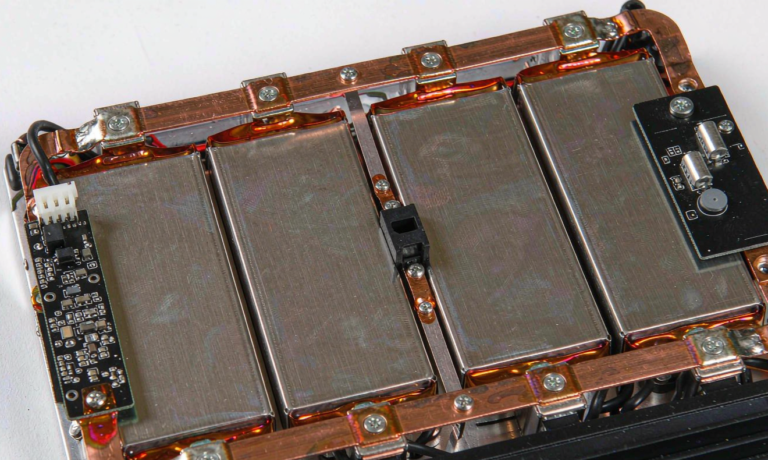
The BMS was selected for the pulse. A 100 A continuous BMS with a 300 A/3 s limit is a different cost item than a 100 A house-bank BMS. MOSFET RDS(on) and the thermal path decide whether the second crank succeeds; I have seen packs crank beautifully once and then refuse because the FET junction hit 150 °C unheatsunk.
Charge acceptance below freezing is controlled. Charging LFP below 0 °C plates metallic lithium on the anode, so every pack I approve locks charge at 0 to 2 °C and either refuses or engages self-heating. Pads on a 100 Ah bank draw 40 to 80 W — a real parasitic in a northern winter.
Charging Architecture: The Part That Fails Quietly
Dropping a lithium battery into a lead-acid charging system is the most common field failure I investigate, and it never fails loudly.
Alternators. Lead-acid banks taper acceptance current as voltage rises; LFP does not. With sub-3 mΩ pack resistance it accepts whatever the alternator produces, often 100 to 150 A continuously into a 12 V bank, while alternators rated cold sustain only 60 to 70 percent of that. I have measured stator windings at 140 °C and burnt belts on unconstrained installs. A 20 to 50 A DC-DC charger, or an externally regulated alternator derating above 105 °C case temperature, solves it.
Voltage setpoints. Flooded lead acid wants 14.4 to 14.8 V absorption and 13.5 to 13.8 V float with minus 3 to minus 5 mV per cell per °C compensation. LFP wants 14.2 to 14.6 V absorption and no float — holding 100 percent SoC at full voltage accelerates calendar ageing. You must disable temperature compensation: I have logged winter installs where a lead-acid-programmed converter pushed 14.9 V into a cold pack and tripped overvoltage protection every morning.
Equalization. Flooded banks need a periodic 15.5 to 16.0 V equalization to reverse stratification and sulfation. Applied to LFP that is a destructive overvoltage event.
State of charge estimation. An LFP cell sits at 3.30 to 3.35 V across most of its mid-range, where the OCV-versus-SoC slope is under 5 mV per percent, so voltage-based gauges are useless. Use a shunt-based coulomb counter and synchronize at full charge every one to two weeks — 0.5 percent offset on a 300 A shunt is 1.5 A of phantom error.
Application Matching and Compliance
Engine starting alone is optimized for CCA and pulse resistance — a small high-power LFP jump pack or an AGM starter. Trolling motors, RV house banks, and off-grid solar are deep cycle work sized on usable Wh with Peukert applied, where LFP is the default economic answer above roughly 2 kWh. Dual-purpose marine is best served by one LFP house bank with a documented pulse rating plus a small dedicated starter, isolated so a house load can never drain the starting reserve. Standby and UPS is a third category — long float, rare discharge — where float behaviour and thermal environment matter more than cycle count.
On compliance: lead-acid starter batteries fall under IEC 60095-1 and SAE J537, stationary vented types under IEC 60896-21/22. For lithium I work to UN 38.3 for transport, IEC 62619 for industrial applications, IEC 62133-2 for portable sealed cells, and UL 1642, UL 2054, or UL 1973 by end product; marine lithium adds ABYC E-13 to ABYC A-31, and engine-room installations need ignition protection per ISO 8846 or SAE J1171. Change the cell supplier, electrode lot, or BMS current rating and your UN 38.3 summary and IEC 62619 report no longer cover that configuration — I have watched a program lose eleven weeks because a sourcing change was treated as paperwork.
Specification Checklist and Acceptance Testing
Before a purchase order goes out — and on any custom battery solution — I require the following in writing:
- Capacity at the stated discharge rate and temperature, not a single C/20 figure
- 3-second and 10-second pulse current limits, with the low-temperature test condition stated
- Cycle life to 80 percent SoH at a named DoD, rate, and temperature
- BMS continuous and peak current, charge lockout temperature, and balancing method
- Recommended absorption voltage, whether float is permitted, and whether temperature compensation must be disabled
- UN 38.3 test summary plus IEC 62619 or IEC 62133-2 covering the exact configuration
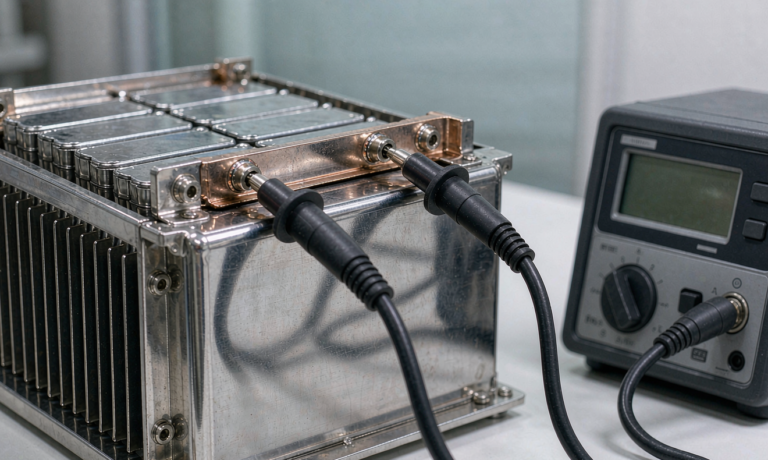
On incoming inspection I run four checks: insulation resistance above 100 MΩ at 500 V DC (readings of 1 to 10 MΩ almost always trace to moisture or a compromised vent); cell delta under 30 mV after a two-hour rest; a 0.2C capacity check returning at least 95 percent of nameplate; and a step load to the real cranking pulse showing recovery within 50 ms with sag under 10 percent.
Store everything at 30 to 60 percent SoC, 15 to 25 °C, below 65 percent RH. Self-discharge is 3 to 20 percent per month for antimony flooded lead acid, 1 to 3 percent for AGM and LFP — but BMS quiescent draw of 10 to 50 mA, or 0.25 to 1.2 Ah per day, is enough over a six-month off-season to take a 100 Ah pack below its low-voltage cutoff. Fit a physical disconnect.
FAQ
Can a deep cycle lithium battery be used to start an engine?
Only if the pack documents a cranking pulse rating — typically 8C to 12C for 3 seconds — and the BMS peak limit covers it. Energy-optimized cells often crank once and then trip as the MOSFETs heat. Check the 3-second figure at minus 18 °C, not the continuous rating.
How many amp-hours do I need for a trolling motor running six hours?
Multiply current by hours, divide by allowable DoD, then apply Peukert. For 45 A at 40 percent duty over six hours that is 108 Ah per day: lead acid at 50 percent DoD with a 0.78 Peukert factor needs about 277 Ah nameplate; LFP at 90 percent DoD needs about 120 Ah usable.
Why does my lithium battery shut down in cold weather when cranking?
Two mechanisms. Internal resistance roughly doubles between 25 °C and minus 18 °C, so terminal voltage sags below the ECU browout point; charging is blocked below 0 °C to prevent lithium plating. A pack with self-heating and a documented cold pulse rating handles both; a generic one handles neither.
Do I need a DC-DC charger between the alternator and a lithium house bank?
Almost always yes. An LFP bank accepts more current than an alternator can sustain — rated cold, they typically handle only 60 to 70 percent continuously. A 20 to 50 A DC-DC charger also gives the correct absorption voltage and isolates house bank from starter.
Can I use my existing lead-acid charger or converter for an LFP battery?
Sometimes, but verify three things: absorption voltage between 14.2 and 14.6 V, temperature compensation can be disabled, and no automatic equalization mode. A lead-acid profile compensating upward in cold weather pushes past 14.9 V and trips overvoltage protection repeatedly.
What does reserve capacity mean and how do I convert it to amp-hours?
Reserve capacity is the minutes a battery supplies 25 A at 25 °C before dropping to 10.5 V. Convert with Ah ≈ RC × 25 ÷ 60, so RC 180 is about 75 Ah. It is more honest than a C/100 marketing rating.
Is a dual-purpose marine battery a good compromise for both starting and house loads?
For lead acid it is a real compromise: medium plates give maybe 60 to 70 percent of true deep-cycle life and of true starter CCA. With LFP the compromise is far smaller, so I specify a large LFP house bank with a documented pulse rating plus a small dedicated starter, isolated so a house load can never strand you.
How long will a lithium deep cycle battery last compared with AGM in real service?
At 50 percent DoD, AGM delivers 400 to 700 cycles while LFP delivers 6000 to 8000 to 80 percent SoH — a roughly tenfold difference, plus better usable capacity because LFP tolerates 90 percent DoD instead of 50 percent. Cost per kWh throughput: about 0.03 to 0.06 USD for LFP versus 0.20 to 0.40 for AGM.
Further Reading
References