Sodium-Ion Battery Safety Profile and Abuse Testing
Over the last three years I have run abuse campaigns on more than forty sodium-ion cell builds in our own test house — 18650 and 26700 cylindricals, 20 Ah to 160 Ah prismatics, and pouch formats from four different cell makers. The question I get from almost every procurement team is the same one: is a sodium-ion battery safer than the LFP pack we are using today? The honest engineering answer is not a simple yes. A sodium-ion battery has a genuinely different abuse signature, and in three specific ways it is more forgiving than lithium iron phosphate, while in two others it demands more discipline from the pack designer. This guide walks through what the test data actually shows, which standards apply, and the design rules that decide whether a sodium-ion battery pack passes certification on the first attempt.
Why a Sodium-Ion Battery Fails Differently
Three material differences drive almost everything downstream. First, the anode current collector is aluminium, not copper. Sodium does not alloy with aluminium at anode potentials, so a sodium-ion cell can be discharged all the way to zero volts without dissolving a copper collector and re-plating it as metallic dendrites on the separator. That single fact changes transport classification, storage practice, and end-of-life handling.
Second, the hard carbon anode stores sodium in two regimes: a sloping region above roughly 0.15 V versus Na/Na+, and a low-potential plateau between about 0.10 V and 0.02 V. Most of the usable capacity sits on that plateau, and the margin between the plateau and metallic sodium deposition is narrower than the equivalent margin in a graphite-lithium cell. Charging behaviour, not thermal behaviour, is where sodium-ion cells get hurt.
Third, the cathode chemistry matters more than people expect. Layered sodium transition-metal oxides (NaNiFeMn type) and Prussian blue analogues behave differently under abuse, and the gap between them is wider than the gap between LFP and NMC on some of the metrics we track. When a supplier quotes a “sodium-ion battery safety” result, the first question is always which cathode.
Thermal Thresholds: What ARC Data Shows
Accelerating rate calorimetry is the tool that separates marketing claims from physics. We run ARC on every new cell build, heat-wait-search in 5 °C steps with 40 minutes of dwell, and record the self-heating onset temperature — the point where the cell generates more heat than it can shed.
Typical onset values we measure, at 100% state of charge:
- Layered oxide sodium cell: self-heating onset 200–230 °C
- Prussian blue analogue sodium cell: onset 210–240 °C
- LFP cell: onset around 250 °C
- NMC 811 cell: onset 110–140 °C
So the honest ranking is NMC far below everything else, LFP at the top, and a sodium-ion battery sitting 20 to 45 °C below LFP. That is a meaningful margin in a ventilated enclosure, and it is not the marketing “sodium is inherently safe” claim either.
Peak temperature tells a second story. A layered-oxide sodium cell driven to full thermal runaway typically peaks between 380 °C and 500 °C at the can wall. An NMC 811 cell in the same fixture routinely exceeds 700 °C because the delithiated cathode releases oxygen that feeds the reaction internally. LFP lands in the 400–550 °C band. Lower peak temperature means the cells adjacent to a failing unit see less radiant load, which is exactly the number that decides whether propagation stops or cascades.
Gas generation is the third column in the table. Vented gas from a sodium cell at full runaway runs roughly 0.4 to 1.2 litres per amp-hour at 25 °C, with a composition around 35–50% CO2, 20–35% CO, 10–25% H2, and 3–8% light hydrocarbons. Hydrogen at 4.0 vol% and carbon monoxide at 12.5 vol% are the two lower-flammability limits that drive enclosure gas detection design, and most authorities require detection and ventilation at 25% of LFL.
The Abuse Test Matrix We Run
Transport qualification is UN 38.3, and the eight tests are not optional regardless of chemistry. In practice, here is where sodium-ion builds trip up:
- T1 altitude simulation: 11.6 kPa or lower for at least 6 hours. Gel-free liquid electrolyte systems handle this easily; we watch for pouch swelling above 3%.
- T2 thermal cycling: 72 °C and −40 °C, six hours each, ten cycles, transfer time 30 minutes or less. The cold end is where hard carbon cells lose rate capability, and capacity recovery after the tenth cycle is the number we log.
- T3 vibration: logarithmic sweep 7 Hz to 200 Hz and back, three hours total across twelve cycles. Loose busbar laminations show up here, not in T4.
- T4 shock: 150 g over 6 ms for small cells, 50 g over 11 ms for large cells.
- T5 external short circuit: resistance below 0.1 Ω at 55 °C. Sodium cells generally survive with surface temperatures 15–30 °C lower than an equivalent NMC cell, because internal resistance runs higher and the initial current spike is lower.
- T6 impact and crush: 9.1 kg dropped from 61 cm, or a 13 kN ± 0.78 kN crush for prismatic and pouch formats.
- T7 overcharge: twice the maximum continuous charge current. Sodium layered oxide has less tolerance for over-delithiation than many teams assume — see the next section.
- T8 forced discharge: 1C reverse discharge. This is the test that most cleanly demonstrates the aluminium-collector advantage.
Beyond transport, we run a product-level matrix: nail penetration at 3–8 mm/s with a 5 mm steel nail, 130% and 200% overcharge, external heating ramp, single-cell thermal propagation with instrumented neighbours, and salt-fog and damp-heat conditioning before repeating the electrical tests. A cell that passes fresh but fails after 500 hours at 85% relative humidity is not a qualified cell.
Sodium Plating: The Failure Mode ARC Cannot Show
Accelerating rate calorimetry tells you what happens when things go wrong thermally. It tells you nothing about the abuse mode we see most often in the field: metallic sodium deposited on the anode surface during cold or fast charging.
Because the hard carbon plateau sits so close to 0 V, the overpotential window is thin. Our own threshold testing on a 20 Ah layered-oxide cell produced roughly these limits for the onset of plating:
- At −10 °C, plating begins above about 0.2C
- At 0 °C, above roughly 0.3C
- At 25 °C, above about 1.2C
- At 45 °C, above roughly 2C
The mechanism matters for pack design. Sodium metal is soft and its SEI is more soluble than the lithium analogue, so plated sodium partially recombines during rest — which means capacity loss looks reversible and the BMS never sees a hard fault. What is not reversible is the impedance growth. We track 1 kHz DCIR every hundred cycles; a rise of 25–30% above baseline typically appears three hundred to five hundred cycles before a capacity knee. If your monitoring only watches capacity, you will miss sodium plating entirely.
The engineering response is dull but effective: hard lockout below 0 °C, a current derate table that follows the coldest thermistor rather than the average, and a preheat path that brings cells above 5 °C before any appreciable charge current flows. In cold-climate cabinet installations we budget 3–8% of daily energy for preheating, and we tell the customer that number up front.
Overcharge, Over-Discharge and the Zero-Volt Advantage
Sodium layered-oxide cathodes typically carry a 3.9–4.0 V upper cut-off, roughly 0.25 V below an NMC cell. That lower ceiling is not just a capacity limitation; it keeps the electrolyte further from its oxidation potential and reduces the oxygen release that drives high peak temperatures. Overcharge tolerance, however, is chemistry-specific. In our 130% overcharge tests, layered-oxide cells vent between 150% and 180% of nominal charge input, while Prussian blue analogue cells tend to vent later but release noticeably more gas when they do. Neither behaviour is a reason to relax the BMS overvoltage trip.
Deep discharge is where a sodium-ion battery genuinely wins. Because both electrodes can use aluminium collectors, a cell can be taken to 0 V, held there, and recovered without the copper dissolution and internal short risk that makes deep discharge dangerous for a lithium cell. Two practical consequences follow. Storage and transport can be done fully discharged, which is why the new UN 3551 (sodium-ion cells) and UN 3552 (sodium-ion batteries) entries permit short-circuited, zero-volt shipment in many cases — a real logistics advantage over the 30% state-of-charge limit applied to UN 3480. And in long-idle seasonal applications, an end-of-life pack can be safely swept to zero rather than held at a partial charge.
One caution: recovering a zero-volt cell is not free. We see 3–6% permanent capacity loss after a full 0 V storage and recovery cycle, and the recovery charge must be done at 0.05C with a full capacity verification afterwards. Treat zero-volt capability as a safety and logistics feature, not as an operating mode.
Standards and the Certification Path
A sodium-ion pack does not get its own regulatory exemption. The standards a buyer should name in a specification are:
- UN 38.3 plus a test summary — mandatory for transport
- IEC 62619 for industrial and stationary applications, including external short circuit, thermal abuse, overcharge and forced discharge
- IEC 62133-2 for portable and light mobility products
- UL 1973 for stationary storage, and UL 9540 with UL 9540A where the installation falls under NFPA 855
- UN 3551 / UN 3552 for sodium-specific transport classification, with the packing instruction confirmed by a dangerous-goods officer rather than assumed
- NFPA 855, NFPA 68, NFPA 69 and the local electrical code for separation distance, deflagration venting and gas detection
UL 9540A is worth a separate note because it is the test that decides installation cost. It runs in four escalating levels — cell, module, unit, installation — and reports the maximum cell temperature, gas composition, heat release rate, and whether thermal propagation occurs. A sodium-ion pack that demonstrates no propagation at the module level moves the project out of the most expensive fire-protection category. Get that test done before the enclosure design freezes.
Budget realistically: UN 38.3 on a single cell variant runs 6,000–12,000 USD and four to eight weeks. IEC 62619 on a pack adds 15,000–35,000 USD. Full UL 9540A to the module level with a unit-level test can reach 80,000–150,000 USD. Design freeze before testing, because a bill-of-materials change to cells, barriers or vent hardware resets the clock.
Pack Design Rules That Decide Whether You Pass
After enough campaigns, the same five rules keep separating first-attempt passes from repeat loops:
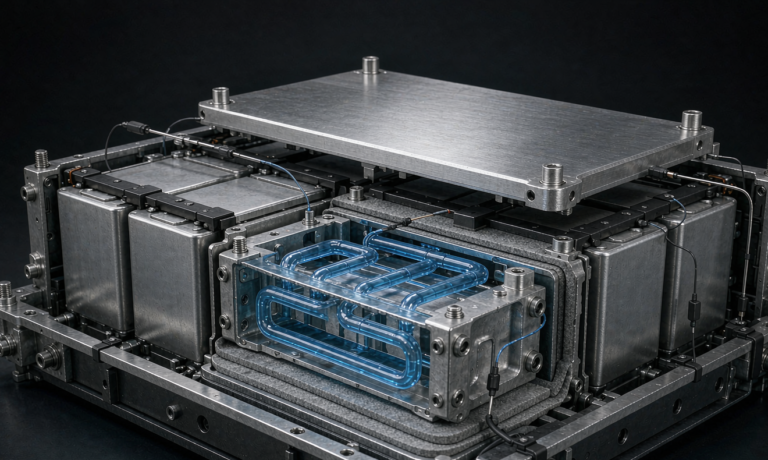
- Size the thermal barrier to measured peak temperature, not to the datasheet. Ceramic fibre or aerogel sheets between cells, 1–2 mm, are usually enough for a sodium pack because the peak is lower, but only if compression is maintained across the full life of the pack.
- Specify vent direction. Every prismatic cell vents through a scored disc on a defined face. If the pack layout points that face at its neighbour, you have built a propagation path. Route vented gas to a plenum with a burst disc.
- Do not skip the DC arc-flash study. A 400–600 V sodium string has similar available fault energy to a lithium string of the same voltage. The protection study belongs at design review, not after commissioning.
- Keep compression in the specified window. Sodium cells are usually specified with a modest stack pressure; too little and interface impedance climbs, too much and the separator is squeezed and rate capability drops. Use spring or wave-washer elements that hold load as the stack relaxes.
- Write the commissioning checks into the purchase order. Insulation resistance above 100 MΩ at 500 V, cell delta below 30 mV after two hours at rest, and a 0.2C capacity test returning at least 95% of nameplate.
Field Monitoring and Early Warning
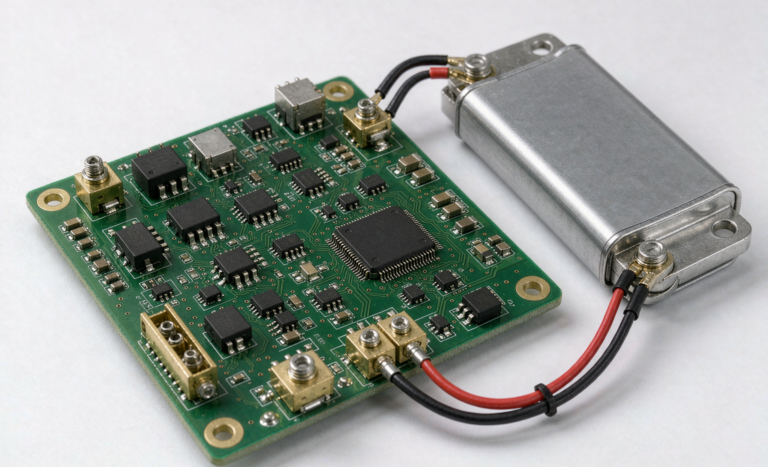
Sample rates we hold as a minimum: cell voltage at 1 Hz with ±5 mV accuracy, pack current and protection decisions at 1 kHz internally, temperature at 10 Hz, and contactor opening within 5 ms of a trip decision. Four trends deserve a monthly review — resting cell delta, temperature rise during a single discharge, 1 kHz DCIR, and cumulative amp-hours. A capacity step of more than 8% between two quarterly checks is a fault, not ageing, and should trigger physical inspection.
Frequently Asked Questions
Is a sodium-ion battery safer than an LFP battery?
Not strictly. ARC self-heating onset for a layered-oxide sodium cell is typically 200–230 °C against about 250 °C for LFP, so LFP still holds a 20–45 °C advantage on thermal onset. Where sodium wins is peak temperature, deep-discharge tolerance, and the ability to ship at zero volts.
Can a sodium-ion battery be shipped at 0 V?
Under the UN 3551 and UN 3552 entries, many sodium-ion cells and batteries may be transported in a short-circuited, fully discharged state, unlike lithium cells that are held to roughly 30% state of charge under UN 3480. Confirm the packing instruction with a dangerous-goods officer for the specific route and mode before shipping.
What is the self-heating onset temperature of a sodium-ion cell?
In our ARC testing, layered-oxide cells begin self-heating between 200 °C and 230 °C at full charge, and Prussian blue analogue cells between 210 °C and 240 °C. Always ask for the ARC curve rather than a single number, because the onset shifts with state of charge and cell age.
Why does cold charging damage sodium-ion cells?
The hard carbon anode operates on a plateau close to 0 V versus Na/Na+, leaving a narrow margin before metallic sodium deposits on the anode surface. Plating begins at roughly 0.3C at 0 °C and about 0.2C at −10 °C in the cells we have tested, and it shows up as impedance growth long before capacity loss.
Which standards apply to a sodium-ion battery pack?
UN 38.3 for transport, IEC 62619 for industrial and stationary use, IEC 62133-2 for portable products, UL 1973 and UL 9540 with UL 9540A for North American stationary installations, plus NFPA 855 and local electrical code for siting and fire protection. Sodium has no general exemption from lithium-style testing.
Does thermal propagation behave differently in a sodium-ion pack?
Yes, and in the pack’s favour. Lower peak cell temperature — typically 380–500 °C versus 700 °C and above for NMC — reduces the radiant load on neighbouring cells, so a properly barriered sodium module often demonstrates no propagation at the module level in UL 9540A testing.
How much gas does a failing sodium-ion cell release?
Expect roughly 0.4 to 1.2 litres per amp-hour at 25 °C, made up mostly of CO2 and CO with 10–25% hydrogen. Gas detection set at 25% of the lower flammability limit, plus deflagration venting per NFPA 68, is the standard enclosure response.
Can a sodium-ion battery be recovered after full discharge to 0 V?
Yes, and this is a genuine advantage of the aluminium anode collector. Recovery should be done at 0.05C with a full capacity verification afterwards; budget for 3–6% permanent capacity loss from a full zero-volt storage and recovery event.
Further Reading
References