Lithium Battery for Utility Task Vehicles and UTVs
My name is Karl Huang, senior lithium battery engineer, and a large part of my work is spent in the field with fleet owners rather than at a drawing board. The most recent request that reached our engineering desk sounded simple: supply a lithium battery solution for a fleet of utility task vehicles, the side-by-side machines that park crews, land managers and ranch hands drive into places a pickup cannot follow. A utility task vehicle battery is not a golf cart battery with a different label, and it is definitely not a stationary storage cabinet mounted to a chassis. The duty is violent, dirty and seasonal, and the pack has to survive all three at once.
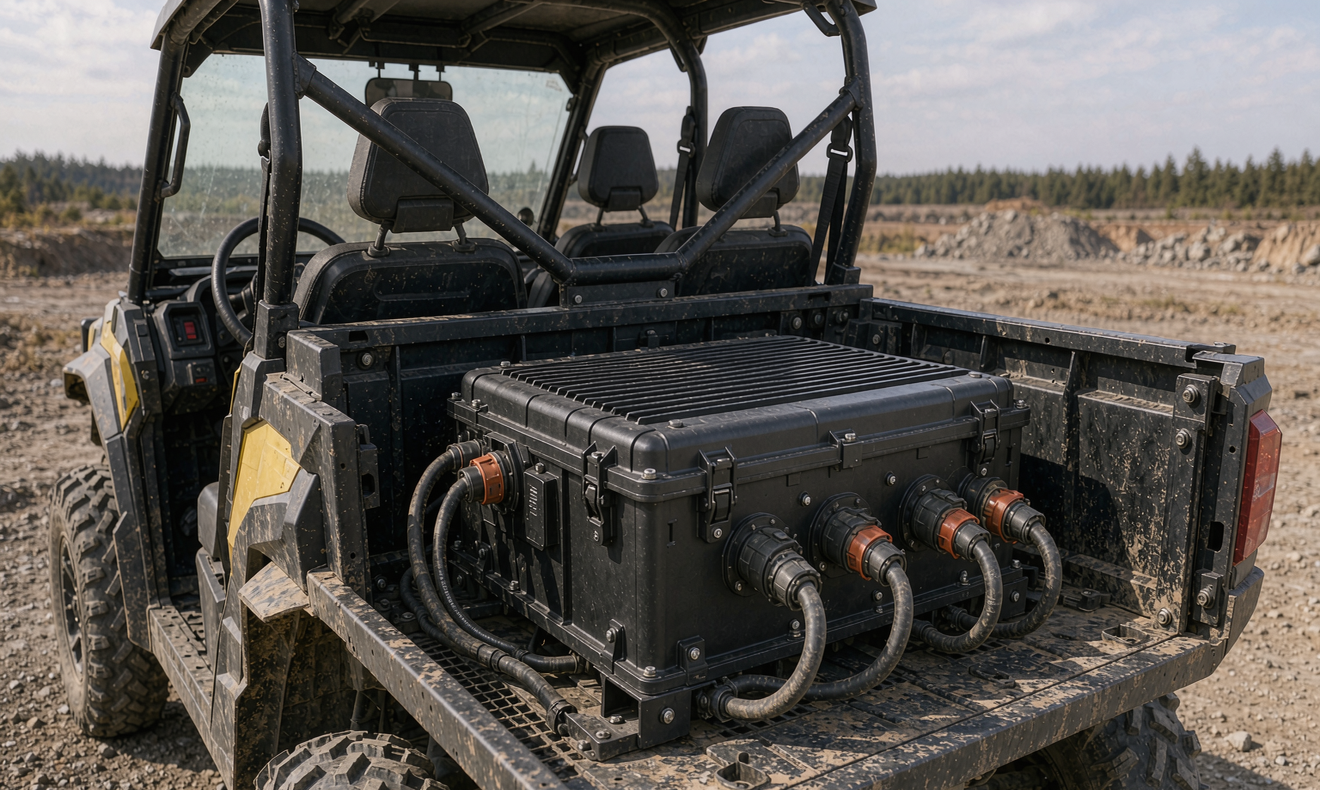
What a Utility Task Vehicle Actually Draws From the Pack
A side-by-side machine is small but not gentle. The traction drive is usually a 48 volt system rated somewhere between 30 and 80 kilowatts for a short burst, and the accessory load sits on the same bus or on a protected 12 volt tap. Owners add a winch, a light bar, a sprayer pump, a cab heater and sometimes a portable tool outlet, and all of that is asked to work while the machine is bouncing through ruts at low speed. The battery sees three quite different load shapes in one shift.
- Traction: bursts of 150 to 350 amps for the first two seconds of throttle, then a steady 60 to 120 amps while climbing or loaded.
- Winch: 120 to 220 amps at line pull, with a ten percent duty cycle rating, so ten minutes of work per hour at best.
- Accessories and cab: 15 to 50 amps continuous, which is what quietly empties a pack overnight if the lights are left on.
When we size a pack we separate those three and log them on the customer machine for at least a week before quoting. A load logger costs less than one pack and tells us whether the owner is a traction user or a winch user.
Sizing the Pack From the Duty Cycle
Start with energy, not with a target range. A typical work day is three to six hours of mixed driving plus a winch session, so a machine covering about 40 kilometres and lifting a loaded trailer twice asks for 2.5 to 4 kilowatt-hours a day. Add a fifteen percent winter margin and a further ten percent for the winch, and a 48 volt machine needs between 5 and 8 kilowatt-hours.
Then convert. A 48 volt system built from fifteen cells in series gives a 54 volt full pack. A 100 amp-hour prismatic cell gives 4.8 kilowatt-hours nominal, so one module of fifteen cells is the sort of building block we quote. The number that confuses buyers is depth of discharge: usable capacity is what you get between a floor at twenty percent and a ceiling at ninety, not the nameplate figure.
Peak Current and Voltage Sag
A winch is a short-duration short circuit. It pulls very high current for a few seconds and expects the voltage to hold. Our 48 volt packs present a direct current resistance of 30 to 55 milliohms, so a 200 amp pull costs six to eleven volts of sag and the terminal voltage drops toward 43 volts. That is acceptable if the cabling and the contactor were sized for it; it is dangerous if someone has spliced the pack to a thin cable harness designed for a golf cart.
The rule I give workshops is simple: cable cross-section and connector rating must be chosen from the peak current and the peak duration, not from the continuous rating. A 200 amp peak for three seconds generates almost no heat in a correctly sized conductor, but the same peak through a fifteen amp automotive connector welds its contacts shut.
Cell and Module Choice for Chassis Duty
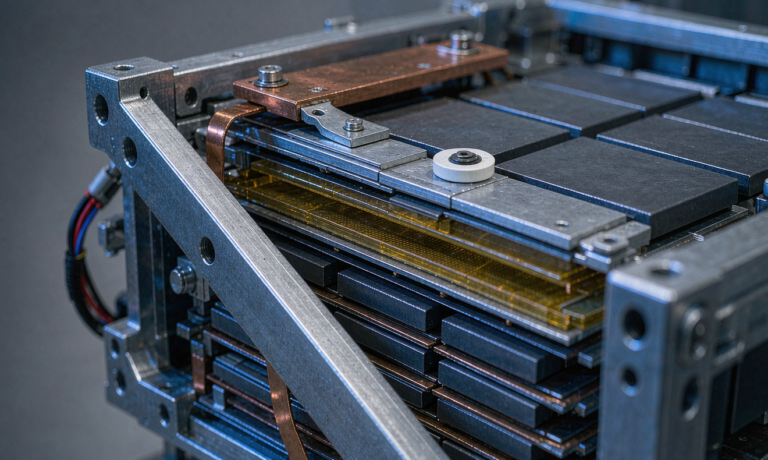
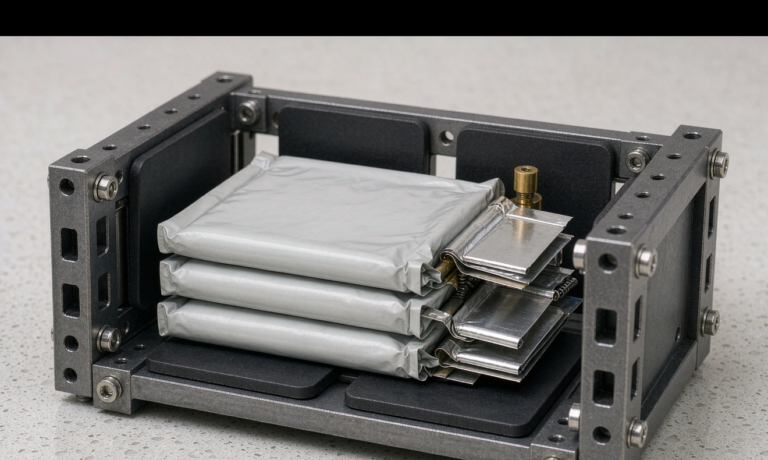
We build utility task vehicle packs around prismatic lithium iron phosphate cells in the 50 to 100 amp-hour range. LFP gives a flat discharge curve, a nominal 3.2 volts per cell, a cycle life in the several-thousand range at 0.5 C and a chemistry that tolerates the abuse a work machine hands out. Pouch cells are lighter, but they need a module cage because a pouch has no structural case of its own. Prismatic cells inside a rigid module are the easier engineering answer for a chassis that vibrates.
- Cell format: prismatic LFP, 50 to 100 amp-hours, grouped in series and parallel strings inside a steel or aluminium module.
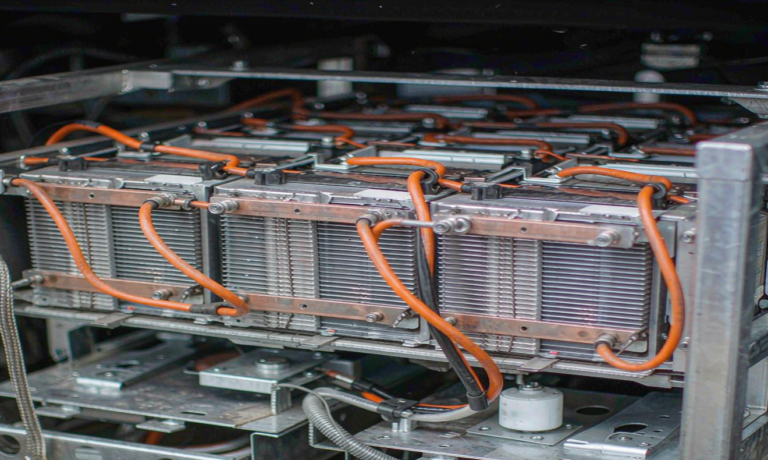
- Module count: two to four modules, so a single failed module can be swapped without opening the whole enclosure.
- Busbar design: laminated copper busbar with torque-marked bolted joints, never soldered tabs, because a chassis transmits heat and shock.
- Cell balancing: passive balancing during the charge window is normally enough; active balancing only pays back on large fleets with long idle periods.
On battery management we specify a system that reports per-cell voltage, pack current and pack temperature over the vehicle bus, and that can hold a fault instead of resetting itself every time the operator cycles the ignition. A pack that hides its own state of health becomes a machine that strands its user on a ridge.
Enclosure Integrity: Dust, Mud, Water and Shock
This is the part of a utility task vehicle battery that separates it from everything else we make. The machine operates in dust so fine it penetrates ordinary seals, it crosses water crossings, it carries salt in the winter and mud in the spring, and it lands hard on its underside. An enclosure rated IP67 is the floor; for fording machines we use IP68 with a submerged vent path and a pressure equalisation port on the top face.
Mechanical qualification matters just as much. We test full enclosures to the vibration and shock profiles used for traction batteries on road vehicles, which is a far harsher schedule than the shake test most consumer packs receive, and we run a neutral salt spray exposure on the enclosure hardware because a corroded bolt is a service call in the middle of nowhere.
Thermal Behaviour Inside a Sealed Bay
A sealed pack in a cargo bay under a seat has almost no natural convection. At a 0.5 C rate a 6 kilowatt-hour module dissipates only a few tens of watts, but a sustained 200 amp discharge on a hot day can push module surface temperatures past 45 degrees Celsius. Our standard approach is a conductive cold plate bonded under the module floor, a mount that uses the vehicle chassis as a heat sink, and a thermal fuse plus a battery management cutoff at the top of the monitored band.
On cold mornings the same enclosure works against you. Below freezing we restrict charging to a reduced rate and for northern machines we bond a low-voltage heating mat to the module floor so the pack can rise above 5 degrees Celsius while plugged in.
Certification and Paperwork for Fleet Buyers
Fleet procurement offices rarely reject a pack on chemistry. They reject it on documentation. For a utility task vehicle pack we ship with cell and pack tests under IEC 62133-2, system level tests under IEC 62619, a UN38.3 transport test summary and a manufacturer’s handling document, and where the machine is registered as a road vehicle we provide the mechanical and electrical evidence required by ECE R100.02, including vibration and shock results for the pack, not just the cells.
Internally we treat three design features as non-negotiable for this application. There is a pressure relief route that vents outside the passenger area, a service disconnect that the operator can reach without opening the enclosure, and a cell level fuse on the highest energy branch so a single internal fault does not become a vehicle fire.
Running a UTV Fleet: Rotation, Storage and Service
Seasonal use is the hidden problem. A park fleet may run six weeks a year and then sit for eight months. We set the working window at 15 to 90 percent state of charge, tell owners to store at about 50 percent, and trickle-charge only where storage is heated and monitored. A pack left at full charge through a hot summer loses calendar life faster than one worked hard and put to bed at half.
For fleets we grade state of health at the start of each season and keep a spare module in the shop. A module below 80 percent of original capacity still has second life in a static role such as a site trailer, which keeps the cost per machine sensible across the fleet.
How large should a utility task vehicle battery be?
For most 48 volt work machines a 5 to 8 kilowatt-hour pack covers a full day of mixed driving with the winch used occasionally. Size from logged daily energy use plus a fifteen percent winter margin, not the traction motor rating, which only matters for peak power.
Can a UTV pack be charged from the vehicle alternator?
Yes, but the charging source has to be a smart battery management system aware charger with a suitable current limit. A standard alternator output of 120 to 180 amps into a cold 48 volt pack will exceed the cell charge current limit, so we either reduce the field current through the vehicle interface or install an on-board charger that follows the pack’s acceptance curve.
Why not use a golf cart battery in a utility task vehicle?
Golf cart packs are designed for smooth terrain, gentle vibration and a steady duty cycle. A side-by-side transmits significantly more shock and operates in conditions where dust and water ingress dominate. The cell chemistry may be the same, but the enclosure rating, the mechanical qualification and the busbar design have to be specified for the worse duty, not the friendlier one.
How long does a lithium pack last on a work fleet?
Lithium iron phosphate is comfortable with a ten year calendar life when the pack is stored and charged inside a sane state of charge window. The practical limit here is often the enclosure and connectors rather than the cells, so our annual service focuses on torque marks, seals and the cooling interface.
What is the maximum safe winch draw from a 48 volt pack?
We publish a peak current with its duration, for example 250 amps for five seconds, and we design the cables, contactor and busbars against that figure. Repeated winch pulls longer than thirty seconds should be limited by the winch duty cycle rather than by the battery, because sustained high current heats the pack more than a single pull ever will.
Is sodium-ion a better fit for cold-season work?
Sodium-ion handles low temperatures well and we supply it for stationary and light-duty roles, but a winch plus traction load asks for sustained high discharge power and a long cycle life from a compact pack. Lithium iron phosphate still wins on power density per litre for this kind of mobile duty.
Further Reading
References