Battery Solution for Electric Snow Plow Fleets
My name is Karl Huang, senior lithium battery engineer, and I spend most of my winter in fleet yards rather than in offices. Every year the same call comes in from municipal transportation departments: they want their snow plow trucks converted from diesel auxiliary power to a lithium battery solution, and they want a pack that will start a full-size plow blade at minus 25 degrees Celsius without complaining. That is a very different engineering problem from a forklift pack or a server rack battery, and it is the reason we keep a dedicated sizing path for plow fleets.

What an Electric Snow Plow Actually Draws From a Battery Pack
A plow truck is not a delivery van with a big motor. The traction load is modest, but the hydraulics are brutal. Lifting and angling a five to seven metre blade valves a pump that can momentarily pull several hundred amps while the plow is being positioned at a curb. In cold air that same hydraulic oil is roughly twice as viscous, so the pump does not like the first thirty seconds of any shift. From the battery side, that means our pack has to deliver short bursts well above the continuous rating, then recover.
When we size a pack for this duty we always separate two currents: the sustained cruise current that moves the truck between routes, and the peak current that belongs to blade lift, dump and salt spreader actuation. If you only design for cruise, the pack voltage will sag every time the operator raises the plow, and the driver will start avoiding the lift function in deep snow. That is the failure mode I see most often in retrofits done without load logging.
- Blade lift and angle: short peaks of 250 to 400 amps for one to three seconds.
- Propulsion on plow-down runs: steady 80 to 150 amps depending on tyre and road surface.
- Spreader and blower: 40 to 90 amps with a fairly constant duty in salt routes.
- Idle warm-up and cab heat: 20 to 40 amps continuous while stationary.
Because those peaks are short, the limiting factor is rarely energy. It is thermal behaviour and voltage sag under a hard step load, which is exactly where a well balanced custom battery solution beats a pack salvaged from a stationary application.
Sizing Rule We Use on Every Plow Route
We log the actual route with a clamp meter and a data logger for two weeks before we quote anything. If the route consumes 55 kWh per shift with peaks of 400 amps, we do not ship a 55 kWh pack. We ship roughly 70 to 80 kWh, because the cold-weather derate and the reserve for a stuck blade in a drift are both real costs, not hypothetical ones.
Cold-Weather Capacity Loss and How We Compensate
Lithium iron phosphate cells lose usable capacity in cold air, and a plow truck spends its whole life in that condition. At minus 20 degrees Celsius a typical LFP cell gives back maybe 75 to 85 percent of its room-temperature capacity, and the internal resistance roughly doubles. If the pack is the only power source for hydraulics and cab heat, that loss shows up directly as shorter duty and lower cranking power on a cold morning.
Our standard mitigation is a self-heating pack. The cells carry a low-voltage heater mat bonded under the module and controlled by the battery management system so that heating only runs when the pack is plugged in or when the state of charge is comfortably above the floor. Heating a 60 kWh pack from minus 18 to plus 5 degrees Celsius before the shift typically costs two to four percent of pack capacity, which is far cheaper than the margin you would otherwise have to buy.
- Ignore self-heating and you will size the pack roughly 20 percent oversize, which adds weight and cost.
- Overheat the pack with the vehicle moving and you waste energy that the driver expected as range.
- Let the pack sit at a full state of charge in sub-zero air for a week and calendar ageing accelerates at the plate.
Every pack we ship for plow duty is cycled at low temperature in our test cell before it is approved, and the test report goes to the fleet manager together with the warranty document.
Pack Architecture for Plow Duty Cycles
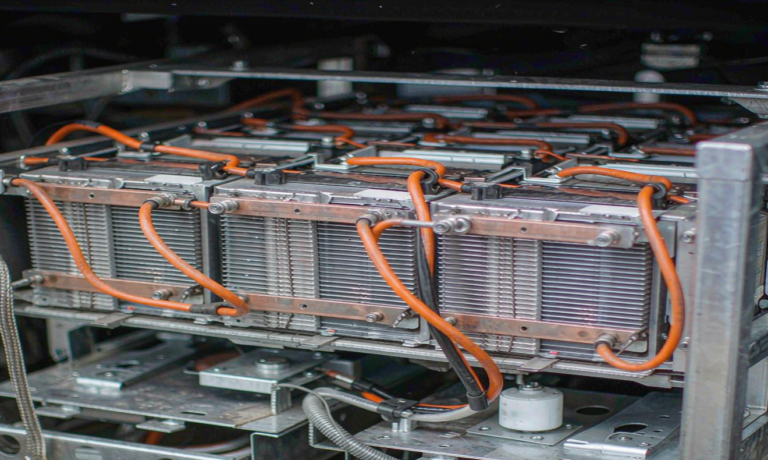
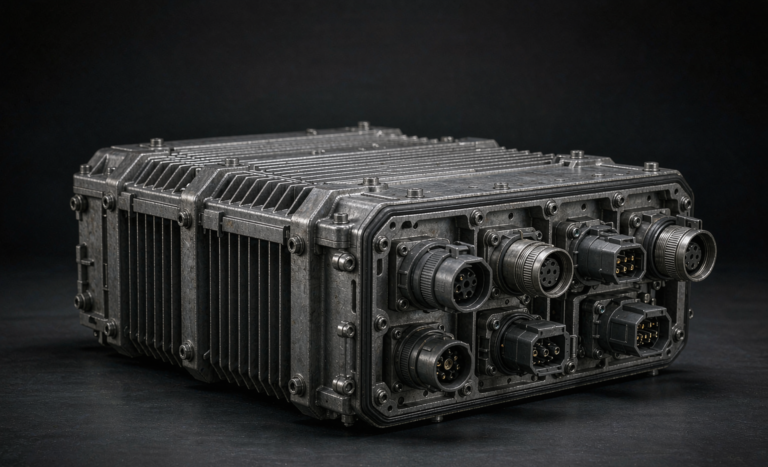
A municipal plow fleet wants standardisation far more than it wants exotic chemistry. We normally build the pack as a modular rack of LFP modules in a steel enclosure rated at least IP67, because salt brine gets into everything and the wash-down bay is not a gentle environment. Each rack is a replaceable unit so that a single failed module does not take a truck out of service for a week.
Three architectural choices matter more than cell selection here. First, the bus bar and terminal design has to survive repeated high-current peaks without heating the enclosure; we use laminated busbars and torque-checked bolted joints rather than soldered tabs. Second, the battery management system needs a peak-current rating that is defined in the datasheet for the actual pulse length, not a marketing C-rate. Third, the enclosure needs a drain path and a corrosion allowance, since road salt is far more aggressive than rain.
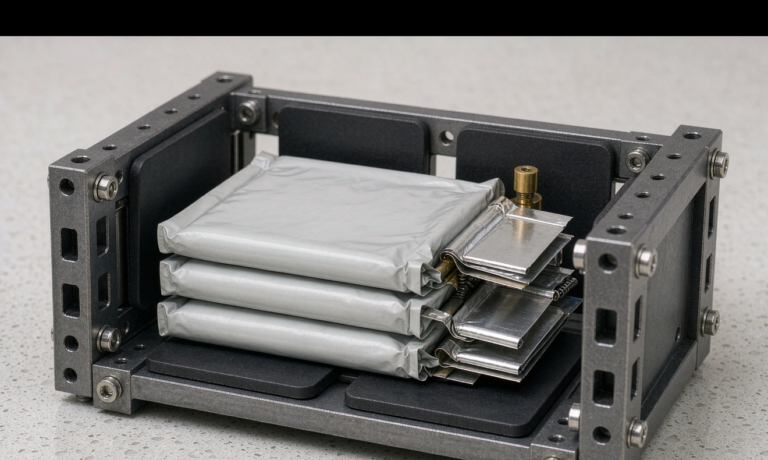
- Cell format: prismatic LFP modules, 50 to 100 Ah, grouped into a rack of 5 to 8 kWh each.
- Enclosure: IP67 rated steel with a saline-mist tested finish and a heated floor plate.
- Battery management: per-cell monitoring, peak current rating specified for three-second pulses.
- System standard: IEC 62619 for stationary and mobility use, with UN38.3 transport tests on every design.
Safety, Enclosure and Certification for Winter Work
Certification is where most plow retrofits stall. A pack that is fine on a test bench can fail a municipal procurement review because the paperwork does not cover the duty. We submit IEC 62133-2 cell and pack tests, IEC 62619 system tests, UN38.3 transport documentation, and an IP67 ingress report for the final enclosure. For trucks operating around fuel depots we also provide the thermal runaway propagation data that the fire officer asks for.
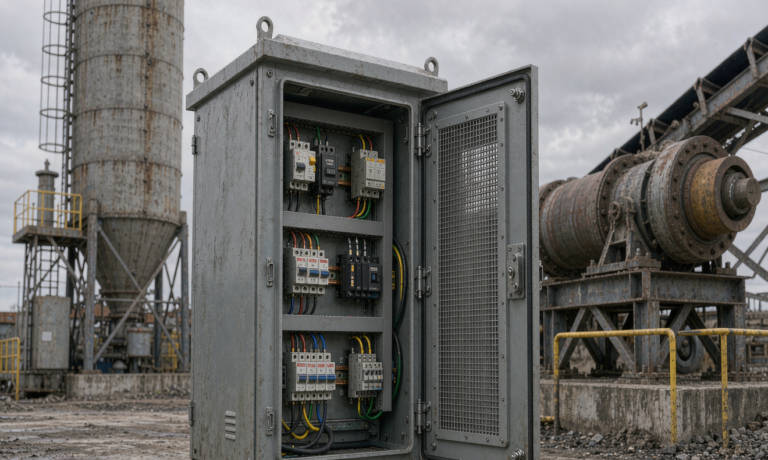
Inside the enclosure the design targets are unglamorous but effective: a pressure relief path that vents to the outside of the bay, a gas detection sensor wired to the vehicle alert system, cell-level fusing on the highest-energy branches, and a disconnect that the driver can trip without opening the cabinet. We also test the pack with a vibratory table profile that mimics a plow hitting curb edges, because a pack that rattles loose its busbars in month four is a very expensive service call.
Running the Fleet: State of Charge Discipline and Charging Windows
Fleet managers usually ask for 100 percent state of charge every night. On a plow truck that is the wrong target. We set the daily working window at 15 to 90 percent and reserve the top of the range for the overnight top balance. The bottom of the range matters more: staying above 20 percent protects the cells from low-temperature copper plating when the truck is left plugged in all weekend in February.
Charging also has to fit the depot. Most municipal yards have limited three-phase power, so the charger is either an on-board unit at 22 kW or a depot DC unit at 50 to 120 kW. We plan the shift pattern around the charging window rather than the other way round: a plow truck knows by mid-afternoon which routes will run twice, and the dispatcher can hold a spare pack in the heated workshop for the worst night of the year.
Fleet Sizing Example
A sixteen-truck plow route with a 70 kWh pack per truck and one spare rack per four trucks keeps the yard at roughly nine spares for every ten trucks in service, with no special dispensing. That is the number I quote, and it is far easier to defend in a budget meeting than a single oversized pack per vehicle.
Total Cost and Payback for Municipal Fleets
The honest comparison is cost per plow-hour. A diesel auxiliary system burns fuel, needs a DEF system, has a regen brake that fails in cold weather, and carries a service interval that includes the exhaust aftertreatment. A lithium battery solution removes the auxiliary engine entirely and replaces it with a pack that has a ten-year calendar life and a cycle life in the several-thousand range for this duty profile.
In the fleets we have converted, the payback lands somewhere between four and seven seasons depending on shift length and local diesel price, and the maintenance line is the part that changes the most: no oil, no coolant loop, no exhaust, and a predictable module swap instead of a failing engine rebuild. The pack cost is front-loaded, but the fleet manager is not buying a pack alone, they are buying the absence of an engine.
How long does a plow battery pack last in daily winter use?
For a plow fleet the pack spends at most a few months a year under load, so calendar ageing dominates. In our conversions a pack scheduled for a ten-year calendar life typically keeps above 80 percent of its original capacity after eight to ten seasons, provided the fleet keeps the state of charge inside the 15 to 90 percent window and runs the preheat cycle before each shift.
Can a lithium pack start the hydraulics at minus 30 degrees Celsius?
Yes, provided it is a self-heating pack sized for the peak, not just for the cruise current. A preheated LFP pack at minus 30 degrees will deliver its rated peak current through the hydraulic pump, while an unheated pack at the same temperature may sag badly enough to stall the pump on the first lift of the shift.
Do we still need the diesel engine in the truck?
Most municipalities keep the main engine for propulsion and cab heat, and we take over the auxiliary load. The result is a smaller engine, no diesel exhaust in the operator cabin at a December bus stop, and a much smaller fuel tank that only has to feed the powertrain.
How does road salt affect the battery enclosure?
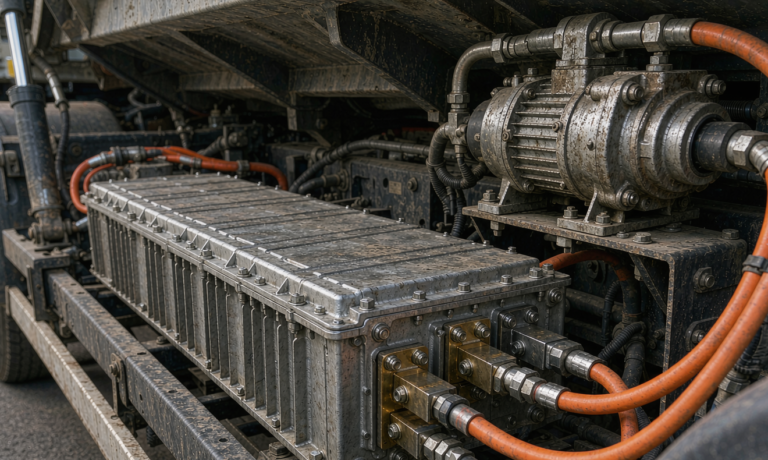
Salt is the main corrosion risk, not the cells. We use IP67 enclosures with a saline-mist tested coating, stainless hardware, and a heated floor plate that also prevents ice formation under the cabinet. The connector bank is the first thing to inspect at every annual service.
What happens if a truck finishes its route with an empty pack?
We design a reserve that covers the worst realistic case: a stuck blade, a closed depot road, and a route run twice. If the pack still empties, the vehicle pulls to a safe location and runs in a reduced-hydraulic mode, but in six seasons of conversions we have not seen that happen on a routed truck, only on a cherry-picker plow that was left running all night.
Is a sodium-ion pack a better fit for plow fleets?
Sodium-ion handles cold better and has no low-temperature plating risk, and we do supply sodium-ion packs for depot standby work. For the high peak currents of blade lift, LFP still gives us the discharged power and the cycle life that operators expect, so we keep LFP for the plow packs themselves.
Further Reading
References