Lithium Battery Performance for Mobility Devices
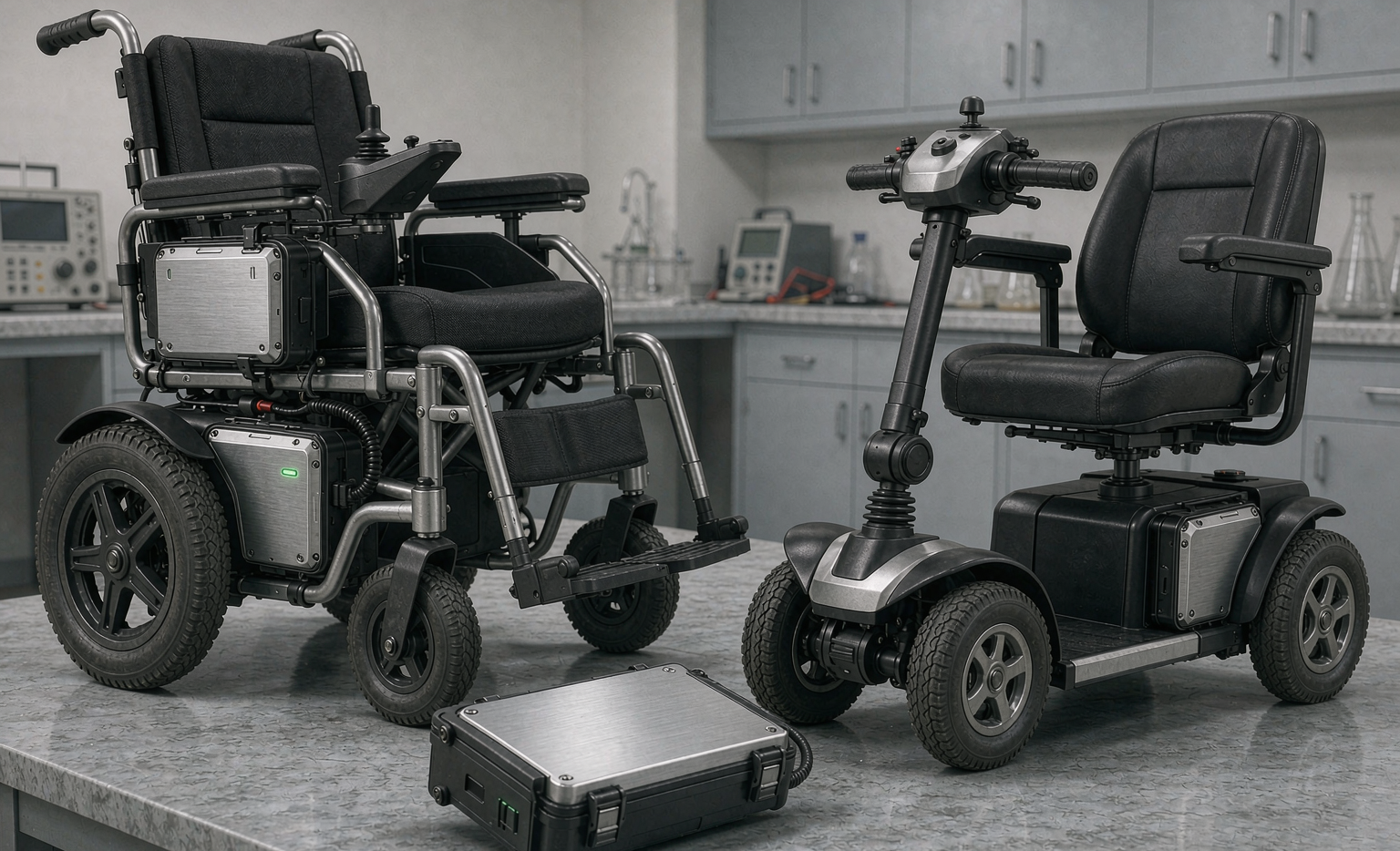
I have spent the better part of a decade on the factory floor and in the field with lithium battery packs, and few applications test a cell the way a mobility device does. A powered wheelchair or a mobility scooter is not a gadget someone can set down when the power runs out. The person depending on it is often medically vulnerable, outdoors, possibly on a slope, with no safe place to wait for a charge. When I talk about lithium battery performance for mobility devices, I am not discussing lab specs on a datasheet. I am discussing whether a 78-year-old gets home before the pack hits its low-voltage cutoff.
Why Mobility Devices Are a Different Performance Problem
Most consumer electronics draw a steady, modest current. A mobility device does the opposite. The duty cycle is bursty and punishing: near-zero draw while parked, a 15-30 A pull during normal rolling, and 50-70 A spikes when the user hits an incline, a curb, or thick carpet. That is a 3-5 C peak on a pack that may only be rated for 1-2 C continuous. The performance question is therefore not “how many watt-hours” alone, but “can the pack hold its voltage under a 5 C transient without sagging below the motor controller’s under-voltage lockout.”
Then there is the human factor. A smartphone that dies is an inconvenience. A mobility aid that dies on a hill is a safety event. Every performance decision for these packs has to be filtered through a single rule I teach my team: stranding the user is the worst failure mode, and we design backward from it.
Chemistry Choice: LFP vs NMC for Personal Mobility
For mobility aids, I lead almost every design review with LFP (lithium iron phosphate, LiFePO4) unless weight is genuinely mission-critical. The reason is safety margin, not energy. LFP has a thermal-runaway onset near 270°C, versus roughly 210°C for NMC (nickel-manganese-cobalt). In a device a person sits on or leans against, that 60°C of headroom is not a footnote; it is the difference between a contained fault and a fire.
The trade-off is specific energy. LFP cells land around 90-160 Wh/kg; NMC reaches 150-250 Wh/kg. Pack-level, that translates to roughly 80-130 Wh/kg for LFP versus 120-180 Wh/kg for NMC. For a foldable travel scooter where every kilogram matters, NMC earns a place. But for the bulk of wheelchairs and heavy-duty scooters, LFP’s cycle life of 2,000-6,000 cycles at 80% depth of discharge (against NMC’s 500-1,500) wins on total cost of ownership and on the simple fact that fewer pack replacements means fewer chances for a field failure.
One more point I always raise: LFP contains no cobalt, which removes both a conflict-mineral concern and a supply-cost wildcard. For a custom battery solution built to run for five years in the field, that stability matters as much as the chemistry curve.
The Numbers Behind Real-World Range
Range anxiety in mobility devices is almost always a sizing error, not a chemistry error. Here is the math I hand to new engineers. Take a typical mid-size scooter drawing an average of 250 W. A two-hour outing is 0.5 kWh of energy. A 24 V, 20 Ah pack holds 0.48 kWh nominal, but usable energy at 80% depth of discharge is about 0.38 kWh. Realistically that yields 12-18 km of mixed urban riding, not the 25-30 km the marketing sheet promises at the 0.1 C “ideal” rate.
Voltage platform is the next lever. The 24 V standard (often a drop-in for legacy lead-acid wheelchairs) is ubiquitous and cheap, but 36 V and 48 V architectures are becoming common on faster mobility scooters and e-bikes because they cut current for the same power: at 500 W, 24 V pulls ~21 A while 48 V pulls ~10 A. Lower current means thinner wiring, less lithium battery pack heating, and longer connector life. I size the bus around the peak, not the average.
Power Delivery on Hills and Starts
The single biggest performance complaint I hear from mobility users is “it slows down on the hill.” That is a C-rate and internal-resistance story. As you draw higher current, the effective capacity drops (the Peukert effect), and the pack voltage sags under load. A pack with matched cells and a tight resistance spread stays above the controller’s cutoff; a poorly graded pack dips and the motor stutters or cuts out.
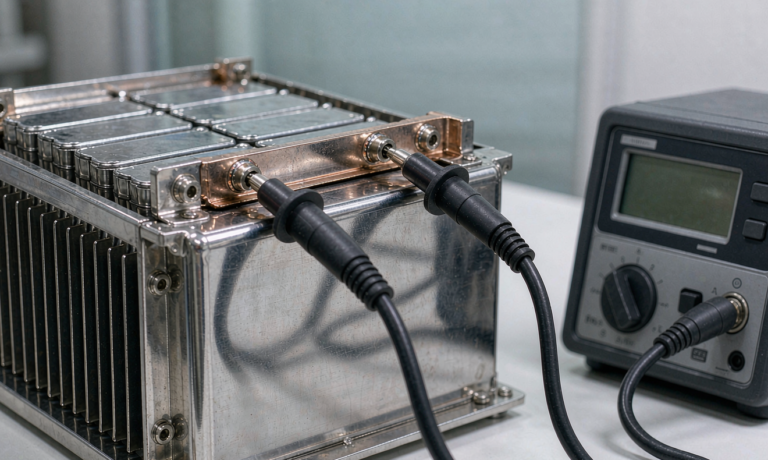
In our build process we grade cells to a capacity coefficient of variation under 6% and a DCIR (direct-current internal resistance) spread under 10%, measured with four-wire Kelvin contacts. That discipline is what keeps a 5 C start transient from collapsing the pack voltage. When a user asks for more hill-climbing authority, the answer is rarely a bigger battery; it is lower internal resistance and a busbar rated for the peak, not the cruise.
Cold-Weather Performance and Charge Lockout
Cold is the silent range killer. Below 0°C, lithium-ion capacity can fall to 70-80% of rated, and charge acceptance collapses. I spec a charge lockout below 0°C on every mobility pack, with a soft derate between 0°C and 5°C, because forcing current into a cold cell plates metallic lithium on the anode and permanently damages it. LFP actually discharges better in the cold than NMC, but its cold-charge limit is stricter, so the BMS logic has to be conservative.
For users in northern climates, I recommend a pack with a self-heating option or at least an insulated enclosure, and I always brief caregivers: charge indoors, ride outdoors. A lithium ion battery that is warm when you plug it in will both charge faster and live longer.
Cycle Life, Fade, and the Stranding Risk
A daily-charged mobility device accumulates roughly 365 cycles per year. An LFP pack rated for 2,000 cycles at 80% DoD is therefore good for about five to six years before it crosses the 80% state-of-health gate we use for retirement. The danger is not the sudden death; it is the slow fade that shorts the user’s range by 20% before anyone notices.
We combat this with a state-of-health model in the BMS that tracks capacity fade and internal-resistance growth, and we set a low-voltage cutoff that leaves a real reserve. The worst design I ever saw let the pack run to true empty, stranding the user and also deep-cycling the cells into early failure. A custom battery solution for a vulnerable user must hide a buffer the user can never accidentally consume.
Safety Architecture and the Standards Floor
Mobility aids sit at the intersection of consumer and medical regulation, so the standards stack is taller than people expect. The baseline I will not ship without:
- UN38.3 (T.1-T.8) – altitude simulation, thermal, vibration, shock, external short, impact/crush, overcharge, and forced discharge. This is the transport safety floor and a good proxy for mechanical ruggedness.
- IEC 62133-2 – safety requirements for portable secondary lithium cells and batteries, covering short-circuit, overcharge, and temperature abuse.
- IEC 60601-1 – the safety standard for medical electrical equipment; powered wheelchairs are medical devices in most markets, and this is where leakage current and enclosure requirements enter.
- ISO 7176 – the wheelchair-specific family of standards covering batteries and chargers for electrically powered wheelchairs.
- IEC 62619 / UL 2580 – industrial and electric-vehicle cell safety, used when the pack scales beyond a simple consumer form factor.
For air travel, I brief users on the FAA/EASA rules: spare lithium batteries must travel in carry-on, packs between 100 Wh and 160 Wh need airline approval, and mobility aids with batteries installed are generally permitted because the device is essential to the passenger. Knowing this ahead of a trip prevents a ruined vacation and a confiscated pack.
BMS Features That Actually Matter for Mobility
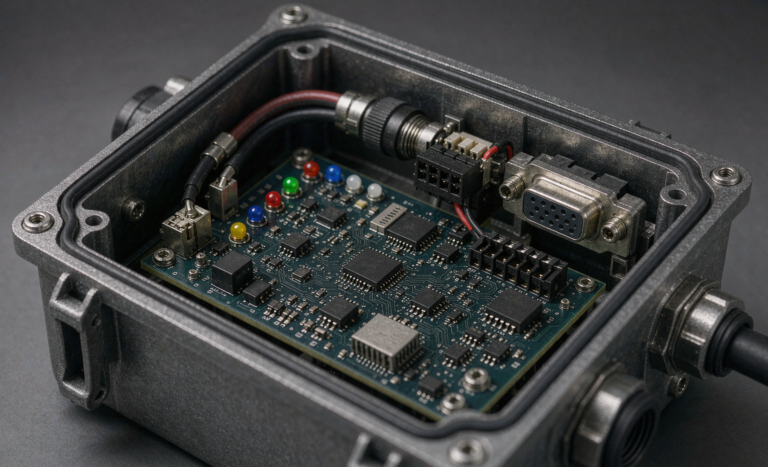
A generic protection board is not enough here. The BMS for a mobility device needs features tuned to the stranding-and-safety reality:
- Low-voltage cutoff with reserve buffer – disconnect before the user is truly stranded, leaving enough to crawl to a safe spot.
- Layered over-current protection – a 60 A class-T fuse plus electronic OCP that trips under 200 ms on a hard short.
- Pre-charge circuit – limits inrush when the pack mates with the controller, protecting both the connector and the capacitors.
- Cell balancing to ~20 mV – keeps the pack young and prevents one weak cell from dragging the string down.
- Thermal cutoff and fuel gauge – so the user sees remaining range, not a surprise.
I have borrowed the same high-rate cell discipline from our drone battery programs, where a 15-18 C transient is normal. The lessons transfer directly: grade the cells, weld the bus pure-nickel to under 0.15 mΩ per joint, and never trust a pack you have not burned in.
Frequently Asked Questions
How long does a mobility device lithium battery last?
With daily charging, an LFP pack typically delivers 5-6 years or 2,000+ cycles before dropping below 80% state of health. NMC lasts roughly 2-4 years. Real life depends on depth of discharge, ambient temperature, and whether the user charges indoors in the cold months.
Why does my scooter lose range in winter?
Cold reduces usable lithium-ion capacity to 70-80% below 0°C and slows charge acceptance. The fix is to keep the pack warm while charging and to size the battery with a winter margin if you live in a cold region.
Can I take a mobility scooter battery on a plane?
Under FAA/EASA rules, mobility aids with batteries installed are generally allowed, and spare packs between 100 Wh and 160 Wh need airline approval and must be in carry-on luggage. Always notify the airline in advance and carry the UN38.3 test summary.
Is LFP or NMC better for a wheelchair?
For most wheelchairs and heavy scooters, LFP is the safer, longer-lived choice thanks to its ~270°C thermal-runaway onset and 2,000-6,000 cycle life. Choose NMC only when minimum weight is genuinely critical, such as a foldable travel device.
What should I look for when buying a replacement pack?
Demand the UN38.3 and IEC 62133-2 documentation, confirm the BMS has a reserve-buffer low-voltage cutoff, and match the voltage platform (usually 24 V) and connector to your device. A reputable custom battery solution vendor will give you the cell-grade report, not just a sticker.