Semi-Solid State Battery Certification and Transport Guide
I have shipped semi-solid state cells to test houses and customers on four continents, and the same conversation happens every time. A procurement team hears the word “solid” and assumes the dangerous-goods rules that govern liquid-electrolyte lithium cells no longer apply. They do. A semi-solid state battery is still a rechargeable lithium-ion cell under every transport regulation that matters, because it still contains a lithium-intercalating anode, a transition-metal oxide cathode, and an organic electrolyte phase. What changes is the amount of free liquid: we take it from 20-30 wt% in a conventional cell down to 8-14 wt% in a gel or semi-solid system. That reduction changes abuse behaviour, and it changes what a certifier will ask you to declare, but it does not change the classification.
In this guide I walk through the path I use: the UN38.3 test matrix, how to pick the right UN number and packing instruction, where shipments actually fail, which product standards sit behind the transport paperwork, and how to plan 90 days of work without discovering in week eleven that a design change voided the report.
Why “Semi-Solid” Does Not Exempt You From Lithium Rules
Neither the UN Model Regulations, the ICAO Technical Instructions, the IMDG Code, nor 49 CFR contains a definition of “solid-state battery“. They define a lithium-ion cell by construction: a rechargeable unit where lithium ions move between electrodes through a non-aqueous electrolyte. A gel polymer or semi-solid electrolyte is still non-aqueous, so unless you have gone all the way to a ceramic or sulfide separator with no organic phase, you are shipping a lithium-ion cell.
Two consequences follow. First, the full UN38.3 test matrix applies, including the abuse tests that assume an electrolyte can vent. Second, you must declare electrolyte content and composition, because laboratories now ask for it explicitly when a pouch cell does not behave like a conventional one during crush testing. A semi-solid cell vents later than a comparable NMC811 cell – typically 40 to 70 seconds from nail penetration against under 60 seconds – but it still vents, and the report has to say so.
The reduced free-liquid content is a genuine safety argument once you have data. Accelerating-rate calorimetry puts self-heating onset at 165-180 C for our semi-solid cells, against 110-140 C for NMC811 and around 250 C for LFP, with peak runaway temperature at 550-650 C. That helps the thermal-propagation narrative under IEC 62619 and UL 9540A, but it does not shortcut UN38.3.
The UN38.3 Test Matrix, Test by Test
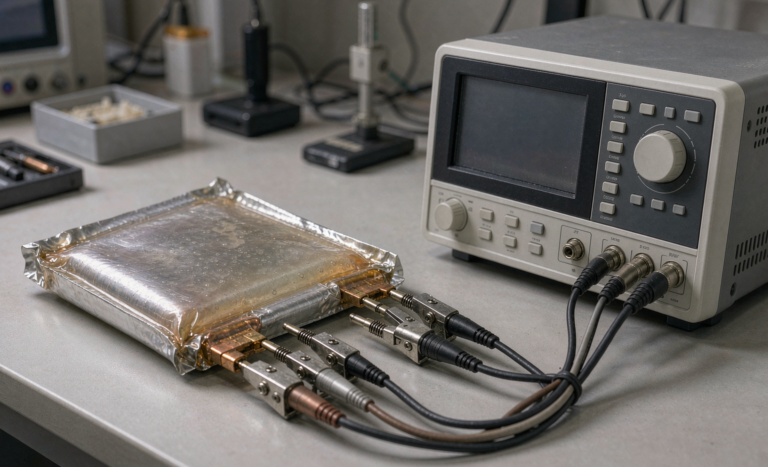
UN38.3 is eight tests, T1 through T8, run on cells and separately on batteries. The Manual of Tests and Criteria sets pass criteria that I summarise as: no mass loss beyond tolerance, no leakage, no venting, no disassembly, no rupture, and no fire, with an external case temperature ceiling of 170 C.
- T1 altitude simulation. The cell sits at 11.6 kPa or less for at least six hours at ambient temperature. This is roughly the pressure at 15,000 m. For a semi-solid pouch this is where I see the first real difference: with only 8-14 wt% free liquid there is less to flash-boil, so swell is smaller, but gel delamination from the electrode stack can show up as a capacity step in the post-test check.
- T2 thermal cycling. Six hours at 72 C, six hours at minus 40 C, ten cycles, transitions capped at 30 minutes. If your polymer host has a glass transition near minus 20 C you will see impedance climb, and the fix is the formulation, not the test plan.
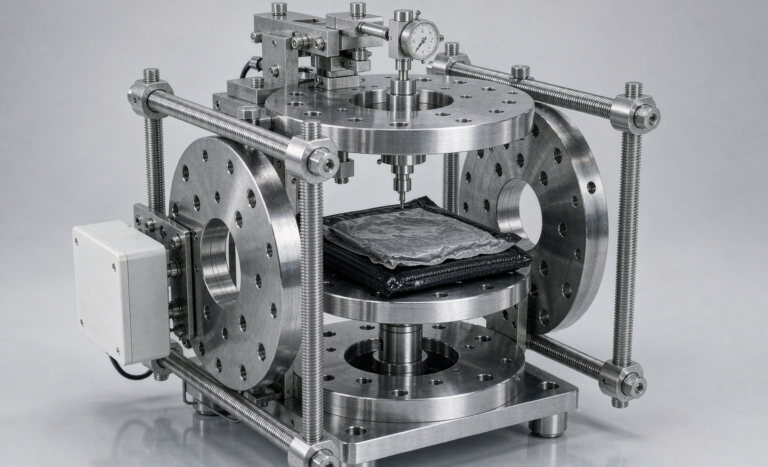
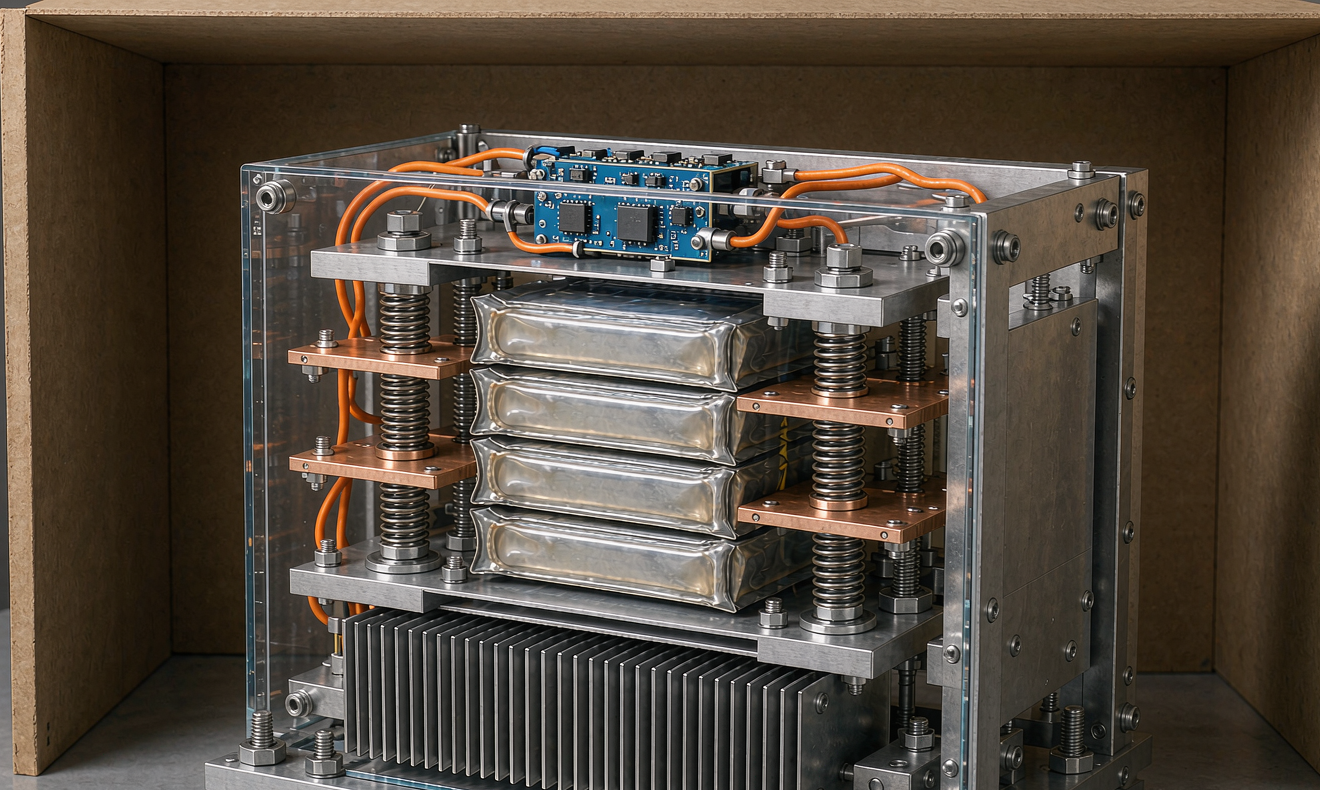
- T3 vibration. A sinusoidal logarithmic sweep from 7 Hz to 200 Hz and back, 15 minutes per sweep, twelve sweeps, three hours total. This is the test that catches bad stack-pressure hardware. Our cells want 0.1-0.5 MPa of compression; a foam pad that has already relaxed 15-25 percent over 1000 cycles will not hold it.
- T4 shock. Half-sine pulse, 150 g peak for 6 ms on small cells, or 50 g for 11 ms on large cells, three pulses in each direction on each axis.
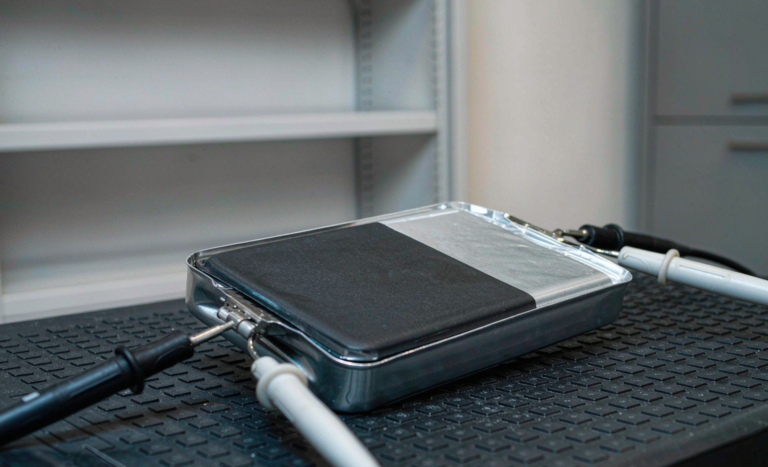
- T5 external short circuit. At 55 C, total external resistance under 0.1 ohm, held until the case returns to within a couple of degrees of ambient or the test window expires. Gel electrolytes slow the current spike measurably, which is one of the few places semi-solid genuinely outperforms liquid.
- T6 impact or crush. Cylindrical cells above 18 mm diameter take the 9.1 kg drop weight from 610 mm; prismatic, pouch and coin cells take a 13 kN crush at roughly 0.78 kN tolerance, released when peak force is reached or the voltage drops by one third.
- T7 overcharge. Charged at twice the maximum continuous charge current the manufacturer specifies. Semi-solid cells have slightly lower first-cycle efficiency – 88-93 percent against 94-96 percent for liquid NMC – so the coulombic balance differs enough that I always pre-screen before booking lab time.
- T8 forced discharge. The cell is driven into reverse at 1 C. This one is about internal construction, not chemistry.
Across our submissions, open-circuit voltage retention after T3 and T4 is 98.5-99.7 percent against a 90 percent pass bar, with mass loss under 0.1 percent. Book four to eight weeks of laboratory time and budget 24 to 40 cells plus 8 to 16 batteries per variant.
Picking the Right UN Number and Packing Instruction
Start with the watt-hour rating: nominal voltage multiplied by rated capacity in ampere-hours. A single cell above 20 Wh, or a battery above 100 Wh, moves you out of the excepted category and into full Class 9 regulation. Most semi-solid pouch cells we build for aviation and defence customers are 45-120 Wh, so they land in the fully regulated category immediately.
Then choose the UN number. UN3480 covers lithium-ion cells and batteries shipped on their own; UN3481 covers them packed with, or contained in, equipment; UN3171 covers battery-powered vehicles and is not a shortcut for spare packs. If you also ship sodium-ion product, note that UN3551 and UN3552 exist for sodium cells and batteries, and several authorities made those mandatory from 1 January 2026.
Under IATA, PI965 governs UN3480, PI966 governs packed-with, and PI967 governs contained-in. Sections IA and IB require the Class 9 lithium battery mark, a shipper’s declaration, UN-specification packaging, and for cargo aircraft a 35 kg net mass limit per package. Section II is the small-cell exception, capped at 2.7 kg per cell and 11 kg per battery. Claiming Section II for a 60 Wh cell is the most common misdeclaration I see, and it is the one that gets a consignment pulled in Frankfurt or Hong Kong.
Packaging qualification is its own small project: 1.2 m drop test, stacking test, and sometimes a vibration test on the loaded crate. I specify an inner tray that restrains the stack-pressure fixture as well as the cell, because a cell that arrives decompressed has effectively failed its own T3 qualification.
Air, Sea and Road: Where Shipments Actually Fail
Mode matters more than most engineers expect. Air freight under IATA requires UN3480 consignments to sit at no more than 30 percent state of charge, and the shipper must evidence it. Air takes eight to fourteen days door to door but costs six to ten times sea per kilogram plus a dangerous-goods surcharge.
Sea under the IMDG Code has no numeric state-of-charge limit for UN3480 shipped under special provision 188, though stowage is strict: category A, away from heat, with segregation rules. Transit is 30 to 45 days from China to Europe, and I prefer it for samples that are not schedule-critical because a container is gentler on packaging than an air hub’s transfer belt.
Road and rail – ADR in Europe, 49 CFR 173.185 in the United States – follow the same philosophy. The failures I have investigated cluster in five places: state-of-charge evidence that does not match reality, a missing UN38.3 test summary, a watt-hour figure on the label that disagrees with the spec sheet, outer packaging crushed in transshipment, and a lithium battery mark on the outer box but not the inner one.
The state-of-charge item deserves emphasis, because a BMS reading is not evidence. I take a coulomb-count log plus a 30-minute rest open-circuit reading and put both in the shipment file.
Product Certification: IEC, UL, CB and the EU Battery Regulation
Transport paperwork gets the cell on the plane; product certification gets it sold. For portable applications the baseline is IEC 62133-2, which covers cells and batteries as a pair. For industrial and stationary use it is IEC 62619. In North America the conversation is UL 1642 for cells, UL 2054 for batteries, UL 1973 for stationary, and UL 9540 with 9540A for storage systems.
Run these under the IECEE CB Scheme and you test once, receive a CB test certificate and report, then clear national deviations instead of repeating everything – typically 30 to 50 percent cheaper. Budget USD 8,000-15,000 and 10-16 weeks for IEC 62133-2 on a cell plus battery, USD 6,000-12,000 and four to eight weeks for UN38.3, and USD 30,000-60,000 if UL 1973 is in scope. A first-time package for one cell design runs USD 40,000-90,000.
Then there is EU Regulation 2023/1542, the part most suppliers still underestimate. Carbon-footprint declarations have been required since 18 February 2025 for EV, light-means-of-transport and industrial batteries above 2 kWh, with due diligence from August 2025. The digital battery passport becomes mandatory on 18 February 2027, and recycled-content targets – 16 percent cobalt, 85 percent lead, 6 percent lithium, 6 percent nickel – arrive in August 2031. If you sell semi-solid cells into Europe, structure material provenance and carbon data now.
Outside Europe: KC in Korea, PSE under METI in Japan, BIS against IS 16046-2 in India, GB 31241 in China for portable. Each adds weeks, so sequence them by market size.
The Documentation Package Auditors Accept
When a competent authority or a customer’s quality team asks for the file, this is what I hand over, in this order: the UN38.3 test summary, which has been mandatory to make available since January 2020; the full cell and battery specification with watt-hour rating, nominal voltage, chemistry and mass; the IEC 62133-2 or IEC 62619 CB report; a 16-section safety data sheet; the transport declaration; and the declaration of conformity.
Two items are specific to semi-solid technology and I add them every time. The first is a free-electrolyte declaration by weight plus the gel composition summary. The second is a stack-pressure and handling sheet stating the 0.1-0.5 MPa window, what happens below 0.05 MPa – interfacial impedance rises 30-60 percent – and what happens above 1.0 MPa, where gel is squeezed out of the separator pores and rate capability falls. Anyone receiving the cells needs that sheet, because the failure is invisible: the pack looks perfect and simply loses cycle life.
I also include storage conditions: 30-60 percent state of charge, 15-25 C, below 65 percent relative humidity. At 100 percent SOC and 40 C a semi-solid cell loses 9-11 percent of capacity a year; at 30-60 percent and 25 C calendar fade is 1.5-2.5 percent. That gap is the whole argument for shipping at partial charge.
Semi-Solid Failure Modes We Design Around Before Shipping
Low pressure comes first. A cargo hold runs around 75 kPa and T1 takes the cell to 11.6 kPa. Pouch swell is smaller than in a liquid cell, but gel delamination is real, so we ship with a compression plate and a controlled vent path rather than trusting the pouch seal.
Cold is second. T2 goes to minus 40 C and ground handling on northern routes in January can beat that. The protection that matters is a charge interlock, because charging below 5 C plates lithium – visible as coulombic efficiency falling under 99.5 percent and 1 kHz impedance rising 8-12 percent per 100 cycles.
Vibration is third, and it is a hardware problem more than a chemistry one. The compression fixture has to survive T3 and then survive a forklift. We use wave springs rather than foam for anything shipped as a spare, because foam relaxation of 15-25 percent over 1000 cycles costs 8-12 points of end-of-life capacity retention.
A 90-Day Certification Plan for a New Semi-Solid Cell
Weeks one and two are gap analysis and, critically, design freeze. UN38.3 must be repeated after a design change, and the definition of change is broader than most teams assume – electrode loading, separator supplier, electrolyte tolerances and enclosure geometry all count. Freeze it or you pay twice.
Weeks three to eight: UN38.3 T1-T8 at a third-party laboratory. Weeks four to ten in parallel: IEC 62133-2 or IEC 62619. Weeks ten to fourteen: CB conversion and national deviations. Weeks twelve to sixteen: safety data sheet, labels, and packaging qualification. Order at least 1.5 times the samples you think you need – the expensive outcome is a four-week queue slot missed because cells were short.
Frequently Asked Questions
Is a semi-solid state battery exempt from lithium transport rules?
No. It remains a lithium-ion cell under the UN Model Regulations because it contains a non-aqueous electrolyte phase. Only a fully inorganic all-solid-state cell would raise the question, and no transport regulation defines an exemption today.
At what state of charge must semi-solid cells be shipped by air?
For UN3480 by air under IATA, no more than 30 percent state of charge, and you must be able to evidence it. Sea and road consignments under the relevant special provisions have no numeric limit, but shipping at 30-60 percent is still good practice because it minimises both calendar fade and mechanical swell.
Does UN38.3 need to be repeated after a design change?
Yes, if the change touches chemistry, electrode loading, separator, enclosure geometry or rated capacity. In practice I treat any bill-of-materials change inside the cell as a trigger and re-run T1-T8 rather than argue about materiality.
How long does UN38.3 plus IEC 62133-2 certification take?
Roughly 12 to 16 weeks end to end if the two programmes run in parallel: four to eight weeks for UN38.3 and 10 to 16 weeks for IEC 62133-2, plus CB conversion and any national deviations on top.
Can semi-solid packs ship by sea above 30 percent state of charge?
Yes under IMDG special provision 188 for UN3480, subject to packaging, marking and stowage category A requirements. Confirm the carrier’s own policy first, because several lines apply a 30 percent rule voluntarily.
What is the difference between UN3480 and UN3481?
UN3480 is for lithium-ion cells and batteries shipped on their own. UN3481 covers the same products packed with equipment, or contained in equipment. The packing instruction and the documentation differ, and declaring the wrong one is a common cause of detained consignments.
Does the EU digital battery passport apply to semi-solid cells?
From 18 February 2027 it applies to industrial batteries above 2 kWh, LMT batteries and EV batteries, regardless of electrolyte type. The supporting carbon-footprint declaration has been required since February 2025 and due-diligence obligations since August 2025.
How much does certification cost for one new semi-solid cell design?
Budget USD 40,000-90,000 for a first-time package covering UN38.3, IEC 62133-2 or IEC 62619, CB conversion and packaging qualification; UL 1973 or UL 9540A moves it higher.
Further Reading
References