Battery Solution for Mobile Banking and Pop-Up Retail
I have spent much of the last six years specifying packs for two customers who look nothing alike on paper but need exactly the same thing: a mobile banking van that parks in a village with no reliable grid, and a branded pop-up stall inside a shopping centre for a ten-day activation. Both need quiet, clean, transportable power that starts the moment the shutter goes up and never drops out mid-transaction. Both are told that a small petrol generator will do. Both come back after one season asking for a proper battery solution for mobile banking and pop-up retail duty.
This guide covers the load audit, the sizing arithmetic, the peak-power trap that kills most first attempts, chemistry selection, thermal and transport realities, the certification list, and the acceptance tests I insist on before a unit goes into the field.
Why These Two Applications Break the Generator Assumption
A generator is the default answer because it is cheap to buy. The problems only appear in operation. A petrol inverter generator runs at 60-75 dB(A) at seven metres, which is louder than conversation at one metre; in a village banking queue or a covered market that is the difference between a usable counter and an unusable one. Most indoor malls ban combustion equipment outright, and a growing number of pedestrian zones restrict it.
There is also a reliability argument that matters more in banking than in retail. A card terminal that loses power mid-authorisation creates a reconciliation discrepancy the branch has to chase manually. A VSAT or LTE link dropping during a sync window can leave a day of transactions unbatched. Generators are good at steady load and poor at fast steps: an espresso pump kicking in, a printer firing, a cash recycler spinning up. A battery system handles those in milliseconds and holds voltage and frequency through them.
Load Audit: What a Van or Stall Actually Draws
Every project starts with a one-day power log at one-second resolution, not a nameplate survey, because almost every device here is intermittent.
- POS or card terminal: 5-15 W continuous, 20-30 W while printing
- Laptop or tablet: 30-65 W running, 65-100 W charging over USB-C PD
- LTE or 5G router: 10-20 W; a VSAT terminal with BUC is 40-120 W
- Biometric capture device: 5-15 W
- Receipt or label printer: 20-40 W average, 60-100 W for seconds per print
- Cash recycler or compact ATM module: 200-500 W, 700-900 W peaks on shutter and dispenser motors
- LED lighting and signage: 30-80 W; a small LED video wall is 150-400 W per square metre
- Espresso machine: 1200-1800 W element, 20-30% duty once hot, plus a pump surge
- Small display fridge: 40-80 W average with 3-5x compressor inrush
- PA or small sound rig: 100-300 W programme
The shape of the day matters as much as the total. A mobile banking van runs a 250-350 W baseline for eight to nine hours with a 700-900 W peak every few minutes when the recycler cycles. A coffee-and-retail pop-up has a 300 W baseline but a 1.5-1.8 kW element switching all day and a 2-3 kW combined peak when boiler, fridge compressor and sound system coincide.
Sizing the Pack: The Arithmetic I Use on Every Project
Work from usable energy at the load and then divide by every derating factor, not the other way round: depth of discharge, conversion efficiency, end-of-life capacity, and a temperature margin when it applies.
Example A – mobile banking van. Baseline 300 W for nine hours is 2.7 kWh; VSAT at 80 W adds 0.72 kWh; printing and recycler bursts 0.6 kWh; lighting 0.5 kWh; small fridge 0.5 kWh. Usable energy is about 5.0 kWh. Then 5.0 / 0.90 DoD / 0.92 inverter / 0.80 end-of-life = 7.5 kWh nominal. I quote 7.5-8 kWh, and that gap is exactly where first-time specifiers get burned.
Example B – coffee and retail pop-up. Espresso machine 1600 W at 25% duty over eight hours is 3.2 kWh, lighting 0.5, fridge 0.5, POS and router 1.0, sound 250 W at 40% duty 0.8. Usable is about 6.0 kWh, so 6.0 / 0.90 / 0.92 / 0.80 = 9.0 kWh nominal. Add 10% if the stall sits above 35 degrees most of the day.
The other half of sizing is power. Example A needs a 1.5 kW continuous inverter with 3 kW surge for the recycler. Example B needs 3 kW continuous and 6 kW for three seconds. A pack that meets the energy number with a 1 kW inverter trips on the first cappuccino.
Peak Power and Waveform: The Espresso Machine Problem
Heating elements are easy; they are resistive and forgiving. The pump and compressor are not. A small vibratory or rotary pump draws 3-6 times running current for 80-300 ms, and a compressor locked-rotor inrush is 3-5 times for 100-400 ms. Budget surge at 2x rated for three seconds and 1.5x for five minutes, and verify on a bench with the real appliance. I have watched a “2 kW” unit pass a resistive test at 2.2 kW and trip instantly on a 900 W espresso machine.
Waveform is the second trap. Modified sine wave inverters cause three specific failures: audio systems hum, thermal and label printers run hot or mis-feed, and switched-mode supplies in VSAT and payment hardware draw distorted current that ages DC-link capacitors. Specify pure sine wave with total harmonic distortion under 3% at rated load and under 5% near surge, measured on battery rather than on bypass.
Transfer time matters for banking. Most payment terminals ride through a 4-10 ms transfer, but some legacy cash recyclers do not. For anything holding open transactions I specify always-online double conversion or a static switch with a measured sub-8 ms transfer, tested with the real terminal in the loop.
Choosing the Cell Chemistry: LFP, NMC or Sodium-Ion
LFP is my default for both applications, and the reason is thermal margin rather than energy density. LFP gives 150-180 Wh/kg at cell level, 4000-6000 cycles to 80% capacity at 0.5C and 25 degrees, and accelerating rate calorimetry self-heating onset around 250 degrees Celsius. NMC 811 gives 240-280 Wh/kg, 2000-3000 cycles and onset around 110-140 degrees. In a van closed up in the sun, that difference is the whole argument.
NMC earns its place in one narrow case: a carry-in unit where the crew lifts it up stairs or carries it 200 metres from a loading bay, so every kilogram counts. I only specify it with a hard 45 degree cell-temperature cut-off and an explicit instruction never to store it in a vehicle.
Sodium-ion is genuinely interesting for winter markets and cold-climate rural banking. Layered-oxide sodium cells hold 85-92% of room-temperature capacity at minus 20 degrees and, more importantly, accept charge at temperatures where a lithium cell would plate. Round-trip efficiency is 88-92% against 93-96% for LFP, and the enclosure grows 25-40% for the same energy. Below about minus 10 degrees that trade is usually worth it.
Whichever chemistry you choose, store and ship at 30-60% state of charge. Fade at 25 degrees and 50% SOC runs 1.5-2.5% per year; at 100% SOC and 40 degrees I measured 9-11% in a single year on two instrumented fleets.
Portability, Weight and Manual Handling Limits
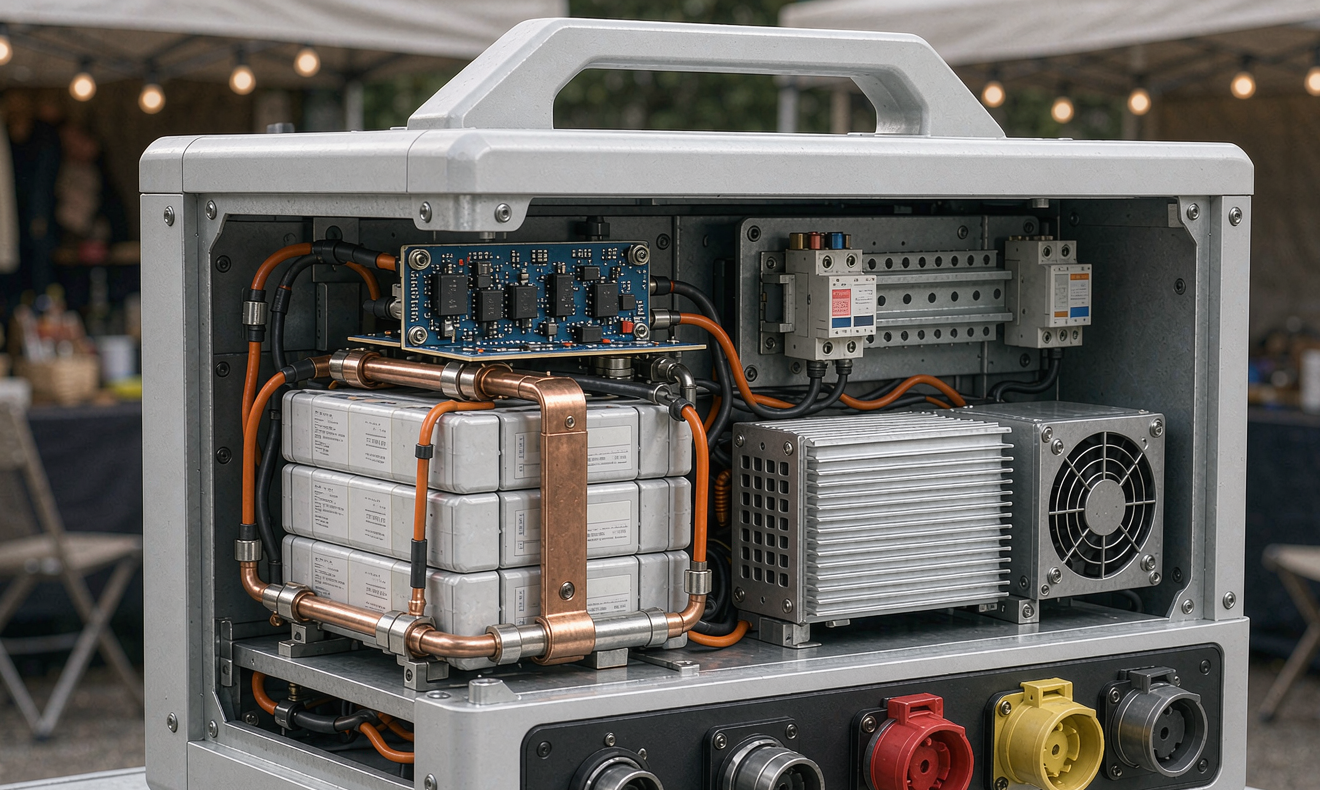
A 7.5 kWh LFP pack with enclosure, inverter and BMS lands around 70-90 kg. That is a two-person lift at best and a back injury at worst. My rule is that no module a crew lifts exceeds 25 kg, roughly where occupational manual-handling guidance tightens for frequent lifting. The 7.5 kWh system becomes three 2.5 kWh modules on a wheeled cart, or two modules plus a fixed inverter head, and the crew wheels it.
Use 125 mm or larger polyurethane-tyred wheels with sealed bearings; cobbles, gravel and kerbs destroy small plastic castors within weeks. If the unit travels in a vehicle it needs rated tie-down points and restraint for a 20 g frontal load, because in a crash an 80 kg battery becomes the heaviest object in the cabin. Add a locking bracket or ground anchor, a hidden GPS tracker with its own backup cell, and a mechanical lock that is not the same key across the fleet.
Heat, Ventilation and Where Not to Put the Pack
The two worst requests I get are to install inside a closed van in direct sun and inside a sealed display cabinet. A closed panel van in 34 degree ambient reaches 55-65 degrees at roof height within an hour. Cycle life at 45 degrees cell temperature drops below 2000 against 4000-6000 at 25 degrees, so a pack that should last eight seasons lasts three.
Mitigation in order of value per dollar: park in shade or use a reflective screen; keep the pack low and away from roof and wheel arches; cross-ventilate through filtered intakes; add a fan that pulls outside air rather than recirculating cabin air. Compressor cooling earns its keep above 45 degrees ambient but needs 150-400 W and a condensate path. I refuse Peltier coolers above about 200 W of heat load; at a coefficient of performance of 0.5-0.7 they add more heat than they move once supply losses are counted.
IP54 is the minimum for an outdoor stall, IP65 for coastal or dusty sites. Every enclosure I build gets an ePTFE hydrophobic vent, because a sealed box cycling through a 25 K daily swing pulls in moisture, and I have opened units holding 40 ml of water after one year.
Charging Strategy: Depot Mains, Solar, Alternator and Backup
Most units charge overnight at a depot, which is the cheapest energy they will see. A 7.5 kWh pack at 0.2-0.3C needs 1.5-2.2 kW, well inside a standard 10-16 A circuit. Charge slower where you can: I cap routine charging at 0.3C and reserve 0.5C for turnarounds.
Solar helps but is consistently oversold. A 400 W foldable panel delivers 1.6-2.4 kWh a day after 25-35% losses, which covers a 300 W mobile banking baseline almost exactly and almost none of a 6 kWh coffee day. Size solar against the baseline, never the peak.
Vehicle alternator charging through a 12 or 24 V DC-DC charger at 20-40 A is the unsung hero here; it turns drive time between villages into free energy. Make it ignition-sensed with a low-voltage disconnect or you will eventually strand the van. Keep a small generator for multi-day sites, but size it as a charger rather than a load carrier: 2 kW feeding the battery in one efficient window beats 3 kW carrying the stall all day.
Safety, Certification and Public-Access Requirements
Portable power equipment for this market should carry UL 2743 for portable power packs in North America, IEC 62133-2 for cells and packs, IEC 62619 for semi-fixed industrial use, and UL 1973 or UL 9540 with 9540A where a large wheeled unit is treated as stationary storage. Transport is governed by UN38.3 with the test summary on file and 30% SOC or less under UN3480; a unit permanently built into a vehicle falls under UN3171.
Publicly accessible sockets change the safety picture. Any outlet a member of the public can reach needs 30 mA RCD or GFCI protection, IP44 or better with spring-loaded caps, and a cable route that does not cross a walking area. Two insurance claims I know of from a single season of pop-up work both came from trailing cables, and neither involved the battery.
Electromagnetic compatibility matters more than expected. A cheap inverter emitting conducted noise will interfere with payment terminals and venue audio. Require IEC 61000-6-3 and IEC 61000-6-1 and, for banking, run a site test with the terminal and router on battery before the first customer arrives.
Commissioning and Acceptance Tests
Six tests, in order, before a unit goes into service. Each one has caught a real defect in my own builds.
- Insulation resistance: 500 V megohmmeter between pack terminals and enclosure. Accept above 100 MΩ; do not energise below 10 MΩ. A reading of 1-10 MΩ is almost always a failed vent or moisture, not a cell fault.
- Cell balance: charge to full, rest two hours, measure delta. Under 30 mV to accept, under 15 mV on a fresh pack, above 50 mV is a fault. A delta that appears only under load is connection resistance, not cells.
- Capacity: discharge at 0.2C to cut-off and compare to nameplate. Accept at 95% or better.
- Step load: apply the worst real load from zero, measure sag and recovery on a scope. Dip under 10%, recovery under 50 ms, no BMS trip. Use the espresso machine or the recycler, not a resistor bank.
- Thermal survey: full load for 30 minutes, image every joint. Re-torque anything more than 15 K above its neighbour.
- Low-temperature lockout: confirm charging is inhibited below 0 degrees and that any heating pad brings cells above 5 degrees before current flows.
Frequently Asked Questions
How much battery capacity does a mobile banking van really need?
For terminals, router or VSAT, printer, lighting and a small cash recycler over nine hours, usable energy at the AC load lands near 5 kWh. Divided by depth of discharge, inverter efficiency and end-of-life capacity, that means roughly 7.5-8 kWh nominal. Add air conditioning or a full ATM and double it.
Can a portable power station run an espresso machine at a pop-up stall?
Yes, but only if the inverter is sized for surge rather than running power. A 1600 W machine with its pump needs about 3 kW continuous and 6 kW for three seconds, pure sine wave. Most failures are a 2 kW unit that passes a resistive bench test and trips on the first milk froth.
Is LFP always the right chemistry for these applications?
LFP is the right default for thermal margin, 4000-6000 cycles and self-heating onset near 250 degrees Celsius. Choose NMC only when crew-carry weight dominates and a 45 degree limit can be enforced. Choose sodium-ion for sustained sub-zero work where low-temperature charging matters more than enclosure size.
How long will a pop-up retail battery pack last in real service?
At 25 degrees and 90% depth of discharge, LFP gives 4000-6000 cycles, which is eight to twelve seasons of weekend use. At 35 degrees that falls to 3500-4000 and above 45 degrees below 2000. Storage state of charge is the variable most operators get wrong.
Do I need solar panels on a mobile banking unit?
For the baseline, not the peaks. A 400 W foldable panel yields 1.6-2.4 kWh per day, covering a 300 W baseline almost exactly and very little of a heating-dominated retail load. Use depot mains or the alternator for the rest.
What certifications should a portable battery solution for public-facing sites carry?
UL 2743 for the portable power pack, IEC 62133-2 for cells and battery, IEC 62619 for semi-fixed use, UL 1973 or UL 9540 with 9540A for large wheeled units, UN38.3 with a test summary for transport, plus IEC 61000-6-3 and 61000-6-1 for compatibility with payment hardware.
How heavy is a 7.5 kWh portable system and can one person move it?
Expect 70-90 kg including enclosure and inverter. It should never be a one-person lift. Split it into modules under 25 kg each on a cart with 125 mm or larger polyurethane wheels, and provide rated tie-down points for vehicle transport.
Is a battery system actually cheaper than a petrol generator for a market stall?
On running cost, yes. A generator uses 5-8 litres a day, roughly $7-13, plus service every 100-200 hours, against under two dollars of mains electricity for the same throughput. Capital cost is several times higher, but most operators recover the difference in two to three seasons, and the deal is usually closed by noise and emissions rules rather than the fuel bill.
Further Reading
References