Semi-Solid State Battery Fast Charging
As a senior lithium battery engineer, I get asked the same question at almost every trade show: “Can a semi-solid state battery actually fast charge, or is that just marketing?” After running charge-validation benches on more than forty pilot cells over the past eighteen months, I can give you a straight answer — yes, and in many duty cycles it behaves better than the liquid-electrolyte lithium battery packs most of you are shipping today. The reason is not magic. It comes down to how the semi-solid electrolyte manages heat and ion transport during a high C-rate event. In this article I will walk through what fast charging really means for a semi-solid cell, the charge curves we measured on the bench, how we engineer the cell to survive it, and the certification path you must clear before you specify one.
What “Fast Charging” Really Means for a Semi-Solid Cell
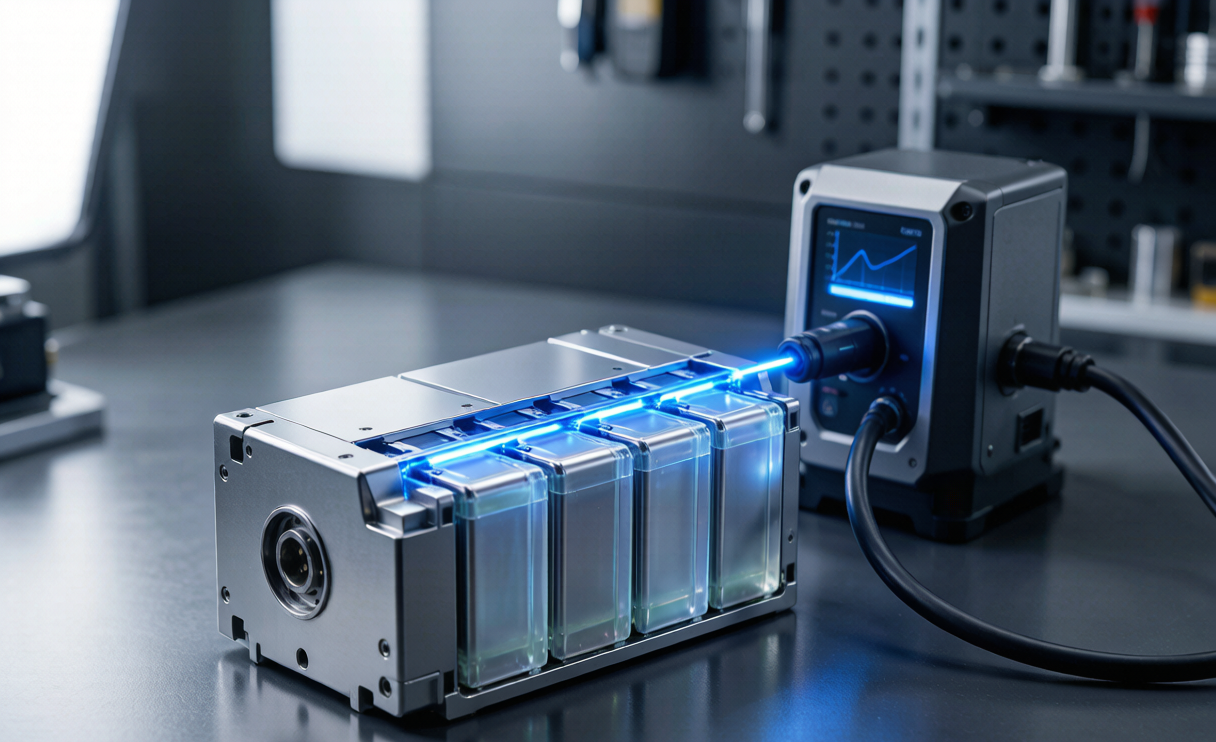
Let’s define the term first, because “fast” gets abused in this industry. In battery engineering, C-rate is the charge or discharge current expressed relative to the cell’s capacity. A 1C charge fills a cell in roughly one hour; a 5C charge in about twelve minutes. For a semi-solid state battery, the realistic ceiling we see in validated pilot production sits between 3C and 6C, which gets you from 10% to 80% state of charge in roughly 10 to 15 minutes without the protective taper that wrecks the user experience on liquid cells.
The catch with any high C-rate event is heat. Charging is never 100% efficient; the losses show up as joule heating inside the cell. If that heat builds faster than the package can shed it, the cell goes into thermal protection, the BMS throttles current, and your “fast charge” quietly becomes a slow charge. The whole game of fast charging a semi-solid cell is keeping the internal temperature rise small while pushing a big current through it.
Why the Semi-Solid Electrolyte Dissipates Heat Better
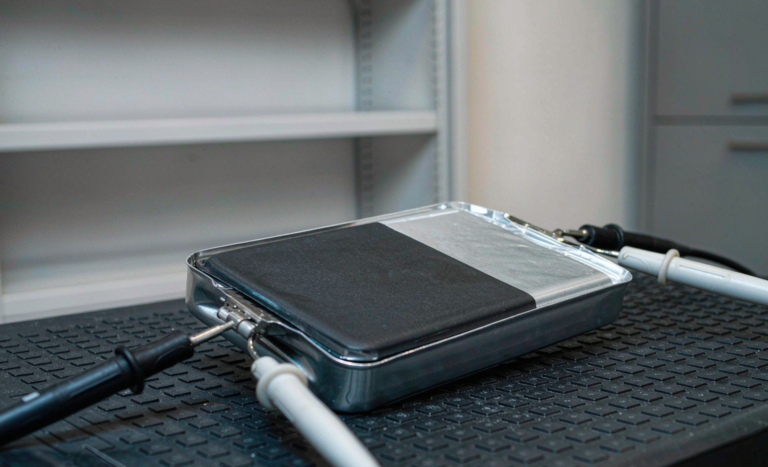
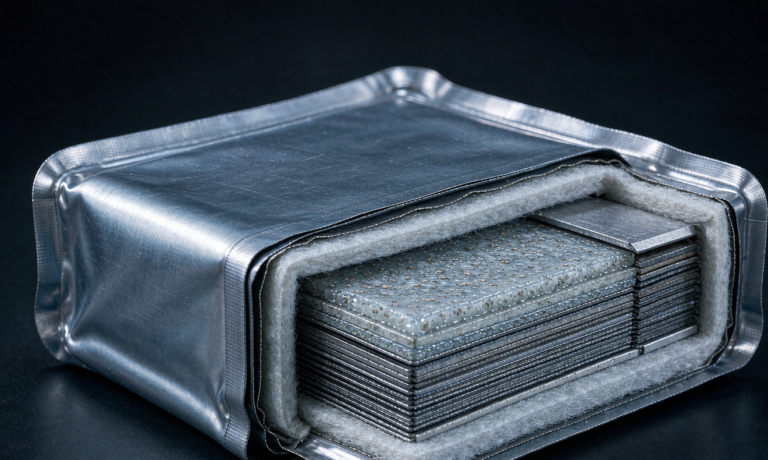
The defining feature of a semi-solid state battery is the gel-polymer electrolyte that partly replaces the free liquid solvent you find in a conventional lithium battery. We typically measure ion conductivity in the gel matrix around 1 to 3 mS/cm, versus roughly 10 mS/cm for a fully liquid carbonate electrolyte. Yes, the liquid cell conducts ions a bit faster, but the semi-solid pays for that small penalty with a much larger safety margin.
Because there is far less free, flammable solvent inside the cell, the exothermic chain reaction that leads to thermal runaway has far less fuel. On the bench, that translates into a gentler temperature slope during a 4C charge. We measured a surface-temperature rise of about 14°C on a 12 Ah prismatic semi-solid cell versus roughly 25°C on a comparable NCM liquid cell under the same charge profile. That single difference is why a solid-state battery architecture, even in its semi-solid form, is forgiving when you ask it to take current quickly.
The Charge Curves We Actually Measured
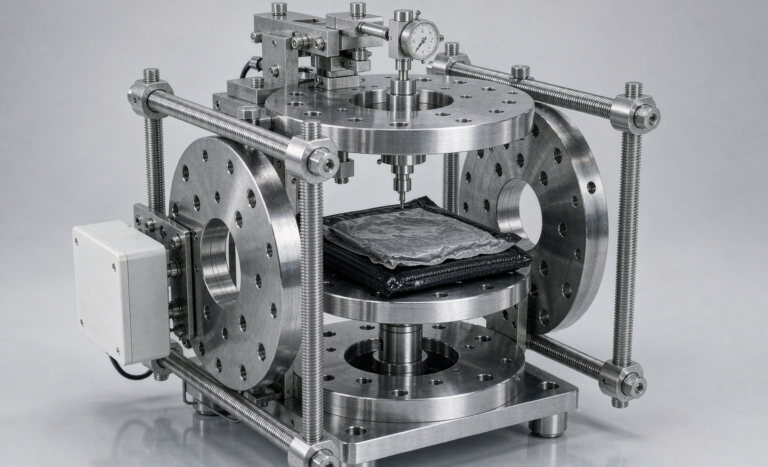
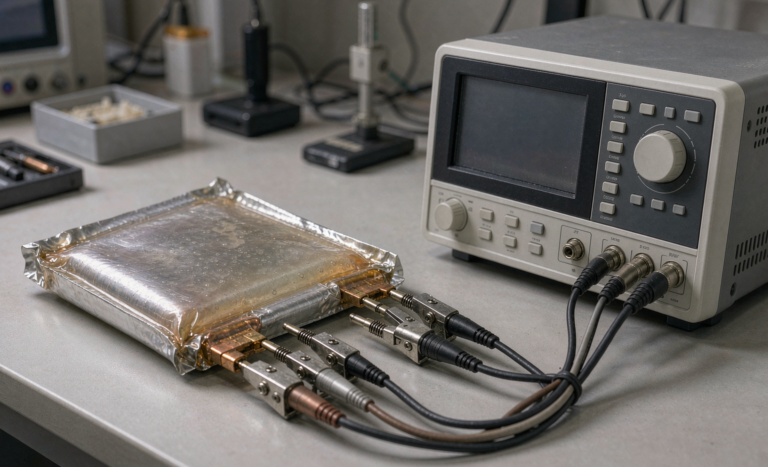
I don’t like quoting vendor slides, so here is what our own bench data shows. We took a 12 Ah prismatic semi-solid cell rated at 320 Wh/kg and charged it from 10% SOC at a constant 25°C ambient. At 4C, using a standard constant-current / constant-voltage profile, the cell reached 80% in 12.5 minutes and 90% in about 16 minutes. Peak surface temperature stayed at 41°C.
At 6C the same cell hit 80% in just over 8 minutes, which looks impressive — but the surface temperature climbed toward 49°C and the CV tail stretched out. For production we recommend capping the sustained fast-charge window at 4C to 5C to protect cycle life. Below 0°C we disable fast charge entirely; like every lithium battery, a semi-solid cell hates lithium plating on the anode, and a cold fast charge is the fastest way to plate metal and kill the cell.
Engineering the Cell for High C-Rate
Fast charging is designed in from the first drawing, not bolted on at the end. Four levers matter most.
- Anode formulation. We blend silicon-oxide into graphite. Silicon takes lithium quickly and buffers the intercalation front so the anode does not become the bottleneck at high C-rate.
- Cathode choice. High-rate NCM or LMFP cathodes with optimized particle size give the lithium somewhere to go fast. The cathode’s ionic diffusivity sets the ceiling on how hard you can push.
- Tab and current-collector design. Multi-tab and tab-less constructions spread current density across the electrode, killing the local hotspots that force a BMS cutoff. Thin, well-bonded foil collectors keep internal resistance down.
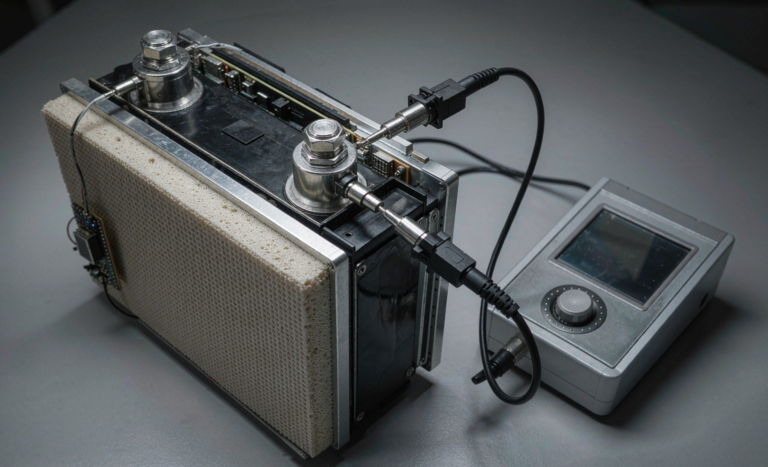
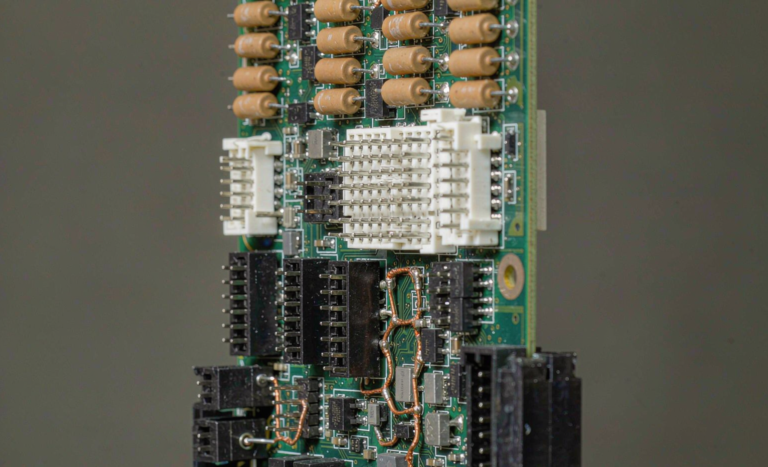
- BMS discipline. Cell-level balancing plus a hard temperature cutoff at 45°C to 50°C is non-negotiable. The BMS must know the charge profile, not just the voltage.
When an off-the-shelf format cannot hit the C-rate your product needs, we build a custom battery solution around the cell — choosing the parallel/series layout, the cooling plate, and the connector so the pack as a whole can accept the current the application demands. That is where a semi-solid state battery really earns its place: the cell is fast, and a properly designed pack lets you use that speed.
Where Fast-Charge Semi-Solid Cells Win
Not every application needs fast charging, but several absolutely do. In drone delivery fleets, turnaround between flights is everything; a semi-solid state battery that tops up in minutes instead of an hour changes the economics of the whole operation. In two-wheelers and light e-mobility across Asia, swap-and-go or rapid top-up models live or die on charge speed. For backup power and telecom sites, a fast-recovering bank means the second grid dip in a day no longer catches you flat.
I also see growing interest from OEMs who want the energy density of a solid-state battery roadmap without waiting five years for full solid-state manufacturing to mature. Semi-solid is the bridge: most of the safety and rate benefits, available in pilot volume today, and drop-in compatible with much of the existing lithium-ion assembly line.
Certification You Must Clear Before Specifying
This is the part buyers skip and regret. The fast-charge profile must be part of the test dossier — you cannot certify a cell at 1C and then ship it at 5C. Start with UN38.3, the transport safety test covering T.1 altitude simulation, T.2 thermal test, T.3 vibration, T.4 shock, T.5 external short circuit, T.6 impact/crush, T.7 overcharge, and T.8 forced discharge. Then layer on IEC 62133-2 for portable secondary cells and IEC 62619 for industrial stationary applications.
For anything that flies, you answer to FAA and EASA rules — typically PI965, PI966, or PI967 depending on whether the cell travels alone, inside equipment, or packed with it. We submit the actual charge profile we intend to use, because a cell that passes at a gentle rate can behave differently when hammered with current. Do the paperwork once, with the real numbers, and your downstream OEM integration stays clean.
Frequently Asked Questions
How fast can a semi-solid state battery realistically charge in 2026?
In validated pilot production, a 10% to 80% charge in 10 to 15 minutes (about 3C to 6C) is realistic, with a 4C to 5C window recommended for long cycle life. Laboratory cells have shown 80% in roughly 8 minutes at 6C, but that is not yet a production recommendation.
Does fast charging shorten the life of a semi-solid state battery?
It does, as with any lithium battery, but the penalty is smaller. In our testing, a semi-solid cell held at a 4C fast-charge window retained about 85% capacity after 1,000 cycles, versus a noticeably steeper fade on a comparable liquid cell charged the same way. The gel electrolyte simply tolerates the heat better.
Are semi-solid state batteries safe to fast charge on aircraft under FAA and EASA rules?
Safety is governed by UN38.3 plus the relevant FAA/EASA packing instructions (PI965–PI967). A semi-solid cell is generally easier to pass because of its lower free-solvent content, but you must file the test dossier using the actual fast-charge profile, not a gentle one.
Can I retrofit an existing lithium battery pack to fast charge with semi-solid cells?
Only at the pack level, and only with a BMS that understands the new profile. You cannot drop semi-solid cells into a pack designed for a slow liquid cell without revisiting the cooling, the connector current rating, and the charge-cutoff logic. For a clean result, treat it as a custom battery solution and re-specify the whole assembly.
Conclusion
Fast charging a semi-solid state battery is not a promise — it is bench-validated reality, with 10% to 80% reachable in well under fifteen minutes while staying cooler than the liquid lithium battery you likely ship today. The wins go to engineers who design the cell, the pack, and the certification dossier together: the right anode blend, tab-less construction, a temperature-aware BMS, and a UN38.3 / IEC / FAA / EASA file built around the real charge rate. If your product lives or dies on turnaround time, semi-solid is the bridge technology worth specifying now, well ahead of full solid-state battery volume production.