Semi-Solid State Battery for Industrial Robotics: An Engineer’s Deployment Guide
The first time a customer asked me to fit twice the energy into an autonomous mobile robot without changing the chassis, I told them politely that physics does not negotiate. Eighteen months later we shipped that pack. The chassis was unchanged, the energy went from 1.9 kWh to 2.6 kWh, and the difference came almost entirely from moving to semi-solid cells. That programme taught me more about robotics power than the previous five combined.
I am Karl Huang, a senior lithium battery engineer, and most of my week is spent on packs that live inside machines rather than vehicles: automated guided vehicles, autonomous mobile robots, collaborative arms, warehouse tote shuttles, and inspection platforms. Robotics is a peculiar application. The duty cycle is brutal, the volume budget is fixed by mechanical designers who finished their work a year earlier, and the machine frequently operates within arm’s reach of a human being. This guide covers what a semi-solid state battery genuinely changes in that context, backed by measurements from our own test floor and field fleets.

Why Robotics Power Budgets Are Harder Than They Look
A warehouse AMR looks undemanding on paper. Average traction power on a flat concrete floor is often only 180 to 350 W for a 200 kg payload class machine. The problem is never the average. It is everything layered on top of it.
Break down a real 24-hour shift on a tote-handling AMR and the energy split typically lands near: traction 42%, lift or manipulator actuation 24%, compute and perception stack 19%, thermal management and auxiliaries 9%, and standby losses 6%. That compute figure surprises people. A perception stack running multiple depth cameras, a LiDAR, and an embedded GPU draws 60 to 140 W continuously, and unlike traction it never rests. A robot parked and thinking still burns energy.
The second complication is opportunity charging. Nobody in a modern distribution centre tolerates a robot going away for two hours. Fleets are scheduled around 6 to 12 short charges per day, typically 8 to 15 minutes at 1.5C to 3C, cycling the pack between roughly 35% and 85% state of charge. That is partial state of charge (PSOC) operation, and it is where a lot of otherwise decent packs quietly fall apart. Over a year, a fleet running that pattern accumulates 2,000 to 3,000 equivalent full cycles, not the few hundred a naive calculation suggests.
Third, the volume budget. On the last four robotics programmes I supported, the battery bay was fixed before we were engaged. Typical envelopes were 340 x 220 x 95 mm, 410 x 180 x 120 mm, and in one painful case an L-shaped cavity nobody could describe without a CAD viewer. When the box cannot grow, the only remaining variable is energy density.
What Semi-Solid Chemistry Changes at Cell Level
Let me define the term precisely, because marketing has muddied it. A fully solid-state cell removes liquid electrolyte entirely, using ceramic, sulfide, or polymer conductors. A semi-solid cell retains a modest quantity of liquid or gel electrolyte, commonly 5% to 15% by mass versus 18% to 25% in a conventional lithium battery, immobilised inside a thickened electrode matrix that conducts ions through its bulk.
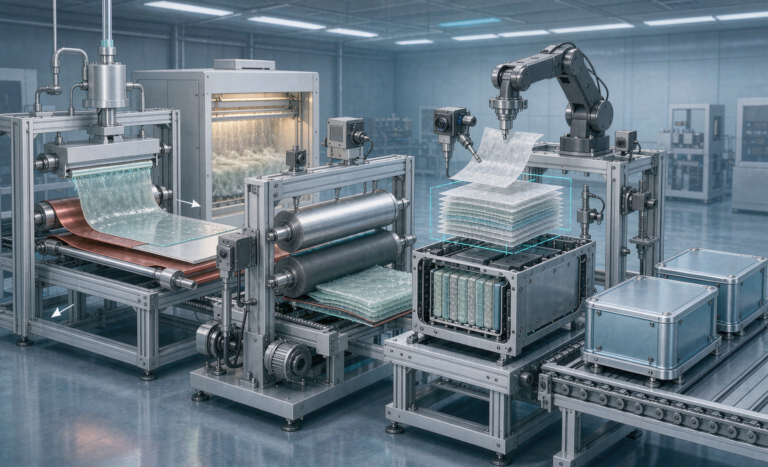
The engineering consequence is thick electrodes. Standard coated electrodes sit at 60 to 90 micrometres. Semi-solid electrodes run 250 to 400 micrometres. Fewer layers means fewer current collectors, fewer separators, and far less inactive mass per kilowatt-hour. Production cells we have qualified deliver 300 to 360 Wh/kg and 700 to 800 Wh/L at cell level, against 250 to 280 Wh/kg for a good NMC cell of the same generation.
Translated into a robot, that is the difference between a 1.9 kWh pack and a 2.6 kWh pack in an identical bay. On the AMR programme I opened with, the fleet operator converted that 37% energy gain into 2.4 additional productive hours per machine per day, because the robots could skip two of their scheduled opportunity charges and stay on task through the peak pick window.
The second change is abuse behaviour. With most electrolyte immobilised, a mechanical breach does not release a pool of flammable solvent. Our nail penetration results on 50 Ah semi-solid pouches showed peak surface temperature between 180 and 240 degrees Celsius with venting but no propagation to adjacent cells. Comparable high-nickel conventional pouches produced flame events in roughly one trial in three. In a shared human workspace governed by ISO 10218 and ISO/TS 15066 for collaborative operation, that margin carries real weight with safety officers.
PSOC Cycling: The Test That Actually Predicts Fleet Life
Most datasheet cycle life figures come from a 100% depth-of-discharge test at 0.5C and 25 degrees Celsius. No robot has ever operated that way, and I have stopped accepting such numbers in supplier reviews.
We run a robotics-representative profile instead: 35% to 85% SOC window, 2C charge, a discharge trace recorded from a live AMR fleet, 35 degrees Celsius ambient, with a full characterisation sweep every 200 equivalent full cycles. Results from our most recent comparison, both cells at similar nominal energy:
- Semi-solid NMC: 91% capacity retained at 1,500 EFC, 86% at 2,500 EFC, internal resistance up 14%.
- Conventional NMC: 84% at 1,500 EFC, 74% at 2,500 EFC, internal resistance up 31%.
- Thermal behaviour under 2C charge: semi-solid peak core temperature 38.5 degrees Celsius, conventional 44 degrees Celsius, same cooling arrangement.
The resistance figure is the one fleet engineers should care about most. A pack whose resistance climbs 31% loses charge acceptance, which extends every opportunity charge, which compounds across a fleet as lost availability. We modelled a 60-robot deployment and found that resistance-driven charge time growth alone cost the equivalent of 3.1 robots of capacity by year three on conventional cells, against 1.2 on semi-solid.
Designing the Pack: What I Specify for Robotics
Cell chemistry is maybe 40% of the outcome. The rest is pack engineering, and robotics has its own rulebook. Here is what goes into every custom battery solution we build for this sector.
Mechanical and Ingress
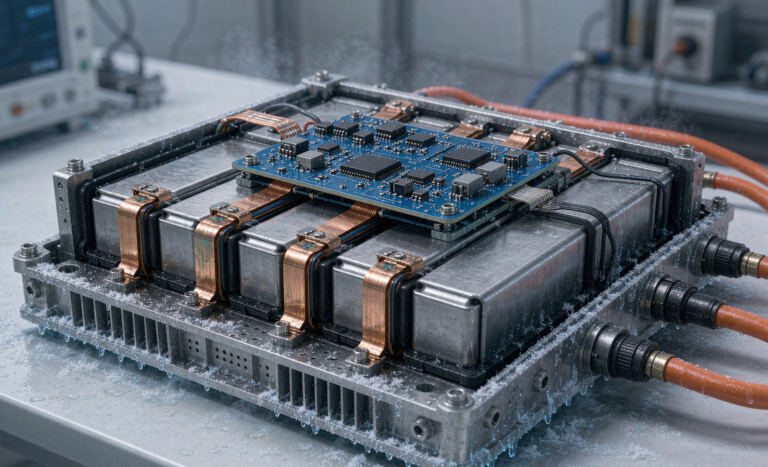
AMRs live on floors with debris, occasional wash-down, and forklift traffic. We specify IEC 60529 IP54 as a floor and IP65 where wash-down is credible. Vibration qualification follows IEC 60068-2-6 sine sweep and 2-27 shock; robotics is gentler than mining, so 2 to 3 g RMS for 8 hours per axis is usually sufficient, but caster impacts on floor joints produce 12 to 18 g transients that must not loosen busbar hardware. We use wedge-lock cell retention with 0.2 to 0.4 MPa stack pressure, which also happens to suit semi-solid cells well, since maintaining stack pressure improves interfacial contact and measurably slows resistance growth.
Electrical Interface
Blind-mate charging contacts on a docking station are standard, and they are the single most common field failure I see. Contact resistance should be held below 0.4 milliohms per pole, with a mechanical alignment tolerance of plus or minus 2.5 mm and a wipe action on every dock. We instrument contact resistance in the BMS and flag drift above 0.8 milliohms, because a degraded contact at 60 A dissipates 2.9 W into a plastic housing and will eventually deform it.
Thermal Management
Most robotics packs are passively cooled, which is viable up to roughly 2C charging if the pack is designed for it. We target 25 to 38 degrees Celsius operating band with under 4 degrees Celsius spread between the hottest and coldest cell. Above 2.5C charging, forced air becomes necessary. Below 10 degrees Celsius we lock out fast charge entirely to avoid lithium plating, and where cold-store robots are involved we specify a self-heating film consuming about 3% of pack energy over an 8 to 12 minute preheat.
BMS and Data
Balance thresholds at 30 mV triggering and 80 mV alarm. Insulation monitoring at 500 ohms per volt. Full telemetry over CAN with SOH, resistance, per-cell delta, and cumulative energy throughput logged to the fleet manager. I insist on energy throughput rather than cycle count, because in PSOC operation cycle count is meaningless. Retirement criteria: 80% SOH or 25% resistance rise, whichever comes first.
Where Semi-Solid Is the Wrong Answer
I would rather lose an order than see a customer disappointed eighteen months in, so here are the three cases where I actively recommend a conventional pack.
Cost-dominated, low duty cycle machines. A semi-solid pack currently carries a 35% to 60% cell-cost premium. If a robot runs one shift a day, charges overnight, and has spare volume in the chassis, LFP is the better commercial answer. The energy density advantage buys you nothing when the box is not full.
Very high pulse power. Thick electrodes trade power density for energy density. Continuous 5C discharge is not a semi-solid strength today. Manipulators with aggressive acceleration profiles that pull 4C to 6C bursts are better served by thin-electrode power cells, or by a hybrid architecture with a supercapacitor bank handling the peaks.
Sub-zero operation without preheat. Charge acceptance below minus 10 degrees Celsius is genuinely poor. If a machine must fast charge in a freezer aisle and there is no thermal budget for preheat, do not specify semi-solid.
Two Field Lessons Worth Your Time
The first involves a fleet of 40 tote shuttles that began throwing intermittent undervoltage faults after four months. Cell health was fine. The cause was the dock: the charger terminated on voltage, and the facility’s ageing distribution board sagged 6% during peak conveyor load, so the charger terminated early. Robots left the dock at 71% believing they were at 85%. We moved termination to a coulomb-counted target with a voltage backstop and the faults stopped. Always check the building before blaming the battery.
The second is subtler. A cobot integrator reported capacity fade at three times our predicted rate. Their machines idled 14 hours a day at 100% SOC, plugged in and topped up continuously. High SOC dwell at elevated temperature is the most efficient way to age a lithium battery that I know of. We changed the fleet policy to a 60% storage SOC during idle windows and fade returned to model. This is the same principle behind keeping a home energy storage system off a permanent full float, and it applies just as firmly in a factory.
Qualification and Compliance Checklist
For anyone drafting a specification, this is the compliance set we work to on robotics programmes:
- UN 38.3 tests T.1 through T.8 for transport qualification, mandatory before any shipment.
- IEC 62133-2:2017 for portable sealed secondary lithium cells and batteries.
- IEC 62619 for industrial secondary lithium cells, which is the correct standard for AMR and AGV packs.
- UL 1973 for stationary and motive auxiliary applications, frequently requested by North American integrators.
- UL 2271 or UL 583 where the machine is classified as an industrial truck.
- ISO 3691-4 for driverless industrial trucks and their systems, which drives functional safety expectations on the BMS.
- IEC 60529 IP54 or IP65 ingress rating as the environment demands.
- UN 3480 and UN 3481 classification with IATA PI 965 shipping at 30% state of charge, plus ADR for European road freight.
One practical note: semi-solid cells pass UN 38.3 without special accommodation in our experience, and their thermal propagation behaviour usually makes the IEC 62619 propagation assessment easier to argue, not harder. Budget the same 10 to 14 weeks for certification that you would for a conventional pack.
Frequently Asked Questions
How much extra runtime does a semi-solid pack actually deliver in an AMR?
In a fixed battery bay, expect 25% to 40% more energy for the same volume, which on typical warehouse duty cycles converts to roughly 1.5 to 2.5 additional productive hours per machine per day. The gain is largest where the chassis is volume-constrained and smallest where the bay has spare room.
Is a semi-solid state battery safer around human operators?
Materially, yes, though no lithium chemistry is inherently safe. The immobilised electrolyte reduces flammable liquid release after a breach, and our propagation testing shows venting without flame where conventional high-nickel cells sometimes ignite. It does not remove the need for proper enclosure design, gas venting paths, and BMS protection.
Can I retrofit semi-solid cells into an existing robot pack design?
Sometimes, but rarely as a drop-in. Cell dimensions differ, stack pressure requirements differ, and the charge profile needs retuning. On retrofits we have completed, mechanical retention and the BMS charge algorithm both required rework. Treat it as a new pack programme with a reused enclosure, and plan 16 to 24 weeks.
What charge rate should I use for the longest fleet life?
1.5C to 2C bulk charging to 80%, then a 0.5C taper, gives the best balance of dock time and longevity in our data. Pushing to 3C costs roughly 12% to 18% of cycle life for about 3 minutes of dock time, which is almost never a good trade across a fleet.
How do I compare quotes for a custom robotics battery solution?
Ignore cost per kilowatt-hour and compute cost per delivered kilowatt-hour over the machine’s service life, using PSOC-representative cycle data rather than datasheet figures. Ask every supplier for their test window, ambient temperature, and charge rate. If they cannot state those three numbers, the cycle life claim is not evidence.
Does semi-solid chemistry need different fire suppression in the charging area?
The same water-based suppression strategy applies, sized for the total energy present. What changes is the risk profile of a single-cell event, which is less likely to propagate. Keep the standard dock spacing, thermal detection, and emergency disconnect regardless of chemistry.
Closing Thoughts
Industrial robotics is the application where semi-solid chemistry currently makes the clearest engineering case, because the constraint that matters most is volume and the operating pattern that matters most is PSOC cycling. Both play to its strengths. It is not universally correct, it costs more, and it will disappoint you in high-pulse or sub-zero duty. But when a mechanical designer hands you a fixed box and a fleet manager hands you an availability target, it is often the only chemistry that lets you satisfy both.
If you are scoping a robotics programme and want a second opinion on cell selection, pack architecture, or a qualification plan, our engineering team reviews these specifications regularly and is happy to look at your duty cycle data.