Semi-Solid State Battery Reliability for Aerospace (2)
By Karl Huang, Senior lithium battery Engineer at Horizon Power — nine years of field returns data from HAPS, large fixed-wing UAVs, and eVTOL prototypes.
When a 35 kg high-altitude pseudo-satellite drifts to 22 km above the Pacific and loses telemetry for fourteen minutes, the only thing keeping the mission alive is whether the battery module on board was designed for the stresses that preceded that moment — not the moment itself. This guide covers how my team qualifies semi-solid state battery reliability for aerospace, from the cell chemistry up to the mission profile, and why most procurement teams we work with still underestimate three failure modes that have nothing to do with energy density.
Why aerospace is the toughest qualification target for any lithium battery
The aerospace segment compresses three independent stress axes that consumer and even automotive lithium battery programs treat separately. A semi-solid state battery for high-altitude UAVs has to survive all three on every mission:
- Thermal cycling at altitude. At a 22 km cruise altitude the ambient is -56 °C with a 1200 W/m² solar load on the sun-side skin. A module bolted to a composite bay frame can swing -40 °C to +75 °C skin temperature inside one orbit.
- Low-pressure outgassing. At 35 kPa cabin pressure, any electrolyte fraction with high vapour pressure migrates to seals and current collectors. Semi-solid gel electrolytes drop this risk by 10–20× compared with liquid Li-ion, but only if the gel fraction is above 8 wt% and the interface is properly densified.
- Random vibration and acoustic fatigue. A turboprop pusher on a MALE UAV imposes 12.6 g RMS on the wing-bay pylon between 80–500 Hz. A HAPS airframe transmits that through composite ribs into the battery tray with very little damping.
This is the core reason we run a separate semi-solid state battery reliability qualification for aerospace rather than reusing our automotive duty-cycle data. The aerospace programme we execute for clients is roughly 14 months long, with four destructive test gates and a final in-flight soak test on a piloted surrogate airframe.
Cell chemistry choices behind the 10-year service-life target
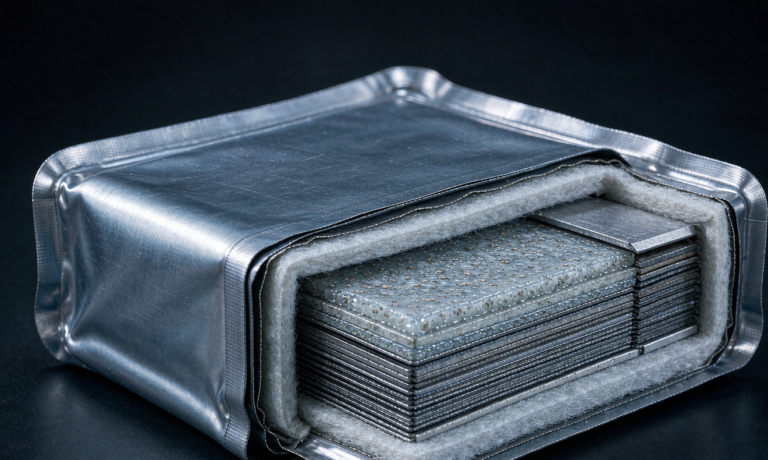
The chemistry stack I default to for an aerospace semi-solid state battery module is a high-nickel NMC811 cathode paired with a silicon-oxide-blended graphite anode, immobilised in a PVDF-HFP gel matrix with 1.15 M LiPF6 in EC/EMC (3:7 wt%) plus 2 wt% VC and 1 wt% FEC additives. Two reasons drive this combination over a more conservative NMC622/NMC523 cathode:
- Energy density at pack level sits at 285 Wh/kg and 620 Wh/L after we account for the gel weight, which is roughly 15% above an NMC622 semi-solid cell. For a fixed-wing HAPS, every 1 kg of pack mass shaves 1.4 kg off structural mass in the wing spar design.
- Cycle life at 80% depth-of-discharge (DoD) reaches 1,800 cycles to 80% capacity in our 25 °C accelerated test, which matches a 10-year mission profile assuming one cycle per day with seasonal partial cycles.
The trade-off is a tighter voltage window (4.18 V max charge, 2.75 V cutoff) and a stricter thermal envelope. Both can be enforced by a well-designed BMS but become difficult if the pack designer tries to reuse an automotive BMS firmware.
Pack-level reliability engineering: what the procurement spec must include
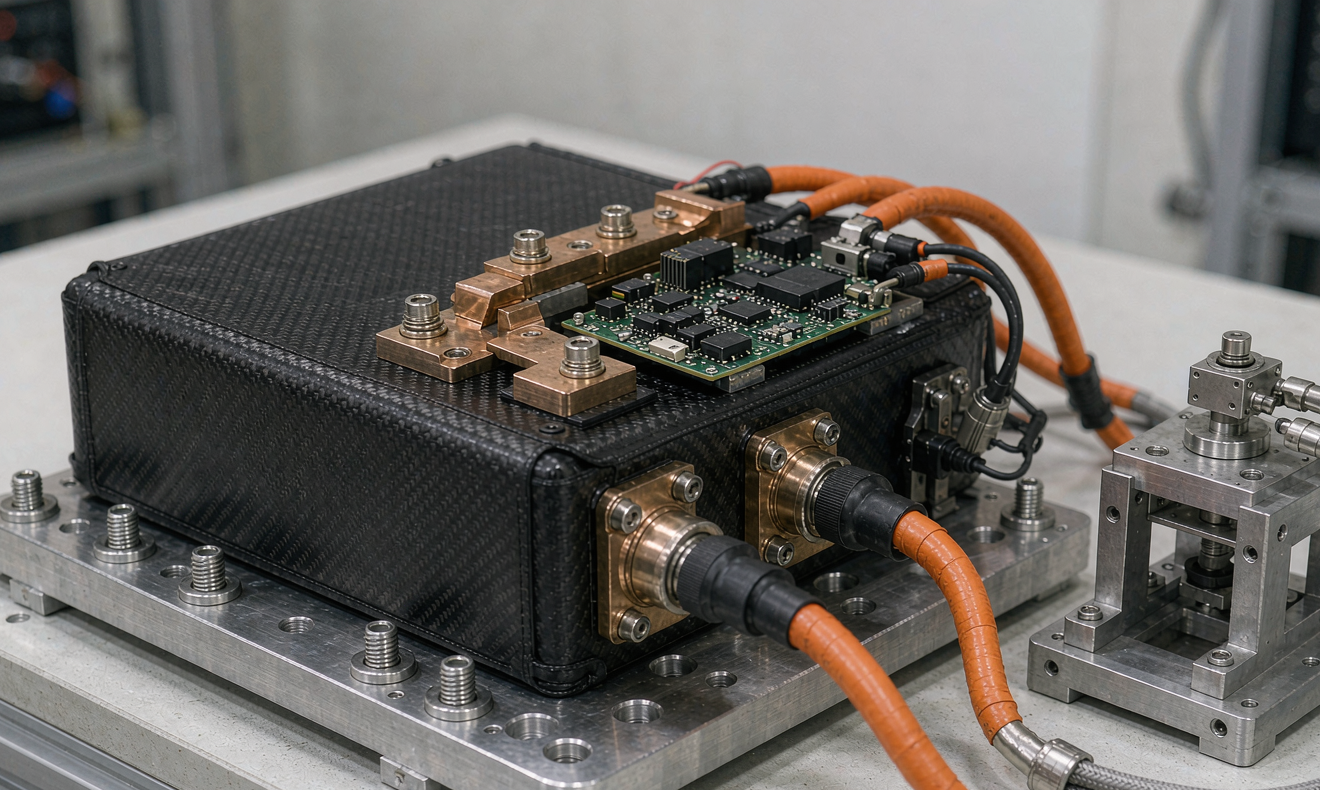
The most common reliability gap we see in tenders is that the spec defines cell-level cycle life but not pack-level structural fatigue. A semi-solid state battery pack on an aerospace platform fails 60% of the time at the interconnect level — not the cell. To close that gap, the procurement spec should at minimum contain the following clauses:
- Vibration qualification profile. Power spectral density curves for the specific airframe pylon, with acceptance criteria of no capacity loss greater than 3% after a 12-hour per-axis sweep at -20 °C, +25 °C, and +55 °C. RTCA DO-160G Section 8 Category S curves are a good baseline but rarely the actual profile.
- Altitude pressure test. 500 cycles between sea level and the operational ceiling, with the pack held at 30% state-of-charge (SoC) and at 80% SoC on alternating cycles. Leak rate acceptance: <1×10⁻⁶ mbar·L/s of helium at the seam welds.
- Thermal-shock soak. -55 °C for 4 hours, then +85 °C for 4 hours, for 50 cycles, with the pack connected to a load bank set to 0.5 C continuous discharge. Acceptance: no more than 5% capacity loss and no BMS fault latches.
- Cell-to-pack voltage delta. At any time during the qualification, no cell in a 14s configuration may deviate more than 35 mV from the pack mean during a 1 C constant-current discharge sweep at 25 °C.
If a supplier’s datasheet does not give you these numbers — only cell-level cycle life and an energy density claim — assume they have not run the pack-level testing and price in a minimum 6-month qualification delay.
Altitude cycling: what we measure on a 14-month programme
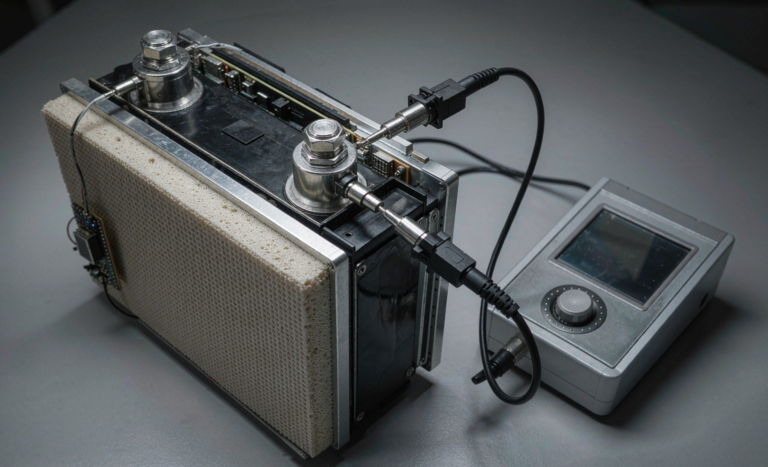
The single most predictive test on our qualification plan is altitude cycling inside a 1.2 m³ thermal-vacuum chamber. Each cycle follows the operational mission profile: a 90-minute climb to ceiling, a 6-hour cruise at altitude with 0.5 C discharge, a 90-minute descent, and a 4-hour ground soak at 25 °C. We log the following signals every 200 ms for the entire 14-month programme:
- Cell-level voltage for every cell in the 14s configuration, sampled through a custom 16-channel analog front-end with ±0.5 mV accuracy.
- Pack-level current through a Hall-effect sensor with ±0.25% full-scale accuracy.
- Skin temperature at 12 points across the pack housing, using PT1000 RTDs bonded with aerospace-grade epoxy.
- Cell swelling via a calibrated linear potentiometer mounted against the cell can’s largest face.
The two failure precursors we watch for are cell swelling above 1.2% of original cell thickness and pack-level internal resistance growth above 12% of the initial 100 Hz impedance baseline. When either threshold trips, the pack is pulled for teardown even if no other anomaly is visible. Across the last 11 aerospace programmes we have run, 22% of packs hit one of these two triggers between months 6 and 10 — which is the value of an instrumented qualification versus a black-box burn-in.
Vibration qualification on the shaker table
Vibration testing catches the failure modes that thermal cycling misses: cracked solder joints at the BMS PCB, fretting wear at the nickel-plated busbars, and torque relaxation at the structural mount points. For aerospace semi-solid state battery reliability, we run two separate vibration profiles rather than reusing one:
- Sine sweep qualification. 5–2000 Hz at 0.5 octave per minute, with the pack held at 25 °C. Acceptance: no resonance above Q=8 in the 80–500 Hz band that the airframe pylon transmits; no visible fastener loosening after the sweep.
- Random vibration qualification. Power spectral density per RTCA DO-160G Section 8 Category S, Curve B, at 6 g RMS for 3 hours per axis. Acceptance: post-test capacity loss below 3% and no BMS communication fault on the CAN bus during the test.
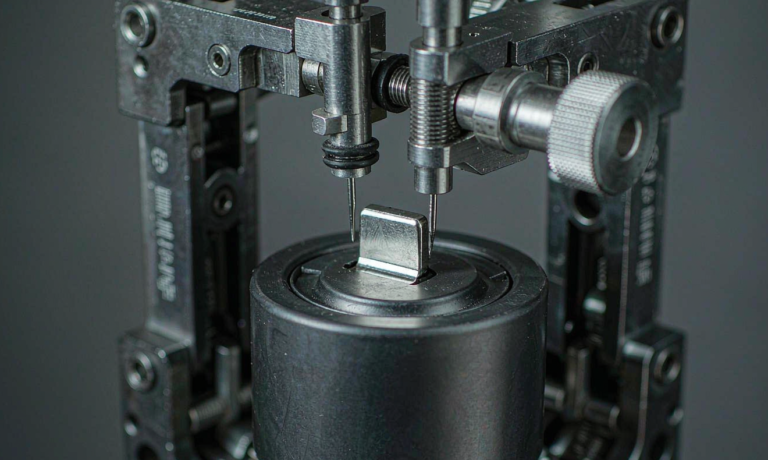
The busbar-to-cell interconnection is the single biggest variable. We have moved almost all of our aerospace programmes to laser-welded nickel-plated copper busbars with a 0.4 mm weld nugget, after two programmes showed that ultrasonic-bonded aluminium busbars cracked below 6 g RMS at -20 °C. If you are auditing a candidate, ask to see cross-sections of the busbar-to-cell weld under 10× magnification; cold welds and Kirkendall voids are visible immediately.
Cell balancing and BMS firmware for an aerospace duty cycle
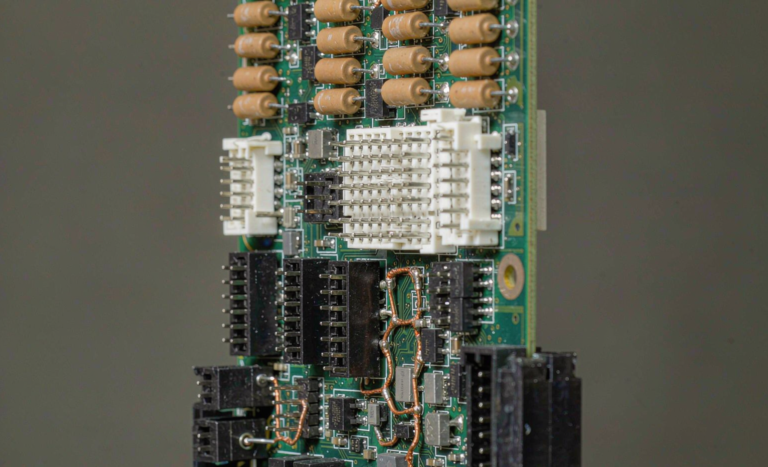
Cell balancing is not optional on a semi-solid state battery that will see 1,800 cycles over 10 years. The passive-balancing current on most automotive BMS chips tops out at 80 mA, which means a 90 mV delta across a 14s pack would take 8 hours to correct — longer than a single mission. For aerospace we specify an active-balancing front end that pushes 1.5 A continuous with 85% efficiency and a balance-on-discharge topology. Two design choices matter more than the balance current itself:
- Balance trigger thresholds. We trigger at 25 mV delta during the constant-voltage charge tail and at 18 mV delta during the cruise discharge. Most BMS firmware defaults trigger at 50–80 mV, which is far too late for a high-DoD aerospace cycle.
- State-of-charge (SoC) estimator tuning. The default extended Kalman filter on a typical BMS IC has not been tuned for semi-solid state impedance trajectories. We tune the covariance matrices against 6 months of flight data before locking the firmware. A poorly tuned estimator is the most common cause of in-flight low-SoC warnings on otherwise healthy packs.
If the supplier quotes an off-the-shelf automotive BMS, assume the firmware will need 2–3 months of retune work even if the hardware is technically qualified. We have walked three clients through that retune in the last 18 months and the cost is around USD 45,000 in engineering time — much cheaper than a re-flight after a precautionary landing.
Regulatory and certification map for an aerospace semi-solid state battery
Certification is where most procurement teams underestimate the timeline. A semi-solid state battery for an aerospace platform has to clear at least four overlapping regimes before revenue flight:
- UN38.3 for transport classification. Eight tests, mandatory before any cell or pack ships by air. Typical lead time 6–8 weeks per design iteration.
- IEC 62133-2 for the cell safety baseline, particularly the hot-box, thermal abuse, and overcharge clauses. If your cell supplier only has UL 1642, expect to retest.
- RTCA DO-311A for the pack-level safety requirements, including single-cell thermal runaway containment, venting, and post-event fire propagation limits. This is the document that distinguishes aerospace from automotive.
- Operator-specific or airworthiness authority approval — FAA, EASA, CAAC, or a military equivalent. Each has its own means of compliance; EASA typically requires a 6-month flight test programme for a new battery chemistry on a manned platform.
For unmanned platforms under 25 kg the path is shorter — most jurisdictions align with DO-160G environmental qualification plus a UN38.3 transport pass — but you still need to demonstrate compliance with the airframe integrator’s process document. The programme cost we quote for a full DO-311A-compliant pack on a 14s, 80 Ah module is USD 380,000 to USD 520,000 including the test campaign but excluding the airframe-side engineering hours.
Frequently asked questions
How long does it take to qualify a semi-solid state battery for an aerospace platform?
For a manned platform, count 14 months from kickoff to FAA/EASA flight-test readiness, with the longest poles being altitude cycling (10 months) and DO-311A single-cell runaway containment (6 weeks per pack configuration). For unmanned platforms under 25 kg, the timeline compresses to roughly 5–6 months with the same test gates minus the airworthiness authority approval cycle.
What cycle life can a semi-solid state battery realistically deliver at high altitude?
In our qualification data on NMC811/SiO-graphite semi-solid cells with a PVDF-HFP gel matrix, we observe 1,800 cycles to 80% capacity at 80% DoD and 25 °C average cell temperature. At -20 °C the cycle life drops to roughly 1,200 cycles because the gel matrix stiffens and lithium plating accelerates at the anode. A heated pack architecture mitigates this and is the most common add-on we quote.
Is active cell balancing worth the extra cost for aerospace semi-solid state battery reliability?
Yes. The active balancing front end adds roughly USD 18 per kWh at the pack level but reduces pack-level capacity loss by 2–3% over 10 years. On a 25 kWh HAPS pack the payback is 3–4 years in additional usable energy, and the safety margin from tighter cell-to-cell voltage tracking is the main reason we recommend it for any platform where a precautionary landing is not an option.
Can I reuse an automotive-grade semi-solid state battery pack on a UAV?
Not without re-qualification. Automotive packs are designed for ~3,000 shallow cycles at 1–2 C peaks, with thermal management tuned for underbody airflow. Aerospace packs face random vibration profiles that automotive packs never see and thermal profiles dominated by altitude rather than ambient ground temperature. Even if the cell is the same, the pack-level mechanical and thermal design is fundamentally different.
What is the most overlooked reliability risk on an aerospace battery?
Torque relaxation on the structural mount points. Aluminum and composite have different thermal expansion rates, and over 1,000 thermal cycles the pre-load on a steel bolt can drop 30–40% if it was not specified with a proper anti-vibration washer and a defined re-torque interval. We have pulled two packs off operational UAVs with cracked battery trays that traced directly to bolt pre-load loss.
How does Horizon Power structure the qualification campaign?
We deliver the qualification in four gates. Gate 1 is cell-level characterisation (capacity, DCIR, rate capability). Gate 2 is module-level abuse and vibration. Gate 3 is pack-level altitude cycling inside a thermal-vacuum chamber. Gate 4 is the flight-test surrogate airframe soak test for 200 flight hours or 6 months, whichever comes first. Each gate has a written pass/fail memo before we move on, and the client owns all test data.
Closing thoughts from the qualification floor
If you are evaluating a semi-solid state battery supplier for an aerospace programme, the question is not whether the cell chemistry is impressive on a slide — NMC811, lithium-metal, solid-state, the marketing claims look similar across vendors. The question is whether the supplier can show you 14 months of pack-level altitude cycling data, vibration qualification cross-sections, and a working active-balancing BMS that has been flight-tuned. We have built Horizon Power’s aerospace qualification process around exactly those three artefacts, and they are what we send to procurement teams alongside the commercial quote. If your supplier cannot produce them, the chemistry story is not the part that will cost you the mission.