Semi-Solid State Battery Thermal Management: Engineering Cooling Systems That Keep Pack Temperature Under Control
Why a semi-solid state battery Still Needs Real Thermal Engineering
I get asked this a lot: if the semi-solid state battery is supposed to run cooler and safer than a conventional lithium battery, why spend so much effort on a thermal management system at all? After fifteen years on the pack line, including three years designing cooling for semi-solid prototypes, my answer is simple. The chemistry runs cooler at the cell level, but a real pack is dozens of cells, busbars, and a BMS crammed into a sealed enclosure. Heat always finds a way to accumulate, and once one region drifts ten degrees above the rest, the whole pack ages unevenly. Thermal management is not optional for us — it is the difference between a battery that delivers 2,000 cycles and one that swells by year two.
In this article I will walk through how we engineer thermal management for semi-solid state battery packs at Horizon Power, from where the heat actually comes from to how we tie cooling loops into the BMS and what standards we certify against (UN38.3, IEC 62133-2, and the transport rules from FAA and EASA).
Where the Heat Actually Comes From
People imagine a battery heating up only while charging. In practice the heat load is split across four sources. First, ohmic loss in the electrodes and current collectors — even a good semi-solid electrolyte has ionic resistance, and at high C-rate discharge that resistance shows up as warmth. Second, the intercalation overpotential at the cathode interface. Third, the busbars and welds, which carry the full pack current and follow I²R heating. Fourth, the BMS balancing resistors, small but locally hot if you cram 24 cells into a tight module.
On a 10 Ah semi-solid cell we measured during a 3C discharge, surface temperature rose about 7°C in eight minutes when the cell was insulated, versus only 2.5°C with a 1.5 mm aluminum cold plate touching the casing. That single data point is why we never ship a semi-solid state battery without a cooling path on at least one major face.
Liquid Cooling Plates vs Forced Air: What We Actually Specify
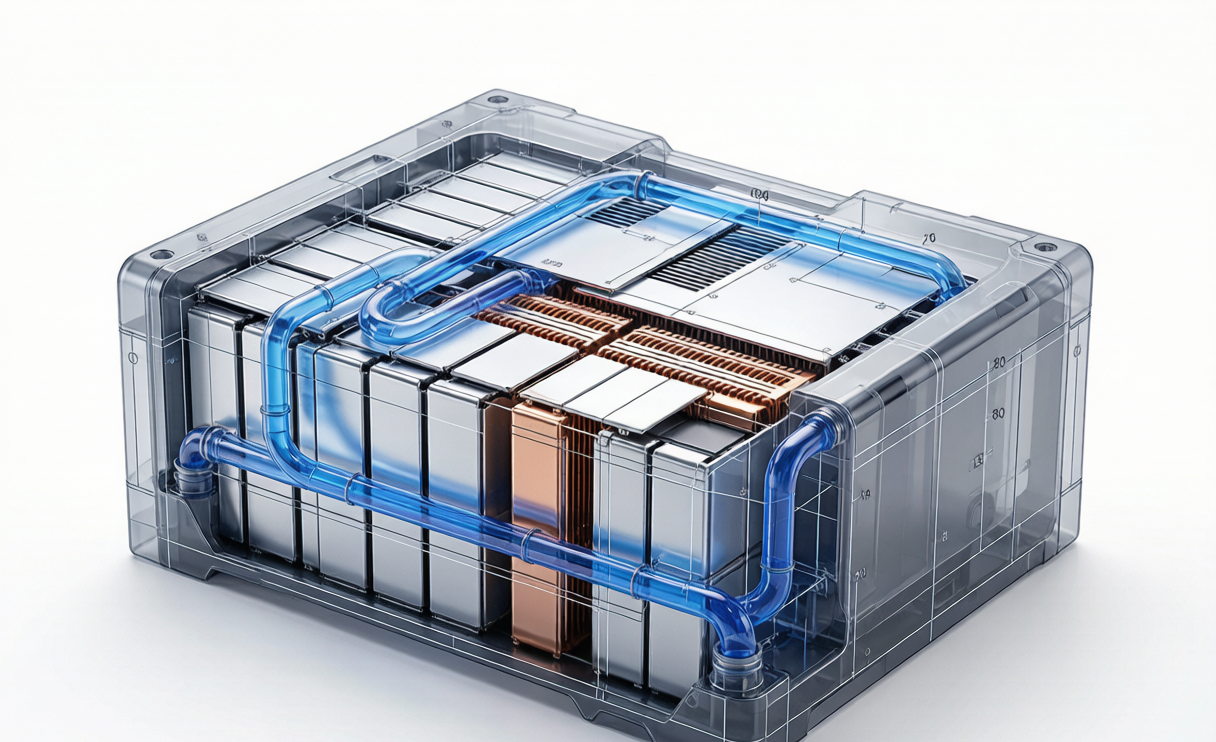
For anything above 48V or any pack that sees continuous load, we specify liquid cooling. Air is fine for a low-power residential module that cycles once a day, but the moment you ask for sustained 1C–3C output, air cannot move enough heat out of a sealed enclosure without a fan the size of the pack itself. We use serpentine aluminum cold plates bonded to the cell stack with a thermal interface material, typically a silicone or graphite pad at 2–5 W/mK.
The coolant is usually a 50/50 water-glycol mix, the same family you would see in an EV, running at 25–35°C supply temperature. We keep flow low, around 0.5–1.5 L/min per module, because higher flow just adds pump noise and parasitic load without buying much temperature drop. A well-designed custom battery solution balances pump power against cooling margin — we target keeping the pack delta-T (hottest to coldest cell) under 5°C across the whole operating window.
Micro-Channel Cold Plates and Thermal Interface Materials
The biggest upgrade we made in our 2025 semi-solid designs was moving from stamped serpentine plates to micro-channel extrusions. Instead of one wide channel, you get twenty thin parallel channels, which collapses the thermal boundary layer and drops the cell-to-coolant gradient by roughly 30%. For a solid-state battery or semi-solid cell, that means you can pull heat out faster during a fast charge without chilling the pack so hard that lithium plating starts.
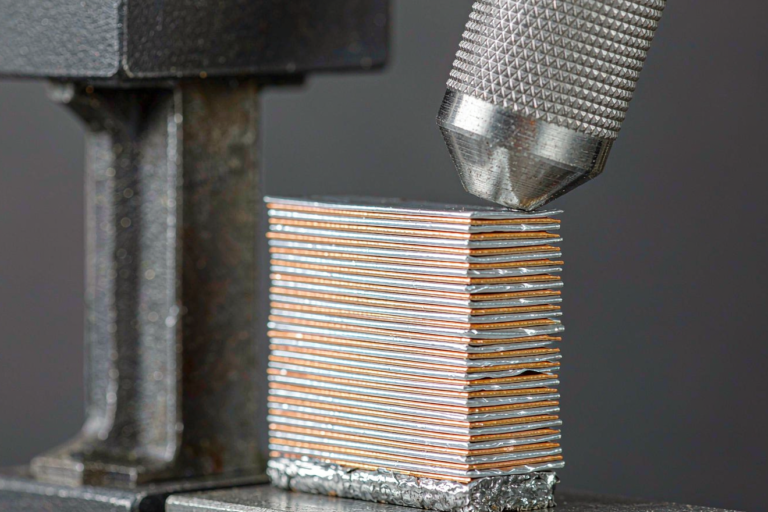
On the interface side, the pad matters more than people think. A cheap 1 W/mK pad with air gaps can double the contact resistance versus a 5 W/mK graphite sheet properly compressed at 0.3–0.5 MPa. We verify the bond with a thermal imaging pass at the end of the line: any cell reading more than 4°C above its neighbors gets the module reworked before it leaves the building.
BMS Thermal Loops and Temperature Sampling
Cooling hardware is dumb without a control loop. Our BMS samples temperature at a minimum of two points per module — one near the inlet, one near the outlet — plus at least one sensor on the hottest-expected cell, usually the center of the stack. We run a simple proportional controller: above 35°C the pump ramps, above 42°C we request charge taper from the charger, and above 50°C we open the contactor and flag a thermal fault.
For a lithium battery pack this kind of loop is standard, but semi-solid cells let us tune it tighter because their thermal runaway onset is higher. That does not mean we relax the thresholds — it means we can run the pack closer to its optimal 25–35°C window without living in fear of a venting event. The BMS log also feeds our cycle-life models, so a pack that sits hot in the field tells us early that the cooling loop is clogged or the pump is failing.
Cold-Start Behavior and Hot-Climate Tuning
Two field conditions dominate our thermal specs. In cold climates, below -10°C, a semi-solid state battery actually has an edge over conventional lithium-ion because the semi-solid electrolyte tolerates lower temperatures without the same dendrite risk, but internal resistance still climbs, so we add a low-power warm-up loop that circulates slightly warmed coolant before the first high-load demand. We keep warm-up current under 5% of pack capacity to avoid draining the very pack we are trying to protect.
In hot climates — think 45°C ambient in a metal enclosure — we flip the strategy. The pack lives outside its comfort zone, so we add a passive radiator and, on our largest enclosures, a variable-speed fan on the coolant circuit. The goal is not to hit 25°C (impossible in the desert), but to hold delta-T under 6°C and keep peak cell temperature below 50°C. That single constraint protects both cycle life and certification margins under IEC 62619.
Thermal Runaway Containment and Certification
No thermal management system is a substitute for a safe cell, but a good one is the last line of defense. We design the enclosure with thermal barriers between modules and a vent path that directs any off-gas away from the BMS and connectors. Our packs are certified to UN38.3 for transport (the T.1–T.8 sequence, including the altitude, thermal, vibration, shock, and external short tests) and to IEC 62133-2 for the cell-level safety requirements. For anything that flies, we align the pack paperwork with FAA and EASA guidance on lithium battery transport and installation.
The point of all this is not a trophy on the wall. It is that a thermal event in one cell should stay one cell. Our internal testing requires that a single cell forced into thermal runaway does not propagate to its neighbor within the module for at least 30 minutes — enough time for the BMS to isolate the string and for anyone nearby to step back. That is the standard we hold every custom battery solution to, semi-solid or otherwise.
What We Tell Buyers to Check
If you are sourcing a semi-solid state battery and the vendor cannot show you a delta-T map across the pack at full load, ask why. A spec sheet that lists energy density but says nothing about thermal behavior is hiding the part that determines whether the battery lasts. Request the cooling architecture, the BMS temperature sampling points, and the test data under both cold-start and hot-ambient conditions. A serious manufacturer will hand you all three without hesitation.
Frequently Asked Questions
Do semi-solid state batteries need cooling if they run cooler than lithium-ion?
Yes. The cell chemistry runs cooler, but a pack is many cells in a sealed box, and uneven heating still drives uneven aging and local hot spots. We cool every semi-solid state battery pack above 48V with at least one liquid cold plate on a major cell face.
What coolant temperature do you target for a semi-solid pack?
We run a 50/50 water-glycol loop at a 25–35°C supply temperature and keep flow around 0.5–1.5 L/min per module. The objective is to hold the hottest-to-coldest cell delta-T under 5°C across the full operating window.
Can air cooling work for a solid-state battery?
For small, low-power residential modules that cycle once a day, yes. But for any continuous-load or high-voltage application, liquid cooling moves far more heat per volume, and we standardise on micro-channel cold plates for those packs.
Which standards cover the thermal safety of these packs?
We certify to UN38.3 for transport and IEC 62133-2 at the cell level, with IEC 62619 for stationary and industrial packs, and we align aviation-related packs with FAA and EASA transport guidance.
How do you stop one cell failure from spreading?
We use thermal barriers between modules, a directed vent path, and a BMS that isolates the string on fault. Internal testing requires a forced single-cell runaway not to propagate to the neighbor for at least 30 minutes.