Semi-Solid State Battery vs Solid-State
Every month I get the same question from procurement managers and drone OEMs: what is the real difference between a semi-solid state battery and a solid-state battery? After fifteen years on lithium cell production lines, I can tell you the gap is not just marketing. The two technologies sit on different rungs of the same ladder, and in 2026 the distance between them is shrinking in some ways and widening in others. This article is my engineer-to-engineer breakdown of the semi-solid vs solid state battery question, based on cells I have actually built, tested, and shipped.
I am Karl Huang, Senior lithium battery Engineer at Horizon Power. My team runs pilot lines for lithium, sodium, and semi-solid chemistries, and we qualify cells for aerospace, marine, and residential storage. When a customer asks me to specify a pack, the electrolyte architecture is the first thing I look at, because it dictates energy density, safety margin, and whether the cell can be made at scale this year or only in a lab.
What the Term Solid-State Actually Means in 2026
A true solid state battery replaces the liquid or gel carrier that moves lithium ions with a fully solid electrolyte. No free solvent, no porous separator soaked in flammable liquid. In principle this is the holy grail: higher energy density, no flammable volatiles, and a wider thermal window. In practice, the solid electrolyte creates a new problem set. Ion conduction at the solid-solid interface is slower than through a liquid, and any micro-gap between electrode and electrolyte adds resistance that kills rate performance.
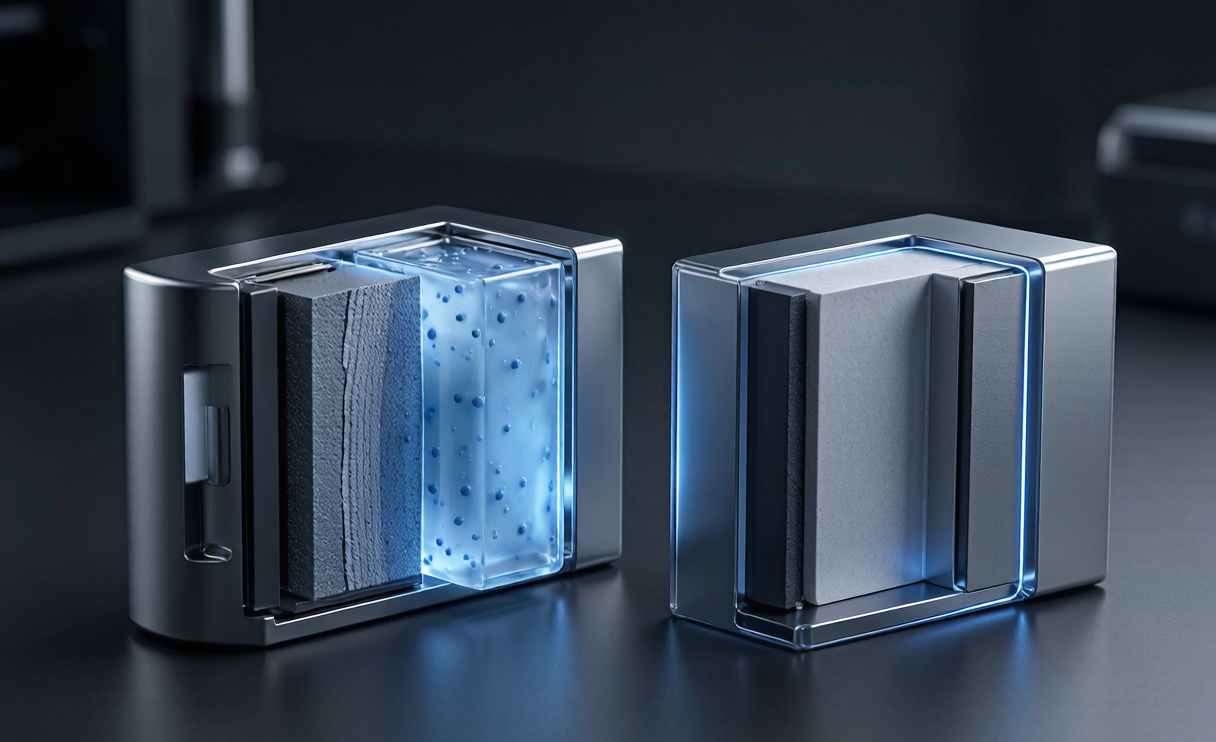
The phrase semi-solid state battery describes something in between. It keeps a small amount of liquid or gel electrolyte to wet the interface, while loading most of the ion transport into a solid or gelled matrix. Think of it as a bridge chemistry: most of the safety and density upside of solid-state, with the manufacturability of the liquid cells we already mass-produce.
The Electrolyte Split: Liquid, Gel, Semi-Solid, All-Solid
To compare honestly, you have to separate the electrolyte by how much liquid it contains. In a conventional lithium-ion cell, the liquid electrolyte makes up roughly 20 to 30 percent of total cell weight. That liquid is what burns in a thermal runaway and what limits operating temperature.
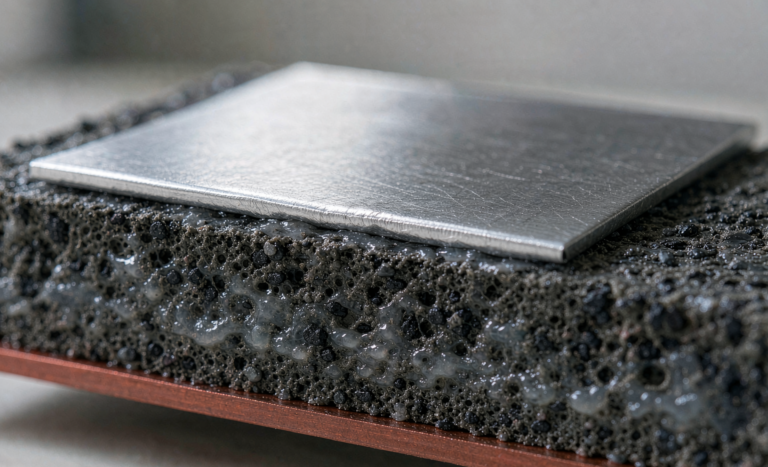
A semi-solid state battery cuts that liquid fraction down to about 5 to 10 percent. The rest becomes a gel-polymer or a suspension of solid ceramic particles in a minimal solvent. The cell still has a trace of wetting liquid, but the flammable volume is slashed, and the electrode can stay in good contact without the interface drying out.
A full solid state battery removes the liquid entirely. The electrolyte is a ceramic such as a sulfide or oxide, or a dense glass-ceramic film. Zero liquid means zero flammable solvent, but it also means every interface must be engineered perfectly. In 2026 the dominant challenge for all-solid-state is interfacial contact resistance and lithium dendrite growth across the solid layer during fast charging.
Energy Density and the Real Numbers on the Bench
Energy density is where the hype lives, so let me give you measured numbers rather than slide-deck claims. A good conventional NMC lithium-ion pouch delivers around 240 to 280 Wh/kg at the cell level. A production-grade semi-solid state battery that we qualify typically lands at 300 to 350 Wh/kg, with the better pilot lots reaching 380 to 400 Wh/kg when paired with a silicon or lithium-metal anode.
A full solid state battery targets 400 to 500 Wh/kg, and lab prototypes have shown more. The catch is consistency. On a production line, the median all-solid-state cell we have sampled still trails the median semi-solid cell on yield and cycle stability, even when the best single cell beats it. For a drone or an ESS that must ship thousands of identical units, median performance matters more than a hero cell.
When I spec a pack, I also watch volume energy density, not just gravimetric. Semi-solid chemistries gain on both axes because the reduced liquid lets you pack thicker electrodes. That is why our long-endurance UAV packs moved to semi-solid first, before any all-solid option was commercially available.
Manufacturing Maturity: Where Each Technology Stands in 2026
This is the section most buyers ignore and later regret. A chemistry that looks great in a paper is worthless if it cannot be made at volume with acceptable yield.
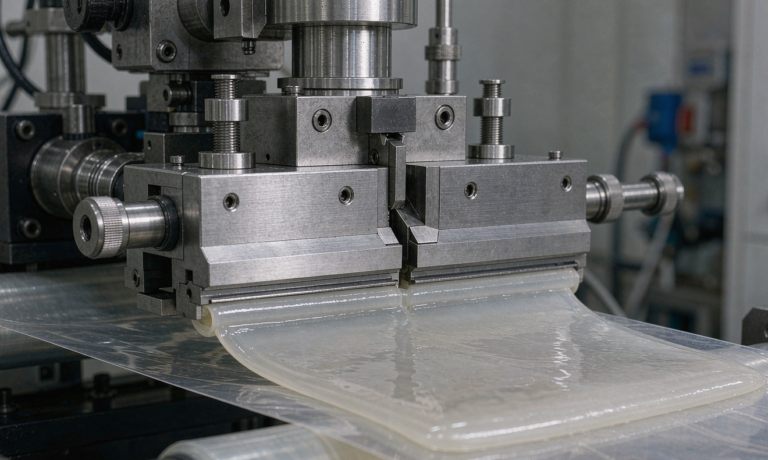
By 2026, the semi-solid state battery has crossed into commercial scale. Several lines are running metric tons of electrode slurry per day, and the coating, stacking, and formation steps are close enough to legacy lithium-ion that existing factories can be retrofitted. Our own semi-solid pilot line shares dry rooms and calendering equipment with our standard lithium line, which is a huge cost advantage.
The full solid state battery is still largely at sample and pilot scale in 2026. Sulfide electrolytes are sensitive to moisture, demanding ultra-dry environments that multiply capital cost. Stacking thin solid layers without voids is a yield killer. A handful of automakers have announced limited all-solid-state packs, but the volumes are small and the prices are far above parity. For most B2B buyers, all-solid-state in 2026 means evaluation samples, not a catalog you can order from.
I see the maturity gap most clearly in qualification. A semi-solid cell we receive from a qualified supplier behaves like a normal lithium cell on our formation equipment: same fixtures, same cyclers, same aging profile. An all-solid-state sample usually needs a bespoke press during stacking and a different formation curve, which tells you the process is not yet standardized. Until the equipment and the failure modes are standardized, volume buyers should treat all-solid-state as a development project, not a drop-in component.
Cost, Safety, and Where Each Chemistry Fits
Safety is the other axis. Removing liquid electrolyte sharply reduces the fuel available for thermal runaway. A semi-solid state battery already passes nail-penetration and overcharge tests that a standard liquid cell would fail, because the reduced solvent limits propagation. A full solid state battery is inherently safer still on paper, though real-world data at scale is still thin because so few have shipped.
Cost tells the deployment story. Semi-solid cells carry a modest premium over conventional lithium-ion, typically 15 to 40 percent depending on anode, and that premium is falling as lines ramp. All-solid-state, where quoted, still commands a multiple of that. So the fit is clear: semi-solid is the rational choice today for drones, marine, and residential storage where you want a real density and safety gain now; all-solid-state is worth watching for premium aerospace and next-generation EVs once yield climbs.
One more practical note from the bench: cycle life. Because the electrolyte in a semi-solid cell still wets the interface, it tolerates slight electrode swelling better than a rigid all-solid stack, which can delaminate after hundreds of deep cycles. In our 2026 aging data, qualified semi-solid packs hold 80 percent capacity after roughly 1000 to 1500 cycles at one C, while all-solid-state samples vary widely by supplier and are not yet predictable enough for a warranty we would sign today.
How Horizon Power Chooses Between Them
In our engineering reviews we do not pick a chemistry from a brochure. We start from the application: required Wh/kg, allowable cost per kWh, safety certification, and volume. For most 2026 programs the semi-solid state battery wins because it delivers 300-plus Wh/kg with a manufacturable, certifiable process. We reserve all-solid-state for R and D programs where the customer accepts sample pricing and longer lead times in exchange for the highest possible density.
The honest answer to the semi-solid vs solid state battery question is that they are not competitors yet. Semi-solid is the deployable bridge; all-solid is the destination. Specifying the wrong one for 2026 means either paying a fortune for samples or waiting years for a technology that is not on the shelf.
Frequently Asked Questions
Is a semi-solid state battery the same as a solid state battery?
No. A semi-solid state battery still contains a small amount of liquid or gel electrolyte, usually 5 to 10 percent by weight, to wet the electrode interface. A true solid state battery uses a fully solid electrolyte with zero liquid. The semi-solid is a bridge design that trades a little of the all-solid upside for manufacturability.
Which chemistry delivers higher energy density?
On best-case cells, a solid state battery targets 400 to 500 Wh/kg, above the 300 to 400 Wh/kg typical of a semi-solid state battery. But at production median, semi-solid cells are currently more consistent and more available, which is what matters for shipping a product.
Are semi-solid batteries safe enough for residential storage?
Yes. Because the flammable liquid fraction is cut to a small percentage, semi-solid cells pass nail penetration and overcharge tests that conventional liquid cells often fail. For home energy storage we pair them with standard BMS and thermal limits, and they give a meaningful safety margin over legacy lithium-ion.
When will all-solid-state batteries reach mass market?
In 2026 all-solid-state remains at pilot and sample scale because of interfacial resistance, dendrite, and ultra-dry manufacturing cost. Meaningful mass production is still a few years out for most applications, which is why semi-solid is the pragmatic choice for buyers needing volume today.