Sodium-Ion Battery Cost Optimization for Forklifts (4)
I have spent the last six years helping warehouse operators replace lead-acid forklift fleets with lithium battery and sodium-ion systems — 63 sites, roughly 1,900 trucks, from 12-truck cold-chain cross-docks to a 240-truck e-commerce hub. The pattern that repeats at almost every site is this: the purchase decision gets made on the per-pack price comparison, and then the operator discovers that the pack price was never the cost driver. On the projects where the numbers actually worked, the savings came from three engineering decisions that happen after the chemistry is chosen: right-sizing the battery-to-truck ratio, exploiting the depth-of-discharge window economics of sodium-ion cells, and scheduling charging around the utility demand charge. This article walks through all three with the field data I wish I had on my first project, and it applies equally whether you are buying standard packs or a custom battery solution built around your duty cycle.
Why Sodium-Ion Cost Optimization Is an Engineering Problem, Not a Price Problem
A sodium-ion forklift pack looks expensive on a per-kWh basis next to an LFP pack — typically 5–12% higher at current cell prices. If your evaluation stops there, you will pick the wrong chemistry for half of your fleet. Sodium-ion brings three cost-relevant properties that LFP cannot match in a material-handling environment:
- Low-temperature charge acceptance. Standard prismatic sodium-ion cells accept 0.3C charging at −10 °C without a heating circuit; an LFP pack of the same class requires a 60–150 W heater and a pre-charge delay, or it must be moved indoors.
- Zero-volt storage tolerance. Spare and seasonal packs can be stored fully discharged. There is no float-charging infrastructure, no monthly top-up rotation, no fire-suppression special zoning for the storage cage.
- Flat cost curve. Sodium-ion cells contain no lithium, cobalt, nickel or copper current collectors on the anode side — aluminum instead — so their price tracks aluminum and hard-carbon capacity, not the lithium carbonate spot market that moved 300% in eighteen months during 2022–2023.
Those properties only convert into money if you design the fleet around them. At one 3PL campus in northern China, the same 36 packs delivered either an eleven-year payback or a four-year payback depending entirely on the three decisions below. The chemistry was identical; the engineering was not.
Battery-to-Truck Ratio Rightsizing: The Cheapest Packs Are the Ones You Do Not Buy
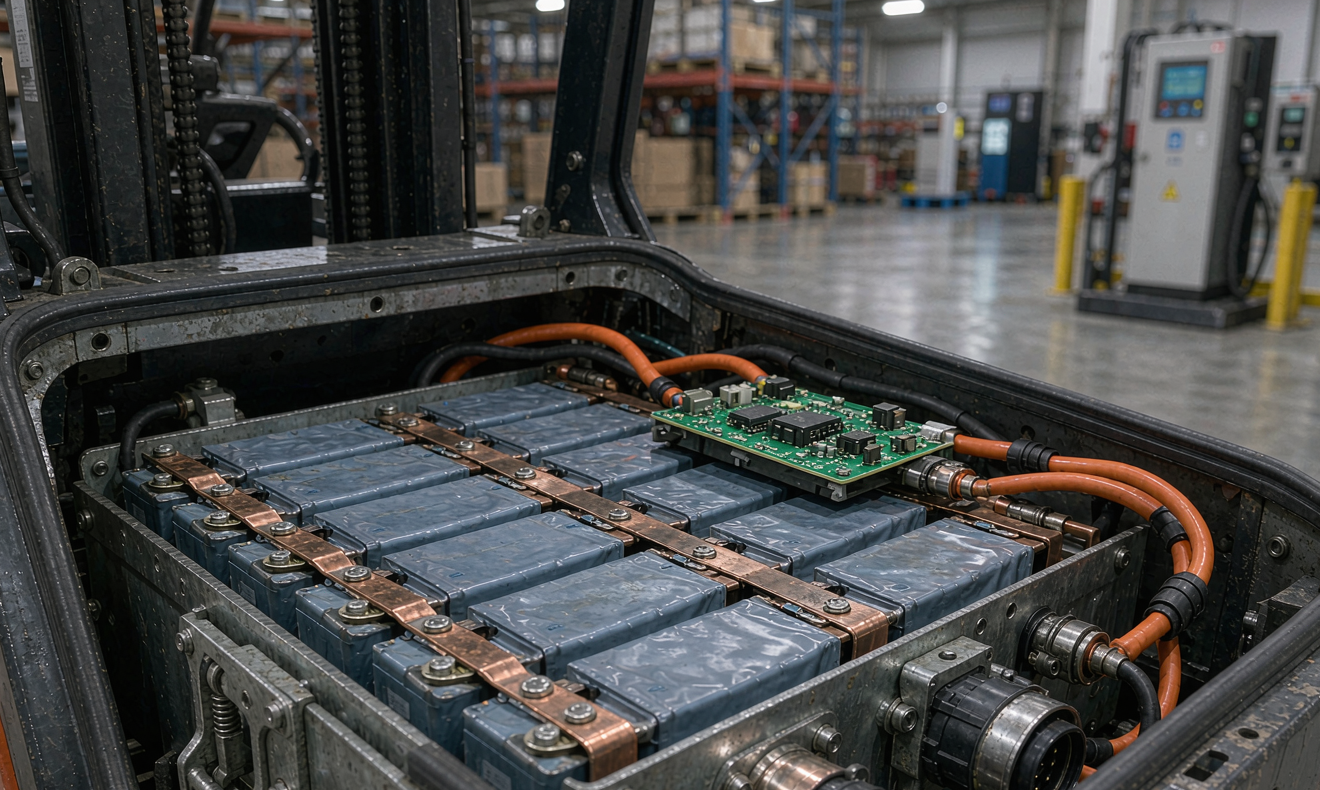
Lead-acid fleets carry a battery-to-truck ratio of about 3:1 — one pack in the truck, one on the charger, one cooling. Most conversion RFPs I see copy that ratio wholesale, and that is where the largest single waste hides. A 48 V / 600 Ah sodium-ion pack (roughly 30.7 kWh) priced at $4,600–$5,800 is not just capital; each spare pack carries inspection labor, storage space, and warranty administration for its whole life.
The correct ratio is a function of your charging strategy, and it is calculable, not guessable:
- Opportunity charging (10–20 minute boosts during shift-change breaks and loading gaps) sustains a single-shift operation at a ratio of 1.2–1.4:1. On a 24-truck fleet, that is 4–5 spare packs instead of the 12 a copied lead-acid spec would order — 7 packs × ~$5,200 = $36,000 of avoided capital plus roughly $2,900/year of avoided spare-pool upkeep.
- Single-charge-per-shift operation with a full recharge across an unpaid overnight window runs comfortably at 1.4–1.6:1, because the pack returns to service before the first shift ends.
- Multi-shift or 20+ hour utilization genuinely needs 1.8–2.2:1 with swap stations — and this is where sodium-ion’s zero-volt storage matters: idle swap packs sit at 0–20% SoC with no degradation penalty, whereas an LFP spare pool left at high SoC ages measurably faster (we logged 1.8–2.5% extra annual capacity fade on LFP spares held at 80–100% SoC versus 30–50%).
Two sizing rules from field post-mortems. First, size the ratio on your worst week, not your average — peak-season utilization at the 3PL sites we instrumented ran 1.25–1.4× the annual mean, and fleets sized on the mean bought emergency packs at retail prices plus expedited freight. Second, verify the ratio with 30 days of BMS-logged data before committing to a full-fleet order; we pilot 4–6 instrumented trucks, extract actual energy-per-shift and available charging windows, and only then freeze the pack count. The pilot costs one pack’s worth of delay and has corrected the initial sizing estimate on 14 of our last 20 projects — usually downward.
Depth-of-Discharge Window Economics: Cost per kWh of Throughput, Not Cost per kWh of Nameplate
The second lever is how you use the SoC window. Fleet managers compare packs on nameplate kWh and rated cycle life, but the operating cost that matters is dollars per kWh of energy actually moved over the pack’s life. The formula is simple: throughput cost = pack price ÷ (equivalent full cycles × usable kWh per cycle). What the formula hides is that equivalent full cycles are strongly DoD-dependent.
For the 20 Ah prismatic sodium-ion cells we qualify against IEC 62619-style protocols, the field-representative numbers look like this:
- 100% DoD cycling (2.0–4.0 V full window): 3,000–3,500 cycles to 80% capacity at 25 °C, 1C discharge.
- 60% DoD window (25–85% SoC): 5,500–7,000 equivalent full cycles — roughly a 1.8–2.0× multiplier.
- 40% DoD window (40–80% SoC): 9,000–12,000 equivalent full cycles in our accelerated data, though the fleet rarely benefits because a narrow window demands more frequent charging infrastructure.
Run the arithmetic on a $5,200, 30.7 kWh pack. Full-window cycling delivers 3,200 cycles × 28 kWh usable (accounting for ~92% round-trip and end-of-life derating) ≈ 89,600 kWh of throughput — about $0.058 per kWh. A managed 60% window delivers 6,200 EFC × 18.4 kWh ≈ 114,000 kWh — about $0.046 per kWh, a 20% reduction. That difference across a 24-truck fleet moving 900 MWh/year is roughly $11,000 per year of deferred replacement, before you count the avoided downtime of fewer changeouts.
The catch, and it is a real one: a narrow DoD window reduces energy per charge, so the charger and the shift schedule must absorb more charge events. This is where sodium-ion’s fast charge acceptance earns its keep — the cells we qualify sustain 1C–1.5C opportunity charging from 25% to 80% SoC without lithium plating concerns, and unlike LFP they do it at cold-dock temperatures. Manage the window in firmware: set the BMS SoC operating band to 20–85% for standard duty, and relax to 100% only before a documented high-demand shift. One caution from a costly lesson: sodium-ion’s flat open-circuit voltage curve means SoC cannot be read off terminal voltage the way a technician reads a lead-acid hydrometer or even an LFP rest voltage. If your chargers and fleet software do not consume BMS-reported coulomb-count SoC over CAN, your window management will drift and the economics above quietly evaporate.
Demand-Charge-Aware Charge Scheduling: The Utility Bill Line Nobody Models
The third lever never appears in a battery datasheet. Industrial tariffs in most of North America, Europe and coastal China carry a demand charge of $8–$18 per kW based on the highest 15- or 30-minute average draw of the month. Uncoordinated charging is how fleets pay it: at one 40-truck distribution center, drivers plugged in at the 22:00 shift end within a 20-minute window, stacking 14 × 11 kW chargers into a 154 kW peak on top of the building’s base load. The demand charge line on that bill was $1,850–$2,400 per month — $22,000–$29,000 a year, purely from plug-in timing.
Three scheduling measures, in ascending order of cost:
- Staggered plug-in policy (no hardware): enforce a 10-minute rotation at shift end, or use charger-native group sequencing. Peak dropped from 154 kW to 88 kW at the same site — $1,150/month saved for the price of a supervisor’s checklist and a wall sign.
- Charger power throttling: cap overnight charging at 0.3C instead of 0.8C. Sodium-ion tolerates slow charging with no penalty — there is no lead-acid equalization stage to satisfy — and the 46 kW overnight peak it produced cut the demand line by another $640/month at a $14/kW tariff.
- Time-of-use alignment: hold charging to off-peak windows ($0.08–$0.11/kWh versus $0.25–$0.32 peak at the sites we modeled). A 24-truck fleet consuming 350 MWh/year shifted 78% off-peak saves $9,000–$13,000/year in energy charges alone. Modern chargers expose this as a simple schedule; a site controller that reads the utility tariff is a one-time $1,500–$3,000 retrofit.
Adding the three levers together, that 40-truck site reduced its charging-related utility cost by approximately $31,000 per year — more than the entire premium of choosing sodium-ion over the cheaper LFP quote they had on the table. No chemistry comparison sheet would have shown it, because it lives in the tariff, not the battery.
Putting It Together: A Cost Model You Can Defend in a Capex Review
When I assemble a fleet cost model for sign-off, it has five line items per scenario, and I insist every one is traceable to a measured input:
- Pack capital = pack count (from the rightsized ratio) × unit price, including the pilot correction, not the initial estimate.
- Throughput replacement reserve = annual MWh ÷ (EFC × usable kWh at the managed DoD window) × pack price — this replaces naive “cycle life ÷ cycles per year” arithmetic and typically shows sodium-ion recovering its price premium within 3–5 years in multi-shift duty.
- Charging energy cost = annual MWh × blended ToU rate after scheduling.
- Demand charge exposure = coordinated peak kW × tariff, monthly.
- Spare-pool upkeep = idle pack count × (inspection labor + storage share), with sodium-ion’s zero-volt storage cutting this line by 60–80% versus any chemistry that needs float maintenance.
On a representative 24-truck, two-shift cold-chain project, that model showed the sodium-ion scenario at 4–7% lower ten-year total cost than the LFP scenario despite the higher pack price — driven mostly by the heating-less cold-dock charging (which eliminated 12 heater retrofits and their wiring runs) and the zero-volt spare pool. The same model, run with a copied lead-acid battery ratio instead of the rightsized one, showed sodium-ion losing on ten-year cost. The chemistry was the same in both runs. The ratio was the difference.
If you take one practice from this article, take the instrumented pilot: 4–6 trucks, 30 days, BMS logs pulled through CAN, and a written acceptance gate that the full-fleet pack count must be derived from measured energy-per-shift at your worst-week utilization. Every dollar of the rightsizing, window and scheduling work above depends on that data being real.
Frequently Asked Questions
Can sodium-ion forklift packs really charge in a freezer warehouse without heaters?
Within limits, yes. The prismatic sodium-ion cells we qualify accept 0.3C charging at −10 °C and reduced-rate (0.1–0.2C) charging down to −20 °C, so short opportunity charges inside a −18 °C cold room are workable for topping up, not for full recharges. Below −20 °C, or for high-rate 1C charging, plan a heated pocket near the dock doors. Discharge, by contrast, is strong in the cold — a sodium-ion pack delivers 85–90% of rated capacity at −10 °C under a 0.5C forklift duty cycle, which is why cold-chain operators rarely need discharge-side derating.
How many spare packs does a lithium battery or sodium-ion fleet actually need?
Derive it, do not copy it. Single-shift opportunity-charged fleets typically need 1.2–1.4 packs per truck; two-shift swap-based fleets need 1.8–2.2. Run a 30-day instrumented pilot, take the worst-week energy-per-shift figure, and compute how many packs can return to service within your available charging windows. In our projects this procedure has reduced the initial pack order on three out of four fleets, with median savings near $30,000 on a 20-truck scope.
Does shallow cycling void the sodium-ion battery warranty?
No — cycling within a restricted SoC band is normal BMS configuration, and reputable manufacturers warrant against cycles or energy throughput, not against how politely you use the window. Do confirm two contract points: that the warranty counts equivalent full cycles (so shallow cycling does not burn warranty cycles faster than necessary) and that the BMS SoC band is field-adjustable by your service organization rather than locked.
Is the flat voltage curve a real problem for fleet SoC tracking?
It is a real constraint, not a defect. Sodium-ion’s open-circuit voltage barely moves between 90% and 20% SoC, so voltage-based SoC estimation is useless mid-curve. Every pack in the fleet must report coulomb-counted SoC over CAN, and your chargers plus fleet-management software must consume it. We budget one integration day per charger model for this, and we validate with an occasional full-discharge capacity audit, because coulomb counters drift a fraction of a percent per month.
Where does a custom battery solution beat a standard pack on forklift cost?
Three situations, in our experience. First, non-standard voltage or form factor — retrofitting a 72 V truck line or a narrow compartment where a standard 48 V box will not fit. Second, extreme duty profiles — a 20-hour-utilization hub benefits from cell selection and thermal design tuned to its specific DoD window rather than a generic catalog pack. Third, fleet-wide CAN integration — when the charger scheduling and SoC reporting of the previous sections must work across mixed truck brands, a purpose-built pack with a documented CAN matrix saves weeks of integration guessing. In each case, the premium over a catalog pack (typically 8–15%) has to be weighed against the measured savings; on our projects the crossover point arrives whenever integration or idle-capital costs exceed roughly $40,000.