12V vs 24V Lithium Battery
As a senior lithium battery engineer at Horizon Power, I have spent more than a decade specifying battery systems for drones, robotics, marine electronics, off-grid solar, and residential energy storage. One question comes up in nearly every design review: should we standardize on a 12V or a 24V lithium battery platform? The answer is never a matter of which voltage is “better” in the abstract—it is a function of cable run length, continuous current draw, inverter efficiency, and the cell chemistry you have chosen. In this article I will walk you through the engineering trade-offs I use on the bench so you can make a confident, defensible specification.
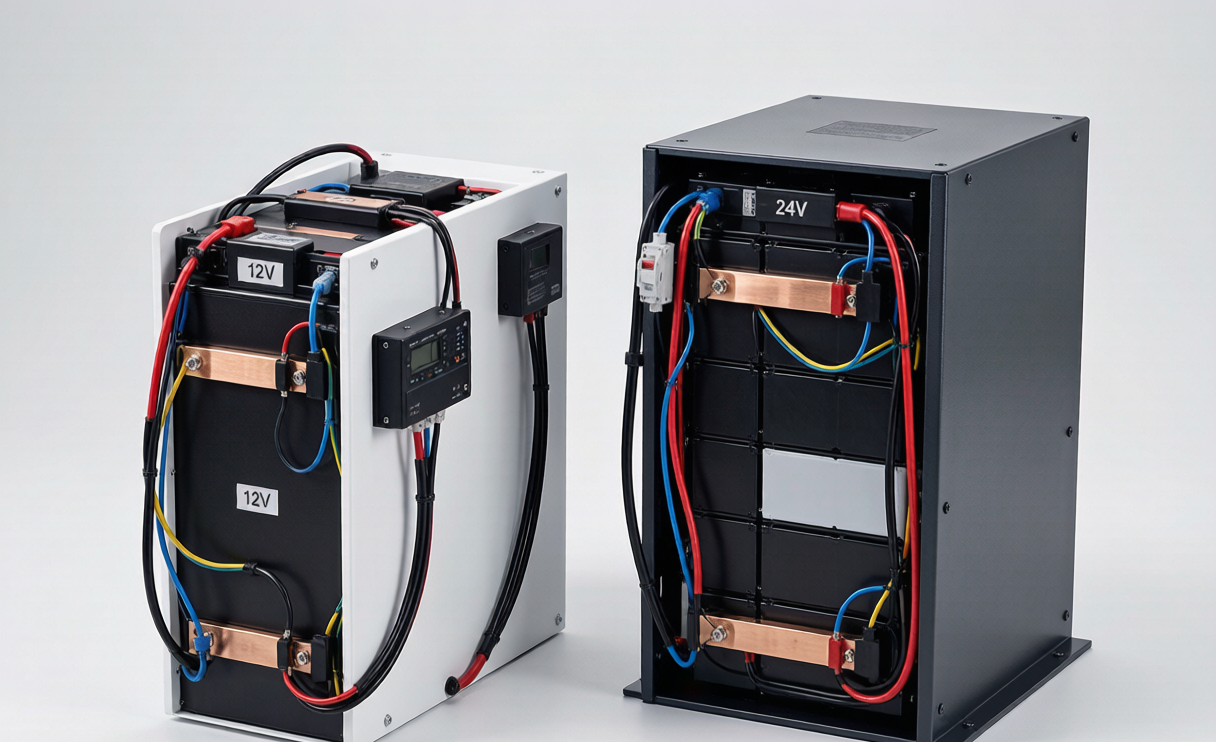
Understanding the Nominal Voltage Platform
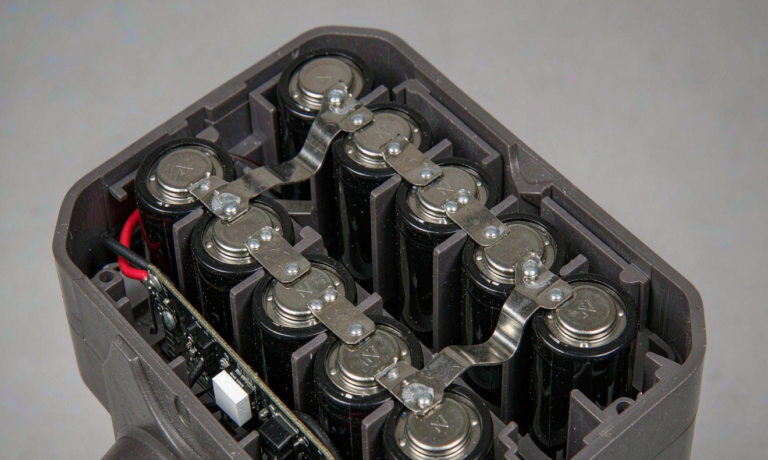
A lithium battery is built from cells wired in series. A 12v lithium battery (more precisely a 12.8V LiFePO4 system) uses four LFP cells in series, each with a nominal 3.2V plateau. A 24V lithium battery uses eight cells in series, giving a nominal 25.6V. If you are working with NMC or Li-ion cells at 3.6–3.7V nominal, a “12V” pack is really three cells (about 11.1V) and a “24V” pack is six or seven cells depending on the cutoff you design for. These platforms are not interchangeable at the load: an inverter or motor rated for 12V will fault or be damaged if you connect a 24V battery pack to it.
In my experience the single most common field failure I am called to diagnose is a voltage mismatch between the battery pack and the load. Always confirm the load’s operating window—typically 10.5V to 14.6V for 12V systems and 21V to 29.2V for 24V systems—before you commit to a bill of materials.
The Decisive Factor: I²R Copper Loss
When you specify a battery system, the quietest killer of efficiency is resistive loss in the cables. The power lost as heat in a conductor is P = I²R, where I is the current and R is the harness resistance. Because power P = V × I, for a fixed load wattage a 24V lithium battery draws exactly half the current of a 12V system.
Let me give you a concrete example from a recent marine electronics job. The load was a 480W inverter. At 12V the current is 480 / 12.8 ≈ 37.5A. At 24V it is 480 / 25.6 ≈ 18.75A. If the cable run has a harness resistance of 0.02Ω, the 12V system loses I²R = 37.5² × 0.02 ≈ 28.1W as heat. The 24V system loses 18.75² × 0.02 ≈ 7.0W. That is four times less loss on the higher-voltage platform. Over a long cable run—say from a battery bay to a cabin 6 meters away—the 12V system would need dramatically thicker (and more expensive) copper to match the 24V efficiency.
My rule of thumb: for any load above roughly 300W or any cable run longer than 3 meters, strongly prefer 24V. Below that, 12V is usually simpler and cheaper.
Inverter and Charge Controller Matching
Most small inverters and DC-DC converters are built around a 12V bus because that is what legacy lead-acid systems used. If your application is a small camper van, a fish finder, or a backup radio, a 12V lithium battery keeps the BOM simple—you buy off-the-shelf chargers and the cost of entry is low. The 12V ecosystem is mature and parts are abundant.
But the moment you scale up, the 24V lithium battery wins. A 2000W pure-sine inverter pulling from a 12V battery demands roughly 170A continuous—that is a serious current to manage safely, requiring 4/0 AWG cabling and heavy busbars. The same inverter on 24V pulls about 85A, which is far easier to fuse, switch, and cool. MPPT solar charge controllers also have a voltage ceiling; a 24V battery pack lets you use higher-voltage PV strings and recover more energy on cloudy mornings.
Cell Chemistry and System Balancing
The chemistry you pick changes the math. LFP (LiFePO4) is my default recommendation for stationary and semi-stationary storage because of its thermal stability, 3000–6000 cycle life, and flat discharge curve. NMC and other high-energy Li-ion cells give you higher specific energy for weight-sensitive drones and portable gear, at the cost of tighter thermal management. Whether you choose LFP or NMC, the 12V vs 24V decision is independent of chemistry—both platforms can be built from either cell type.
For a battery pack built on LFP, a 24V system simply has eight cells in series rather than four. The battery management system must monitor more series strings, but the per-watt cost of the BMS usually drops because current is lower. I often tell clients: if you are already paying for a quality BMS, the 24V architecture gives you better value per delivered watt.
Practical Selection Checklist
Here is the quick decision framework I use in client meetings:
- Load power: Under ~300W and short cable runs → 12V. Above ~300W or long runs → 24V.
- Current handling: If continuous current exceeds ~80A, 24V avoids heavy cabling and fusion headaches.
- Existing ecosystem: If you already run 12V accessories (fans, lights, pumps), a 12V lithium battery avoids extra DC-DC converters.
- Solar input: Larger PV arrays pair more naturally with 24V battery packs and high-voltage MPPT.
- Scalability: If you may double capacity later, 24V leaves more headroom before you need parallel strings.
Field Notes from My Own Builds
On a recent agricultural drone ground-station project, the client initially specced a 12V lithium battery for a 600W payload. The cable ran 4 meters and the harness got uncomfortably warm under load. We re-spun the design around a 24V battery pack with the same cells, kept the same gauge wire, and the temperature rise dropped by roughly 75%. Same cells, same cost, dramatically safer. That is the kind of win you get when you let I²R—not habit—drive the voltage decision.
Frequently Asked Questions
Can I connect a 12V and a 24V lithium battery in the same system?
Not directly in parallel—their voltages differ and you would create a short through the balancing path. You can run them on separate loads, or use a 12V/24V auto-sensing DC-DC converter to step the 24V bus down to feed 12V accessories. I recommend isolating them with a proper converter rather than bridging them.
Is a 24V lithium battery more dangerous than 12V?
No. Both use the same cell chemistries and the same protection philosophy. The higher system voltage actually reduces current for a given load, which lowers heating and arc-flash energy in the wiring. The key safety requirement is a correctly rated BMS, fuses, and properly sized cabling—regardless of voltage.
Which lasts longer, 12V or 24V?
Lifespan is set by chemistry, depth of discharge, and temperature—not by system voltage. An LFP battery pack will deliver 3000–6000 cycles at 80% DoD whether it is 12V or 24V. The 24V architecture may indirectly extend life by running cooler under high loads, since lower current means less I²R heating in the harness.
Do I need a special charger for a 24V lithium battery?
Yes. You must use a charger (or MPPT) programmed for the correct cell count and chemistry—e.g., a 24V LFP profile with a 29.2V absorption setpoint. Using a 12V charger on a 24V lithium battery will undercharge it and can confuse the BMS. Match the charge profile to the pack, never the other way around.
Choosing between a 12V and 24V lithium battery is one of the highest-leverage decisions in any battery application. Let the load power, cable length, and current budget decide—not tradition. If you would like help speccing the right platform for your product, our engineering team at Horizon Power is happy to review your requirements and validate the architecture before you build.