Lithium Battery Cell Grading and Sorting
What Cell Grading Actually Means
When a customer asks why two seemingly identical lithium battery packs behave differently in the field, the answer usually traces back to one overlooked step in manufacturing: cell grading. I am Karl Huang, Senior Lithium Battery Engineer at Horizon Power, and in twelve years of building packs I have seen grading discipline — or the lack of it — decide whether a battery fleet stays consistent for 800 cycles or drifts apart after 150. This article explains what lithium battery cell grading and sorting really involves, the data we capture, and why it is the quiet foundation of pack consistency, safety, and cycle life.

Cell grading is not a luxury add-on. It is the process that turns a bin of individual cells into a predictable, balanced energy source. In my experience the single biggest predictor of a pack’s first-year return rate is not chemistry or brand — it is whether the cells were graded to a known tolerance before assembly. A consistent pack is easier to balance, safer under abuse, and far cheaper to support in the field. Below I will walk through how we do it and the numbers that prove it matters.
What Cell Grading Actually Means
Grading (often called sorting or matching) is the practice of measuring every cell against the same criteria and binning cells with similar electrical characteristics together before they are welded into a lithium battery pack. A single cylindrical or pouch cell is a precision component, but even cells from the same production lot vary. Grading captures four parameters:
- Capacity (mAh / Ah) — measured by a full 0.5C charge-discharge cycle. Two cells rated 3000 mAh can differ by 30–80 mAh straight from the line.
- Internal resistance (mΩ) — measured at a fixed state of charge, typically 50% SOC, with an AC impedance bridge or a 1 kHz pulse. IR drives voltage sag and heat.
- Open-circuit voltage (OCV) — the resting voltage after a stabilization period; a proxy for SOC and self-discharge.
- Self-discharge rate — how much capacity a fully charged cell loses over a 7–14 day storage at 25 °C. High self-discharge flags a latent defect.
We record all four for every cell. A 3000 mAh lithium ion battery that looks perfect on paper but hides 12 mΩ of extra resistance will become the weak link in a parallel group, forcing the BMS to work harder and shortening pack life.
Why Cell Consistency Decides Pack Behavior
In a series string, cells are as strong as the weakest; in a parallel group, current naturally flows toward the lowest-resistance cell. When cells are not matched:
- Voltage spread grows under load, so the BMS reaches end-of-charge or end-of-discharge cutoff based on the worst cell, wasting the good cells’ capacity.
- Balancing current rises. A passive balancer sized for 50 mA cannot correct a 200 mV spread without long, wasteful trickle charging.
- Heat concentrates in the highest-IR cell, accelerating aging and, in extreme cases, pushing toward thermal runaway.
Consistency is therefore a safety and longevity issue, not just a spec-sheet nicety. This is where a disciplined custom battery solution beats a catalog build: we grade to the tolerance the application actually needs.
The Grading Workflow on Our Production Line
A typical Horizon Power grading flow for a lithium battery pack program runs like this:
- Formation — every cell gets its first controlled charge-discharge to activate the SEI layer, the same step we detail in our formation-process guides.
- Aging — 7–14 days at controlled temperature so early-life capacity settling and self-discharge surface.
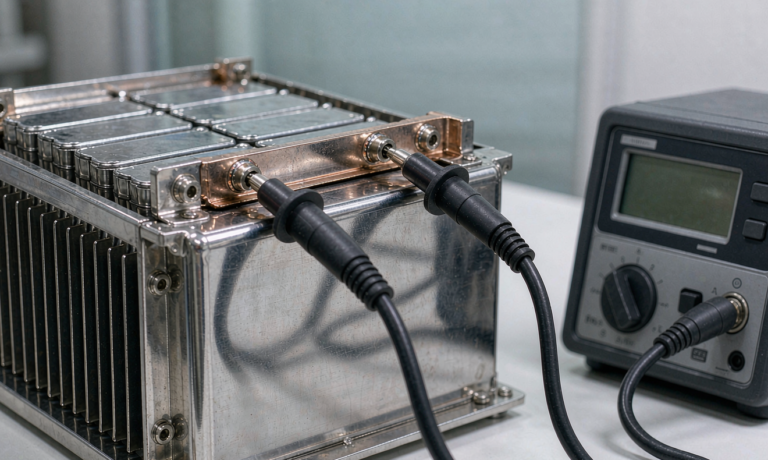
- Full characterization — a 0.5C capacity cycle, an IR measurement at 50% SOC, and an OCV check, all logged to our MES with a unique cell serial.
- Sorting into bins — we sort by capacity window (e.g. ±10 mAh), IR window (e.g. ±2 mΩ), and self-discharge class. A LFP battery pack for solar storage and an NCM battery pack for a power tool get different tolerance bands because their duty cycles differ.
- Traceability — each finished pack carries the bin ranges of its cells, so a future warranty claim can be traced to the exact grading lot.
This is the engineering discipline behind a number you can trust on the spec sheet.
Real Numbers: Graded vs Ungraded Packs
We ran a controlled comparison on two otherwise identical 14S4P 18650 packs built from the same cell shipment:
- Ungraded pack: initial per-cell voltage spread of 78 mV at rest, IR spread of 9 mΩ, and a 14% capacity gap between the strongest and weakest parallel group.
- Graded pack (±10 mAh / ±2 mΩ bins): rest spread of 12 mV, IR spread of 2 mΩ, and under a 20 A load the pack held its voltage platform within 0.3 V end-to-end.
After 500 cycles at 1C, the ungraded pack had lost 21% capacity and showed two swollen cells; the graded pack retained 91% and stayed within 1 °C cell-to-cell in temperature. The lesson is unambiguous: grading is cheap insurance against field failures. A solid BMS solution can mask mismatch for a while, but it cannot restore capacity the weak cell already threw away.
When Grading Matters Most
Not every application needs tight grading, but these demand it:
- High-rate discharge (power tools, drones, heavy-lift) — small IR differences become large voltage sags at 30–60C.
- Large series strings (48V telecom, ESS racks) — the cumulative weak-cell effect scales with series count.
- Long-life stationary storage — ten-year warranties live or die on early consistency.
- Mixed procurement lots — if you must build from two shipments, grading is the only way to make them behave as one.
A concrete example: a client building 48V ESS racks from two cell shipments saw chronic top-balancing faults until we graded both lots to a common ±15 mAh / ±2 mΩ band and rebuilt the strings. Balancing time dropped from 6 hours to under 40 minutes per rack, and the BMS solution finally had margin to manage real load instead of chasing mismatch.
Standards and Quality Gates
Grading supports compliance, not just performance. Our graded cells ship inside packs validated to IEC 62133 (safety for portable cells), IEC 62619 (industrial stationary cells), and UN38.3 (transport simulation). For aviation and cross-border logistics we document the transport test summary so freight forwarders clear the lithium battery shipment without delay. Grading data also feeds our lot-release records, which auditors expect under these standards.
How We Brief Grading Tolerance in an RFQ
If you are sourcing a pack, specify grading in the RFQ rather than assuming it happens. Tell the supplier the capacity window (we recommend ±1% of rated), the IR window (±2 mΩ for high-rate, ±4 mΩ for energy cells), and whether self-discharge screening is required. A good custom battery solution partner will quote grading as a line item, not hide it. At Horizon Power we publish the bin ranges on the pack label so your incoming QC can verify them.
The bottom line: lithium battery cell grading and sorting is the difference between a pack that performs like the simulation and one that surprises you at cycle 200. Measure every cell, sort to the tolerance your duty cycle earns, and your fleet will stay consistent, safe, and long-lived.
Grading Pitfalls That Undo the Benefit
Grading only pays off if the rest of the build respects it. Three mistakes I see repeatedly:
- Re-mixing bins during assembly — a graded pack is only as good as the pick-list. If a line operator grabs the nearest cell instead of the binned one, the spread returns instantly. We enforce bin-to-pack scanning so a cell outside the declared window cannot be welded.
- Grading once, then aging unmonitored — cells continue to settle after grading. For long-shelf-life programs we re-verify OCV after the pack is built and before shipment, catching any cell that drifted out of band.
- Over-grading for the application — tightening tolerance beyond what the duty cycle needs adds cost and scrap with no field benefit. A lithium battery for a low-current sensor can live happily with a ±3% window; reserving ±1% for the packs that actually need it is the efficient choice.
The takeaway is that grading is a system, not a single test. Measure, bin, assemble to the bin, and verify — skip any step and you pay for grading without getting the consistency.
Frequently Asked Questions
What is the difference between cell grading and cell matching?
They are often used interchangeably. Grading is the act of measuring and binning cells by capacity, IR, OCV, and self-discharge; matching (or sorting) is selecting cells from the same bin to build a pack. In practice a graded cell is one that has already been sorted into a known tolerance band.
How tight should the capacity window be?
For most packs we recommend ±1% of rated capacity (about ±30 mAh on a 3000 mAh cell). High-rate and large series strings benefit from a tighter ±10 mAh window. Looser windows are acceptable only for low-current, short-life consumer items.
Does grading add a lot of cost to a pack?
Less than most buyers expect. The characterization cycle is largely automated on our line, so grading typically adds 3–6% to pack cost while preventing the far larger cost of field returns, imbalance, and premature capacity loss.
Can a BMS replace the need for grading?
No. A BMS solution balances and protects, but it cannot create capacity a weak cell lacks, nor undo the extra heat a high-IR cell generates. Grading reduces the balancing burden and extends life; the BMS then has an easy job instead of a losing one.
Do LFP and NCM cells need different grading?
Yes. An LFP battery has a very flat voltage curve, so OCV-based sorting is less meaningful and we lean on capacity and IR. An NCM battery has a steeper curve and higher energy density, so tighter IR windows matter more for safety under high rate. We set per-chemistry tolerance bands.
How do I verify a supplier actually graded my cells?
Ask for the bin ranges and the per-cell data log, and have incoming QC spot-check a sample against the claimed window. A reputable lithium battery manufacturer will provide traceable grading records tied to the pack serial number without hesitation.