Lithium Battery PCM vs BMS
One question comes up in almost every lithium battery design review I run: “Do we need a full BMS, or is a protection circuit module enough?” I’m Karl Huang, Senior Lithium Battery Engineer at Horizon Power, and after specifying protection for hundreds of packs — from small consumer cells to industrial lithium battery pack assemblies shipped under UN38.3 — I can tell you the honest answer is “it depends on what the pack has to survive.” A PCM and a BMS are cousins, not rivals. Understanding where they overlap and where they diverge is the difference between a pack that quietly protects itself and one that becomes a warranty claim.
What a Protection Circuit Module (PCM) Actually Does
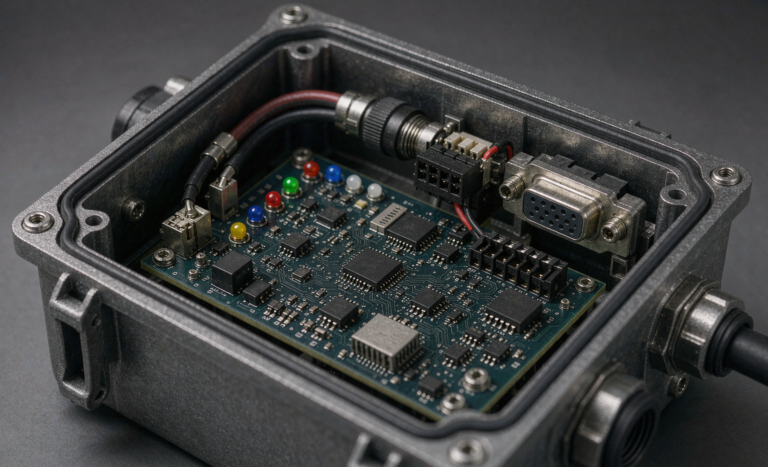
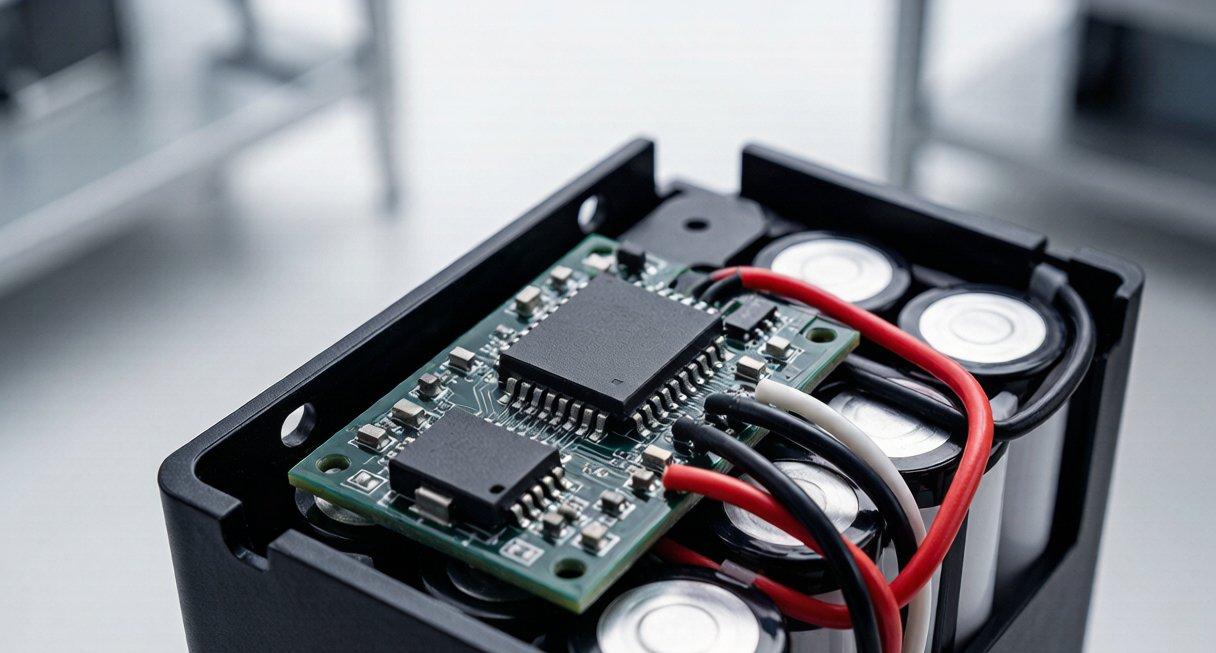
A protection circuit module is the minimum safety layer I recommend for any lithium-ion battery that leaves the factory. At its core, a PCM is a hardwired electronic switch built around a protection IC (usually from families like S-82xx or similar) and a pair of MOSFETs in series. Its job is brutally simple: cut the pack off before something dangerous happens.
Concretely, a competent PCM watches four things. First, overcharge — it opens the charge path when any cell group crosses roughly 4.25 V/cell. Second, over-discharge — it disconnects the load at about 2.5–2.75 V/cell to protect cell chemistry. Third, over-current — it trips on a short circuit in microseconds and on sustained overload within a second or two. Fourth, temperature — most quality modules add an NTC thermistor that opens the pack above a set threshold (commonly 50–70 °C) and below a cold-charge limit (often around 0 °C) to prevent lithium plating.
For a single-series or modest multi-series lithium battery, that is genuinely enough. The PCM is cheap, draws almost no quiescent current (tens of microamps), and needs no firmware. If you are building a 1S or 2S consumer device, a PCM is the right call. It is a safety net, not a brain.
What a Battery Management System (BMS) Adds on Top
A BMS keeps everything a PCM does and then adds intelligence. Where a PCM only reacts, a BMS observes, measures, calculates and communicates. The defining feature is cell-level balancing: a BMBMS continuously bleeds or shuffles charge between series groups so that a 10S lithium battery pack stays balanced instead of drifting cell by cell until one group hits the cutoff first.
Beyond balancing, a real BMS gives you state-of-charge (SOC) and state-of-health (SOH) estimation, usually via Coulomb counting plus voltage modeling. It talks to the outside world through SMBus, CAN-bus or RS485. It logs cycle data, flags weak cells before they fail, and can push telemetry to a fleet dashboard. For an industrial lithium-ion battery that must run unattended for years, that visibility is what keeps the total cost of ownership sane.
In short: a PCM protects the pack from the worst-case event; a BMS protects the pack from gradual, predictable wear — and tells you about it. When a customer asks me for a custom battery solution with remote monitoring, the BMS is non-negotiable.
PCM vs BMS: The Engineering Differences That Matter
When buyers ask me to compare a lithium battery PCM vs BMS, I frame it around five engineering axes rather than marketing language.
- Balancing: PCM — none. BMS — active or passive cell balancing, typically 20–100 mA passive, higher for active topologies.
- Communication: PCM — silent. BMS — SMBus/CAN/RS485 with readable registers.
- State estimation: PCM — none. BMS — SOC/SOH with Coulomb counting.
- Quiescent draw: PCM — microamps. BMS — milliamps, which matters for long-shelf-life packs.
- Cost and complexity: PCM — a few dollars. BMS — tens to hundreds, plus firmware and validation.
The trap I see most often is specifying a BMS for a throwaway consumer product, or a bare PCM for a 20 kWh home storage bank. Get this mismatch wrong and you either blow margin or you lose visibility you critically needed.
When a PCM Is Enough (and When You Need a BMS)
Here is the rule of thumb I give clients. Use a PCM when: the pack is low series count (1S–4S), the application is supervised or short-duty, the runtime is short, and no one needs to read battery data remotely. Examples include small power tools, LED lighting, and many portable consumer gadgets.
Move to a BMS when any of these are true: the pack is 6S or higher, it stores significant energy, it runs unattended, it is part of a fleet, or regulations demand traceability. E-bikes, forklifts, home energy storage, medical devices and any lithium battery pack on an aircraft-adjacent platform all land here. For aviation-linked gear, FAA and EASA expectations push hard toward documented, monitorable protection rather than a silent fuse-like module.
How We Specify Protection in Custom Battery Packs
At Horizon Power, the protection discussion happens on day one of any custom battery solution, not after the cells are chosen. We start from the abuse cases: what is the worst realistic over-current? What is the maximum charge voltage the charger could push? Then we set the PCM/BMS thresholds with margin, not at the absolute cell limit.
I also spec the protection topology against the cell chemistry. An LFP lithium battery tolerates deeper discharge and is more forgiving, so thresholds relax. An NCM pack is tighter on voltage window and demands stricter balancing. For a full BMS solution we define balancing current, sense-wire routing, isolation resistance, and the communication protocol the customer’s controller speaks. None of this is guesswork — it is captured in the DFMEA before the first prototype.
We validate against the standards buyers actually ship under: UN38.3 for transport, IEC 62133 for portable cells and packs, IEC 62619 for industrial stationary use, and UL 1642 / UL 2054 for the North American market. A protection circuit is only as good as the test report behind it.
Compliance, Certification and What Buyers Often Miss
The most common gap I audit is treating certification as a paperwork step. It is not. A PCM that passes IEC 62133 on paper but uses a protection IC with loose tolerance will drift in the field. We therefore qualify the protection IC lot-by-lot and keep margin between the trip point and the cell’s true limit.
Another miss: buyers forget quiescent current. A BMS drawing 3 mA will flatten a small lithium-ion battery in weeks of storage; a PCM drawing 20 µA will not. For seasonal or emergency gear, that single number can decide the architecture. If you cannot justify the BMS drain, a PCM with an occasional manual check is the pragmatic engineering answer.
Finally, document the protection behavior in the pack’s passport. When a pack fails a field audit, the first question is always “what was it allowed to do?” A clear spec sheet beats a silent module every time.
Common Failure Modes I See in the Field
Across returned packs, the same handful of protection failures repeat. The first is sense-wire detachment: if a BMS loses a cell-group sense line, it guesses the voltage and either over-balances or alarms constantly. We solve this with strain-relieved sense harnesses and redundant routing on any lithium battery pack that vibrates in service.
The second is MOSFET thermal runaway during a sustained overload the PCM was never rated to clear. A cheap module sizes its FETs for nominal current, not fault current, so it survives one short and fails on the next. We derate FETs to roughly half their datasheet continuous rating and verify with repeated short-circuit cycling.
The third is cold-charge damage. A PCM without a low-temperature cutoff will let a charger push current into a frozen lithium-ion battery, plating metallic lithium and permanently degrading the cell. Any pack destined for outdoor or logistics use gets a hard 0 °C charge cutoff, full stop.
A Practical Selection Checklist for Procurement
When a buyer sends me an RFQ, I ask five questions that decide PCM vs BMS. Series count: above 6S, lean BMS. Duty cycle: continuous or seasonal standby? Standby favors the low-draw PCM. Monitoring need: does the host controller expect data? If yes, BMS. Energy at risk: a small pack failure is annoying; a 20 kWh bank failure is a fire report. Certification market: North America wants UL; Europe wants IEC; transport always wants UN38.3. Answer those and the architecture chooses itself.
For most industrial clients I now recommend a modular BMS solution that scales across their product line — one validated firmware, multiple pack sizes. That reuses certification effort and shrinks the custom battery solution lead time dramatically. It is the pattern we ship most often, and it is why a thoughtful protection decision up front pays back across the whole roadmap.
Frequently Asked Questions
Is a PCM the same as a BMS?
No. A PCM is a passive safety switch that disconnects the pack under fault. A BMS includes all PCM functions plus balancing, SOC/SOH estimation and communication. Think of the PCM as the circuit breaker and the BMS as the breaker plus the smart meter.
Can I retrofit a BMS to a pack that only has a PCM?
Sometimes, but it is rarely clean. A BMS needs dedicated sense wires to every series group and a communication bus the host understands. Retrofitting usually means rebuilding the interconnect board. It is far cheaper to spec the right protection in the original lithium battery pack design.
How many cells can a PCM protect?
A PCM typically protects up to about 4S–7S economically; beyond that, balancing and per-group monitoring become necessary and a BMS is the better architecture. Higher-series packs without balancing drift quickly and lose usable capacity.
Does a BMS improve safety or just reporting?
Both. The BMS keeps the PCM-level hard protection and adds early warning — it catches a weak cell before it becomes a fault. That predictive layer is exactly why a BMS solution reduces field failures in unattended industrial deployments.
What standards govern lithium battery protection circuits?
The headline ones are UN38.3 for transport, IEC 62133 for portable packs, IEC 62619 for stationary industrial use, and UL 1642 / UL 2054 for the US market. Aviation-linked applications also face FAA and EASA expectations favoring monitorable protection.
Which costs more to maintain over the pack’s life?
On paper the PCM is cheaper. In practice, a BMS often lowers lifetime cost for large packs because it extends cycle life through balancing and prevents silent failures. For a small lithium battery, the PCM wins on both price and standby drain.