Lithium Battery Thermal Runaway Mitigation
When a lithium battery fails catastrophically, it rarely does so quietly. Over fifteen years on the factory floor and in the field—commissioning lithium-ion packs for telecom backup, forklift fleets, and off-grid storage—I have learned to respect one failure mode above all others: thermal runaway. It is the chain reaction that can turn a single weak cell into a pack-wide fire in a matter of seconds. In this article I will walk through what thermal runaway actually is, the abuse conditions that trigger it, and the layered mitigation strategies we engineer into every lithium battery pack that leaves our line. If you specify, integrate, or maintain lithium-ion battery systems, this is the one failure mode you cannot afford to misunderstand.
What Thermal Runaway Actually Is
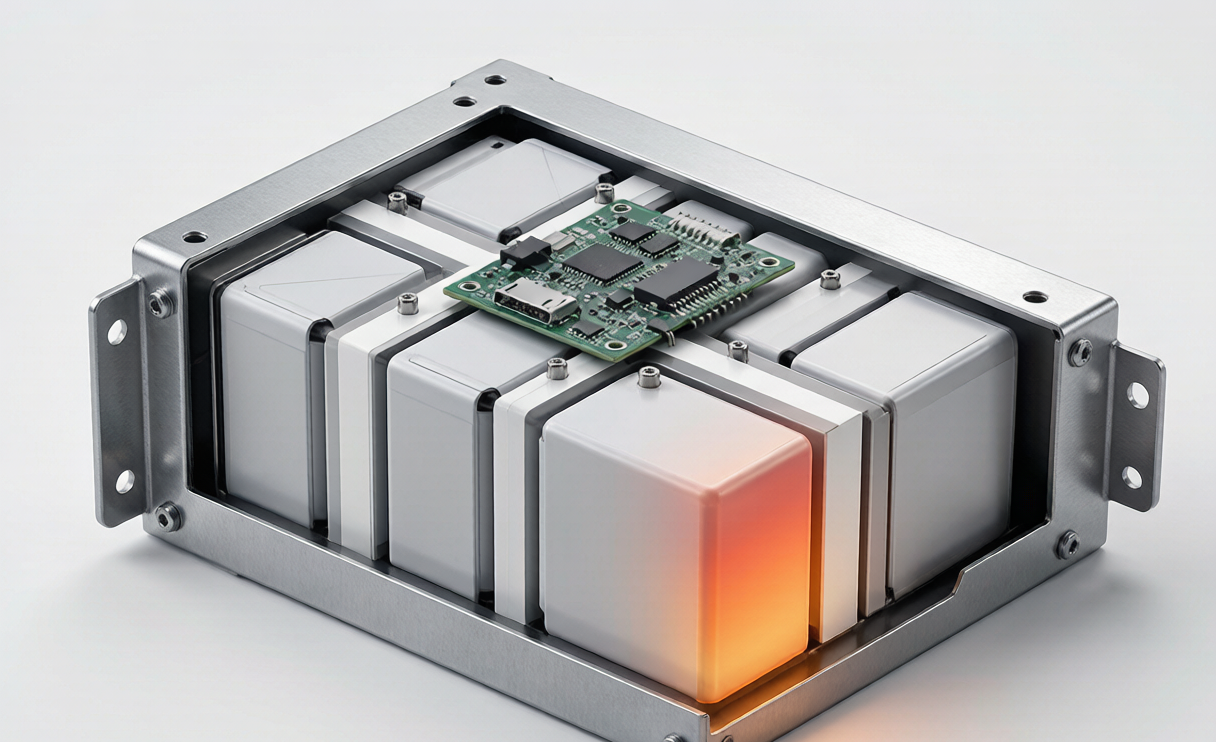
A lithium-ion cell stores energy in a delicate electrochemical balance. Inside the cell, a porous separator keeps the anode and cathode electrically apart while allowing lithium ions to shuttle through a flammable organic electrolyte. Thermal runaway begins when that balance is broken by heat. As cell temperature climbs, a sequence of exothermic side reactions starts feeding on itself, and once it passes a critical threshold there is no practical way to stop it from outside.
In my cell-teardown reviews I describe the cascade to customers using five temperature stages, because understanding the timeline is the first step to defeating it:
- 80–90°C: The solid-electrolyte interphase (SEI) layer begins to decompose, releasing heat and gas.
- 110–130°C: The polyolefin separator softens and melts, allowing direct anode-cathode contact.
- 130–150°C: Cathode material (especially nickel-rich NCM) releases bound oxygen, and the electrolyte begins to decompose violently.
- 150–200°C: Flammable electrolyte vapour ignites; the cell vents, jets flame, or both.
- Propagation: Heat radiated or conducted to neighboring cells drags them over the same cliff, one after another.
This is why a lithium battery pack cannot be judged safe by looking only at the cell datasheet. The danger is not the single cell—it is how the pack contains or stops the cascade. Every lithium battery pack we ship is designed around the assumption that one cell will eventually misbehave, and the job of the system is to keep that event from becoming a systemic fire.
The Common Triggers I See in Real Installations
Thermal runaway is almost always a symptom of an upstream abuse condition. In field audits across more than a hundred deployments, the triggers group into six families:
- Overcharge: Pushing a cell beyond its upper limit (4.20 V/cell for NCM, 3.65 V/cell for LFP) causes lithium plating and internal heating. A failed charger is the most common root cause I encounter.
- Internal short circuit: Metallic dendrites, a manufacturing contaminant, or a folded separator can bridge the electrodes inside the cell, creating a low-resistance path that self-heats.
- External short / overcurrent: A crashed power tool or a crushed cable can draw hundreds of amps, dumping energy as heat faster than the pack can shed it.
- Mechanical abuse: Crush, drop, or penetration physically breaches the separator and can weld the electrodes together on contact.
- External heat: A nearby fire or an enclosed, poorly ventilated cabinet can raise ambient temperature past the cell’s tolerance even with no internal fault.
- Manufacturing defect: Mis-welded tabs, foreign particles, or inconsistent electrolyte fill create latent weak points that surface months later.
The takeaway for any engineer specifying a custom battery solution is simple: you cannot eliminate every trigger, so you design the pack to survive the ones that are statistically inevitable.
Detecting Onset Before It Is Too Late
The cheapest thermal runaway is the one you catch in its first ten seconds. Modern monitoring is built on the principle that an incipient cell does not go from healthy to detonating without warning—it heats, vents, and changes its electrical signature first. A credible BMS solution therefore watches three independent signals:
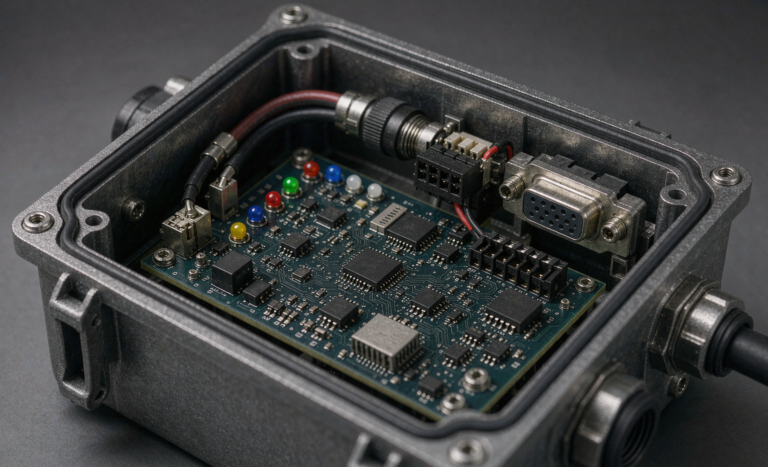
- Per-cell voltage and temperature: Multi-point sensing at the cell level, not just at the pack bus bar, so a single hot cell cannot hide inside an average.
- Temperature gradient: A sudden delta between adjacent cells is an early fingerprint of an internal short, often visible minutes before any absolute-temperature alarm.
- Off-gas detection: VOC and pressure sensors can identify electrolyte decomposition before flame, buying crucial evacuation and isolation time in enclosed rooms.
In one warehouse ESS we commissioned, the BMS flagged a 6°C gradient between two modules at 2 a.m. A technician found a loose busbar connection arcing under load. We isolated the string before it ever reached the separator-melt stage. That is detection doing its job.
Mitigation Across Three Engineering Layers
I teach my team to think about mitigation as three nested defenses: cell, pack, and system. If one layer is breached, the next must still hold.
Cell layer. Chemistry and internal construction set the floor. Ceramic-coated separators resist shrinkage; “shutdown” separators physically close their pores near 130°C to block ion flow; cathode coatings slow oxygen release. These are design decisions made before the cell is ever welded into a pack.
Pack layer. Here we add fuses, positive-temperature-coefficient (PTC) devices, and current interrupt devices (CID) that physically open the circuit under fault. We space cells to limit conductive heat transfer and wrap modules in thermal-barrier materials. A well-built lithium-ion battery module treats each cell as a potential hazard that must be isolated, not just connected.
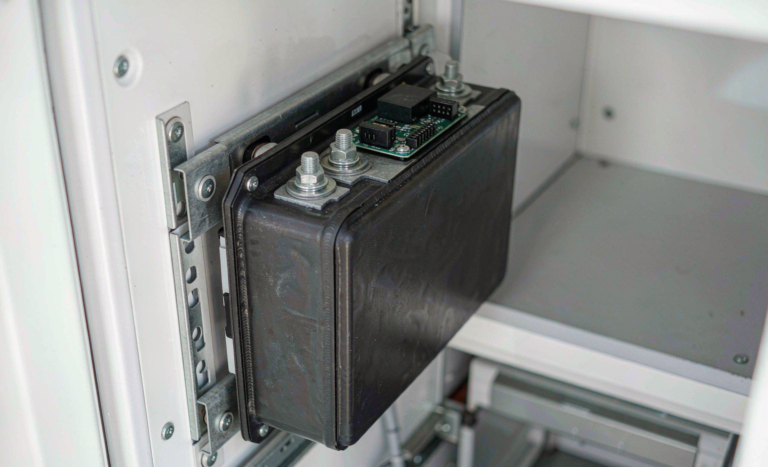
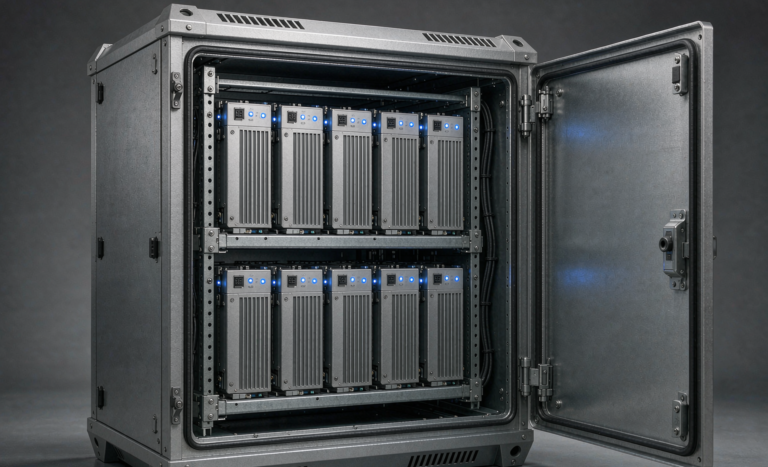
System layer. This is where the BMS solution enforces hard limits: charge cutoff, discharge cutoff, overcurrent contactors, and cell-balancing that prevents chronic overcharge drift. For stationary and vehicle applications we also design compartmentalization and fire-rated enclosures so that a single cell failure cannot propagate to the rest of the installation.
Why Cell Chemistry Changes the Equation
Not all lithium chemistries are equal when it comes to thermal runaway. The cathode material decides how willingly the cell gives up oxygen:
- LFP (lithium iron phosphate): The cathode is structurally stable and does not release free oxygen until roughly 270°C. It is intrinsically more forgiving, which is why a LFP battery is my default recommendation for indoor, occupied-space, and high-cycle applications.
- NCM / NCA (nickel-rich): Higher energy density, but the cathode starts releasing oxygen near 150–200°C, giving a much narrower safe window. An NCM battery demands stricter BMS limits and more aggressive thermal design.
There is no free lunch: the chemistry that gives you the longest flight time or smallest pack is usually the one that fails fastest when abused. The correct choice depends on whether your priority is energy density or abuse tolerance, and I always document that tradeoff explicitly in the specification.
The Standards That Frame Mitigation
Mitigation is not optional folklore—it is codified in certification. When I review a custom battery solution for a client, I map the design against the standards their market requires:
- UN38.3: The global transport test regime—altitude simulation, thermal test, vibration, shock, external short, impact, and overcharge. Pass this or the pack cannot legally ship.
- IEC 62133: Safety requirements for portable cells and batteries, covering short-circuit, overcharge, and forced-discharge scenarios.
- IEC 62619: The industrial stationary-battery safety standard, with explicit requirements for thermal runaway propagation control.
- UL 1642 / UL 1973 / UL 2580: Cell, stationary, and EV/transport safety respectively; UL 2580 in particular demands that a single cell failure not propagate to adjacent cells.
- FAA / EASA: Aviation authorities whose carrying and installation rules for lithium-ion battery systems hinge directly on demonstrated thermal-runaway containment.
These standards exist because regulators have seen what happens when mitigation is treated as a checkbox. A 12v lithium battery in a cabinet and a 400 V traction pack in a vehicle are governed by different rules, but both ultimately answer the same question: when one cell goes, how do you stop the rest?
Field Practices From My Commissioning Log
Standards tell you the minimum; field experience tells you where the minimum falls short. Three habits have saved more packs than any single component:
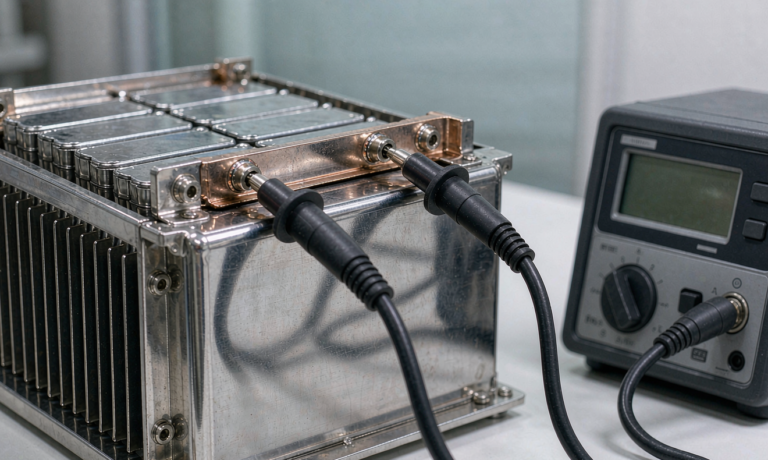
- Benchmark every charger before first energization. A misconfigured 48 V rectifier once tried to push 58 V into an LFP string. The BMS cut at 3.65 V/cell and we caught a doomed charger before it cooked the pack. Verify the source, not just the battery.
- Treat a crushed or punctured cell as a live hazard. After a forklift dropped a module, the temperature-gradient alarm showed one cell climbing while its neighbors sat flat. We quarantined it in a fire-rated bin and shipped it back for teardown rather than reusing it.
- Train the operators, not just the engineers. The best thermal barrier in the world fails if someone stacks cardboard boxes against a vent. I run a ten-minute site briefing on what the alarms mean and what to do when they sound.
These are not exotic measures. They are the unglamorous discipline that keeps a lithium battery installation boring—which is exactly what you want it to be.
Frequently Asked Questions
At what temperature does thermal runaway start?
There is no single threshold, but the cascade typically ignites once cell temperature passes roughly 130–150°C in nickel-rich chemistries. LFP resists until around 270°C. The danger is not the starting point but the self-accelerating heat that follows once the SEI and separator begin to fail.
Can a BMS actually prevent thermal runaway?
A strong BMS solution prevents most external triggers—overcharge, overcurrent, and chronic imbalance—by cutting the circuit before the cell overheats. It cannot reverse an internal short that already exists, which is why cell-level design and pack isolation remain essential. Mitigation is layered, never single-point.
Is LFP really safer than NCM for thermal runaway?
Yes, in practical terms. An LFP battery is far less willing to release oxygen, giving a much wider margin between a fault and a fire. An NCM battery offers higher energy density but a narrower safe window, so it requires stricter limits and more robust thermal design.
Which standards govern thermal-runaway safety?
The core set is UN38.3 for transport, IEC 62133 and IEC 62619 for cell and industrial safety, and the UL family—UL 1642, UL 1973, UL 2580—for cell, stationary, and vehicle applications. Aviation use adds FAA and EASA requirements centered on demonstrated containment.
How do you stop propagation between cells?
Through spacing, thermal barriers between cells and modules, fire-rated enclosures, and compartmentalization, all verified against propagation tests such as those in UL 2580 and IEC 62619. The goal is to let one cell fail without dragging its neighbors over the edge.
Can a damaged lithium battery be safely repaired?
Generally no. A crushed, punctured, or swollen cell should be isolated, quarantined in a fire-rated container, and returned for controlled disposal or recycling—not patched and reused. Field repair of a compromised lithium-ion battery invites exactly the failure mode this article describes.