Lithium Battery for Industrial Cleaning Equipment: A Field Engineer’s Specifications Guide
Over the past nine years building lithium battery packs for commercial and industrial OEMs, I have watched the cleaning-equipment sector complete one of the fastest chemistry transitions in the entire material-handling world. Walk into any distribution center, airport terminal, or hospital today and the floor scrubbers and sweepers you see are overwhelmingly running on lithium. As Karl Huang, Senior Lithium Battery Engineer at Horizon Power, I have personally led the cell selection, BMS tuning, and certification work for dozens of industrial cleaning machines across three continents. In this guide I will walk through exactly what I specify when a cleaning-equipment manufacturer asks me for a lithium battery industrial cleaning equipment solution — the performance targets, the chemistry trade-offs, the safety standards that gate the design, and how we size a pack to survive a real multi-shift duty cycle without premature capacity fade.
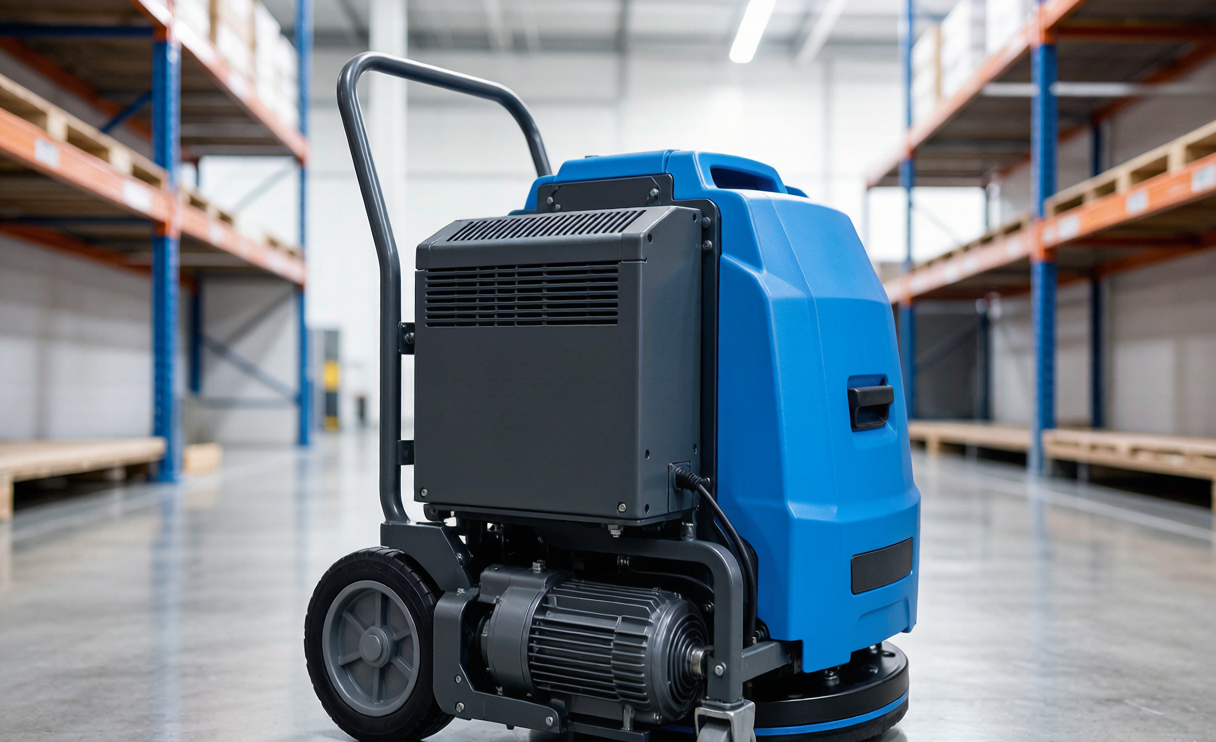
Why Industrial Cleaning Equipment Is Moving to Lithium
The legacy power source for floor scrubbers has been the flooded lead-acid (FLA) battery. It worked, but it arrived with a long list of liabilities that facility managers know too well: a strict 8-hour charge plus an 8-hour cool-down window, water topping, acid spills, and a usable depth of discharge capped around 50% if you wanted the battery to last. In my field visits I regularly measure FLA packs that have lost 30% of their nameplate capacity inside 18 months purely because operators charged them hot or let them sit discharged over a weekend.
A modern lithium-ion battery removes almost all of that friction. Opportunity charging during operator breaks, a true 80–100% usable depth of discharge, zero maintenance, and a service life measured in years rather than months. When a contract cleaner runs three shifts, the difference between a pack that needs a swap-out every year and one that runs four years is a direct line item on their margin. That is why, when a client approaches me for a custom battery solution for their scrubber line, lithium is the default starting point rather than an upgrade discussion.
Key Performance Requirements I Specify for Cleaning Equipment Packs
Before I pick a single cell, I sit down with the machine’s duty profile. For industrial cleaning equipment the numbers that actually matter are not the marketing specs — they are the ones that show up as failures at 2 a.m. on a third-shift floor. Here is the checklist I hand every OEM engineer:
- Continuous discharge current: Floor scrubbers with dual brush decks and vacuum motors draw 25–60 A continuously. I design the pack for a sustained 1C–2C discharge with 3C peak headroom for brush stall.
- Cycle life at partial state of charge: Cleaning fleets charge opportunistically, so the pack must tolerate thousands of partial cycles. I target 2,000+ cycles to 80% capacity at 25°C for LFP chemistry.
- Cold-temperature charging: Many warehouses drop below 10°C in winter. I specify a low-temperature charge cutoff and self-heating capability above −10°C to protect the cells.
- Vibration and shock resistance: Scrubbers ride over expansion joints and thresholds. I validate packs to IEC 60068-2-6 vibration and a 1.5 m drop on the pack enclosure.
- Ingress protection: High-pressure washdown is routine. I specify IP54 minimum on the enclosure, IP67 on the cell-to-BMS connectors.
Battery Chemistries Compared: LFP vs NMC for Floor Machines
The two chemistries I reach for in this application are lithium iron phosphate (LFP, LiFePO4) and nickel manganese cobalt (NMC). Both are excellent, but they serve different priorities.
LFP is my default for most industrial cleaning equipment. It runs at a nominal 3.2 V per cell, delivers 3,000–6,000 cycles, operates safely up to 60°C, and is intrinsically more thermally stable — there is no cobalt to decompose and release oxygen. The trade-off is lower energy density (90–160 Wh/kg), which means a slightly larger pack for a given runtime. For a walk-behind or ride-on scrubber where volume is not the binding constraint, LFP is the right call almost every time.
NMC earns its place when weight or footprint is the limiting factor — compact sweepers, battery-powered sweeper-trucks, or machines where every kilogram of payload matters. It offers 150–250 Wh/kg and excellent power density, but with roughly half the cycle life of LFP and a tighter thermal envelope. For these packs I invest more heavily in liquid-assisted cooling and a conservative 0.5C charge rate to protect longevity.
In my experience, a lithium battery industrial cleaning equipment program that prioritizes total cost of ownership over peak performance should default to LFP. The cycle-life advantage alone pays back the modest size penalty within the first replacement interval.
Safety Standards and Certifications That Gate the Design
This is the section I never let a sales team skip. A battery that cannot clear certification is a paperweight, and industrial cleaning machines ship globally. The three standards I build the entire safety architecture around are UN38.3, IEC 62133, and the transport/aviation rules from FAA and EASA.
UN38.3 is the baseline transport test. It subjects cells and packs to altitude simulation, thermal test, vibration, shock, external short circuit, impact, overcharge, and forced discharge. Every pack Horizon Power ships has passed UN38.3 as a condition of leaving the factory — there is no exception for “prototype” units.
IEC 62133 is the international safety standard for portable sealed secondary cells and batteries containing alkaline or non-acid electrolytes. For our cleaning-equipment packs it governs the cell-level abuse testing (short circuit, overcharge, forced discharge, temperature abuse) and the pack-level requirements for protection against excessive current, overvoltage, and overheating. I treat IEC 62133 as the design contract between my engineering team and the end user.
For equipment that travels by air or is serviced across borders, FAA and EASA regulations on lithium battery transport and the associated state-of-charge limits during carriage matter. Even if the scrubber itself is ground-bound, spare packs shipped as service parts must comply. I keep a documented chain of compliance so a customs hold never strands a customer’s maintenance inventory.
On top of these, I layer our own BMS protections: over-voltage, under-voltage, over-current, over-temperature, cell-balancing, and a hard contactor disconnect on fault detection. A good lithium-ion battery is only as safe as the electronics watching it.
Custom Battery Solutions: Sizing for Real Duty Cycles
Off-the-shelf packs rarely fit a real machine. When a client asks for a custom battery solution, I start from the energy budget rather than the dimensions. We measure the actual amp draw across a full cleaning route — brush motors, vacuum, solution pump, drive motor, and the controller overhead — and log it with a data logger for at least one representative shift.
From that log I compute the watt-hour demand, add a 20% runtime margin, and then size the pack for the cycle life the client needs. A typical ride-on scrubber with a 34-inch deck pulls about 1,100–1,500 Wh per charge and runs 3–4 hours. To deliver that with LFP at a sustainable 0.5C–1C rate, I land on a 24 V or 36 V pack in the 40–60 Ah range. The enclosure, connector, and BMS are then engineered around the machine’s existing battery bay so the retrofit is drop-in for the OEM’s assembly line.
I also specify the charger. Opportunity charging only works if the charger speaks the pack’s communication protocol (CAN bus or SMBus) and tapers correctly. A mismatched charger is the fastest way to kill an otherwise excellent lithium-ion battery.
Maintenance and Lifecycle Expectations
One of the biggest operational wins with lithium is what you no longer have to do: no watering, no equalization charges, no acid Handling. But “maintenance-free” does not mean “ignore it.” I coach fleet operators on three habits that protect their investment:
- Keep the pack between 20% and 80% state of charge for daily duty, only occasionally using full range.
- Store at roughly 50% charge in a cool, dry place if the machine will sit idle for more than two weeks.
- Let the BMS log data — we review monthly cycle counts and internal resistance trends to predict cell replacement before a failure interrupts service.
With those practices, the LFP packs I have deployed in commercial cleaning fleets routinely deliver 3–5 years of hard service before capacity dips below 80%. That is the number facility managers should put in their total-cost-of-ownership model, not the optimistic “10-year” claims you sometimes see in brochures.
Frequently Asked Questions
Can I replace a lead-acid battery in my scrubber with a lithium battery directly?
In most ride-on and walk-behind machines, yes — but only with a properly engineered conversion. The voltage must match, the enclosure must fit the existing bay, and the charger must be lithium-compatible or replaced. I always recommend a custom battery solution validated against the specific model rather than a generic drop-in, because brush-motor inrush current and BMS cutoff behavior vary widely between machines.
How long does a lithium battery for industrial cleaning equipment last per charge?
For a typical 24–36 V LFP pack sized at 40–60 Ah, expect 3–4 hours of continuous scrubbing, which covers one to two standard shifts. Runtime scales directly with pack capacity and the machine’s amp draw, so the honest answer depends on your duty cycle — which is exactly why I log it before sizing.
Is LFP safe enough for a busy warehouse environment?
Yes. LFP is the most thermally stable mainstream lithium chemistry, and when the pack is built to UN38.3 and IEC 62133 with a multi-layer BMS, the residual risk is lower than that of the flooded lead-acid batteries it replaces. The main hazards shift from acid and gas to thermal management, which our BMS controls continuously.
Do these batteries comply with shipping and aviation rules?
Every pack Horizon Power ships is UN38.3 certified, and our documentation supports FAA and EASA transport compliance for spare service packs. We provide the full test summary and declaration so your logistics team can move service inventory without customs delays.
Choosing the right lithium battery industrial cleaning equipment platform is less about chasing the highest energy density and more about matching chemistry, BMS, and certification to the machine’s real-world abuse. If you are specifying a new scrubber line or retrofitting a fleet, I am happy to review your duty-cycle logs and propose a custom battery solution built to last the full contract — not just clear the first shipment.