Drone Battery for Crop Health and Multispectral Scouting: An Engineer’s Guide
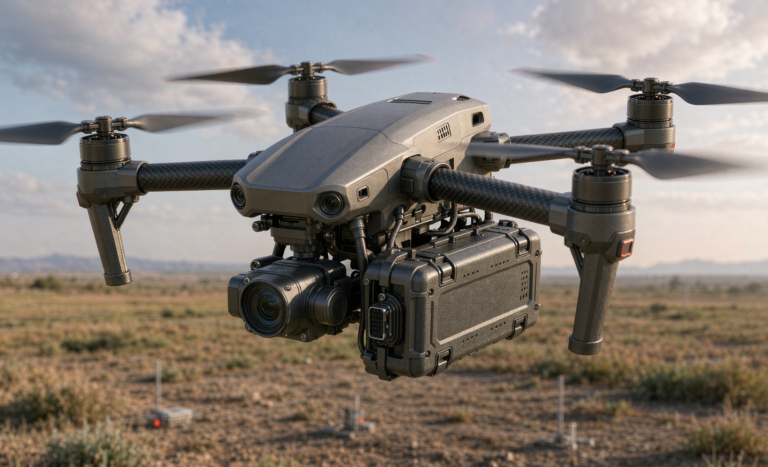
I have spent the last decade designing lithium battery packs for industrial drones, and the fastest-growing request on my desk right now comes from agronomy teams. They are not asking for spray drones. They are asking for a drone battery that can carry a multispectral camera over hundreds of hectares of crops, day after day, and deliver radiometrically consistent data. Crop health scouting sounds gentle compared with heavy-lift spraying, but from a battery engineer’s point of view it is one of the most demanding duty cycles in agriculture. This article is my field-tested guide to specifying, operating, and maintaining a drone battery for crop health and multispectral scouting missions.
Everything below comes from real deployments: NDVI mapping fleets in wheat and cotton regions, phenotyping trials on research stations, and the painful lessons of packs that aged out two seasons early because nobody matched the battery to the mission profile. If you operate a scouting fleet, or you are sourcing a custom battery solution for one, this is written for you.
Why Multispectral Scouting Is a Unique Drone Battery Duty Cycle
A spray drone works hard for eight minutes, lands, and swaps. A scouting drone flies long, steady survey grids at constant altitude and constant speed, because the multispectral sensor needs stable ground sampling distance and consistent sun geometry. That changes the discharge profile completely.
On a typical 25-minute NDVI mapping sortie I log a nearly flat 0.6C to 0.9C continuous discharge, with only brief 2C to 3C bursts during climb-out and turn-arounds at the end of each survey line. Compare that with a spray mission, where the drone lithium battery sees sustained 3C to 5C under full payload. The scouting profile is kinder per minute, but the aircraft flies three to four times as many minutes per day. Over a season, a scouting pack accumulates far more energy throughput than a spray pack of the same capacity.
There are three consequences I design around:
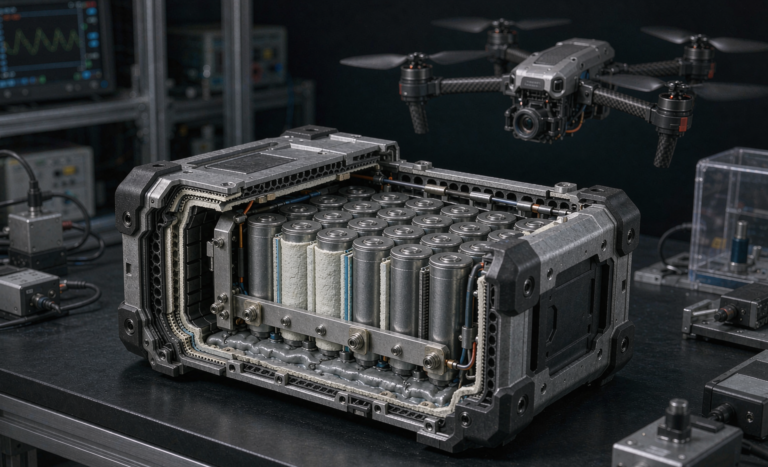
- Energy density beats power density. For mapping work I select high-energy NCM cells at 260 to 280 Wh/kg rather than high-rate cells at 180 to 200 Wh/kg. The mission rarely needs more than 3C, so paying a mass penalty for 10C capability is wasted payload that should have gone to flight time.
- Cycle life is measured in full-depth cycles. Scouting missions are planned to consume 75 to 85 percent of usable capacity, flight after flight. Shallow-cycle assumptions in generic datasheets do not apply. I qualify cells to 500 cycles at 90 percent depth of discharge with less than 20 percent capacity fade before they go anywhere near a customer fleet.
- Voltage sag corrupts data indirectly. When a tired lithium battery sags under load, the flight controller trims speed and the gimbal power rail ripples. I have traced banding artifacts in multispectral orthomosaics back to a pack with one weak parallel group. Battery health is data quality.
Sizing the Pack: Flight Time Math for Crop Health Missions
Here is the sizing method I use with agronomy customers. Start from the survey requirement, not from a battery catalogue.
Assume a 500-hectare scouting block, a 10-band multispectral payload of 350 g, flight at 100 m altitude giving roughly 7 cm ground sampling distance, 75 percent side overlap, and a survey speed of 12 m/s. That works out to roughly 190 line-kilometres of flying. A modern quad-rotor mapping airframe covers that in about 4.5 flight hours.
Now work backwards:
- Aircraft all-up mass 6.5 kg draws about 900 W in steady survey cruise.
- A 25-minute working sortie plus climb, transit, and 25 percent reserve needs roughly 500 Wh of usable energy.
- Usable means between 95 percent and 15 percent state of charge, so nameplate capacity must be about 620 Wh — in practice a 6S 27,000 mAh pack at 22.2 V nominal.
- 4.5 flight hours divided by 25-minute sorties means 11 sorties. With a two-hour charge turnaround per pack, a three-pack rotation keeps one aircraft airborne continuously through a working day.
The most common mistake I see is buying two packs instead of three or four. The fleet then fast-charges at 2C in the field to keep up, and fast charging in 35°C summer heat is the single biggest cycle-life killer in agricultural fleets. A proper custom battery solution includes the rotation count, not just the pack.
Environmental Realities: Heat, Dust, and Dawn Flights
Crop scouting happens in exactly the conditions cell manufacturers put in the fine print. Three environments dominate the failure statistics I collect.
Field heat
Midday canopy-level air in July regularly exceeds 38°C, and a dark pack sitting on a truck tailgate can reach 55°C surface temperature before it ever flies. Charging above 45°C cell temperature accelerates solid electrolyte interphase growth dramatically; my telemetry shows packs habitually charged hot lose usable capacity roughly twice as fast per cycle. My rule for field crews is simple: shade the packs, and the smart BMS refuses charge above 45°C cell temperature — that limit is firmware, not advice.
Dust and chaff
Harvest-season scouting fills connector shells with fine organic dust. Combined with morning humidity it becomes mildly conductive paste. I specify gold-plated, self-wiping contacts rated for 5,000 mating cycles and an IP54-rated pack enclosure per IEC 60529 as the baseline for agricultural service, and I train crews to cap connectors during transport. Corroded balance leads cause more field aborts than cell failures do.
Cold dawn radiometric windows
Phenotyping teams love flying at 07:00 for stable illumination. In spring that can mean 5°C. A cold-soaked lithium battery delivers noticeably higher internal resistance, sags earlier, and — critically — must never be fast-charged below 10°C because of lithium plating risk. Our packs include a self-heating mode that warms cells to 15°C in about eight minutes off the pack’s own energy, which costs about 4 percent state of charge and saves the pack.
Smart BMS Features That Matter for Scouting Fleets
For a mapping fleet, the battery management system is a fleet-management instrument, not just a protection board. The features I consider non-negotiable in a scouting drone battery:
- Per-cell logging at 1 Hz, retrievable over the data port, so a weak parallel group is caught in trend data weeks before it strands an aircraft over a cornfield.
- True state-of-health reporting based on coulomb counting plus periodic capacity recalibration, not a naive voltage lookup. Mission planning software should read remaining watt-hours, and plan survey lines against that number.
- Cycle count and throughput odometer. I retire scouting packs at 80 percent state of health or 500 full-equivalent cycles, whichever comes first. Without an odometer in the pack, nobody actually tracks this.
- Storage mode automation. After 72 hours idle, the BMS self-discharges the pack to 3.80 V per cell. Agricultural fleets sit idle between growth stages; packs stored all winter at full charge are the classic swollen-pack story I hear every spring.
- Balance current of at least 100 mA. Long steady discharges expose small capacity mismatches. I use a 30 mV imbalance warning threshold and an 80 mV service flag, and passive balancing at 100 mA keeps a healthy 6S pack inside the warning band.
Certification and Compliance: What Agronomy Buyers Must Check
Agricultural service providers increasingly fly under formal operating rules, and the battery paperwork gets audited. The checklist I hand to procurement teams:
- UN 38.3 transport testing, all eight tests T.1 through T.8, with the test summary document available on request. Without it your packs legally cannot travel by air freight, and many couriers now refuse ground shipment too.
- IEC 62133-2:2017 for cell and pack safety. For larger stationary charging buffers at the field depot, IEC 62619 and UL 1973 apply instead.
- IATA Packing Instruction 965 governs lithium-ion batteries shipped standalone by air — Section II limits ship-alone packs to 30 percent state of charge, which surprises many first-time fleet buyers.
- FAA Part 107 operations in the United States place battery condition inside the preflight requirement; a documented battery inspection log is what an auditor will actually ask for. Under EASA rules, the SORA process expects battery failure modes in your operational risk assessment for anything beyond the open category.
When I run supplier audits, the fastest credibility test is asking for the UN 38.3 test summary and the cell-level IEC 62133 certificate with matching model numbers. If the numbers on the paperwork do not match the cells in the teardown, walk away.
Field Story: The 4,000-Hectare Cotton Scouting Season
Last season I supported a service provider scouting 4,000 hectares of cotton on a ten-day revisit cycle with three mapping aircraft. Their first month was rough: they started with six packs bought on price, charged them at 2C in an unshaded trailer, and flew every pack to 10 percent because “the data window was closing.” By week six, average sortie time had dropped from 26 to 21 minutes and two packs showed 90 mV imbalance.
We rebuilt the operation around twelve high-energy packs in strict rotation, 1C charging inside a ventilated, shaded trailer with a 30 kWh LiFePO4 buffer feeding the chargers, a 20 percent landing floor enforced in the mission planner, and BMS trend review every Friday. Sortie times recovered to 25 minutes, and at end of season the fleet-average state of health was 93 percent instead of the roughly 80 percent their first six packs had reached in eight weeks. Nothing exotic — just matching the battery solution to the duty cycle and refusing to charge hot.
FAQ: Drone Battery for Crop Health and Multispectral Scouting
How long can a scouting drone fly on one battery?
With a modern high-energy 6S pack and a 350 g multispectral payload, 22 to 28 minutes of working survey time per sortie is realistic, covering roughly 45 to 60 hectares depending on altitude and overlap. Claims much beyond that usually assume no reserve and a brand-new pack at 25°C.
Does voltage sag really affect multispectral data quality?
Indirectly, yes. Sag triggers speed trimming and power-rail ripple that show up as ground-sampling inconsistency and occasional banding in orthomosaics. A pack past 80 percent state of health should be retired from radiometric work even if it still flies.
How many batteries do I need for continuous scouting?
Plan three to four packs per aircraft with 1C charging. Two packs force field fast-charging in the heat, which is the fastest way I know to halve pack life in an agricultural season.
Can I fast-charge in the field between survey blocks?
Only with cell temperature control. My rule: 2C to 80 percent is acceptable when cell temperature stays under 40°C and the pack finishes on a 1C taper; never fast-charge below 10°C or above 45°C cell temperature.
When should a scouting pack be retired?
At 80 percent state of health or 500 full-equivalent cycles, whichever comes first — and immediately if you see persistent imbalance above 80 mV, physical swelling, or connector heat damage. Retired packs can still serve light training duty, but not radiometric missions.
Final Thoughts from the Bench
Crop health scouting rewards operators who treat the drone battery as mission equipment rather than a consumable. Size the pack from the survey requirement, buy enough packs to charge gently, keep cells shaded and between 15°C and 40°C, and let the BMS data tell you when a pack leaves radiometric service. If your fleet has an unusual sensor load or an aggressive revisit schedule, a custom battery solution engineered around your actual duty cycle will outperform any off-the-shelf pack — and your orthomosaics will show it. Questions about a specific airframe or sensor stack are welcome; matching chemistry to mission is exactly the work my team does every week.