Drone Battery Charging Depot Infrastructure: An Engineer’s Field Guide
The first drone battery charging depot I helped commission was in Weifang, Shandong, for a crop-spraying fleet running eight aircraft across roughly 400 hectares a day. The operator had done the obvious thing: bought a shipping container, filled it with consumer chargers on a plug strip, and run an extension from the farm shed. Three weeks in, they called me because their turnaround time had crept from nine minutes to twenty-six, and two packs had swollen badly enough to jam in the aircraft bay.
Nothing was wrong with the cells. The problem was the depot. Charging infrastructure is the part of drone operations that nobody budgets for and everybody eventually pays for twice. I have spent the last decade designing lithium battery systems for industrial UAV fleets, and I can tell you plainly: the depot determines your fleet’s real duty cycle far more than the energy density printed on the pack label.
Why Depot Design Decides Your Fleet Economics
Operators tend to size their fleet by flight time. That is the wrong variable. What actually caps daily output is the ratio of packs to aircraft and the rate at which the depot can return a pack to service — charged, cooled, inspected and logged.
Run the arithmetic. A 16,000 mAh 6S agricultural pack flies about 11 minutes under spray load. If your depot returns it in 55 minutes, each pack contributes roughly one sortie per hour. Eight aircraft flying continuously need something near 40 packs in rotation once you allow for cooldown and the packs sitting in transit crates.
Cut depot turnaround to 25 minutes and that same fleet runs on 24 packs. At current industrial pack pricing that is a five-figure difference in capital, recovered by spending far less on the charging hardware. This is the single strongest argument for treating depot infrastructure as an engineering project rather than an accessory purchase.
The second-order effect matters more. Fast, controlled turnaround with proper thermal management extends cycle life. In fleets I have tracked, well-run depots deliver 550 to 700 usable cycles on the same LiPo chemistry that dies at 220 cycles in a hot container with unregulated chargers.
Power Architecture: Sizing the Service You Actually Need
Charging demand is spiky, and spiky loads are what blow depot budgets. A single 6S 16 Ah pack charged at 5C draws close to 2 kW at the wall once you account for converter losses. Twelve bays running simultaneously is a 24 kW instantaneous demand — more than most rural agricultural connections will carry.
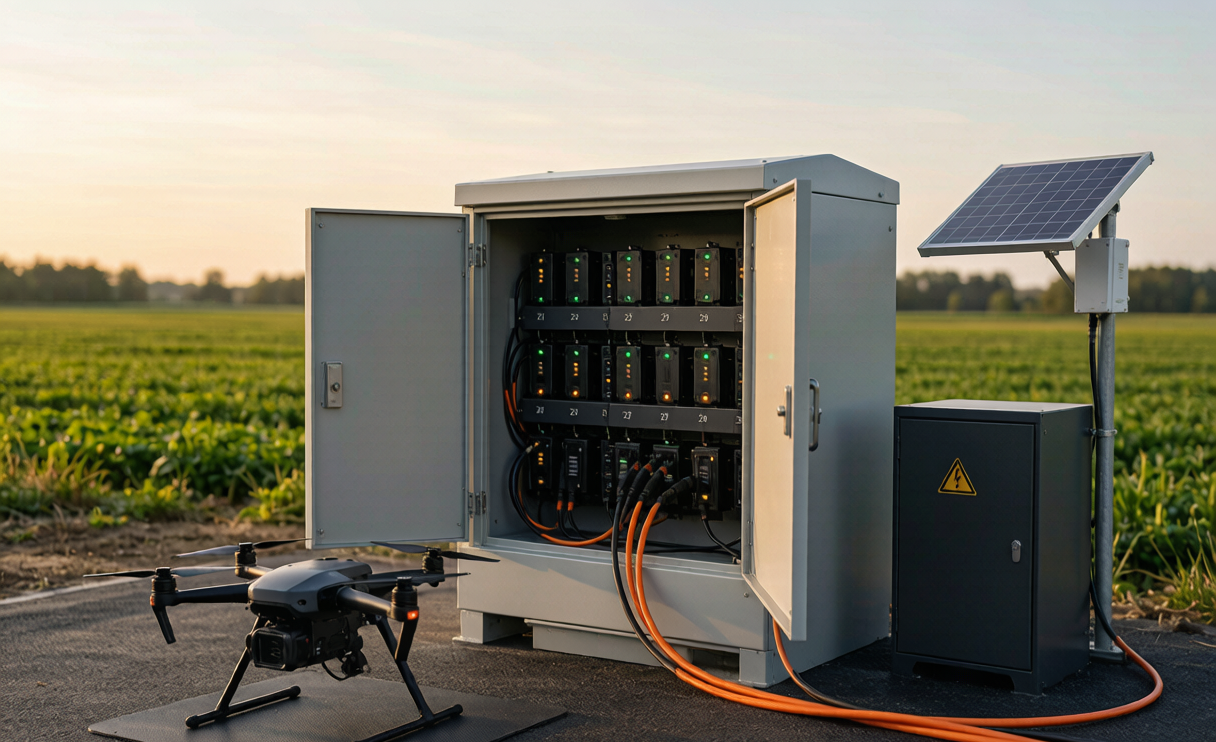
I size depots on three numbers: peak simultaneous demand, average energy per operating day, and available grid capacity. Where grid capacity falls short, the answer is almost always a buffer battery rather than a service upgrade. A 30 kWh LiFePO4 buffer cabinet charging slowly from a 7 kW supply can discharge at 25 kW during the turnaround burst.
That buffer approach also solves the demand-charge problem. Many commercial tariffs bill on peak kW, and a depot that spikes to 24 kW for eight minutes every hour can generate a demand charge larger than the energy bill itself. Flattening the draw with a stationary lithium battery typically pays back within two seasons.
For genuinely off-grid sites, I pair a solar canopy with the same buffer cabinet. A 12 kWp array in a decent irradiance region covers a mid-size survey fleet’s daily energy, though I still specify a generator inlet. Weather is not a reliable project partner, and a grounded fleet costs more per day than the fuel.
Thermal Management Is the Whole Game
If you take one thing from this article, take this: temperature control at the depot does more for pack longevity than any other variable you can influence. Lithium cells degrade through side reactions whose rate roughly doubles for every 10 °C rise above 25 °C.
Packs arrive from a summer sortie at 45 to 55 °C. Charging them immediately is what produced the swollen packs in Weifang. My rule is firm — no charge current until the pack core is below 35 °C, and the depot must be built to make that fast rather than making the crew wait.
Practically this means forced-air cooling bays with 2 to 3 m/s cross-flow over the pack faces, separated inlet and exhaust paths, and cooling that runs on arrival rather than at the operator’s discretion. A properly ducted bay pulls a hot agricultural pack to charge-ready in six to eight minutes. Passive shelving in the same ambient takes over forty.
I specify NTC or PTC sensing on the bay itself, not just inside the pack, because bay-level sensing catches a failed pack that has stopped reporting. The bay controller should hard-inhibit charge outside the 0–45 °C window and refuse to resume without an operator acknowledgement.
Cold sites need the inverse. Charging lithium cells below 0 °C plates metallic lithium on the anode — permanent capacity loss and a genuine internal-short risk. Northern winter depots get heated bays that pre-warm packs to 10 °C before any current flows, per the operating window in IEC 62133-2:2017.
Safety, Containment and Compliance
A depot concentrates a great deal of stored energy in a small space. Forty 6S 16 Ah packs is roughly 14 kWh sitting in one cabinet. That deserves the same seriousness as any other energy installation.
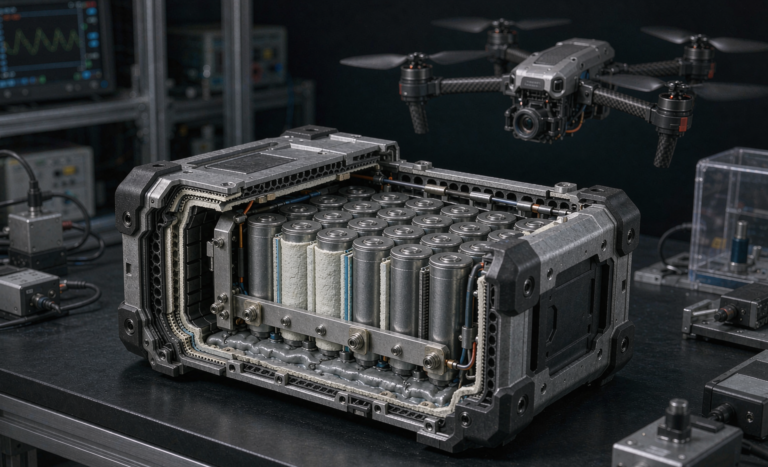
My baseline specification covers five elements. Bays are separated by steel or ceramic-fibre dividers so a thermal runaway event stays local. The enclosure vents outward and upward, away from personnel routes. Every depot carries a Class D extinguisher plus a submersion tub, because water works on the lithium fire you actually get. Smoke and off-gas detection is wired to an audible alarm and a charge cutoff. And storage voltage is enforced at 3.80 to 3.85 V per cell for any pack idle beyond 48 hours.
Certification-wise, the packs cycling through your depot should already hold UN 38.3 test reports covering T.1 through T.8, and IEC 62133-2:2017 for the cell-level safety case. If your depot includes a stationary buffer, that system falls under IEC 62619 and, in North American markets, UL 1973 — a distinction that catches operators out during insurance review.
Transport matters too. Packs moving between depot and field on public roads sit under IATA PI 965 for air freight and ADR provisions on the ground. Keeping state of charge at or below 30% for transported spares is both a regulatory expectation and a sensible risk reduction.
Where the depot sits under an approved UAS operation — FAA Part 107 in the United States, or an EASA specific-category operational authorisation in Europe — the ground infrastructure typically features in the operational risk assessment. I have seen SORA submissions returned specifically because battery handling and charging procedures were undocumented.
Charging Strategy and Battery Management Integration
Depot chargers are not scaled-up hobby chargers. The behaviour I specify is CC-CV with a chemistry-matched cutoff, per-cell balance monitoring, and an adaptive current profile that responds to reported cell temperature.
Charge rate deserves nuance. Yes, a modern high-rate LiPo tolerates 3C to 5C charging. But sustained fast charging accelerates SEI growth measurably. My standard depot profile runs 2C to 80% state of charge, then tapers to 1C for the final 20% — most of the speed benefit, a fraction of the degradation penalty.
Balance discipline separates good depots from expensive ones. I set the alarm threshold at 30 mV cell delta at full charge and quarantine anything above 80 mV. Drift is the earliest reliable signal of a weakening cell, and catching it in the depot is far cheaper than catching it at 60 metres over a field.
Wherever the pack BMS supports it, I insist on digital communication — SMBus, CAN or a vendor protocol — so the depot logs true cycle count, internal resistance trend and cumulative amp-hours. Any custom battery solution we build for fleet customers ships with this telemetry, because a depot that cannot read pack health is only guessing.
Layout, Workflow and Traceability
Depot layout is a manufacturing problem. I lay them out as a one-way loop: receive, inspect, cool, charge, rest, stage. Packs never travel backwards, and charged stock never mingles with returning stock. That one discipline eliminates the most common depot failure — a hot or damaged pack going back to an aircraft.
Inspection at receipt takes fifteen seconds per pack: visual check for swelling or connector damage, open-circuit voltage, and case temperature. Anything failing goes to a quarantine bay, physically separated, never to the charge queue.
Every pack carries a unique ID — QR or RFID — scanned at each station. The resulting record gives cycle count, capacity trend, temperature history and fault events per serial number. This is how you retire packs on evidence rather than on a calendar, and it is what lets me tell a fleet manager in March which twelve packs will not survive the season.
Staffing is worth mentioning. A twelve-bay depot serving eight aircraft needs one dedicated technician during operations. Operators who try to run the depot with spare pilot time consistently see the inspection step quietly disappear within a fortnight.
Frequently Asked Questions
How many charging bays does a drone battery depot need?
Start from sorties per hour, not aircraft count. Divide your target hourly sorties by the number of packs each bay can return per hour, then add 25% headroom for cooling and inspection. For a typical eight-aircraft agricultural fleet with 25-minute turnaround, twelve to fourteen bays is the usual answer.
Can I charge drone batteries straight after landing?
No. Wait until the pack core is below 35 °C. A pack landing at 50 °C and going straight onto 3C charge sees accelerated electrolyte breakdown and will typically lose 20 to 30% of its cycle life. Build active cooling into the depot so the wait costs you minutes, not the afternoon.
Is a solar-powered drone battery depot practical?
Yes, with a buffer battery. Solar alone cannot follow the spiky charging load. A 10 to 15 kWp array paired with a 30 kWh LiFePO4 buffer cabinet handles most mid-size fleets, and the buffer also flattens demand charges on grid-connected sites. Keep a generator inlet for extended overcast periods.
What certifications apply to depot charging infrastructure?
The drone battery packs need UN 38.3 for transport and IEC 62133-2:2017 for cell safety. Any stationary buffer battery falls under IEC 62619 and, in North America, UL 1973. Enclosures should carry an appropriate IEC 60529 IP rating — IP54 minimum for sheltered depots, IP65 for exposed field cabinets.
How long should a properly managed drone battery last in fleet service?
With controlled thermal conditions, 2C tapered charging and enforced storage voltage, I routinely see 550 to 700 cycles to 80% capacity on high-rate LiPo, and well beyond 1,500 cycles on LiFePO4 or semi-solid-state chemistries. The same packs in an uncontrolled depot often fail before 250 cycles.
Building a Depot That Pays for Itself
The Weifang operator rebuilt their depot the following spring: cooled bays, a 30 kWh buffer cabinet, serialised pack tracking and one dedicated technician. Turnaround dropped to 23 minutes, they cut their pack inventory by a third, and they finished the season without a single swollen pack.
None of that required exotic technology. It required treating charging infrastructure as engineering — sizing the power honestly, controlling temperature aggressively, containing the energy safely, and logging every pack. If you are scaling a UAV fleet beyond three or four aircraft, design the depot before you buy the next drone. It is the cheapest capacity you will ever add.