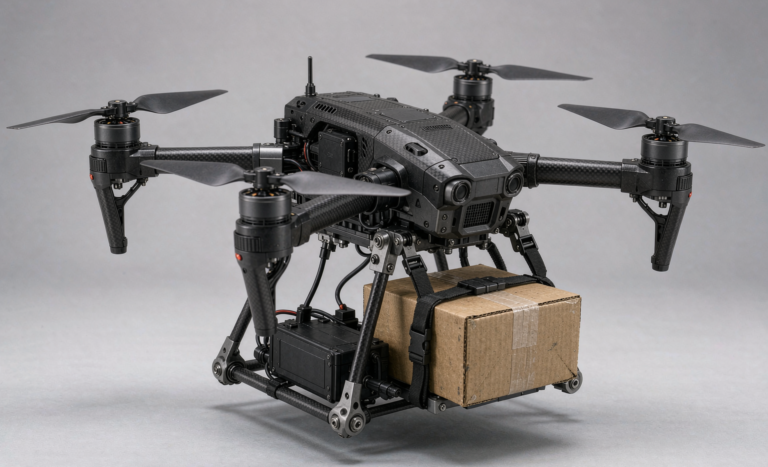
Drone Battery Modular Design for Rapid Field Swap: An Engineer’s Playbook
I have spent the better part of two decades designing lithium battery packs, and if there is one lesson the field keeps teaching me, it is this: the battery that wins is rarely the one with the highest energy density on the datasheet. It is the one that gets an aircraft back in the air fastest. drone battery modular design for rapid swap is where electrical engineering, mechanical engineering, and plain operational common sense collide. In this article I want to walk through how I approach modular drone battery architecture — the connector choices, the latching mechanics, the BMS handshake, the certification traps — drawing on packs my team has built for agricultural spraying fleets, survey operators, and inspection contractors. If you are evaluating a custom battery solution for a fleet where turnaround time is money, this is written for you.

Why Modular Swap Architecture Beats Bigger Packs
The instinct of most fleet buyers is to ask for more flight time: a bigger drone battery, more watt-hours, more minutes aloft. But endurance is only half of the productivity equation. The other half is duty cycle — the fraction of the working day the aircraft actually spends flying.
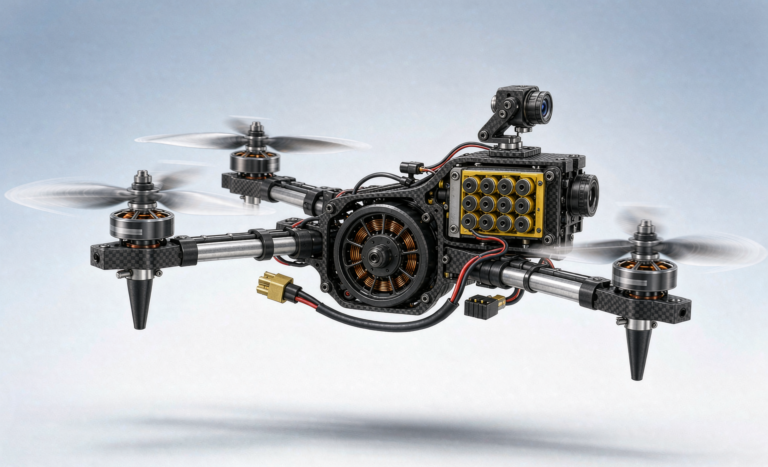
Run the numbers on a typical spray operation. A 30,000 mAh 14S pack at roughly 1.5 kWh gives you a 12–14 minute sortie with a full tank. If recharging takes 45 minutes and you only have two packs, your aircraft flies less than 40% of the day. Add a modular rapid-swap system with six packs in rotation and a 90-second swap, and utilization climbs above 85%. Same drone lithium battery chemistry, same aircraft — more than double the hectares covered.
Modularity also changes the economics of degradation. A monolithic oversized pack ages as one unit: when one cell group drifts, the whole asset is compromised. With smaller interchangeable modules, you retire capacity in smaller increments, keep the healthy modules working, and smooth out your replacement budget. On a 40-aircraft fleet I supported in 2023, moving from fixed packs to a swap architecture cut battery cost per flight hour by 31% over 18 months — not because the cells were better, but because utilization and retirement were managed at module granularity.
Mechanical Design: Rails, Latches, and the 90-Second Swap
A rapid field swap lives or dies on mechanical detail. My design rules, learned the hard way:
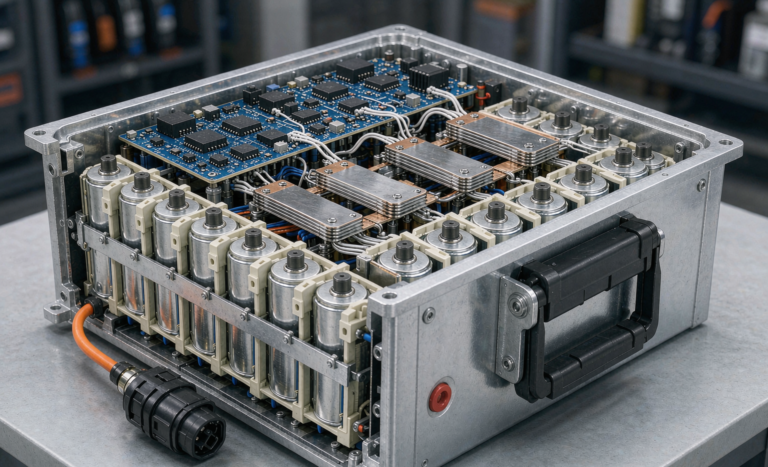
- Blind-mate rail guidance. The operator should be able to seat the pack without looking at the connector. We use tapered rail guides with ±2 mm capture range so the pack self-aligns during the last 15 mm of travel. Gloved hands, dusk light, 38°C heat — the mechanism must forgive all of it.
- Positive latching with tactile and audible confirmation. A dual-cam latch that clicks at full engagement, rated for at least 5,000 mating cycles. I specify a secondary retention feature — a mechanical catch that holds the pack even if the primary latch fails — because a pack departing an airframe at 30 m altitude is a safety event, not a warranty claim.
- Keying and polarization. Physically impossible to insert a module backwards or to insert a 12S module into a 14S bay. Mechanical keying costs nothing at tooling time and prevents the single most destructive field error I see.
- Mass and ergonomics. Above roughly 8 kg per module, one-handed swaps become unsafe and swap times balloon. For heavy-lift aircraft we split energy into two parallel modules rather than one heavy brick — and gain redundancy in the process.
Ingress protection matters more on a swap system than a fixed pack because the connector interface is exposed at every exchange. We design bays and modules to IEC 60529 IP54 as a floor — dust-protected and splash-resistant — with sprung connector shutters on packs destined for spray operations where fertilizer mist is corrosive.
Electrical Interface: Connectors, Precharge, and Hot-Swap Discipline
The electrical interface is where inexperienced teams get burned — sometimes literally. Three non-negotiables from my design reviews:
- Rated, keyed power connectors with wipe length. For packs delivering 100–200 A continuous, I specify multi-lam or crown-spring contacts sized so contact resistance stays under 0.25 mΩ per pole after 5,000 cycles. Contact wipe — the sliding action that scrubs oxide off the surface — is what keeps resistance stable in dusty field conditions.
- Precharge before main contact. Slamming a charged pack onto a flight controller’s input capacitors produces inrush arcing that erodes contacts and can weld them. Our modules sequence a precharge pin (through a 47–100 Ω resistor) ahead of the main power pins using staggered pin lengths, limiting inrush to under 20 A. The connector does the sequencing mechanically — no firmware required, no firmware to fail.
- Signal-before-power handshake. Data pins mate first and break last. The BMS announces pack identity, state of charge, temperature, and health over CAN or SMBus before the aircraft will arm. A pack below 10°C cell temperature, above 60°C, or under 30% state of health is refused politely on the ground instead of failing loudly in the air.
One question I am asked constantly: should the system support true hot swap — exchanging modules with avionics powered? For multi-module aircraft, yes, and it is a genuine operational advantage: mission computers keep their state, GPS keeps its fix. But it demands ideal-diode ORing controllers on each module output so a freshly inserted low-voltage module does not back-feed from its full sibling. That is roughly 40 grams and a few dollars per module. Worth it on inspection fleets; often skipped on cost-driven spray fleets where a 90-second cold swap is acceptable.
BMS Architecture for Interchangeable Modules
A modular fleet is a data problem as much as a power problem. Every module in our systems carries its own BMS with independent protection: over-voltage at 4.25 V per cell, under-voltage at 2.8 V, over-current with a 150% / 5-second trip curve, and dual-threshold over-temperature cutoffs at 60°C discharge and 45°C charge. The lithium battery module must protect itself even when paired with a charger or aircraft it has never met.
Beyond protection, the swap use case adds three requirements I treat as mandatory:
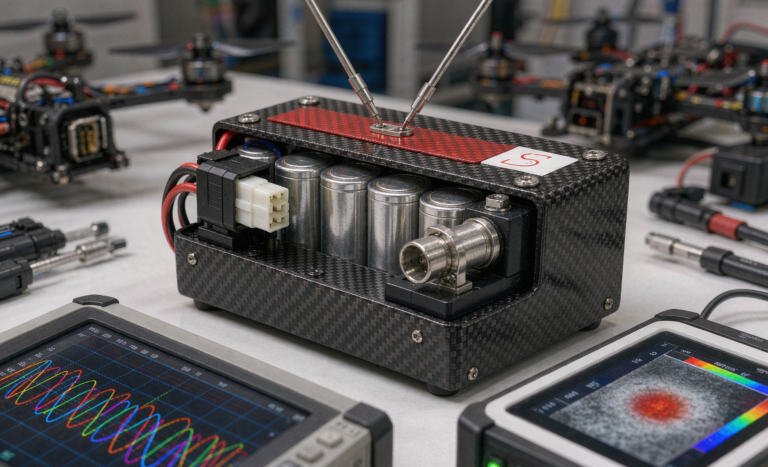
- Persistent identity. Every module carries a unique serial in EEPROM, mirrored in a QR code on the case. Cycle count, deepest discharge, lifetime amp-hour throughput, and worst-case cell delta are logged onboard. When a module reports 80% state of health or 90 mV resting imbalance, it is flagged for rotation out of flight duty into ground-power service.
- Fleet-level matching. When two modules feed one aircraft in parallel, we match them by internal resistance and SOH, not just voltage. A 15% resistance mismatch shifts load to the stronger module, overheating it and accelerating exactly the imbalance you were trying to avoid. Our depot software pairs modules automatically; crews just grab the two packs the tablet highlights.
- Charge governance at the depot. Rapid swap concentrates charging into a ground station, which is an opportunity: the depot charger can afford proper thermal management and taper discipline that airborne charging never gets. We charge at 1C to 80% then taper at 0.5C, hold packs at 50–60% for storage if they will not fly within 12 hours, and refuse charge below 10°C unless the module’s self-heating film brings cells up first.
This is where a custom battery solution earns its premium over off-the-shelf packs. The cells may be identical; the fleet intelligence is not.
Certification and Transport: UN 38.3, IEC 62133, and Aviation Rules
Modularity multiplies your certification surface, so plan it early. Each module design must pass UN 38.3 tests T.1 through T.8 — altitude simulation, thermal cycling, vibration, shock, external short circuit, impact/crush, overcharge, and forced discharge — before it can legally travel by air, sea, or road. Because a swap fleet ships spare modules constantly, your logistics exposure is far higher than a fixed-pack operation: IATA Packing Instruction 965 applies to standalone lithium-ion packs, including the 30% state-of-charge limit for air cargo, and ground shipments in many jurisdictions fall under ADR provisions.
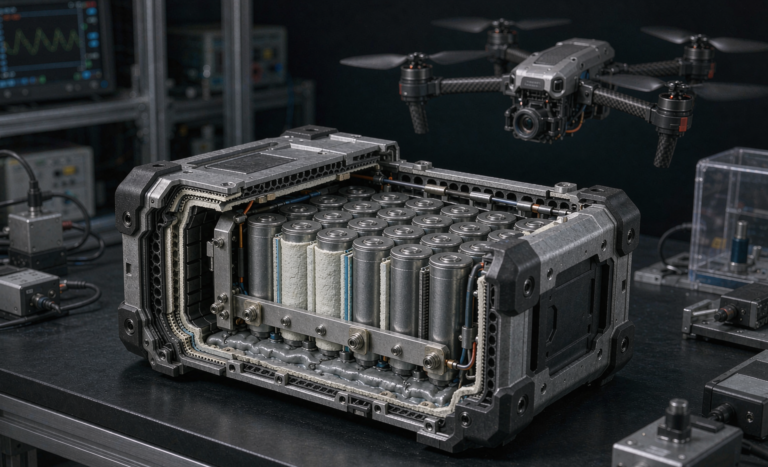
For the cells and pack safety file, I test to IEC 62133-2:2017 for portable applications, and for larger modules crossing into stationary or industrial duty — remember those retired flight modules going into ground-power service — IEC 62619 and UL 1973 become the relevant frameworks. Operationally, FAA Part 107 in the United States and EASA’s SORA methodology in Europe both push operators to demonstrate energy-system airworthiness; a documented BMS refusal logic and latch retention test report make that conversation dramatically easier. My rule: write the compliance matrix before tooling the enclosure. Retrofitting a vent path or a crush structure after tooling costs ten times what it costs on paper.
Field Lessons: What a Cotton-Belt Season Taught Us
Theory is tidy; fields are not. In 2024 we deployed a modular swap system with a spray operator running nine aircraft across a cotton belt in northern China. Three lessons from that season now live in every design we ship:
Dust is a connector’s patient enemy. After roughly 1,400 swaps, two bays showed intermittent CAN dropouts. Root cause: fine dust worked into the signal contacts during swaps performed directly downwind of the loading area. The fix was procedural and mechanical — sprung shutters over signal pins, plus a one-way swap-station layout so packs are exchanged upwind of the mixing rig. Contact dropouts went to zero the following month.
Crews will defeat any indicator they do not trust. Early firmware flagged modules at 85% SOH with a yellow LED, and crews kept flying them because the packs “felt fine.” We changed the logic: yellow modules charge normally but the aircraft refuses arming above 6 kg payload. Compliance became automatic because the rule enforced itself.
Swap speed is a training outcome, not just a design outcome. Average swap time on day one was 3 minutes 40 seconds. After we painted alignment marks on the bays and drilled the two-hand grip sequence, it fell to 78 seconds. Design for the motion, then teach the motion.
FAQ: Modular Drone Battery Systems
How fast can a well-designed drone battery swap actually be?
With blind-mate rails, positive latching, and a trained crew, 60–90 seconds from touchdown to armed is realistic for a single-module aircraft, and under 2 minutes for dual-module heavy-lift platforms. If your swaps take over 3 minutes, the bottleneck is almost always alignment or latch feel, not the operator.
Does modular design reduce energy density?
Yes, modestly. Rails, latches, connectors, and per-module BMS typically cost 4–8% in pack-level Wh/kg compared with a fixed hard-wired pack. In fleet operations the utilization gain overwhelms that penalty; for single-aircraft endurance records, a fixed pack still wins.
Can I mix old and new modules on one aircraft?
Only within limits. We allow pairing when modules are within 5% state of health and 15% internal resistance of each other, and the BMS enforces it during the pre-arm handshake. Mixing a fresh module with a heavily cycled one shifts current to the fresh module and overheats it.
What certifications do swap modules need for transport?
UN 38.3 (T.1–T.8) is mandatory for any lithium-ion module transported commercially. Air shipment of standalone packs follows IATA PI 965 with the 30% state-of-charge cap. Design-safety testing to IEC 62133-2:2017 — and IEC 62619 or UL 1973 for modules reused in stationary storage — is what serious B2B buyers will ask to see.
Is hot swap worth the extra cost?
For inspection and survey fleets where mission computers must stay powered, yes — ideal-diode ORing adds little mass and preserves system state. For spray operations where the aircraft lands, tanks are refilled anyway, and a cold swap costs nothing extra, most of my customers skip it.
Closing Thoughts from the Bench
Modular rapid-swap design is not glamorous engineering. It is rail tolerances, contact plating, precharge resistors, and latch spring rates — details no datasheet headline will ever celebrate. But across every fleet I have supported, those details decide whether a drone battery program delivers 40% aircraft utilization or 85%. If you are specifying a swap architecture, start from the operational motion — the gloved hand in failing light — and let the electrical and mechanical design serve it. That is the discipline we bring to every custom battery solution we build, and it is the difference between a battery that flies and a battery program that works.