Drone Battery for Surveying in Remote Terrain: An Engineer’s Field Guide
The first time I lost a full survey day to batteries, I was sitting at 3,100 metres on a ridge in western Sichuan with eleven dead packs, a client waiting on an orthomosaic, and no grid power within four hours of driving. Nothing had failed in the conventional sense. The cells were healthy, the aircraft was fine, the pilots were competent. What failed was the assumption that a drone battery workflow validated in a warm coastal test yard would transfer unchanged to cold, thin, roadless terrain. It does not. I have spent the eleven years since designing packs and energy logistics for survey crews, and remote-terrain mapping remains the discipline that punishes lazy engineering fastest.
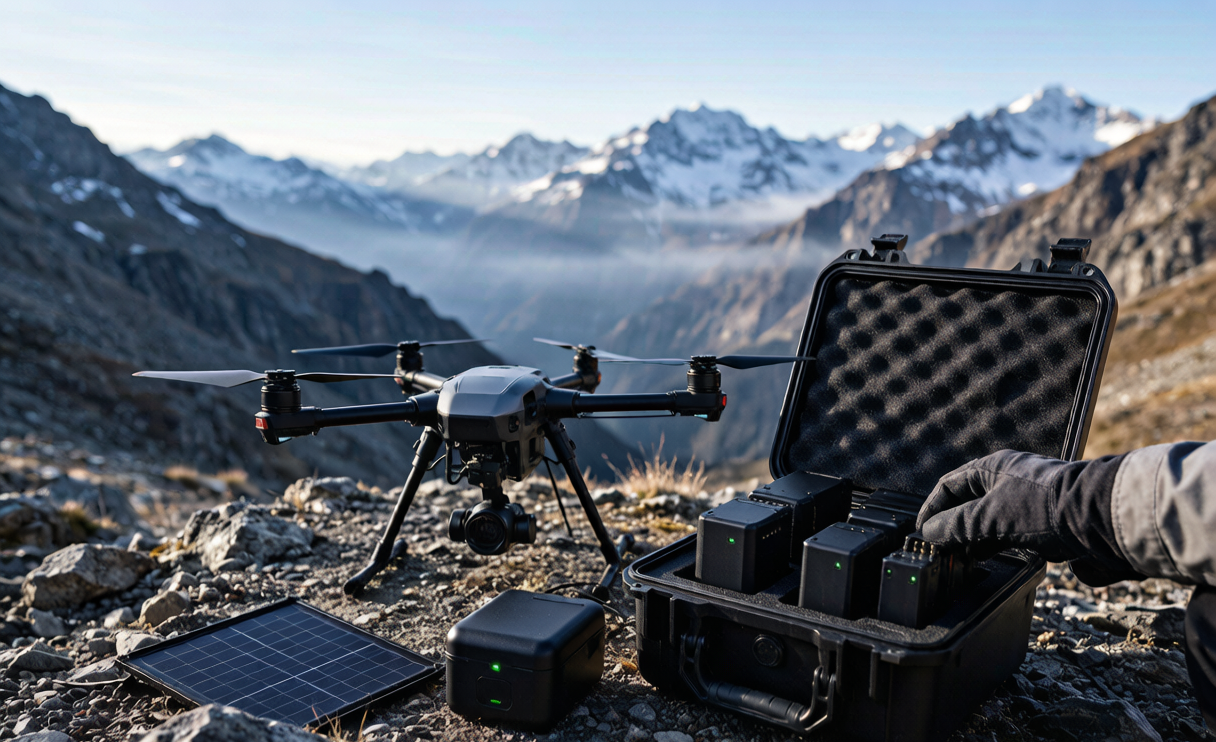
This guide is the field version of what I now hand to every survey client before they mobilise. It covers what altitude and cold actually do to a lithium battery, how to size a fleet you cannot resupply, how to charge off a generator or solar array without cooking cells, and how to move packs legally across borders and onto aircraft. The numbers here come from our own test data and from post-season teardowns, not from a datasheet.
Why Remote-Terrain Surveying Is a Different Energy Problem
A survey mission looks benign on paper: fly a lawnmower pattern at constant altitude and speed, trigger the camera, land. Discharge is smooth, typically 0.7C to 1.1C, with none of the punchy 8C bursts a racing airframe sees. That gentle profile fools people into specifying the cheapest pack that meets nameplate capacity. Then terrain enters the equation.
Three things change at once when you leave the road. Air density drops, so rotors must spin faster for the same lift. At 3,000 metres, air is roughly 74% of sea-level density; on our own multirotor test bench, hover power rose about 12% to 16% versus the same aircraft at 100 metres. Temperature drops, and every degree below 15C raises cell internal resistance and cuts usable capacity. And terrain-following flight adds continuous climb segments that a flat-field mission never sees, because the aircraft must maintain constant ground clearance over ridges and gullies.
Stack those and a pack that delivers 28 minutes of endurance over flat farmland will give you 19 to 21 minutes over a mountain block at 3,000 metres in 2C air. Crews that planned sortie counts on the 28-minute figure end the first day 30% short of coverage, then start pushing packs deeper into the discharge curve to catch up. That is where damage begins, and it compounds every subsequent day of the deployment.
Cold, Altitude and the Physics You Cannot Argue With
Low temperature is the dominant variable in high-terrain surveying. In lithium-ion chemistry, the electrolyte becomes more viscous and lithium-ion diffusion through the graphite anode slows as temperature falls. The practical consequence is higher internal resistance, greater voltage sag under load, and less energy delivered before the pack reaches cut-off.
Our bench measurements on 6S high-energy NMC packs, discharged at a survey-representative 0.9C, show the pattern clearly. At 25C we take 100% of rated capacity as the baseline. At 10C we typically see 94% to 96%. At 0C we see 84% to 88%. At minus 10C we see 68% to 76%, and the sag under load is severe enough that low-voltage cut-off triggers well before the coulometer thinks the pack is empty. That last point matters more than the capacity number, because it means the aircraft lands on a voltage event the pilot did not anticipate.
Charging cold is far more dangerous than discharging cold. Below roughly 10C, plating metallic lithium on the anode becomes a real risk during charge, and plated lithium is permanent capacity loss at best and a dendrite-driven internal short at worst. Our firmware rule is absolute: no charge current above 0.1C until the coldest cell group reads 10C or higher, and no fast charge until 15C. A self-heating pack, drawing a small current through an internal heater film managed by the battery management system, will lift a pack from minus 5C to 15C in eight to twelve minutes and costs about 3% of pack energy. That is the cheapest insurance in remote work.
Altitude has a second, less discussed effect. Reduced air density lowers convective cooling of the pack itself. A pack that stabilises at 42C during a sortie at sea level can reach 48C to 52C at 3,500 metres under the same electrical load. Sustained operation above 45C accelerates electrolyte decomposition and SEI growth, so the same mission profile ages the pack measurably faster at altitude.
Sizing a Fleet You Cannot Resupply
The core sizing question in remote surveying is not “how big should the pack be” but “how many packs must ride in the truck”. Get that wrong and no amount of cell quality saves the schedule.
I size with a four-step calculation. First, establish derated endurance: take bench endurance and multiply by the altitude factor and the temperature factor. A 30-minute flat-field endurance at 3,000 metres and 5C becomes roughly 30 x 0.86 x 0.92, or about 23.7 minutes. Second, subtract reserve. I hold 20% state of charge as a hard floor in remote work, not the 15% typical of urban jobs, because your diversion options are worse and the walk to a downed aircraft is longer. That leaves about 19 usable minutes. Third, divide the daily coverage target by per-sortie coverage to get sortie count. Fourth, apply the rotation ratio.
Rotation ratio is where crews under-buy. A pack cannot go straight from landing back onto the aircraft. It needs a cool-down to below 35C before charge, then the charge itself, then a rest. In a warm depot that cycle is about 55 minutes. In cold terrain, with warming and a conservative charge taper, budget 80 to 95 minutes. If a sortie plus turnaround is 25 minutes and the pack cycle is 90 minutes, you need at least four packs per aircraft in continuous rotation, and I specify five to absorb one pack going out of service without stopping the aircraft.
For a typical three-aircraft mapping crew running eight sorties per aircraft per day, that means fifteen flight packs, plus two spares held sealed as season reserve. Clients balk at seventeen packs for three aircraft until they price a lost mobilisation day, which on remote work routinely exceeds the cost of the entire spare set. This is the calculation that drives most of the custom battery solution work we do for survey operators, and it is worth doing properly before the first pack is ordered.
Charging Off-Grid: Generators, Solar and Buffer Storage
Remote camps charge from three sources, and each has a failure mode I have watched play out.
Portable generators are the default. The trap is that small inverter generators derate with altitude, typically 3% to 3.5% of rated output per 300 metres above sea level. A 2 kW unit delivers closer to 1.4 kW at 3,000 metres. Crews plug in four chargers rated 500 W each, the generator sags, chargers throttle or fault, and charge time doubles. Size the generator for derated output, not the label, and stagger charger start-up so inrush does not trip the breaker.
Solar arrays are attractive and mostly disappointing without buffer storage, because charge demand peaks in the evening when the array is producing nothing. The workable architecture is a home energy storage style buffer: a LiFePO4 pack of 10 to 20 kWh charged by solar during the day and by generator during scheduled runs, feeding the drone chargers on demand. LiFePO4 is the right chemistry here because cycle life above 3,000 cycles and excellent thermal stability matter far more than energy density in a unit that sits on a pallet. That buffer also lets you run the generator at its efficient load point for two hours rather than idling it inefficiently for eight, which typically cuts fuel burn 35% to 45% on our camp deployments.
The third source is vehicle DC. Use it for maintenance charge and for running a warming box in transit only; a 12 V system pulling 60 A into a fast charger will destroy an alternator not specified for it.
Whatever the source, the charge profile stays conservative in the field: constant current at 1C to 80% state of charge, then taper to 0.5C for the final 20%. That taper adds about eight minutes and materially reduces the high-voltage dwell time that drives calendar ageing. In a season of 400 cycles the difference in retained capacity is worth several percentage points.
Pack Construction and Safety Standards That Actually Matter Out There
A drone lithium battery destined for remote work needs mechanical and environmental specification that urban packs can skip. Our survey packs are built to a fixed set of requirements.
Every cell design passes UN 38.3 tests T.1 through T.8 before it enters a pack, which is the transport qualification and also a useful proxy for basic abuse tolerance. Pack-level design follows IEC 62133-2:2017 for the lithium-ion safety requirements and IEC 62619 for the industrial cell criteria, with UL 1973 informing the enclosure and thermal-propagation approach on larger buffer units. Enclosures are sealed to IEC 60529 IP54 as a minimum, and IP65 for packs that will see rotor-wash dust on gravel landing zones or riverbed sites.
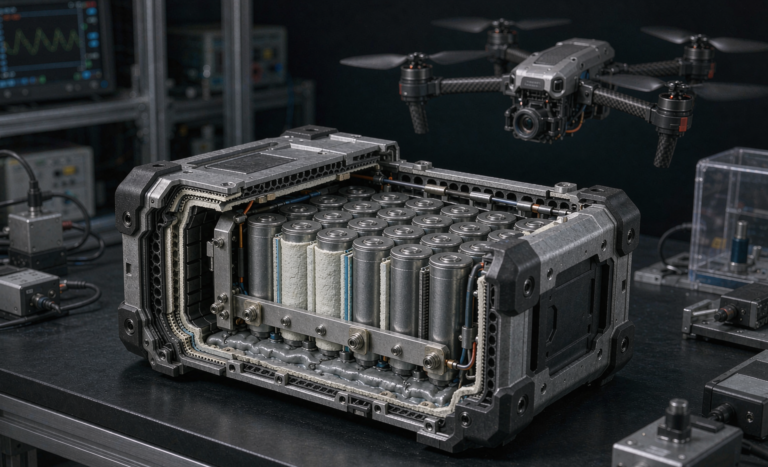
Mechanically, cells are held in a compression fixture rather than tape, because vibration on rough vehicle transit is what loosens weld joints and creates the intermittent-resistance faults that appear three weeks into a season. Nickel-strip welds are pull-tested on a sample basis, and every pack gets a 30-minute vibration soak before it ships. Connectors are the second failure point: pogo pins and blade contacts must hold below 0.3 milliohms per pole, and I specify gold-over-nickel plating on anything that will be mated more than a thousand times in dusty air.
Balance discipline is the field’s early-warning system. We log cell-group delta after every charge. Above 30 millivolts at rest, the pack is flagged for observation. Above 80 millivolts, it comes out of rotation immediately. In eight seasons that single rule has caught nearly every developing cell fault before it became a thermal event.
Transport, Regulation and Getting Packs to the Site Legally
Remote sites usually involve a flight, a border, or both, and battery logistics defeat more mobilisations than terrain does.
Air freight of standalone lithium-ion packs follows IATA Packing Instruction 965 and, for the cell sizes typical of survey aircraft, requires shipment at no more than 30% state of charge. Plan for it: a pack shipped at 30% needs a full charge cycle on arrival, so the first camp evening is a charging evening, not a flying evening. Road transport in Europe falls under ADR, and packs above the small-cell thresholds need the correct UN 3480 or UN 3481 documentation depending on whether they travel with equipment.
Passenger-carriage rules matter for crews who fly commercially with hand-carried spares. Most carriers cap spare packs at 100 Wh without approval and 160 Wh with airline approval, with terminals individually protected. A 6S 22 Ah survey pack is roughly 490 Wh and cannot travel in the cabin under any circumstance. I have watched a crew lose four days because someone assumed otherwise at a check-in desk.
On the flight-operations side, remote surveying frequently means beyond-visual-line-of-sight approvals. FAA Part 107 operations in the United States require a waiver for BVLOS, and European operations under EASA use the SORA methodology, where battery reliability evidence and a documented maintenance and retirement policy strengthen the safety case. Keeping serialised cycle logs per pack is not bureaucratic overhead; it is the evidence base a regulator will ask for, and it is what lets you retire packs on data rather than on hunch.
Frequently Asked Questions
How much endurance do I actually lose flying surveys at 3,000 metres?
Expect 12% to 16% higher hover power from reduced air density alone. Combined with typical mountain temperatures around 0C to 5C, plan on 25% to 35% less usable endurance than your sea-level warm-weather figure. Validate with a test flight on arrival before you commit the mission plan, because airframe and payload combinations vary more than the physics suggests.
Can I charge packs straight after landing in cold terrain?
No, and for two opposite reasons. Immediately after a sortie the pack core is often 40C to 50C and needs to fall below 35C before charge. Once it cools in cold ambient air it can drop below 10C, at which point charging risks lithium plating. The right sequence is land, rest in an insulated box, and start charge when the pack reads between 15C and 35C. A warming box with a thermostat handles this automatically and is the single most useful accessory in a cold-terrain kit.
What state of charge should packs be stored at between deployments?
Store at 40% to 50% state of charge in a cool, dry place, ideally 10C to 20C. A pack left at 100% for three months at 30C can lose 4% to 8% of capacity permanently. Our field rule is that any pack not flying within 72 hours goes to storage charge, and most modern chargers automate this. Re-check storage packs every 90 days and top them back to the storage window if they have self-discharged below 30%.
How many cycles should I expect from a survey pack?
With a 0.7C to 1.1C discharge profile, 1C-to-80% charging with taper, and thermal discipline, our high-energy NMC survey packs typically retain 80% state of health at 450 to 550 full equivalent cycles. Retire at 80% SOH or when internal resistance rises 25% above the pack’s commissioning value, whichever comes first. Packs regularly charged cold or stored full often reach that threshold 150 cycles earlier, which is why field discipline pays for itself.
Is a custom pack worth it for a small survey fleet?
It depends on the airframe. If you fly a mainstream commercial platform with a well-supported OEM pack, buy the OEM pack and spend your money on rotation count and charging infrastructure. If you fly a custom or integrated airframe, or if you need a specific endurance, connector, or environmental rating, a custom battery solution usually pays back within one season through higher sortie counts and fewer aborted days. The break-even point in our experience sits around six to eight aircraft, or any fleet where mobilisation costs exceed a few thousand dollars per day.
Closing Notes from the Field
Remote-terrain surveying rewards crews that treat energy as a logistics discipline rather than a purchasing decision. The pack is only one component. The rotation count, the warming box, the buffer storage, the charge taper, the balance log and the transport paperwork are the system, and any one of them can end a deployment.
If I had to compress a decade of field notes into three rules, they would be these. Derate endurance for altitude and cold before you plan coverage, never after. Never charge a cold pack, and never charge a hot one. And log every cycle, because the packs that fail in the field almost always warned you in the data two weeks earlier. Get those right and the batteries become the boring part of the job, which in remote terrain is exactly what you want them to be.