Drone Battery for Powerline and Utility Corridor Inspection
Every spring, utility crews ask me the same question: “Why can’t our inspection drone just fly the whole transmission line in one trip?” As a senior lithium battery engineer at Horizon Power, I have spent years answering that with math, not optimism. A drone battery built for racing is useless on a 150 km powerline corridor, and a pack tuned for cinematic shots will not survive a full day of beyond-visual-line-of-sight (BVLOS) inspection in midsummer heat. Powerline and utility corridor inspection is its own discipline: long linear ranges, heavy sensor payloads, few landing zones, and a hard regulatory energy reserve. This guide walks through how we actually engineer a drone lithium battery for corridor inspection — energy budgeting, cell chemistry, voltage platform, thermal behavior, field charging, and the safety standards that keep it legal to transport and fly.
Why Corridor Inspection Needs a Different Battery Philosophy
Most people picture drone flight as short and punchy. Inspection is the opposite. A mapping or racing drone lives in 3–10 minute windows; a corridor inspection mission is measured in kilometers and in the watt-hours needed to cover them. The design priority flips from burst current to energy density and sustained endurance. Where a racer cares about 40C pulse capability, an inspection pack cares about how many watt-hours it can deliver per kilogram while cruising at a steady 5–8C equivalent load.
That shift changes every downstream choice. We size the pack from the corridor length and cruise power, not from a lap time. We pick chemistry for gravimetric energy (Wh/kg) and calendar life across a season of flights, because a utility flies the same airframe hundreds of times. And we build in a generous energy reserve, because a drone that runs out of charge 3 km from the nearest landing zone is not a scheduling problem — it is a lost airframe and a regulator’s note. A quality drone lithium battery for this work is an endurance instrument, not a power cell.
Energy Budgeting: Sizing the Pack to the Corridor
The core calculation is simple and unforgiving. Take the corridor length, divide by cruise speed to get flight time, multiply by average cruise power, then add the reserve. A typical fixed-wing or long-range multirotor inspection platform cruises at 12–16 m/s (about 43–58 km/h). To cover 150 km of transmission line at 14 m/s you need roughly 10,700 seconds, or just under three hours of continuous flight — far beyond any single rotorcraft pack. That is why corridor work leans on fixed-wing or hybrid lift platforms and why the battery is only one part of a larger endurance system.
For a multirotor spot-inspection model covering 20–30 km per sortie, the math is friendlier: at 12 m/s and 600–900 W cruise draw, you need 1.7–2.5 hours and roughly 1,100–2,300 Wh. We translate that into a pack and then add a 30% reserve for wind, headway corrections, and the mandated return-to-home buffer. The result is a drone battery that looks oversized on paper but is correctly sized for the mission and the rules.
How Payload Mass Eats Your Endurance
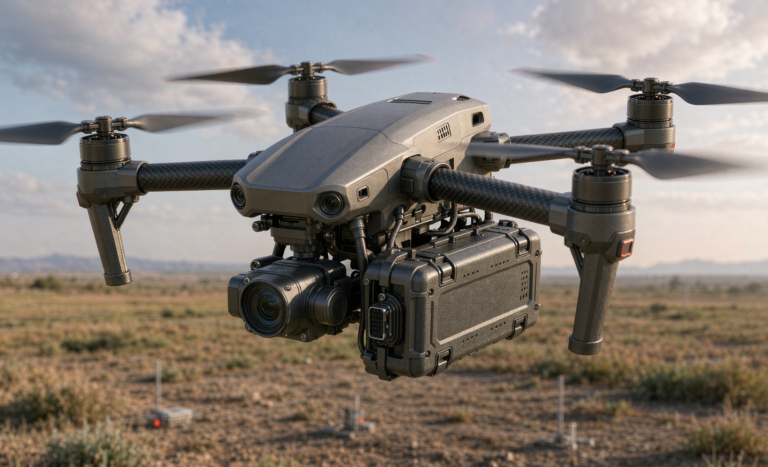
Inspection drones rarely fly empty. A thermal camera, a multi-spectral or LiDAR gimbal, and a real-time link add 400–1,200 grams of payload. Every gram of payload costs roughly 1–2% of rotorcraft endurance, so a heavy sensor suite can quietly cut flight time by 20–40%. We model the pack against the loaded mission mass, never the airframe alone, and we advise utilities to choose sensors first and size the lithium battery second. A custom battery solution that ignores payload is a pack that lands short of the corridor end.
Choosing the Chemistry: NMC vs LFP for Endurance
For corridor inspection we usually choose between high-energy NMC (nickel-manganese-cobalt) and LFP (lithium-iron-phosphate). NMC wins on gravimetric energy, typically 200–260 Wh/kg at the cell level versus 150–180 Wh/kg for LFP, which directly extends range for a fixed mass budget. For long corridors where every gram of battery trades against payload or reserves, that 30–50% energy edge is decisive. The cost is cycle life and thermal window: NMC prefers to stay below 45–50°C core and degrades faster past 500–800 full cycles.
LFP is the conservative choice for high-cycle, high-heat environments — it tolerates abuse, holds a flatter voltage, and survives 2,000+ cycles. For a utility flying the same daily route in desert heat, LFP’s thermal forgiveness can outvalue NMC’s range. We present both and let the mission profile decide; the right answer is the one that matches the corridor’s climate and the fleet’s flight frequency, not a generic “best cell.”
Voltage Platform: Why Higher Voltage Saves Energy
Corridor inspection packs commonly run 6S (22.2 V) or 12S (44.4 V) rather than the 4S of small cinematic drones. The reason is electrical efficiency, not speed. Power delivered is P = V × I, so doubling the pack voltage roughly halves the current for the same wattage. Since copper and busbar losses scale with I², a 12S pack wastes far less energy as heat than a 4S pack delivering identical power. On a three-hour mission, that efficiency gap shows up directly as extra kilometers covered.
We also design the discharge curve so the pack holds a usable voltage across the whole mission, not just the first 20 minutes. A flat discharge and a well-tuned battery management system (BMS) let the motors and ESCs run efficiently from takeoff to the reserve trigger. This is where a thoughtful drone lithium battery layout — series count, cell matching, and BMS balancing — separates a pack that flies the full corridor from one that quits at the halfway tower.
Thermal Behavior in the Field
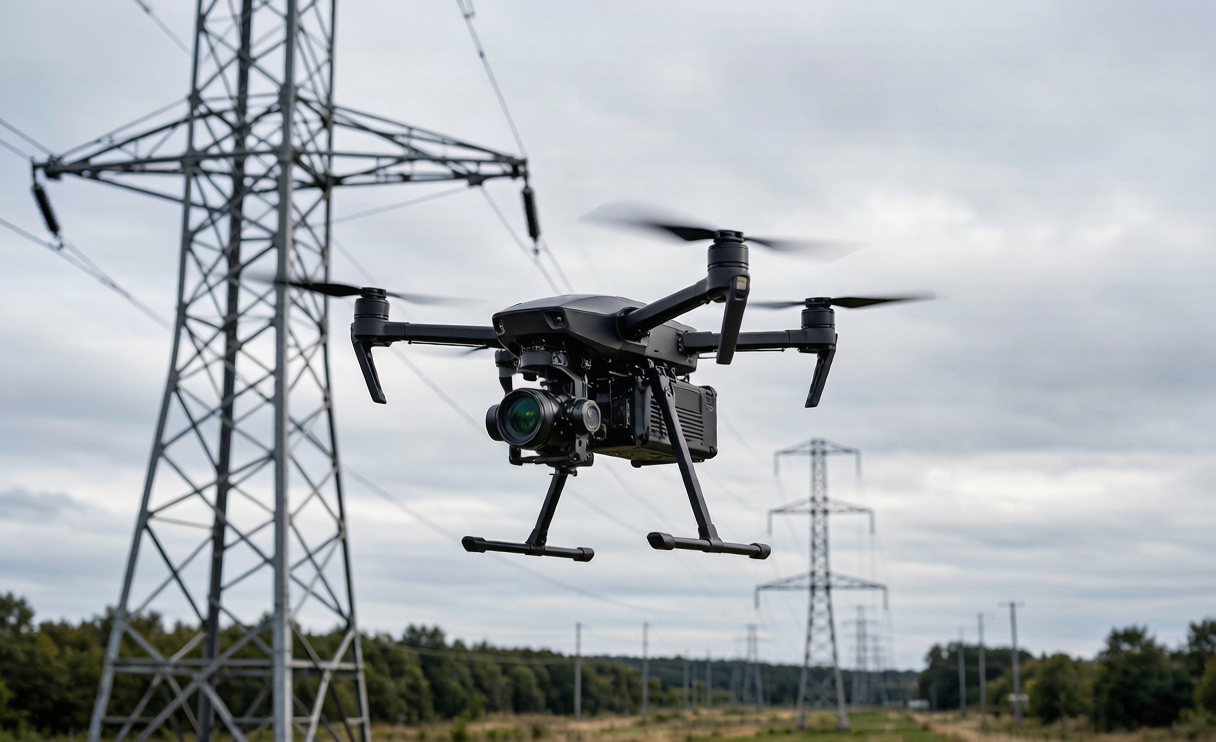
Inspection happens where the lines are: overhead, in sun, often in hot climates. A pack sitting on a 40°C tarmac before launch starts warm, and sustained cruise current heats it further. We set a hard core-temperature ceiling (typically 50–55°C for NMC, higher for LFP) and model adiabatic rise from I²R plus solar load. The field rule is simple: launch cool, keep the parallel-group temperature delta under 3–4°C, and never charge a pack that has not cooled below 35°C.
We also protect against the reverse problem — cold corridors at dawn or altitude, where lithium ion loses capacity and internal resistance climbs. Below about 10°C, we precondition the pack or accept a reduced stated range. A custom battery solution for a utility should include a thermal operating window printed on the pack and a BMS that logs maximum cell temperature per flight, because that log is the earliest warning of a degrading cell.
Charging and Swapping at Remote Sites
Corridors rarely start next to a wall outlet. Crews charge from generators or vehicle inverters at access roads and substations, or they swap pre-charged packs. We design for both: packs rated for 1C–2C field charging from a 1–2 kW inverter, and a standardized hot-swap form factor so a crew carries six to ten identical packs per airframe. The math matters — a 2,000 Wh pack at 1C needs a 2 kW source; undersize the generator and you bottleneck the whole day’s sorties. We hand utilities a charging-power worksheet matched to their pack count and target sorties per day.
Reserves, BVLOS, and the Regulatory Energy Buffer
BVLOS inspection — flying beyond the pilot’s visual line of sight along a corridor — is where battery planning meets law. FAA Part 107 operations and EASA regimes expect a demonstrable energy reserve for a controlled return or landing. We build a minimum 30% state-of-charge reserve into every mission plan: enough to return to the launch point, or to reach a known safe landing zone, against headwind. That reserve is not optional margin; it is the battery budget the regulator implicitly requires, and we treat it as a hard floor the BMS will not discharge below.
For cross-border or international utility work, the same pack must satisfy transport rules whether it flies or rides in a truck. We keep watt-hour labeling accurate, hold packs under the 100 Wh carry-on threshold for air travel or the 160 Wh approved limit, and certify every pack to UN 38.3 T.1–T.8 and IEC 62133-2:2017 so it can be shipped and flown without special-cargo friction.
Safety and Transport Compliance
An inspection fleet carries dozens of packs across states and sites, so transport safety is not a box-tick — it is daily operations. Every Horizon Power drone battery for corridor work passes UN 38.3 altitude simulation, thermal, vibration, shock, external short, impact, overcharge, and forced-discharge testing, plus IEC 62133-2:2017 cell and pack safety. We log each pack’s watt-hour rating and serial, and we train crews on the 30% state-of-charge storage rule for transport under IATA/UN3480 and UN3481 guidance.
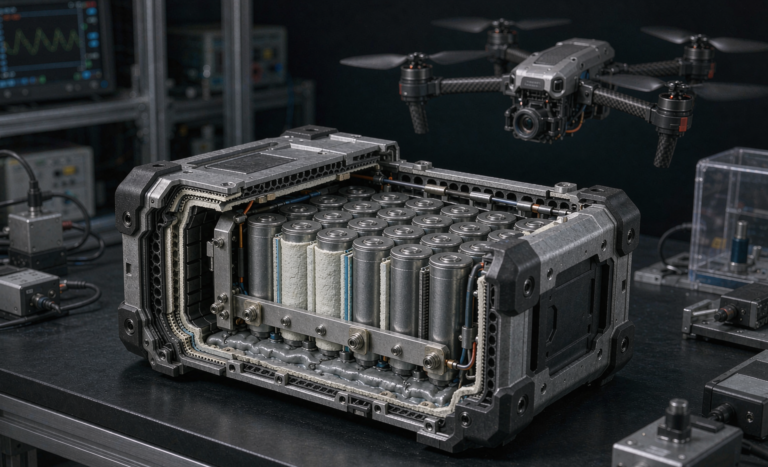
On the line itself, the main battery risks are thermal runaway from a damaged cell after a hard landing near structures, and over-discharge from a missed reserve. Our packs use a fire-retardant barrier rated to the IEC 62133-2 abuse tests, balanced parallel groups so one weak cell cannot cook its neighbors, and a BMS that disconnects on over-temperature or over-discharge. A quality lithium battery for utilities is engineered to fail safe, not just to fly far.
When to Request a Custom Battery Solution
Off-the-shelf packs rarely match a specific corridor, climate, and sensor load at once. If your flights run longer than 45 minutes, your payload exceeds 800 g, or your routes cross sustained heat or altitude, a custom battery solution pays for itself in extra sorties per day and fewer lost-airframe incidents. We start from your cruise power, corridor length, payload mass, and climate window, then lock the cell chemistry, series-parallel topology, and BMS rules after three prototype flights with real temperature logging. The goal is a drone battery your crew can plan a full day around, not one they nurse between charges.
FAQ
What battery capacity do I need for a 150 km powerline corridor?
A single rotorcraft pack will not cover 150 km; that range needs a fixed-wing or hybrid platform and multiple sorties or in-field charging. For a 20–30 km multirotor spot-inspection sortie at 12 m/s and 600–900 W, plan 1,100–2,300 Wh plus a 30% reserve. Size the drone lithium battery from loaded mission mass and cruise power, not from the airframe alone, because payload often removes 20–40% of endurance.
Is NMC or LFP better for utility inspection drones?
NMC for range: 200–260 Wh/kg gives 30–50% more energy than LFP, valuable on long corridors. LFP for heat and cycle life: it tolerates higher temperatures and 2,000+ cycles, better for daily desert routes. Choose by climate and flight frequency. A custom battery solution should be specced to your specific corridor, not a generic cell.
How much energy reserve is required for BVLOS corridor flights?
Plan a minimum 30% state-of-charge reserve for a controlled return or safe landing against headwind. FAA Part 107 and EASA expectations treat this buffer as a safety floor, and a good BMS will not discharge below it. Build the reserve into the mission plan before you calculate sortie length.
Can inspection drone batteries be shipped between sites?
Yes, if certified. Every pack should pass UN 38.3 T.1–T.8 and IEC 62133-2:2017, carry accurate watt-hour labeling, and be transported at or below 30% state of charge under UN3480/UN3481 guidance. Keep packs under 100 Wh for carry-on or 160 Wh with approval so they stay shippable without special cargo.
How do I charge packs at remote corridor access points?
Use a 1–2 kW inverter or generator at access roads and substations, or swap pre-charged standardized packs. A 2,000 Wh pack at 1C needs about 2 kW, so size the generator to your pack count and target sorties per day. Never charge a pack that has not cooled below 35°C, and log maximum cell temperature per flight.