Drone Battery Deployment for Racing Drones
I have spent the last decade designing and qualifying packs for FPV racing, and the pattern I see over and over is that teams obsess over cell chemistry and then lose races because of deployment. Deployment is everything that happens between the moment a finished pack leaves my production line and the moment it is retired: how many packs a team fields, how they are labeled, staged, charged, cooled, rotated, transported and eventually pulled from service. A perfectly engineered 6S 1300 mAh 120C pack will still hand you a mid-lap brownout if it is charged hot, staged at the wrong state of charge, or flown 40 cycles past its internal-resistance limit.
This article is the deployment playbook I hand to race teams and event organizers. It is not another spec-sheet comparison; it covers the operational engineering of a racing drone battery fleet — fleet sizing arithmetic, the charge-window math that decides whether you make your next heat, the thermal budget of a hot race field, the cycle-tracking discipline that separates a professional team from a bag of anonymous packs, and the transport rules that decide whether your packs arrive at the event at all.
What Deployment Actually Means for a Racing Drone Battery Fleet
In consumer use, a drone battery is a single object with a charge cycle. In competitive racing it is a fleet asset with a duty cycle, a service history and a retirement date, because the failure modes that dominate race weekends are logistical rather than electrochemical.
A typical race heat lasts 90 to 150 seconds. On a 6S 1300 mAh pack, average draw sits around 30 to 45 A with punch-out peaks of 100 to 130 A, which is why 100C-plus ratings exist here. Each heat consumes roughly 75 to 85 percent depth of discharge, landing the pack near 3.5 to 3.6 V per cell at rest. A pilot in a full qualifying-plus-bracket weekend flies eight to fourteen heats a day plus practice, so the deployment question is never a single pack’s performance — it is whether the fleet can deliver a fresh, cool, balanced pack every eight to twelve minutes for two days straight.
I frame every fleet deployment around four operational variables: pack count, charge throughput, thermal recovery time and traceability. Get those right and a mid-tier lithium battery pack will outperform a premium pack that is deployed carelessly.
Fleet Sizing: The Arithmetic Behind Pack Count
The most common mistake I see is a pilot arriving with six packs for a two-day event. The math does not work, and the reason is thermal rather than electrical.
After a hard heat, cell surface temperature on a high-C-rate pack lands between 55 and 65 °C, with internal temperature several degrees higher. My rule is that no pack goes on a charger above 40 °C, and I prefer 30 to 35 °C. Passive cooling from 60 °C to 35 °C in a 25 °C ambient takes 20 to 35 minutes for a bare 6S pack, longer if packs are stacked. A 5C recharge then takes 12 to 15 minutes plus three to eight minutes of balancing. Realistically, each pack is out of service for 45 to 60 minutes after every heat.
My sizing formula is therefore turnaround time divided by flight interval, plus reserve. At a 50-minute turnaround and one flight every 10 minutes, that is five packs in circulation just to keep up, and I add 50 percent for crash damage, extra heats and packs pulled for inspection — eight packs minimum per pilot for a practice day, and 12 to 20 for a serious two-day event. A four-pilot team therefore deploys 50 to 80 packs, which is exactly why the tracking and charging systems below stop being optional.
Pack Identity and Cycle Tracking: The Backbone of Deployment
An untracked drone lithium battery is a pack with unknown remaining life, and unknown remaining life is how mid-lap failures happen. Every pack I ship into a team deployment gets a permanent identity before it ever flies.
- Serial and QR label bonded under the heat-shrink or on a Kapton patch, so it survives crashes and hook-and-loop abrasion.
- Baseline record at first commissioning: reference capacity at 1C, per-cell DC internal resistance, pack thickness at three points, and the 60C pulse sag figure. My typical baseline for a fresh 120C 6S cell is 2.5 to 4.0 mΩ per cell, with a pack sag to roughly 3.2 to 3.4 V per cell under a 60C pulse at 50 percent depth of discharge.
- Cycle counter incremented every heat, even aborted ones, because a 20-second full-throttle abort is thermally worse than a clean lap.
- Event log for crashes, over-discharge below 3.0 V per cell, charge faults and any temperature excursion above 70 °C.
A spreadsheet or phone-scanned QR log takes about eight seconds per pack. The payoff is that retirement becomes data-driven rather than superstition, and warranty conversations become factual: when a customer tells me a pack failed at 30 cycles, the log tells us both whether it was cycle 30 or cycle 96 with two over-discharge events.
Race-Day Charging Infrastructure and Charge-Window Math
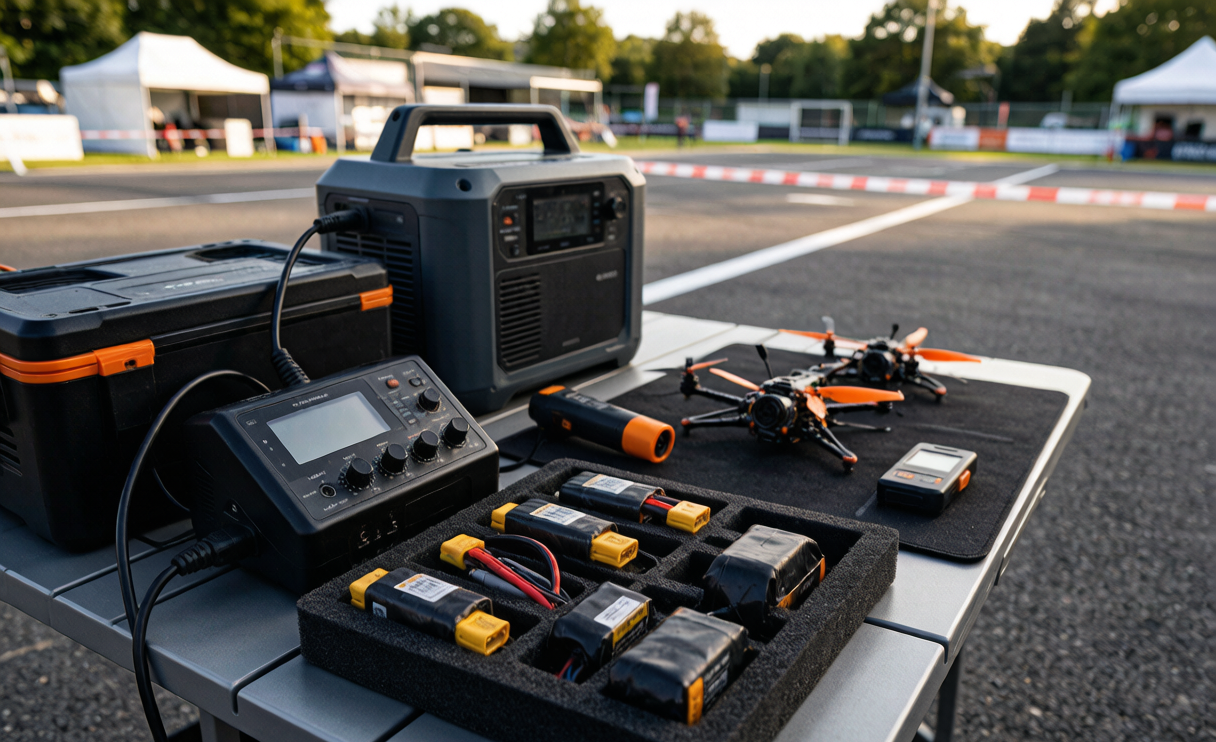
Charging is where deployment plans quietly collapse. A 6S 1300 mAh pack charged at 5C draws about 6.5 A at roughly 25.2 V near the top of charge — around 164 W per pack. Six channels is therefore close to 1,000 W of DC output, and at 88 to 92 percent supply efficiency you need a 1.1 to 1.2 kW source. Field generators rated 1,000 W continuous often sag under charger inrush, so I size the source at 1.5 times the calculated load.
Energy budgeting matters equally. Each full recharge of a 28.9 Wh pack consumes roughly 32 to 34 Wh including losses, so a hundred recharges over a weekend is about 3.4 kWh — comfortably beyond a single 2 kWh portable power station. I plan either two stations with a mid-day swap, a generator, or shore power on a dedicated 16 A circuit.
On charge rate I stay conservative even when the cell datasheet permits more. Charging at 5C rather than 2C typically costs 20 to 35 percent of cycle life on high-C-rate chemistry, because elevated lithium-plating risk compounds with the thermal abuse the pack already took in the heat. My default is 2C on practice days and 4 to 5C only when the heat interval demands it. I also mandate balance charging with a cell-delta cutoff of 30 mV or tighter; a pack that will not balance to 30 mV is pulled for inspection rather than flown.
Field Thermal Management: The Variable Nobody Budgets For
Race fields are hot, and thermal errors cause more retirements than crashes. On a 38 °C day, packs in a black case in direct sun reach 50 to 60 °C before they are even flown, which removes most of your usable voltage headroom and accelerates capacity fade.
My field thermal protocol is simple and non-negotiable:
- Shade and airflow for all staged packs. A light-colored insulated crate with a small fan keeps a staging area within 3 to 5 °C of ambient rather than 20 °C above it.
- Measure, do not guess. An infrared thermometer reading on the pack’s widest face takes two seconds. I gate charging at 40 °C and gate flight at 45 °C.
- Never force-cool with ice or water. Rapid external cooling creates internal condensation and mechanical stress on tabs and welds. Forced ambient air is correct; refrigeration is not.
- Cold weather is the mirror image. Below 10 °C, a race pack’s internal resistance can rise 40 to 80 percent, causing severe sag on the first punch-out. I pre-warm packs to 20 to 25 °C in an insulated container and never charge a lithium battery below 0 °C, in line with the cell manufacturer limits that underpin IEC 62133-2 compliance.
Deployment State of Charge, Staging and Rotation Discipline
State of charge management across a weekend has real cost consequences, because high-voltage storage is the fastest way to age a high-C-rate pack. My rules are:
- Flight-ready staging only inside a two-hour window. Charge to full no more than about two hours before use.
- Overnight and between-days storage at 3.80 to 3.85 V per cell. Every modern charger has a storage mode; use it.
- Landing target 3.5 to 3.6 V per cell resting, never below 3.3 V. A pack pulled below 3.0 V per cell under load gets logged and inspected, and one below 2.5 V is retired, not recovered.
- First-in, first-out rotation so cycle counts stay even across the fleet. Uneven rotation creates a subset of hero packs that are 60 cycles ahead of the rest and fail unpredictably.
I also physically separate the fleet into three staging zones — charged and ready, cooling, and quarantined. Colour-coded trays beat any digital system here, because under race pressure people reach for whatever is nearest.
Transport, Storage and Regulatory Compliance
Deployment includes getting the fleet to the venue legally. Racing packs are lithium-ion cells for transport classification purposes, and the rules are not optional.
Every pack I ship has completed UN 38.3 testing, covering T.1 altitude simulation, T.2 thermal cycling, T.3 vibration, T.4 shock, T.5 external short circuit, T.6 impact or crush, T.7 overcharge and T.8 forced discharge, and cells are qualified to IEC 62133-2. For air transport as cargo, standalone packs ship under UN3480 and packs with equipment under UN3481, with a state of charge not exceeding 30 percent as required by the IATA Dangerous Goods Regulations.
For team travel, FAA and EASA carry-on rules govern. Packs up to 100 Wh travel in carry-on baggage without airline approval; 100 to 160 Wh requires airline approval and is generally limited to two spares per passenger; above 160 Wh is prohibited in passenger baggage. A 6S 1300 mAh pack is about 28.9 Wh and a 6S 1500 mAh pack about 33.3 Wh, so a racing fleet sits well under the 100 Wh threshold — but terminals must be individually protected and packs must be carry-on, never checked. I insist on fire-resistant sleeves plus a hard case and cap every connector, because a loose XT60 shorting against another pack’s tabs inside a bag is the most common transport incident I have investigated.
Retirement Thresholds: When a Pack Leaves the Rotation
The hardest deployment discipline is throwing away packs that still fly. Race packs are consumables, and my retirement criteria are quantitative:
- Capacity below 80 percent of baseline measured at 1C. On 100C-plus race chemistry this typically arrives between 60 and 120 cycles depending on charge rate and thermal history.
- Internal resistance above roughly twice baseline, or above 8 to 10 mΩ per cell on a pack that started at 3 to 4 mΩ. IR rise predicts sag failure earlier than capacity does, which is why I weight it more heavily.
- Thickness growth beyond 5 to 8 percent, or any visible puffing. Swelling is gas generation, and gas generation is irreversible.
- Any cell delta above 50 mV after a full balance charge, or a single cell that consistently lands 100 mV below its siblings.
- Any hard crash with visible deformation, any tab damage, or any over-discharge below 2.5 V per cell. No exceptions, regardless of remaining capacity.
Retired packs are discharged below 1 V per cell in a salt-water bath or via a resistive load, then delivered to a licensed recycler. I keep the retirement record attached to the pack’s log, because fleet-level retirement statistics are how a team learns whether its charging and thermal practices are working.
A Deployment Playbook for Teams and Event Organizers
For teams, everything above compresses into a one-page field routine: scan and record each pack before and after every heat, gate on temperature at 40 °C for charging and 45 °C for flight, balance-charge with a 30 mV delta limit, stage in three zones, rotate first-in first-out, storage-charge at the end of the day, and inspect anything with a logged anomaly before it flies again.
For organizers, deployment is an infrastructure question. A well-run event provides distributed charging power rather than one overloaded circuit, non-combustible charging surfaces with spacing between packs, a Class D extinguisher or bucket of dry sand per charging bay, an outdoor quarantine bin for damaged packs sited away from tents and vehicles, and shaded staging. I have seen more incident reports caused by an event’s charging tent than by any specific pack design, and the fixes are cheap.
Deploying a custom battery solution at Team Scale
When a team commits to a season, deployment changes what I build. Fleet operation rewards consistency far more than headline peak specifications, so a custom battery solution for a race team is specified around repeatability: cells batch-matched to within 2 percent on capacity and 5 percent on DC internal resistance so packs behave identically and rotation stays predictable; serialized labelling with a delivered baseline test report so the team’s log starts populated rather than blank; connector, lead length and wrap colour standardized to eliminate pit-lane mistakes; and thickness and mounting geometry held tight enough that any pack fits any airframe in the inventory.
That last point sounds trivial and is not. A fleet where every pack is mechanically interchangeable across three airframes is a fleet where a pilot never loses a heat to a strap that will not close. Deployment engineering is mostly this — removing the small operational failures a spec sheet never mentions.
Frequently Asked Questions
How many packs does one racing pilot actually need for a two-day event?
Twelve to twenty for a competitive weekend. The binding constraint is turnaround: roughly 20 to 35 minutes of cooling plus 12 to 20 minutes of charging and balancing means each pack is unavailable for 45 to 60 minutes, while heats and practice slots can come every 8 to 12 minutes. Six packs is a practice-session fleet, not an event fleet.
Is it safe to charge a race pack immediately after landing?
No. Cell surface temperature after a hard heat is commonly 55 to 65 °C, and charging above 40 °C accelerates capacity fade and raises the risk of internal damage. Measure with an infrared thermometer and wait until the pack is at or below 40 °C, ideally 30 to 35 °C. Use shade and forced ambient airflow to shorten the wait, never ice or water.
What state of charge should packs be stored at between race days?
3.80 to 3.85 V per cell. Leaving a high-C-rate pack at 4.20 V per cell overnight measurably accelerates ageing, and leaving it below 3.5 V for long periods risks deep self-discharge. Every charger’s storage mode handles this in a single step at the end of the day.
How do I fly a racing fleet to an overseas event legally?
Packs must be UN 38.3 tested across the T.1 to T.8 sequence, with cells qualified to IEC 62133-2. Under FAA and EASA passenger rules, up to 100 Wh goes in carry-on with no approval, 100 to 160 Wh needs airline approval with a typical two-spare limit, and nothing above 160 Wh is permitted. Terminals must be protected and packs never checked. Shipping as air cargo instead means UN3480 or UN3481 at a maximum 30 percent state of charge under the IATA regulations.
When should a pack be retired even if it still flies?
When measured capacity falls below 80 percent of its commissioning baseline, when per-cell internal resistance roughly doubles or exceeds 8 to 10 mΩ, when thickness grows more than 5 to 8 percent or any puffing appears, when cell delta exceeds 50 mV after a balance charge, or after any crash with deformation, tab damage or over-discharge below 2.5 V per cell. Race packs are consumables, and a pack retired one cycle early costs far less than a pack retired one cycle late.