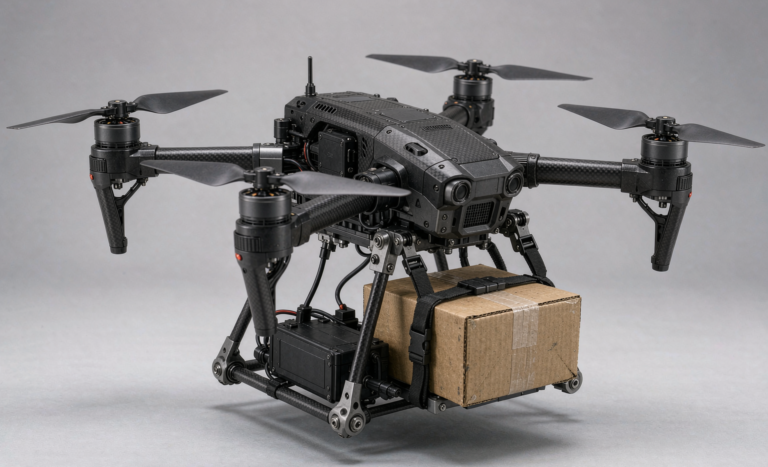
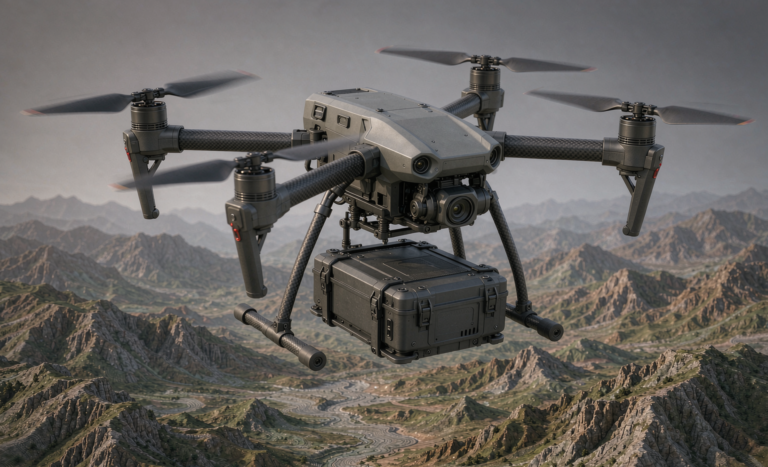
Drone Battery for Railway Track Inspection
When operators ask me to build a drone battery for railway track inspection, the first thing I tell them is that a rail corridor is not a powerline and it is not a wind turbine. It is a long, linear, usually electrified steel ribbon running through dust, vibration, and some of the tightest maintenance windows in the entire inspection world. Over the last few years at Horizon Power I have specced dozens of packs for track-survey fleets, and the engineering rules that keep those drones flying are specific enough that they deserve their own write-up. This is how we, as battery engineers, design a drone lithium battery that survives ballast, 25 kV catenary, magnetic heading error, and a 4 a.m. possession window.
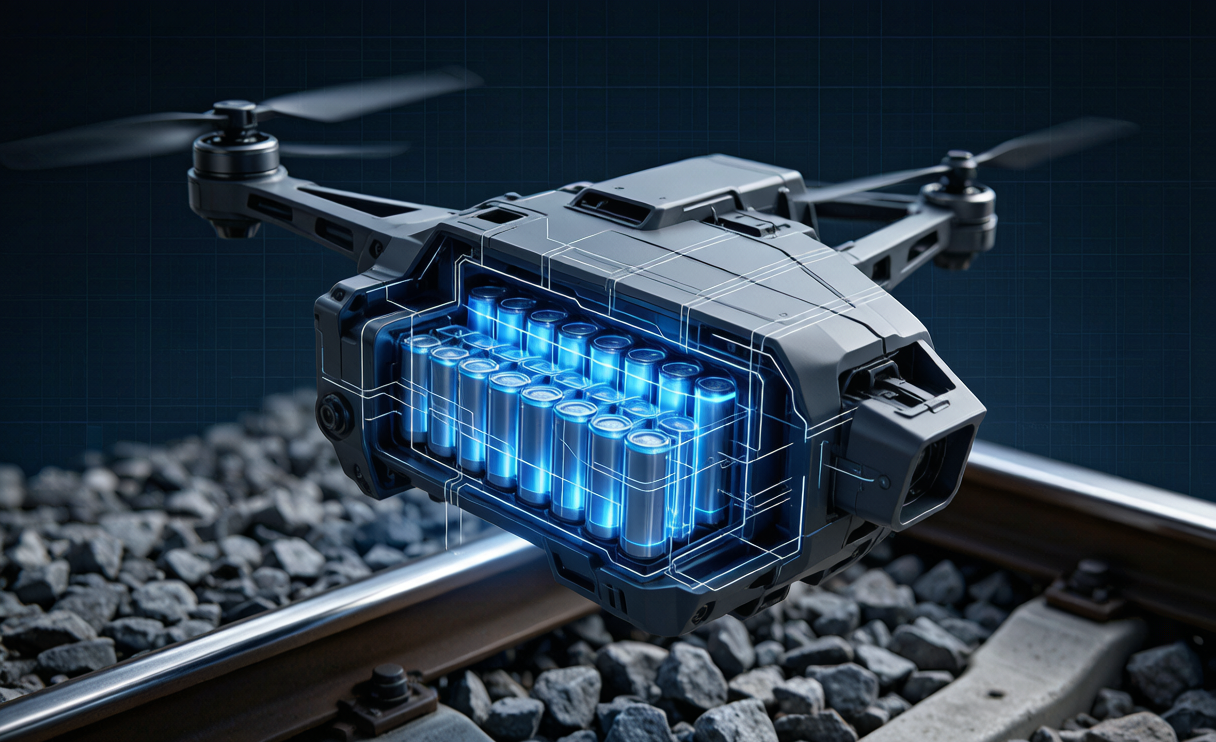
Why Rail Corridors Break the Standard Drone Battery Playbook
Most inspection drones get a flat park or a quiet stretch of coastline. A track-inspection drone gets a continuous 100 km to 300 km steel corridor, often with active traffic a few hundred meters away, overhead wires humming at tens of kilovolts, and a maintenance “possession” that may only last four to six hours before the first train is due. The pack has to deliver predictable endurance inside that window, tolerate a ferromagnetic environment that confuses its own navigation, and shrug off ballast dust that would choke a consumer quad in an afternoon.
The other difference is economics. A missed rail defect becomes a derailment risk, so the survey cannot be “good enough.” The lithium battery behind the aircraft has to support a thermal camera, an RTK positioning module, and sometimes a laser crack-detection head simultaneously, all while the aircraft hovers meters above moving steel. That is a power-quality problem as much as an energy problem, and it shapes every cell and interconnect decision.
Energy Budget for a 100 km Track Survey
Let me work a real corridor number. A fixed-wing or VTOL corridor survey typically cruises at 0.8 to 1.4 kW for the airframe, while a multirotor doing close-up rail-head videography sits at 1.5 to 2.2 kW of hover power. Survey speed is usually 6 to 10 m/s for usable image overlap. A 100 km corridor at 8 m/s is about 12,500 seconds, or 3.5 hours of flight.
Power accounting for a VTOL corridor leg: 0.9 kW cruise plus 12 to 25 W of payload (RGB 5 to 15 W, thermal 20 to 45 W, RTK 5 to 12 W, compute 10 to 25 W) plus a 10 to 25 percent gust margin gives roughly 1.2 kW average. Over 3.5 hours that is about 4.2 kWh of energy. Add a 30 percent possession-reserve buffer and you are specifying around 5.5 kWh of installed capacity for the full corridor.
That is never a single pack. A 6S 22 Ah drone lithium battery is about 0.49 kWh; a 12S 18 Ah pack is about 0.80 kWh. Realistically the fleet carries four to six 12S packs in rotation, hot-swapping at road crossings between legs. The rule I give customers: size the pack for one leg, not the whole corridor, and engineer the swap logistics so the swap never costs more than the flight.
Electrified Lines: 25 kV Catenary, EMI and Compass Error
This is the part that surprises newcomers. A standard overhead catenary runs at 25 kV AC (15 kV in some networks, 750 V to 3 kV DC third rail on metros). That infrastructure radiates. I have seen 2.4 GHz control links drop and GPS L1/L2 positions wander by several meters within 50 meters of an energized line. The battery pack itself is not the victim, but the wiring tied to it is.
Our mitigation is electrical, not chemical. We shield the pack-to-ESC harness, add ferrite cores on the telemetry lines, isolate the payload power rail with a DC-DC converter, and carry a 900 MHz backup command link. Critically, the ferromagnetic rail deflects any magnetic compass by 20 to 40 degrees, so we disable the compass entirely and fly on RTK-GNSS plus visual-inertial odometry. None of that changes the cell chemistry, but it changes how we package and ground the drone battery.
Ballast Dust, Vibration and Hard Landings
Rail ballast is crushed stone, and it gets everywhere. A pack that breathes will ingest conductive fines and fail in weeks. We seal inspection packs to IP5X to IP6X using conformal coating and potting, specify 316L stainless terminals instead of bare nickel, and drop a desiccant pouch rated for at least 50 charge cycles into the enclosure.
Vibration is the quieter killer. Passing trains transmit ground-borne shaking, and landings on uneven ballast are hard. We anchor every lead with adhesive-lined heatshrink within 30 mm of the cell, follow DO-160 and MIL-STD-810 random-vibration profiles from 5 to 2000 Hz, and verify interconnect resistance does not drift after the shake. A custom battery solution that looks fine on the bench and rattles apart at the third crossing is a failure we engineer out before flight one.
Thermal Payload Power and Rail-Defect Detection
The whole point of the mission is the sensor. Hot-box detection (overheated bearings and wheelsets) and internal rail-head cracks show up best on an infrared camera drawing 20 to 45 W, with an RTK module pulling another 5 to 12 W for geo-referenced defect maps. That sensor bus rides the same pack as the motors, so voltage sag during a manoeuvre can inject noise into the imagery.
We keep the payload on a regulated, isolated rail with 20 to 40 ms of hold-up, and we verify the pack’s direct-current internal resistance (DCIR) at 1 kHz plus a 3C for 10 seconds pulse so total sag stays under 8 percent of nominal. If the aircraft’s motor surge dims the thermal feed, the inspection data is worthless. Stable power is the product.
Cold Morning Windows and Heated Packs
Possession windows are often at 4 to 7 a.m., the coldest part of the day on the track. Lithium capacity fades hard with temperature: 100 percent at 25 °C, about 85 percent at 0 °C, 70 percent at minus 10 °C, and only 55 to 60 percent at minus 20 °C. A pack sized for a warm afternoon simply will not complete a cold-morning corridor.
Our fix is a 5 to 15 W pad heater on the cell stack, holding the core between 10 and 25 °C before and during flight. That recovers most of the cold loss and keeps the pack inside its safe charge and discharge envelope. The heater draws from the pack, so we add its energy into the budget rather than pretending it is free. A custom drone battery for rail work without a thermal plan is, in my view, incomplete.
NMC vs LFP — Chemistry for Track Patrol
For the aircraft itself we almost always recommend NMC or NCA cells: 200 to 250 Wh/kg and 500 to 1000 cycles gives the energy density a long corridor demands. Where the aircraft must haul a heavy thermal payload for short close-up legs, high-power LiPo at 150 to 200 Wh/kg with 30 to 50 C discharge handles the burst.
LFP earns its place on the ground. A depot charging cart or a ground-based buffer at the maintenance shed runs 120 to 160 Wh/kg but 2000 to 4000 cycles, so the field chargers last for years. Semi-solid cells at 250 Wh/kg are qualifying for our longest-endurance corridor ships, but for most track fleets the mature NMC pack plus an LFP ground cart is the pragmatic, low-risk choice.
Field Logistics Inside a Possession Window
The battery is only as good as the turnaround. Inside a four to six hour window we run six to ten packs through two six-channel chargers at roughly 1 kW each, charging at 1C to 2C with a 40 °C charge gate. We track every pack with a QR identity and baseline internal resistance, capacity, and thickness, then rotate first-in-first-out so no pack sits at high state of charge.
Storage between windows is held at 3.80 to 3.85 V per cell. We retire a pack at 80 percent of original capacity, at twice its baseline internal resistance, at a 50 mV cell delta, or at 5 percent puffing, whichever comes first. That discipline is what lets a track-inspection program trust its drone battery data month after month.
Transport and Compliance
Moving packs to and along the corridor has its own rules. Every pack we ship meets UN38.3 tests T.1 through T.8 and IEC 62133-2:2017, travels at or below 30 percent state of charge per IATA, and stays inside the 100 to 160 Wh per-battery air-travel envelope under FAA and EASA rules. For rail transport we follow UN3480 and UN3481 provisions and label correctly. None of this is optional for a professional inspection fleet, and we build the compliance checklist into the pack delivery.
Frequently Asked Questions
How many flights cover a 100 km rail corridor?
With a VTOL survey aircraft cruising near 8 m/s and a 12S pack giving roughly 0.8 kWh, one leg covers about 30 to 40 km before the possession reserve kicks in. Plan for three to four legs, which means four to six packs in rotation with hot-swaps at road crossings.
Can a drone battery operate safely near 25 kV catenary?
Yes, provided the pack wiring is shielded, the telemetry is isolated, and the aircraft navigates by RTK-GNSS and visual odometry rather than a magnetic compass. The cells themselves are unaffected; the risk is to the electronics tied to the pack, which we protect with ferrite cores and a regulated isolated payload rail.
Why does cold weather cut track-inspection endurance?
Lithium capacity falls with temperature, to about 85 percent at 0 °C and 55 to 60 percent at minus 20 °C. Early-morning possession windows are the coldest part of the day, so we add a 5 to 15 W pad heater and size the pack for the cold case, not the warm case.
Should I use NMC or LFP for railway inspection drones?
Use NMC or NCA in the aircraft for the energy density a long corridor needs, and LFP in the ground charging cart for cycle life. Semi-solid is an emerging option for the longest endurance ships but is not yet the default for most fleets.
How do you transport inspection packs by rail or air?
Every pack meets UN38.3 T.1 to T.8 and IEC 62133-2:2017, travels at 30 percent state of charge per IATA, stays under the 100 to 160 Wh FAA and EASA limit, and follows UN3480 or UN3481 rail provisions with correct labeling. We deliver that compliance as part of the pack.
If you are building or scaling a track-inspection program, talk to us about a custom battery solution engineered around your specific airframe, sensor bus, and possession window. The right drone lithium battery is the difference between a survey that finishes before the first train and one that does not.