Drone Battery Maintenance for Racing Drones
After fifteen years designing and abusing high-C-rate lithium packs on the bench, I can tell you the single biggest difference between a racing pilot who flies all season and one who is constantly replacing hardware is not the charger, the motors, or even the pilot’s thumbs. It is drone battery maintenance. Racing packs live a brutal life: 100C+ current pulses, deep cycling, hard landings, and storage in the back of a hot car. In this guide I will walk you through the exact maintenance routine my team uses to keep race packs performing at spec, the technical thresholds we monitor, and the standards (UN 38.3, IEC 62133) that shape how we handle every cell.
My name is Karl Huang, and I lead lithium battery engineering at Horizon Power. Most of what follows comes from field data and failure analysis on thousands of returned packs — not marketing copy. If you fly FPV racing quads, treat your drone battery like the high-performance component it is, and it will reward you with consistent punch-outs and a much longer service life.
Why Racing Drone Batteries Wear Out Faster Than Any Other Pack
A racing pack is the most stressed drone lithium battery in consumer aviation. A 6S 1300 mAh pack rated at 120C is theoretically expected to deliver over 150 A continuous. In practice a hard punch-out pulls 90–110 A for fractions of a second, and each pulse heats the cells internally through their DC resistance. That resistance — internal resistance, or IR — is the number I care about most.
When a cell’s IR climbs, three things happen at once: voltage sag under load gets worse, cell temperature rises faster, and capacity that used to be usable is now trapped behind the sag. On a fresh high-quality lithium battery cell you might measure 2–4 milliohms per cell. Once a cell crosses roughly 8–10 milliohms, I retire it from racing duty. It is not dead — it can still power a cinema drone at low C-rate — but it will no longer hold voltage in a race. Good maintenance is really about slowing the rate at which IR rises.
The Charging Discipline That Preserves Capacity
Charging is where most damage is done, quietly, over dozens of cycles. Here is the routine I insist on:
- Charge rate: For race day, 1C is fine and gentle. If you must fast-charge between heats, stay at or below 2–3C and never leave the pack unattended. Every increment above 1C accelerates lithium plating on the anode, which is irreversible capacity loss.
- Balance every charge: Cell divergence is the earliest warning sign. I want all cells within 0.01–0.02 V of each other at the end of charge. A pack that drifts to 0.05 V or more between cells has a weak cell that needs isolating.
- Charge to storage, not full, unless flying soon: A LiPo cell sitting at 4.2 V ages roughly twice as fast as one held at 3.85 V. If you are not flying within a few hours, do not top-charge.
- Temperature gate: Never charge a pack below 0°C or above 45°C. Charging a cold pack forces metallic lithium onto the anode — the exact mechanism behind swollen, dangerous packs.
These same principles scale up to every custom battery solution we build for industrial clients; the chemistry does not care whether it powers a race quad or a survey drone.
Storage Voltage: The Cheapest Life Extension There Is
If you do only one thing from this article, do this: store race packs at 3.80–3.85 V per cell (about 40–50% state of charge). Calendar aging is dominated by two factors — temperature and voltage. A pack stored at 4.2 V and 30°C can lose 20% of its capacity in a few months. The same pack at 3.85 V and room temperature will barely move.
My routine: after a race day, put every pack on storage discharge that evening. I keep them in a fireproof ammo can in a cool room, never in a hot garage or the trunk of a car. If a pack will sit for more than two weeks, I check its resting voltage before storing and again before the next use. A pack that self-discharges noticeably faster than its siblings has an internal issue and comes out of rotation.
Physical Inspection: What My Hands and Eyes Catch That Meters Miss
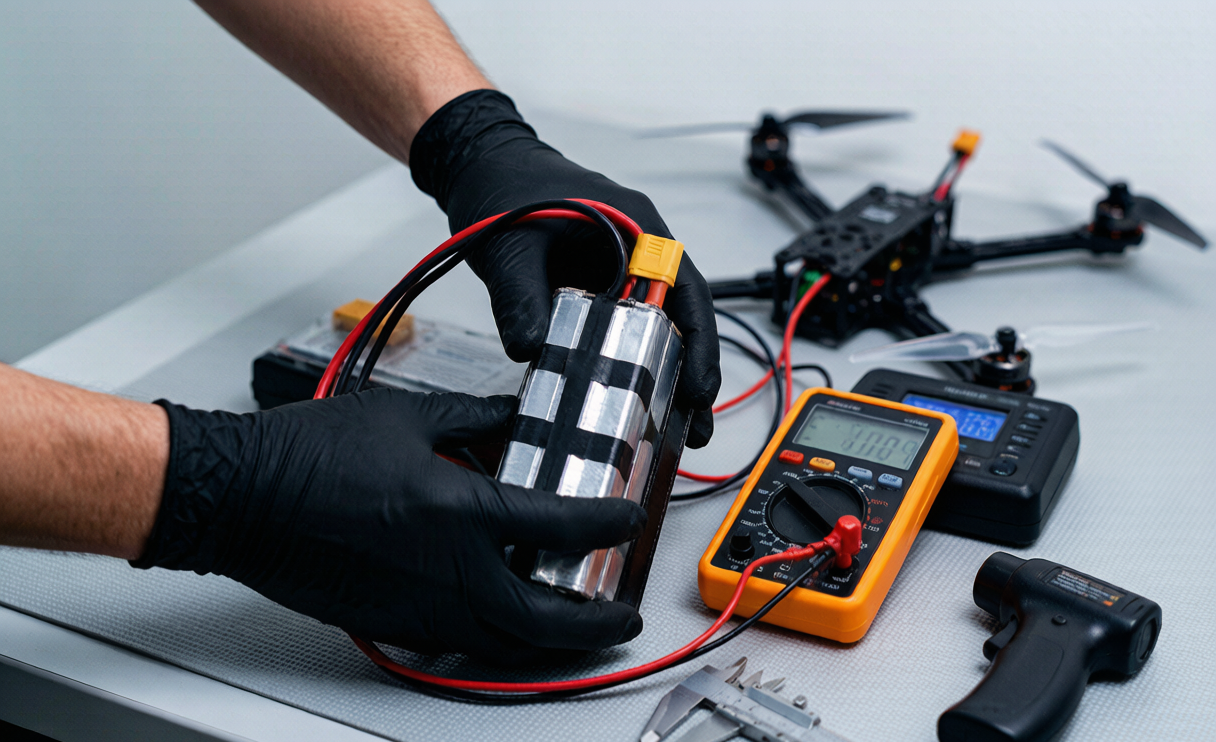
Before every race day I run a two-minute physical check on each drone battery. Instruments are essential, but mechanical damage is often visible or tactile first.
The swelling check
Lay the pack on a flat surface and press each cell face gently. Any puffiness, softness, or a pack that no longer sits flat means gas generation inside — the cell is compromised. A swollen pack never flies again; it goes straight to safe disposal.
Lead and connector integrity
Racing packs take crash loads directly through their leads. I flex each main lead near the solder joint feeling for stiffness or exposed strands, and I inspect the XT60/XT30 connector for melted plastic or discoloration, which signals a high-resistance joint that is generating heat. A loose balance lead or a bent balance-tap pin is a short waiting to happen.
Wrap and corner damage
A nick in the heat-shrink wrap that exposes foil is a puncture risk. I re-wrap any pack with compromised insulation before it goes back into rotation. Rounded, protected corners matter more than pilots think.
The Numbers I Log for Every Pack
Maintenance without data is guessing. Each of my race packs has an ID and a simple log — a notebook or a spreadsheet is fine. For every pack I track:
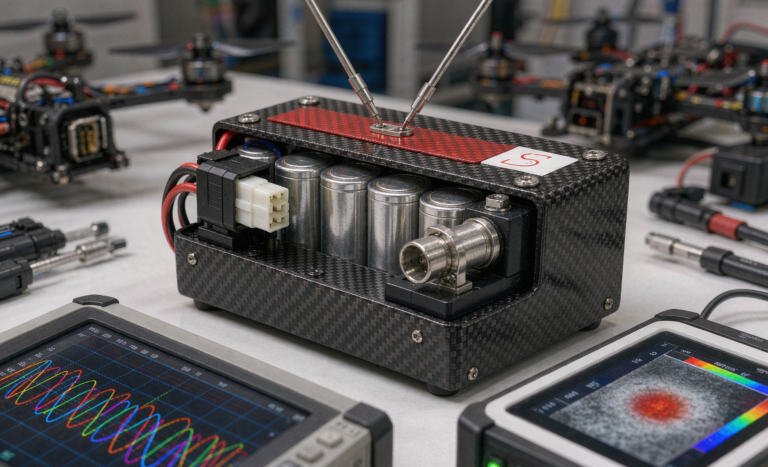
- Internal resistance per cell (measured on the charger or a dedicated IR meter) — the master health indicator.
- Cycle count — most quality race cells give 150–300 useful cycles before IR climbs out of spec.
- Capacity at end of charge — mAh returned during a full charge; a 15–20% drop from new means the pack is aging.
- Cell divergence at full charge — how far the cells spread apart.
- Peak temperature after a hard flight — measured with an IR thermometer; I want cells back under 45°C before recharging.
Trends matter more than any single reading. A pack whose IR jumps 30% between logs is telling you it is near the end, even if it still flies today.
Safety, Handling, and the Standards Behind Them
Every cell we ship is qualified to UN 38.3 for transport safety — the same test suite (altitude, thermal cycling, vibration, shock, external short) that governs how any lithium battery travels by air. Consumer race packs are also expected to meet the safety intent of IEC 62133. Understanding these standards changes how you maintain packs at home:
- Transport: Move packs at storage charge, terminals protected, in a fire-resistant bag. This mirrors the UN 38.3 short-circuit and thermal requirements.
- Charging supervision: IEC 62133’s abuse testing exists because unattended charging is the most common failure trigger. Never walk away from a charging pack.
- End of life: A swollen or heavily damaged pack is a thermal-runaway risk. Discharge it fully into a salt-water bath or hand it to a proper battery recycler — never the household trash.
Pilots who travel to events should also note that aviation authorities such as the FAA and EASA cap loose lithium packs by watt-hour rating in carry-on baggage, and packs must be individually protected against short circuit. A tidy maintenance kit is also a compliant travel kit.
A Practical Weekly and Seasonal Maintenance Schedule
Here is the cadence I recommend to the racing teams we support:
- Every flight day: Physical inspection, balance charge, log peak temperature, discharge to storage that night.
- Weekly (if flying regularly): Measure and log IR and cell divergence for each pack; pull any outlier from the race rotation.
- Monthly: Do a full capacity check; retire packs that have lost more than 20% capacity or crossed your IR threshold.
- Off-season: Store all packs at 3.85 V in a cool, fire-safe location; check resting voltage every 4–6 weeks.
This is the same disciplined framework we apply when engineering a custom battery solution for a commercial fleet — the scale changes, the fundamentals do not.
Frequently Asked Questions
How often should I balance charge my racing drone battery?
Every single charge. Balancing is not an occasional maintenance task for high-C-rate packs — it is how you catch a weakening cell before it drags the whole pack down. I want cells within 0.01–0.02 V at end of charge, and I investigate any pack that drifts beyond that.
What internal resistance is too high for a race pack?
It depends on the cell, but as a rule of thumb, once a cell’s IR roughly doubles from its new value — commonly crossing 8–10 milliohms per cell on a typical 1300 mAh race cell — I retire it from racing. It can still serve in low-demand applications, but it will sag too much under race loads.
Can I leave my drone lithium battery fully charged overnight before a race?
Avoid it. A LiPo held at 4.2 V ages roughly twice as fast as one at storage voltage, and full charge overnight also means an unattended pack for hours — a safety risk. Charge in the morning, or charge to storage the night before and top up on race day.
My pack is slightly puffy but still works. Is it safe?
No. Any visible swelling means internal gas generation and a compromised cell. It may fly a few more times, but the risk of venting or thermal runaway rises sharply. Retire and safely dispose of any swollen pack — no exceptions in my shop.
How many cycles should a good racing battery last?
With the maintenance discipline in this guide, a quality race pack typically delivers 150–300 useful cycles before its internal resistance climbs out of race spec. Poor charging habits and hot storage can cut that in half. Your log will tell you the real answer for your packs.
Final Thoughts From the Bench
Racing is hard on hardware, and the drone battery takes the worst of it. But nearly every premature pack failure I have analyzed traces back to a maintenance shortcut: charging hot, storing full, skipping the balance, or ignoring a rising internal-resistance trend. Build the routine, keep the log, and respect the standards behind the chemistry. Do that, and your drone lithium battery packs will stay fast and safe far longer than the pilots around you expect. If your team needs packs engineered for a specific race platform, that is exactly the kind of custom battery solution my group builds every day.