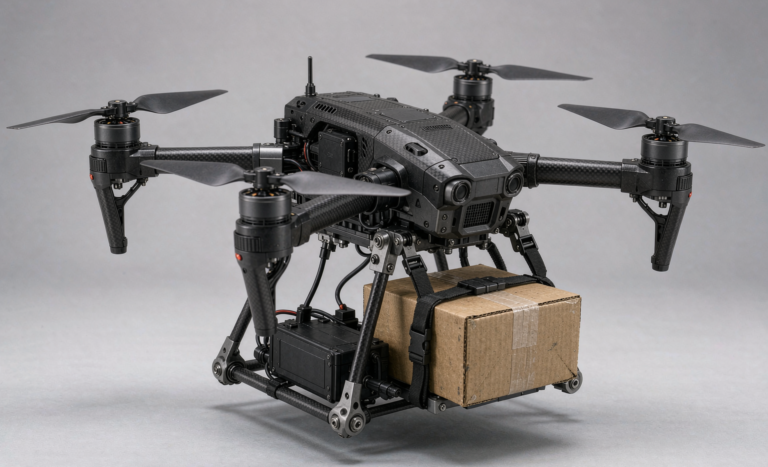
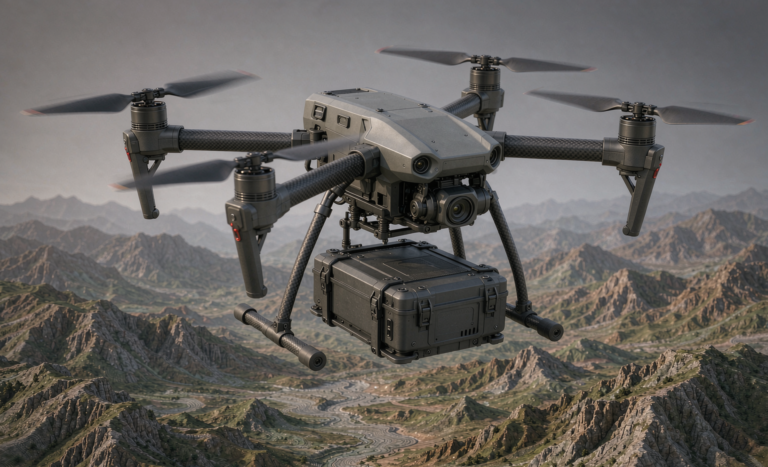
Drone Battery Design for Inspection UAVs
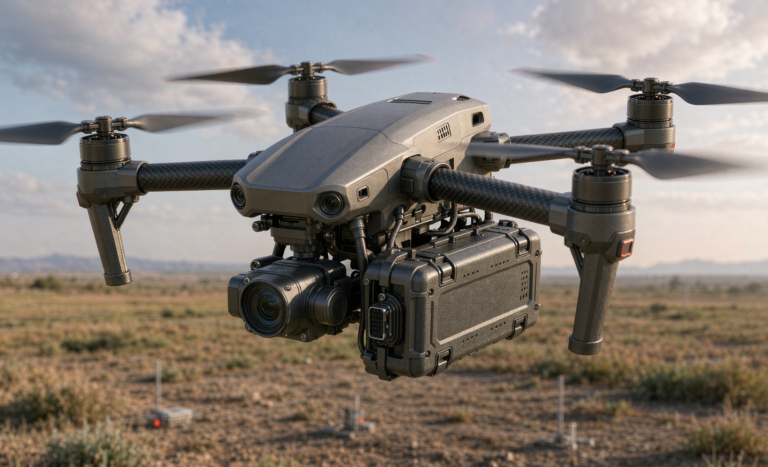
As a senior lithium battery engineer at Horizon Power, I have spent the better part of a decade designing power systems for commercial unmanned aerial vehicles. Inspection UAVs — the kind that fly power-line corridors, cell towers, pipelines, and rooftops — place a peculiar set of demands on a drone battery. They hover for long stretches, they carry sensitive and expensive payloads, they operate in dust, salt fog, and weather, and they are flown by operators who care about one number above all: how long can I stay airborne and still come home safe. In this article I walk through the actual design process we use to turn those field requirements into a certified drone lithium battery pack. If you are specifying a custom battery solution for an inspection airframe, the framework below is the same one we hand to our own mechanical and firmware teams.
1. Capturing the Mission Profile Before Any Cell Is Chosen
Every credible drone battery design starts in a spreadsheet, not on a bench. Before we select a single cell we capture the mission profile: hover duty cycle, forward-flight bursts, payload mass, expected wind, and the ambient temperature band the aircraft must survive. A typical infrastructure-inspection quad — say a 2.5 kg airframe carrying a 600 g gimbal and LiDAR — loiters at roughly 60–70% throttle and needs a 30–38 minute mission with a 20% reserve. That reserve is non-negotiable: inspection sites are rarely next to a landing pad.
From the mission profile we build an energy budget. Loiter power for that airframe is around 380 W; climb and reposition add peaks near 900 W. Integrating the duty cycle over a 35-minute flight lands us at roughly 230 Wh of usable energy. Accounting for the 80% depth-of-discharge we allow on a lithium battery pack, the nameplate capacity comes out near 290 Wh. That single number — not a catalog spec — drives everything downstream.
2. Weight Budget and Form-Factor Trade-Offs
On an inspection airframe, pack mass is stolen directly from payload. Our rule of thumb is that the drone lithium battery should sit between 22% and 30% of takeoff weight; beyond that, flight time stops improving because the extra cells cost more energy to lift than they deliver. For a 2.5 kg quad, that caps the pack near 650–750 g.
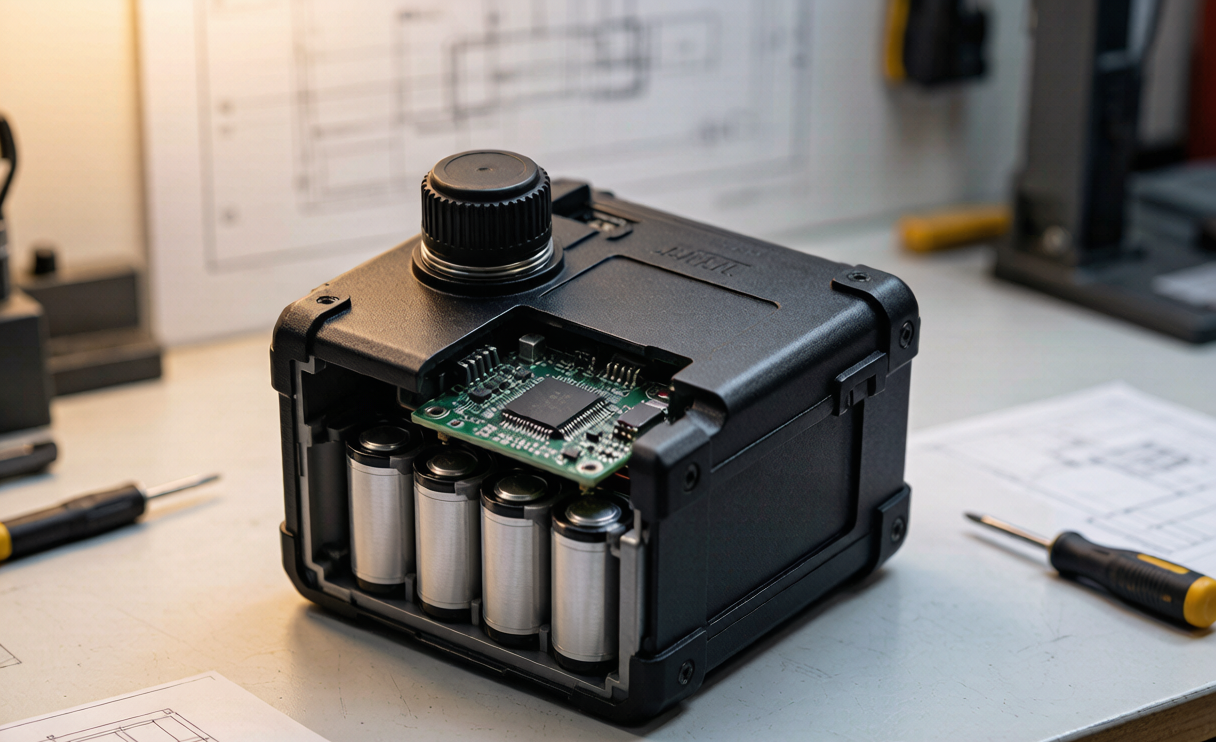
Form factor is the next fork. Pouch cells give the highest volumetric energy density and can be shaped to odd airframes, but they are fragile and swell under abuse — a poor match for field-swapped packs. Cylindrical 21700 cells are heavier per watt-hour yet survive vibration, puncture, and repeated insertion far better. For inspection work we almost always choose 21700 cylindrical cells and accept the small weight penalty, because a pack that fails on the third swap is worse than a pack that is 40 g heavier.
3. Cell Topology: Series, Parallel, and Why Hover Matters
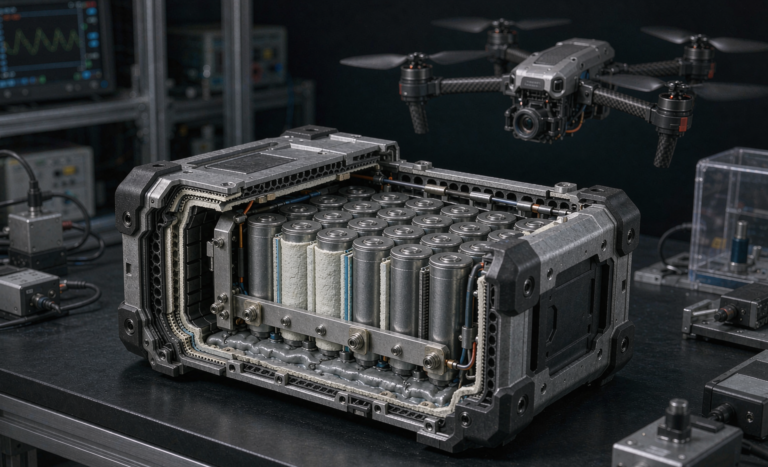
Hover is a sustained, high-current draw, and that changes how we wire the pack. A 6S configuration (roughly 22.2 V nominal) is the sweet spot for most inspection quads because it keeps phase currents reasonable for the electronic speed controllers. The parallel count is where the engineering lives: more parallel groups mean lower per-cell current, lower DCIR heating, and longer cycle life.
For the 290 Wh target we landed on a 6S3P of 4,500 mAh 21700 cells — about 97 Wh per parallel group, 290 Wh total. At loiter the pack pulls roughly 17 A, so each parallel group carries only ~5.7 A, well inside the cell’s continuous rating. That margin is why a well-designed custom battery solution outlasts a generic pack: we size the parallel groups to the hover current, not the burst current, and let the burst headroom take care of itself.
4. BMS Architecture for Inspection Reliability
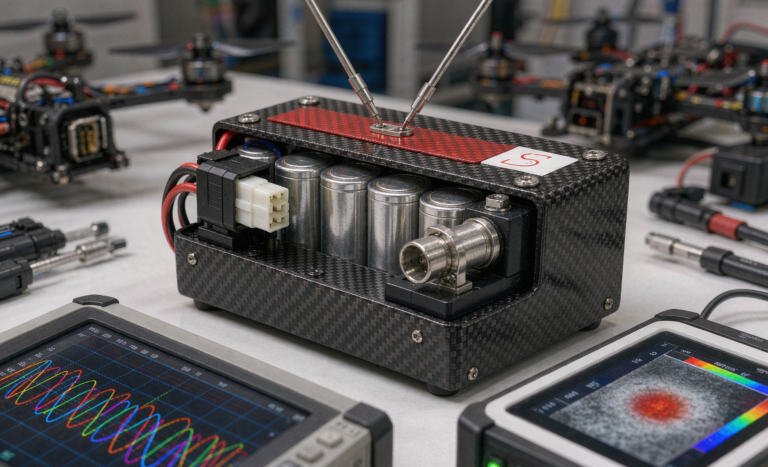
An inspection aircraft has no pilot to feel a puffed cell or smell overheating, so the battery management system has to be the co-pilot. We specify a two-tier protector: a primary analog fuel-gauge IC for balancing and coulomb counting, plus a secondary hardware protector that hard-disconnects on over-voltage, under-voltage, or over-temperature. Redundancy here is not optional — a single-point BMS fault over a pipeline right-of-way is a lost airframe and a lost day of survey.
Communication matters too. The pack speaks SMBus to the flight controller so the ground station can show state-of-charge, cell delta, and cycle count in real time. After a season of flights we pull that log to spot a single weak parallel group before it becomes a field failure. This is the quiet advantage of a purpose-built drone battery: the data outlives the flight.
5. Thermal and Mechanical Ruggedization
Inspection routes run through coastal spray, desert heat, and winter roofs, so the enclosure is a design object in its own right. We pot the BMS in conformally coated resin, seal the shell to IP54 as a baseline (IP67 for coastal or agricultural variants), and isolate the cells from the airframe with a damped mounting frame that absorbs landing shock and rotor vibration. Vibration is the silent killer of lithium battery packs — it loosens welds and fatigues tabs — so we validate every design on a shaker table to at least 3 hours per axis before it leaves the lab.
Thermally, we design the pack to stay below 45 °C at the cell surface under sustained loiter, using the aluminium enclosure itself as a heat spreader. If the math says we exceed that, we add a phase-change pad rather than derating the mission, because inspection operators will not fly a “reduced performance” mode.
6. Connectorization, Swappable Design, and the Certification Path
Field crews swap packs between flights, so the connector has to be foolproof. We use a locking, polarized connector with a separate signal header so a pack cannot be inserted backwards and the BMS handshake is verified before arming. Hot-swap variants add a tiny supercapacitor so the flight controller keeps its clock through a battery change — a small touch operators notice immediately.
Certification is designed in from day one, not bolted on at the end. Every inspection drone lithium battery we ship clears UN38.3 for air and ground transport, IEC 62133-2 for secondary-cell safety, and we size packs to sit under the 100 Wh carry-on threshold where the operator’s workflow demands it; larger custom battery solution packs bound for EASA or FAA Part 137 operations are documented against the relevant 100 Wh shipping and field rules so the operator is never surprised at a checkpoint. Building to those standards early is cheaper than re-spinning a pack that already passed flight test.
What a Good Inspection Battery Design Buys You
Done right, the design work above is invisible. The operator just sees “37 minutes, green across the board” and swaps to a fresh pack without thinking. That is the goal: a drone battery engineered so tightly to the mission that the only thing the field team notices is that it keeps showing up. At Horizon Power we treat every inspection pack as a custom battery solution first and a product second, because the airframe — not the catalog — sets the spec.
How do I size a drone battery for a specific inspection mission?
Start from the energy budget, not a catalog number. Capture loiter power, burst peaks, payload mass, and required reserve, integrate over the full flight, then divide by your allowed depth-of-discharge (we use 80% on a lithium battery pack). For a typical 2.5 kg inspection quad with a 600 g payload, that lands near 290 Wh nameplate. Size the pack mass to 22–30% of takeoff weight and let the cells fill the rest.
Should inspection UAV batteries use cylindrical or pouch cells?
For field-swapped inspection packs we recommend cylindrical 21700 cells. Pouch cells win on energy density and shape freedom but swell and dent under abuse; cylindrical cells survive vibration, puncture, and repeated insertion far better. The small weight penalty is worth the reliability on a drone battery that gets swapped in the field.
What IP rating is realistic for an inspection drone battery?
IP54 is a solid baseline for dust and splashing; choose IP67 for coastal, agricultural, or heavy-rain inspection work. Sealing also protects the BMS, so we pot it in conformal resin regardless of rating. Match the rating to the routes the aircraft actually flies rather than over-specifying weight you do not need.
Do inspection drone batteries need UN38.3 and IEC 62133 certification?
Yes. UN38.3 covers transport (air and ground) and IEC 62133-2 covers secondary-cell safety; both are expected by operators and carriers. If the pack exceeds 100 Wh, plan for the FAA and EASA shipping and field rules up front so the operator is never blocked at a checkpoint. A certified drone lithium battery is cheaper than a recalled one.
How does a custom battery solution reduce total cost versus an off-the-shelf pack?
An off-the-shelf pack is sized for a generic airframe, so you either carry dead weight or run short on reserve. A custom battery solution matches the parallel groups to your hover current, trims mass to your payload budget, and adds the connector and BMS features your workflow needs — fewer swaps per mission, longer cycle life, and fewer lost-flight days. Over a season that beats a cheaper pack by a wide margin.