Drone Battery Performance for Racing Drones: Keeping Every
Most pilots judge a racing drone battery by its capacity and its burst C-rate printed on the label. After more than a decade engineering competitive packs, I can tell you that those two numbers explain maybe half of what actually happens on the track. The other half is what I call race-day consistency: the ability to launch the same punch on your first heat at 9 a.m. and your last heat at 5 p.m., with every pack in your case behaving identically. This is the part of drone battery performance that separates a clean podium run from a mid-pack surprise.
In this article I will walk through the engineering discipline my team uses to keep a whole set of drone lithium battery packs at peak across an entire race day: internal-resistance recovery between heats, correct storage charge, pack rotation, a warm-up protocol, safe between-heats charging, and a pre-flight performance gate. These are the same principles we bake into every custom battery solution we ship to racing programs.
Why Race-Day Performance Is Not Just About Capacity
When a quadcopter accelerates out of a corner, it does not draw watt-hours, it draws watts. The metric that matters in that instant is specific power (W/kg), not specific energy (Wh/kg). A 6S 1300 mAh LiHV pack at 22.2 V nominal can briefly deliver 60–70 C, which is well over 1,700 W from a pack that weighs under 200 g. That burst is what keeps the props spun up through a hard split-S.
But specific power is hostage to internal resistance (IR). As IR climbs, more of that energy is burned inside the cell as heat instead of reaching the motors. So drone battery performance on race day is really a story about keeping IR low and predictable — which is an engineering problem, not a label-reading problem.
The chemistry underneath matters here too. A modern drone lithium battery built on high-load NMC or LiHV blends is tuned for exactly this transient delivery, but only if the cell is healthy. I have seen two packs with identical mAh labels post 40% different punch simply because one had a few extra milliohms of age-related resistance. That is why every number in this article is a resistance number first and a capacity number second.
The Internal-Resistance Recovery Window Between Heats
Here is the detail most pilots miss. Immediately after a 4-minute heat, a pack’s voltage reads low and its IR reads high because the electrolyte and electrodes are hot and partially depleted. If you throw it straight back on the charger, you are working against a cell that has not recovered.
In my bench data across hundreds of 6S LiHV packs, IR measured right after a heat can be 15–25% higher than its resting value, and it takes roughly 20–30 minutes at ambient temperature to settle back. During that window the same pack will sag harder and punch softer than it did in the previous heat. The fix is simple: build a rotation so no pack flies again inside its recovery window. A lithium battery that is allowed to rest will return nearly all of its punch.
Storage Charge: Why a Racing Pack Should Never Sit at Full
A surprising number of race-day problems start the night before. A pack charged to 4.35 V/cell (LiHV full) and left sitting for 12–24 hours undergoes accelerated voltage relaxation and mild chemical stress that raises resting IR the next morning. The convention I enforce is to arrive at the field with packs at storage charge of 3.80–3.85 V/cell, then top up to race voltage only an hour before the first heat.
This single habit keeps every drone lithium battery in the case starting from the same baseline, which is what makes the rotation predictable. It also extends cycle life, because a cell held at peak state-of-charge for long periods ages faster.
Pack Rotation and Consistency Across Your Race-Day Set
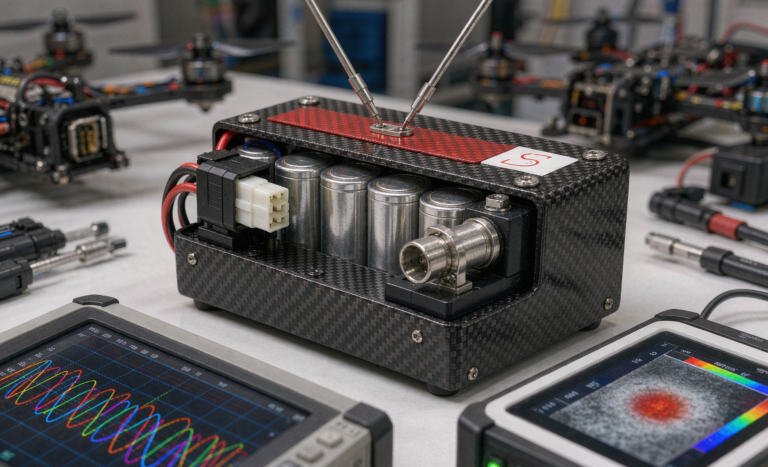
The goal of rotation is not just recovery time, it is parity. If pack A has an IR of 9 mΩ and pack B has 13 mΩ, your lap times will wander depending on which one you grab. Before a race weekend I match every pack in the set to within about 1 mΩ of each other at a standardized 25 °C, 50% state-of-charge reference. That way the drone feels identical no matter which pack clicks in.
Rotation order should be logged. I label packs 1–6 and fly them in sequence, giving each a minimum 25-minute rest. This turns drone battery performance from a lottery into a schedule you can trust.
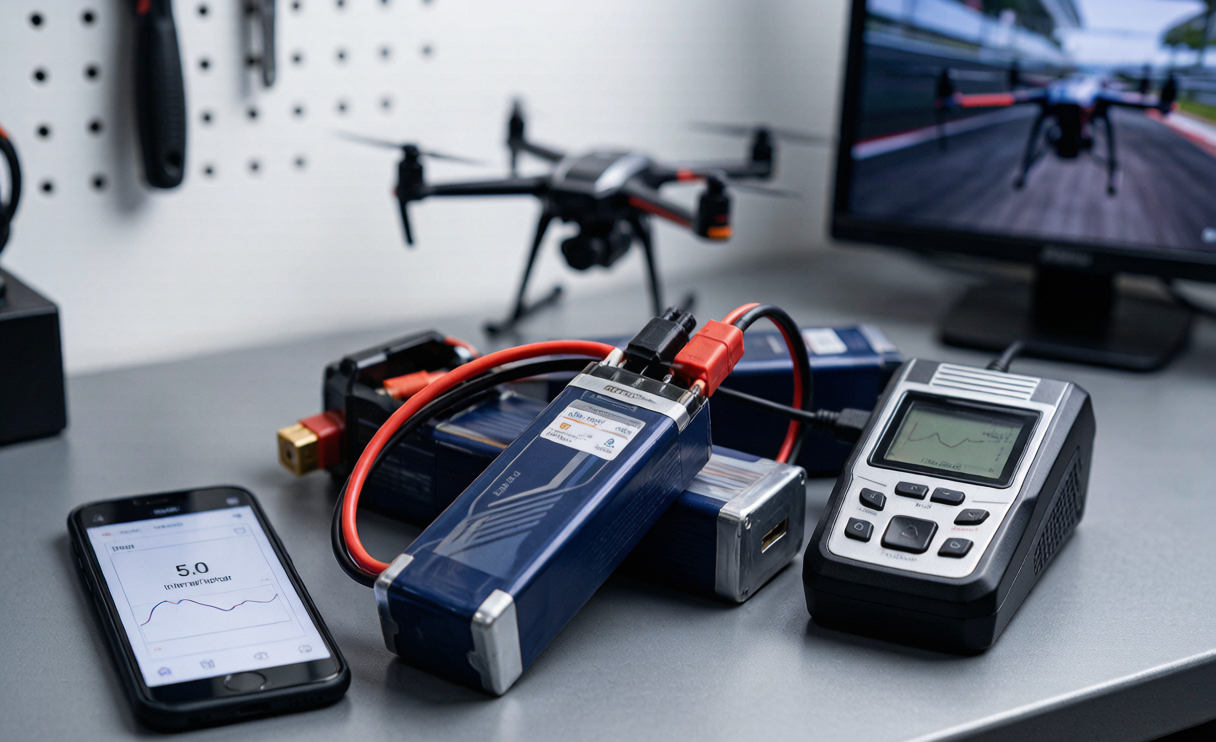
I also keep a simple telemetry sheet: after each heat I log pack temperature, resting voltage, and the IR reading from the charger’s internal-resistance screen. Over a season this builds a fingerprint for every lithium battery in the set, so a pack that quietly drifts up in resistance gets pulled before it ever surprises me on the start line. The data is boring, but it is the difference between guessing and knowing.
The Warm-Up Protocol: Cold Packs Sag, Warm Packs Punch
Internal resistance is temperature-sensitive. A pack at 10 °C can show 30–40% higher IR than the same pack at 30 °C, which translates directly into sag and a softer launch. On cold mornings I keep packs in an insulated bag with a gentle warmer set to hold 25–30 °C, and I never fly a pack that reads below about 18 °C.
The warm-up is not about comfort, it is about chemistry. Lithium cells deliver their rated specific power only inside a narrow temperature band, and a lithium battery flown cold will underperform the label every time. A two-minute pre-flight warm-up at the bench recovers most of that lost punch.
Between-Heats Charging Without Cooking the Cells
Fast charging is tempting when the clock is tight, but charging a hot pack at 3–4 C traps heat and permanently raises IR. My rule is to let the pack cool to below roughly 35 °C, then charge at 1–2 C with a balance charge so each cell ends within a few millivolts. A proper balance at this stage is what preserves the parity I built into the set at the start of the day.
We also cap charge termination at 4.35 V/cell for LiHV and never “over-stuff” to chase a few extra seconds. The temporary gain is not worth the long-term IR creep, and it keeps the pack inside the envelope regulators recognize.
One more rule I enforce: never charge a drone lithium battery that still reads above 40 °C. The charger will happily push current into a hot cell, but the heat has nowhere to go in a sealed pack, and you trade a few saved minutes for a permanently softer pack. Patience between heats is part of the performance, not a delay to it.
A Pre-Flight Performance Gate I Run Every Heat
Before each heat I run a 30-second gate on every pack scheduled to fly:
- Resting voltage within 0.02 V/cell of the others in the set.
- IR within the matched tolerance (about 1 mΩ of the set average).
- Case temperature in the 22–32 °C band.
- No cell more than 0.03 V out of balance after charge.
- Visual: no swelling, no warm spot, no damaged lead.
If a pack fails any line, it drops to the end of the rotation. This gate is the practical expression of good drone battery performance discipline, and it has saved more than one race day from a surprise thermal cutoff.
How We Engineer Custom Packs for Repeatable Punch
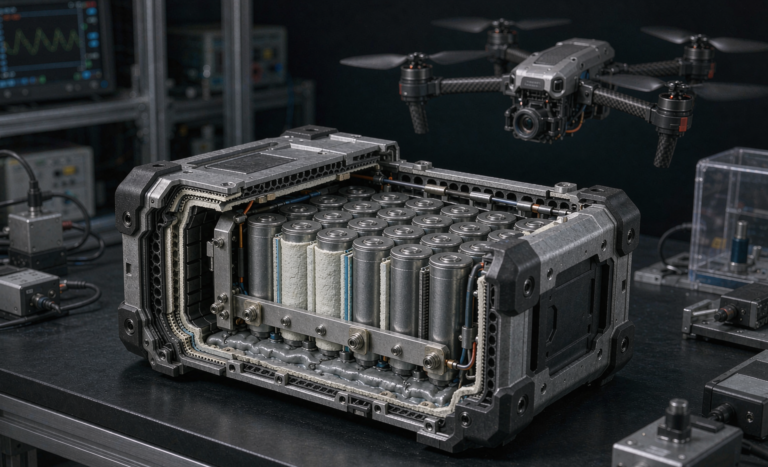
When a team comes to us for a custom battery solution, the brief is rarely “more capacity.” It is almost always “same punch, every time, all season.” We achieve that with tighter cell-matching at incoming inspection, lower-tolerance nickel busbars to cut pack-level IR, and a BMS-free racing topology where every milliohm of lead and weld is accounted for. We then certify the pack family to UN38.3 (T.1–T.8), IEC 62133-2, and keep the architecture inside the FAA/EASA 100 Wh carry-on threshold so the program can travel.
The result is a set where drone battery performance is a documented, repeatable spec rather than a hope. That is the difference engineering makes over a good label.
For teams that want to go further, we can embed a small telemetry tag in the custom battery solution so each pack reports its IR and cycle count back to the pit laptop. That closes the loop: the rotation, the warm-up, and the charge protocol all feed off live data instead of memory. It is the same discipline described here, just automated.
Frequently Asked Questions
How long should a racing drone battery rest between heats?
Give it at least 20–30 minutes at ambient temperature. That is the window in which internal resistance recovers after the heat, so the same pack will sag less and punch harder on the next flight.
What storage voltage should I use for race-day LiHV packs?
Hold them at 3.80–3.85 V/cell overnight and top up to race voltage about an hour before the first heat. This keeps resting internal resistance low and predictable the next morning.
Why does my drone battery perform worse on cold mornings?
Cold cells have higher internal resistance, so more energy is lost as heat inside the pack instead of reaching the motors. Keep packs in the 22–32 °C band with a gentle warm-up before flight.
Is it safe to fast-charge between heats?
Only after the pack has cooled below about 35 °C, and even then limit it to 1–2 C with a balance charge. Charging a hot pack at high rate permanently raises internal resistance.
How do I make every pack in my set feel the same?
Match them to within about 1 mΩ of internal resistance at a standardized temperature and state-of-charge, then rotate them on a logged schedule so each gets equal rest. Consistency is engineered, not accidental.