Drone Battery Reliability for Mapping UAVs: Lot
I am Karl Huang, a senior lithium battery engineer. Over the last eleven years I have qualified battery lots for survey and photogrammetry operators who fly the same corridor every week and cannot afford to re-fly it. Most reliability conversations with mapping teams start in the wrong place: they ask which pack is “the most reliable.” That question has no answer, because reliability is not visible on a spec sheet. It is a statistical statement about a population of packs, measured against a defined mission, at a defined confidence level.
This article covers the part of drone battery reliability that operators almost never build: the incoming qualification system. Not how to fly a pack carefully, but how to decide whether a shipment of 300 or 500 packs is fit to enter your fleet at all — sample sizing, Weibull life-data analysis, the four incoming measurements that catch most bad cells, burn-in strategy, and the supplier feedback loop.
Why Mapping UAVs Need a Statistical View of Drone Battery Reliability
A mapping mission is unusually unforgiving because the deliverable is a contiguous dataset. A racing pilot who lands early loses a heat. A survey operator who lands early at 68% coverage loses the whole block: the remaining strips get flown under a different sun angle, and the photogrammetric bundle adjustment carries that seam forever. The cost of one aborted sortie is not one battery — it is a mobilisation.
So the right metric for a mapping fleet is not mean time between failures. MTBF assumes a constant hazard rate, and lithium cells do not have one. What matters is mission reliability: the probability that a randomly selected pack completes a defined mission profile without dropping below cutoff voltage or triggering a battery management system fault.
I define it concretely before any qualification work begins. For a typical fixed-wing survey platform running a 6S drone lithium battery at 16 Ah, the mission profile I write into the qualification plan looks like this: 45 seconds at 4.5 C for launch, 26 minutes at an average 0.85 C in cruise, a 90-second 2 C loiter reserve, and a landing with no cell below 3.55 V under load at 15 degrees Celsius ambient. That profile is the contract. Every number that follows in this article is measured against it.
Once the mission is defined, the target becomes writable: I specify 0.998 mission reliability at 60% confidence for a new lot and hold the supplier to it. That moves the quality gate upstream of the flight line.
Building the Qualification Plan: Sample Size, AQL, and What “Pass” Really Means
The first mistake I see is testing three packs out of a 500-pack shipment and calling it a qualification. Three samples say almost nothing about the tail of the distribution — and the tail is where your aborted sorties live.
I use attribute sampling per ISO 2859-1 for the non-destructive screen. For a lot of 501 to 1200 packs at General Inspection Level II, the standard gives code letter J and a sample size of 80; at an acceptance quality limit of 1.0, that is an accept number of 2 and a reject number of 3. In plain terms: pull 80 packs, and if 3 or more fail the incoming screen, the lot goes back.
Layered on top of that, I run a smaller destructive and life-test cohort:
- Life cohort: 8 packs. Cycled to end-of-life at the mission profile above, not at a lazy 0.5 C laboratory rate. This cohort feeds the Weibull analysis below.
- Abuse cohort: 3 packs. Confirms the design still matches the certification file — overcharge, external short, and forced discharge per IEC 62133-2, plus thermal and vibration checks against the UN 38.3 T1 through T8 sequence.
- Reference cohort: 2 packs. Never flown. Stored at 30% state of charge and 15 degrees Celsius, re-measured every six months as the lot’s drift baseline.
One clarification on standards, because it causes real confusion in procurement documents. UN 38.3 is a transport qualification tied to a design, not a per-lot test. You re-run T1 through T8 when the cell, the pack construction, or the protection circuit changes — and you demand a test summary naming the exact cell model and revision. If the certificate’s cell revision does not match the cells in the box, the lot is unqualified regardless of bench performance.
The transport arithmetic matters for mapping teams, because survey work travels. A 6S 16 Ah pack is 22.2 V times 16 Ah, roughly 355 Wh — above the 160 Wh ceiling for passenger baggage entirely, so it moves as Class 9 dangerous goods. Only packs under 100 Wh travel easily, and the 100 to 160 Wh band needs explicit airline approval with a two-spare limit.
Reading Weibull Life Data From a Drone Lithium Battery Lot
The eight-pack life cohort is where a qualification stops being a formality. I fit a two-parameter Weibull distribution to cycles-to-80%-capacity, and the shape parameter beta tells me what kind of failure population I have bought.
Beta below 1 means infant mortality: a falling hazard rate, and the defects are manufacturing defects. Beta near 1 means random failures. Beta above 1 means wear-out, which is what a healthy lithium battery population should show, because cell aging is a physical accumulation process, not a coin flip.
On a recent lot of high-quality 16 Ah pouch cells built for survey duty, I measured a characteristic life eta of 520 cycles with a shape parameter beta of 4.2. That beta is comfortably in the wear-out regime, which is the answer I want. From those two parameters, the B10 life — the cycle count at which 10% of the population has reached the 80% capacity threshold — works out to roughly 304 cycles. That is the number that goes into the fleet replacement budget, not the 520.
Two practical rules I apply to Weibull output:
- Plan on B10, never on eta. Eta is the 63.2% failure point. If you budget replacements against eta, you spend a third of the pack’s service window flying degraded hardware and blaming the wind for your short sorties.
- Treat beta below 2 as a supplier problem, not a usage problem. A beta of 1.3 on a lithium cell population means the spread of manufacturing quality is dominating the physics of aging. No amount of storage discipline fixes that. It means cell sorting upstream is loose, and it is the single most useful piece of feedback you can hand a manufacturer.
I fit DCIR growth separately, because capacity fade and resistance growth do not track each other. In my fleet data, packs reach the +40% DCIR retirement threshold before 80% capacity — usually cycle 240 to 280 on the profile above. For mapping, resistance growth is the more dangerous of the two: it shows up as voltage sag during the launch transient, so the pack looks fine on a capacity check and then browns out the autopilot at rotation.
Incoming Inspection: Four Measurements That Catch Most Bad Cells
The 80-pack attribute sample gets a fixed four-measurement screen. I have run variations of this screen across thousands of packs, and these four catch the overwhelming majority of units that would have caused a field event.
1. Open-circuit voltage spread within the pack. Measured at receipt, before any cycling. I reject any pack whose cell-to-cell spread exceeds 10 mV at rest. A well-sorted pack from a competent line arrives inside 5 mV. A 40 mV spread on arrival is a sorting failure, and it will not balance out; the pack will simply spend its life with one cell hitting the cutoff first.
2. Capacity against nameplate. One full mission-profile discharge at 25 degrees Celsius. I accept minus 2% of nameplate and no more. Suppliers routinely nameplate optimistically at a 0.2 C rate, which is meaningless for a drone battery that never sees 0.2 C. Specify the rate in the purchase order or the number is decorative.
3. DCIR by 10-second pulse at 50% state of charge. A 1 C pulse, resistance calculated from the voltage step. On the 16 Ah cells I referenced above, healthy per-cell DCIR sits near 2.4 mΩ, giving a pack figure in the mid-teens of milliohms for a 6S string. I flag anything more than 15% above the cohort median, even if it passes an absolute limit, because an outlier at receipt is an outlier that grows.
4. Self-discharge K-value. The measurement most operators skip, and the one that catches latent internal shorts — the defect class behind most thermal events. Charge to 50% state of charge, rest 14 days at 25 degrees Celsius, measure the OCV drop per day. Above roughly 1.0 mV per day, or a total drop above 15 mV, the cell goes. Run it in parallel with the rest of the qualification and it costs nothing on the critical path.
Burn-In and Reliability Growth: Turning Infant Mortality Into Data
If the Weibull fit shows any infant-mortality component — and on mid-tier lots it usually does — burn-in is how you pay for it before the pack reaches a survey site.
My standard burn-in for mapping packs is three formation cycles at the mission profile, a 48-hour rest at 50% state of charge, and then a repeat DCIR pulse. The comparison between the receipt DCIR and the post-burn-in DCIR is the useful output. A pack whose resistance climbs more than 8% across three cycles is telling you something about its electrode wetting or its tab welds, and it will not improve.
Across the lots I have processed, burn-in plus the four-measurement screen removes roughly 70% of the units that would otherwise have produced an early field event. Not all of them — latent tab-weld defects can survive three cycles and surface at cycle 40. That residual is why fleet-level monitoring still matters, and why I keep the two-pack reference cohort untouched as a drift baseline.
Burn-in has a second benefit specific to survey work: formation cycles let the BMS learn a realistic capacity baseline before the pack flies a paid job. A pack entering service with a stale factory estimate reports remaining-time figures that are wrong in the direction that costs you coverage.
Closing the Loop: RMA Forensics and Supplier Scorecards
A qualification system that only says yes or no to lots wastes most of its own data. The higher-value output is the feedback loop to the manufacturer.
Every pack that leaves my fleet early gets a teardown record with five fields: cycle count, capacity and DCIR at removal, failure mode class, and cell lot code. Four classes cover nearly everything in mapping fleets: imbalance beyond BMS balancing authority, single-cell high resistance, connector or tab mechanical failure, and swelling from gas generation. The distribution across those four points at completely different root causes — and different conversations with the supplier.
A concrete example from a fleet I support: 240 packs, 18 months, roughly 11,400 logged flights, 9 pack-level events that ended a sortie — a per-flight event rate of about 0.079%. Of those 9, six were single-cell high resistance traced to two adjacent cell lot codes, and that finding, not the aggregate rate, let the manufacturer isolate a calendering issue on one line. Aggregate numbers are for your board; lot-code-resolved failure modes are for your supplier.
This is also where a custom battery solution earns its cost premium over a catalogue pack. When the cell lot codes are traceable, when the pack construction is documented, and when the protection circuit thresholds are set for your mission profile rather than a generic one, the feedback loop actually closes. With an anonymous catalogue pack it cannot: you have no lot traceability, so every failure is an isolated anecdote.
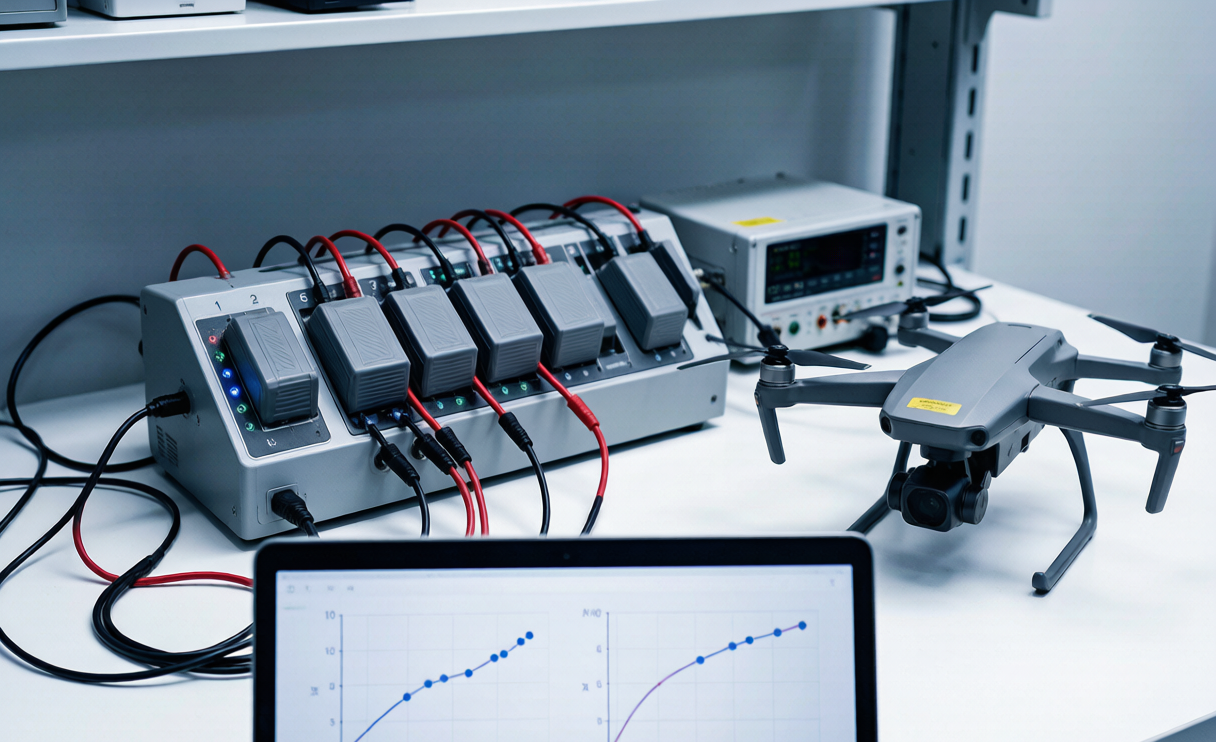
If you are standing this up from nothing, build it in order of return: write the mission profile, add the OCV spread check, add mission-profile capacity verification, add DCIR pulse testing, then add the self-discharge screen and the life cohort. None of it requires a laboratory — a multi-channel cycler, a calibrated meter, a temperature-controlled cabinet, and a spreadsheet with a Weibull fit will run the whole programme. The hard part is organisational: someone has to own the gate and be allowed to reject a lot the schedule wants to accept.
Frequently Asked Questions
How many packs do I need to test to make a real reliability claim?
For attribute screening on a 500-pack lot, ISO 2859-1 Level II gives 80 samples with an accept number of 2 at AQL 1.0. For life data, eight packs is the practical minimum for a usable two-parameter Weibull fit; below six, the confidence bounds on the shape parameter get misleadingly wide. If you can only afford one cohort, choose the life cohort — it reveals the failure mechanism, not just today’s defect rate.
Is MTBF a useful number for a drone battery?
Not really. MTBF assumes a constant hazard rate, and lithium cells have a hazard rate that changes with cycle count and calendar age. A Weibull shape parameter above 1 is direct evidence the constant-hazard assumption is wrong. Use mission reliability at a stated confidence level and B10 life instead. If a supplier quotes MTBF for a drone lithium battery, ask how it was derived — usually it is converted from a cycle-life claim, which discards the information you need.
Does UN 38.3 certification mean this shipment is reliable?
No. UN 38.3 is a transport safety qualification on a design, confirming the pack survives altitude, thermal cycling, vibration, shock, external short, impact, overcharge, and forced discharge. It says nothing about cycle life, capacity consistency, or lot-to-lot quality. IEC 62133-2 likewise addresses safety, not longevity. Both are necessary; neither is a reliability qualification — which is why the incoming screen exists.
What DCIR growth should trigger retirement on a mapping fleet?
I retire at +40% over the receipt baseline, weighting resistance growth more heavily than capacity fade. Resistance growth appears as voltage sag during the high-current launch transient — a brownout risk rather than a coverage risk. In my fleet data, packs hit +40% DCIR around cycle 240 to 280 under a survey profile, well before the 80% capacity threshold.
Can I skip the 14-day self-discharge screen?
You can, but it is the screen that catches latent internal shorts — the defect class behind most thermal events. Run it in parallel with capacity and DCIR testing on the same 80-pack sample and it costs no critical-path time, only cabinet space. If 14 days is truly impossible, a 7-day window at 35 degrees Celsius accelerates the drift enough to catch the worst offenders, with reduced sensitivity to marginal cells.
Do I need a custom pack, or will a catalogue drone battery do?
For occasional flying, catalogue packs are fine. For a fleet where an aborted sortie costs a mobilisation, a custom battery solution buys three things a catalogue pack cannot: cell lot traceability so failures resolve to a root cause, protection thresholds matched to your mission profile, and a documented pack construction that makes teardown findings actionable. The premium is usually recovered in the first avoided re-fly.
About the author: Karl Huang is a senior lithium battery engineer with over a decade of experience in high-discharge pack design, qualification testing, and fleet reliability engineering for unmanned aerial systems.