Drone Battery Cost Optimization for Delivery Drones (4)
As Karl Huang, Senior lithium battery Engineer at Horizon Power, I have spent the last decade designing the drone battery packs that keep delivery fleets in the air. When a logistics operator asks me how to cut the cost of their program, the instinctive answer – “buy cheaper cells” – is usually wrong. The real lever is the ownership model. This article takes a fifth, often-overlooked angle on drone battery cost optimization for delivery drones: shifting from capital-intensive battery ownership to a metered Battery-as-a-Service (BaaS) model, where cost follows flight-hours instead of sitting on the balance sheet. After running four prior lenses on this topic – total-cost-of-ownership, design-for-cost, charging infrastructure, and fleet inventory rotation – the financing model is the one that changes the math most for a growing operation.
Why Capex Ownership Hides the True Cost of a Delivery Drone Battery
The sticker price of a drone lithium battery is the smallest part of what it really costs. A 6S pack rated for delivery duty lands at roughly 90-130 Wh, and a realistic per-pack cost including the BMS, ruggedized enclosure, and certified assembly sits around 200-240 USD. But that number ignores four hidden loads.
- Certification amortization. Every production lot must hold UN 38.3 (T.1-T.8) and IEC 62133-2 evidence. That compliance work is a recurring cost, not a one-time fee, and it is baked into every pack you own.
- Working capital. A 50-drone fleet running two packs each plus 15% spares ties up roughly 100,000-120,000 USD in inventory that depreciates the moment it ships.
- Degradation liability. A pack retired at 80% state-of-health still carries a disposal and recycling cost, and under IEC 62619 stationary-adjacent handling rules that cost is yours.
- Obsolescence mismatch. Accounting may depreciate packs over three years, but in hard daily delivery duty a pack often hits its 80% capacity floor in 18-24 months. The book value and the real value diverge, and the gap is a silent cost.
When I model a fleet for a client, I never quote the cell price. I quote the fully-loaded cost per delivered flight-hour, because that is the number that actually scales with the business.
What Battery-as-a-Service Means for a Delivery Fleet
Battery-as-a-Service flips the relationship. The manufacturer (or a financing partner) retains ownership of the lithium battery assets. The operator pays per cycle, per flight-hour, or per delivered package, and the vendor handles conditioning, swaps, and replacement at the depot. In practice the model works like this:
- The operator receives a pool of qualified packs and returns them at end of shift.
- A depot station conditions, balances, and reissues packs so every drone leaves with a known-good battery.
- Billing is metered against telemetry, not against a purchase order.
- Uptime is contractually backed – if a pack fails within SLA, the vendor replaces it at no charge.
For a delivery startup trying to scale from 10 to 200 aircraft, this is transformative. The battery line item moves from a capital request that needs board approval to a predictable operating expense. A custom battery solution can still be specified per fleet – BaaS is a financing and service wrapper, not a compromise on pack design.
Building the Telemetry and Health Model That Makes BaaS Work
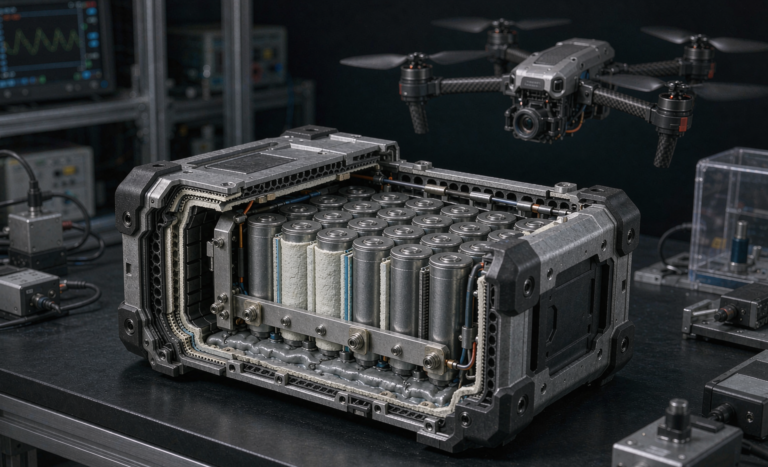
Metered billing only works if the health number you bill against is trustworthy. At Horizon Power we instrument every service pack with a four-channel telemetry capture – terminal voltage, current, cell temperature, and AC impedance – logged at 2-10 Hz during mission and at the depot.
That data feeds a state-of-health (SoH) estimate that drives both retirement and pricing. Our retirement gates are concrete:
- DCIR creep above 0.4 mΩ per 20 cycles triggers a review.
- Usable capacity below 80% of nameplate retires the pack from aviation duty.
- A self-discharge K-value above 2.5 mV/day flags a soft internal fault.
- Inter-group thermal spread beyond 8 ℃ on a 6S3P block indicates a failing parallel group.
Because pricing is tied to delivered capacity rather than wall-clock time, an operator is never billed for a pack that has quietly aged out. The same IEC 62133-2 and FAA/EASA 100 Wh air-transport band discipline that governs owned packs applies here – the service model changes who pays, not the safety bar.
Converting Capex to Opex: A Worked 50-Drone Fleet Example
Numbers make the tradeoff concrete. Consider a 50-drone delivery operation flying two hours a day, 300 days a year, over a three-year horizon.
Ownership model. 100 active packs plus 15 spares at 220 USD each is 25,300 USD of capex. Annual attrition at 20% adds roughly 6,000 USD/year in replacements, 18,000 USD over three years. Add disposal at about 1,200 USD, working-capital carrying cost near 1,500 USD, and the three-year total-cost-of-ownership lands around 42,400 USD.
Battery-as-a-Service model. At 0.55 USD per flight-hour across 90,000 flight-hours (50 aircraft x 2 hours x 300 days x 3 years), the nominal bill is about 49,500 USD. On paper that is higher – and that is the honest answer. BaaS is rarely the cheapest option when you ignore risk.
But owned packs also carry downtime risk. In my field data, a hard pack failure mid-route grounds a drone and can cost 1,500-4,000 USD in lost deliveries and recovery per event. Two such events a year over three years is 9,000-24,000 USD of avoided loss under a 99.5% uptime SLA. Once you net that against the slightly higher nominal BaaS bill, the service model is frequently the lower-risk, lower-effective-cost choice for a scaling fleet. That is the heart of modern drone battery cost optimization: optimize the whole cost, not the unit price.
Risk Transfer, Uptime SLAs and Transport-Saving Reverse Logistics
The quiet advantage of BaaS is risk transfer. When you own the pack, every early failure is your balance-sheet hit. Under a service contract, the vendor absorbs it, which aligns incentives – the vendor is now motivated to design longer-lived packs because they, not you, pay for premature retirement.
Transport is another hidden saving. Owned Class 9 lithium shipments are sent individually, each carrying its own UN 38.3 documentation and handling premium. A BaaS vendor consolidates reverse logistics into bulk return shipments, spreads the certification paperwork across thousands of units, and drops the per-event transport cost substantially. Cold-weather operations add self-heating energy draw; a well-structured service contract can price per delivered watt-hour, so you pay for the energy you actually use rather than a flat winter penalty.
Dual-sourcing is easier too. Because the vendor manages the asset pool, a cell-supply shock does not ground your fleet – the vendor simply draws from a second qualified source. That resilience is itself a cost control.
Designing Packs for a Service Model: The Custom battery solution View
If you are the manufacturer running a BaaS program, the pack itself must be engineered for service, not just for flight. At Horizon Power we co-engineer a custom battery solution with the operator that optimizes the total service cost:
- Standardized form factor. A single 6S architecture that drops into mixed drone models means one SKU serves the whole fleet, collapsing spare inventory and conditioning setup.
- Hot-swap and ORing redundancy. Dual-battery ORing lets one pack fail without dropping the aircraft, raising effective availability and lowering SLA penalties.
- Traceability. A DataMatrix genealogy on every module turns a fleet-wide quarantine into a targeted swap – in one 180-pack deployment we isolated 22 faulty units instead of grounding all 180.
- Design-for-service modularity. Potting is avoided where a screwed module can be swapped in the field for half the cost of a throwaway monolith.
Every one of these choices lowers the vendor’s cost to serve, and in a competitive BaaS market that saving flows straight back to the operator as a lower per-cycle rate. Cost optimization, in other words, is designed in – not negotiated after the fact.
Frequently Asked Questions
Is Battery-as-a-Service cheaper than buying delivery drone batteries outright?
Not always on nominal unit cost – BaaS typically bills a small premium over owned TCO because it bundles risk and service. But once you include avoided downtime, disposal, and working-capital cost, BaaS is frequently the lower-effective-cost option for fleets scaling past roughly 30 aircraft. The right answer depends on your growth rate and your tolerance for grounded-drone risk.
How is a BaaS drone battery priced per cycle?
Pricing is usually per flight-hour or per delivered package, metered from pack telemetry. Because billing tracks delivered capacity rather than calendar time, an aged pack that can no longer hold 80% capacity is retired from the bill automatically. Rates commonly land between 0.45 and 0.90 USD per flight-hour for 90-130 Wh delivery packs, depending on SLA and climate duty.
Who handles UN 38.3 transport and disposal in a BaaS model?
The vendor. Owned packs put every Class 9 shipment and every end-of-life recycling event on your books. Under BaaS the manufacturer consolidates reverse logistics, holds the UN 38.3 (T.1-T.8) and IEC 62133-2 evidence, and manages certified disposal – which also lowers the per-event transport premium through bulk handling.
What state-of-health threshold retires a delivery drone battery in service?
For aviation duty we retire at 80% usable capacity, a DCIR creep above 0.4 mΩ per 20 cycles, or a self-discharge K-value above 2.5 mV/day. Below that floor the pack is cascaded to ground or light-duty use rather than flown, which protects both safety and the per-cycle billing fairness.
Can a Battery-as-a-Service pack fit my existing delivery drones?
Yes, when the service is built around a standardized 6S form factor with a locking connector and a defined envelope. In a custom battery solution engagement we match the mechanical and electrical interface to your airframe so the service pack drops into your existing bays with no airframe modification – the financing changes, the airframe does not.