Lithium Battery for Cordless Framing Nailers
Sixteen penny nails into a stud wall do not sound like a hard job for a battery, but a cordless framing nailer is one of the harshest power tool loads we see in the field. In twenty years ofpack design work I have watched crews throw away healthy 18 V slides simply because the tool lost drive on the last few nails of a wall. A lithium battery for cordless framing nailers has to survive 50 A to 90 A spikes that last a few tens of milliseconds, three or four times a second, while also lasting three to five seasons on the shelf. This chapter covers the cell choice, the pack layout, the thermal budget and the certification path that decide whether a nailer pack earns its place on a tool belt.
What a Framing Nailer Asks of a Battery
A tool battery under a framer does not see a smooth current. It sees a train of short, violent pulses. On a 21 degree framing nailer driving 3-1/2 inch round head nails, the piston solenoid and the return spring load together draw roughly 60 A to 90 A from an 18 V pack for 25 to 60 milliseconds. Between shots there is 200 to 400 milliseconds of rest, and during a raised wall a crew fires three or four shots per second for minutes at a time. The average current is only 2 A to 5 A, but the heat put into a cell follows the square of the peak, not the average, so a pack that looks generous on amp hours can still cook itself if the cells cannot take the pulse.
That is why we rate nailer packs on pulse power first and capacity second. A competent 18 V lithium battery pack built from high rate 18650 or 21700 cells holds 5S1P for 2.0 Ah to 4.0 Ah, or 5S2P for 6 Ah to 12 Ah, with a continuous discharge of 20 A to 30 A and transient peaks above 80 A that decay within a hundred milliseconds. The internal resistance matters more than the label: a pack with 55 milliohms to 80 milliohms of DC resistance at full charge loses voltage exactly when the nailer needs it, and the tool either fails to sink the nail flush or the drive energy drops below the threshold for holding in engineered lumber.
Cell Choice: High Rate NMC Versus LFP
Most cordless nailer packs use high power nickel manganese cobalt oxide cells. Their nominal voltage is 3.6 V per cell, so five cells in series give the 18 V platform, and six give the 20 V maximum systems that crews call longer throw. A typical high rate cell delivers 800 to 1500 cycles at a shallow two or three second pulse duty, holds 200 to 240 watt hours per kilogram, and will happily deliver 15 A to 25 A continuous from a single cell. That combination of pulse authority and light weight is what a framer feels in the tool.
Lithium iron phosphate is the other option and it wins on a different axis. An IFR cell sits at 3.2 V nominal, offers 3000 to 6000 cycles, and stays flatter through its life, but its energy density is closer to 140 to 160 watt hours per kilogram and its peak discharge per unit volume is lower. In practice we only recommend LFP for a nailer pack when the same platform feeds a work light, a compact fan or a syrup pump on a finishing crew, so one charger and one inventorySKU covers everything. For a pure framing tool, weight and flush drive win, and NMC remains the right call.
Sizing Capacity Against Real Nails Per Charge
Field data is less flattering than the nameplate. Our own bench logging on 2×4 pine stud walls puts a healthy 6 Ah 18 V pack at 620 to 900 fastened nails per charge when the crew drives at normal wall pace. Drive the same pack into an engineered floor system, where the fastener must be set into laminated veneer lumber or oriented strand board at an angle, and the same pack delivers only 380 to 520 nails because each shot pulls higher current for longer. Frame the stair stringers and you can drop under 300.
The practical rule we give fleet managers: buy amp hours for the worst material on the job, not the average. A 6 Ah pack is fine for drywall and trim framing, but a sheathing crew fastening OSB all day needs 9 Ah to 12 Ah, which means moving to 5S2P or 5S3P and accepting roughly 30 percent more weight. The extra mass costs a few grams per shot; the alternative is a tool that quits halfway through a row of joists, which costs a callback.
Thermal Behavior Under Continuous Framing Duty
Heat is the silent killer of nailer packs. When a crew fires continuously for ten minutes at three shots per second, the cell surface in a well designed pack climbs 8 to 15 degrees Celsius above ambient and then plateaus, because the rest intervals between pulses carry the heat away. In a poorly vented pack, or one where the nickel tabs are thin, the plateau never arrives and the cell walks toward the protection threshold. We set BMS over temperature cut-off at 65 to 70 degrees Celsius measured on the cell surface, and we deliberately allow a short, one time recovery window so the tool restarts once the pack cools rather than latching off.
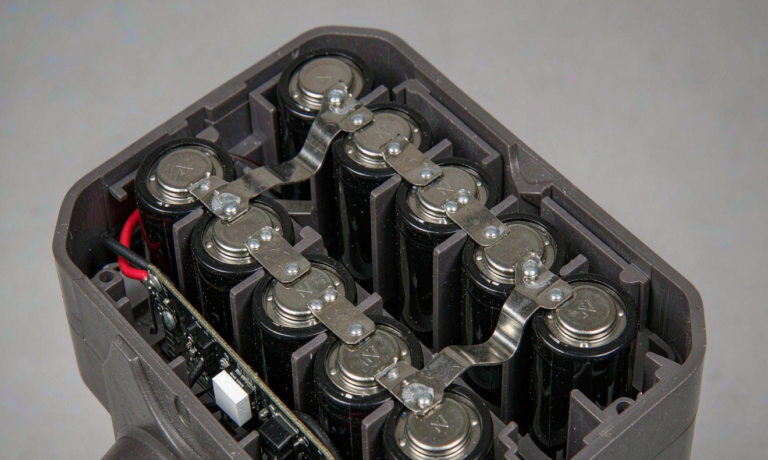
Three design choices do most of the work. First, nickel strip thickness: 0.15 millimetre plate is common and adequate, 0.2 millimetre is better for 5S2P and above. Second, tab weld quality: a weld batch with high resistance adds heat right where the current enters the cell. Third, contact resistance at the tool interface, which we hold under 3 milliohms by using gold plated sliding contacts and clean, torque checked screws. All three show up as millivolts under load, and those millivolts are the difference between a nail set flush and a nail left standing proud.
Pack Architecture, Contacts and Tool Compatibility
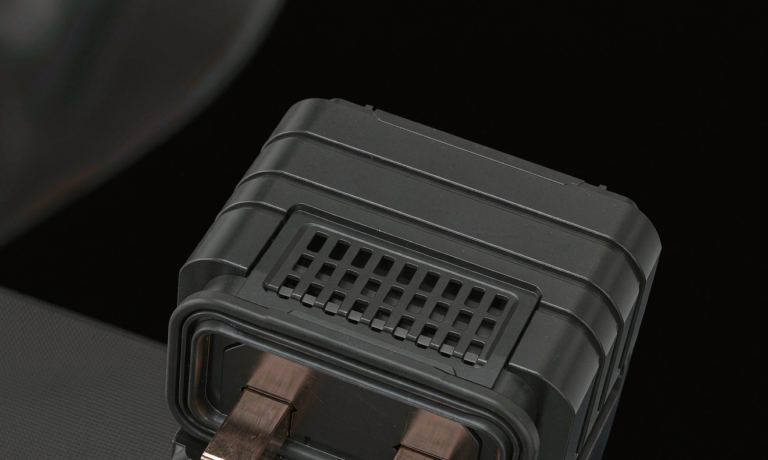
Platform compatibility is the single biggest source of returns. An 18 V nominal system built from 3.6 V cells is what most crews call 18 V, while the 20 V maximum label simply reflects 3.7 V cells charged to 4.2 V. A pack built for the wrong nominal voltage either under drivesthe tool or, worse, sits on a contact block with a different keying and no chance of seating. We machine the housing to the tool maker footprint, use the sliding contact block for some lines and the butt end contact block for others, and never assume a shared interface.
Inside, the choice between 5S1P, 5S2P and 5S3P is a trade between voltage sag and run time. A single string keeps the pack light and cool but sags to roughly 14 V during a drive, which is still enough for most 21 degree nailers. Parallel strings hold voltage above 15 V under the same pulse, which is exactly what a dense engineered lumber floor needs. Each parallel leg gets its own fused lead on the diagnostic lead only, the BMS monitors every cell group, and the state of charge algorithm is tuned for pulse duty so the gauge tells a framer how many shots remain rather than how many volts are left.
Testing, Certification and Transport
A power tool pack is a portable battery, so the certification path starts with IEC 62133-2, which is the part of the international standard that covers cells and packs for portable equipment, power tools included. Alongside it we run UL 2054 for the cell construction and housing, and we issue a UN38.3 test summary from the cell and pack level: altitude simulation, thermal test, vibration, shock, external short circuit, impact, overcharge and forced discharge. That document is what a freight forwarder asks for, and it is the first thing an insurer requests after an incident.
Under transport rules the finished product ships as lithium ion batteries, normally UN 3481, either alone on a pallet or packed with the nailer as a battery contained in equipment. Two practical notes from our shipping desk: consolidate at roughly 30 percent state of charge for air freight as the rules expect, and never ship a swollen pack, because a damaged cell loses its certification and turns a routine return into a HazMat call. If a buyer wants the nailer pack certified for an industrial or vehicle mounting instead, IEC 62619 is the correct standard, but it is not the standard for a handheld tool and applying it here would be the wrong tool for the job.
Frequently Asked Questions
How many nails should a lithium battery deliver per charge on a cordless framing nailer?
A good 6 Ah 18 V pack fastens 620 to 900 nails into 2×4 pine studs at normal pace. Drive into engineered lumber or oriented strand board and the same pack manages 380 to 520 nails, and stair stringer work can drop below 300. Judge a pack on the worst material on the job site, not on the easiest wall.
Is a larger amp hour pack always better for a framing nailer?
Not always. Doubling from 6 Ah to 12 Ah adds roughly 30 to 40 percent of the pack weight and slows the tool, which a framer feels over a full day. Size the capacity to the fastest material you drive all day, and keep a lighter pack for trimming and drywall.
Why does the nailer lose power on the last nails of a wall?
Two effects stack. The cells lose usable charge near the bottom of the state of charge window, and the pack warms up, so internal resistance rises and voltage sags further under the same 80 A pulse. The tool then cannot set the nail flush. Either buy more capacity or swap to a fully charged second pack before the row starts.
Should I use lithium iron phosphate cells in a framing nailer battery?
For pure framing, no. High rate NMC wins on weight and pulse power. Choose lithium iron phosphate only when one battery platform has to feed a nailer, a work light and a small pump, because its cycle life of 3000 to 6000 charges pays off on the slower tools.
How should spare nailer batteries be stored between building seasons?
Store at 30 to 50 percent charge in a cool, dry place, roughly 15 degrees Celsius, and check the voltage every few months. A sealed pack self discharges under 3 percent per month, but a pack sitting at full charge through a summer of float loss adds plating risk at the first hard drive.
Which standards apply to a power tool battery pack?
IEC 62133-2 for cells and portable packs, UL 2054 for construction and housings, and the UN38.3 test summary plus UN 3481 for shipping. IEC 62619 exists, but it is for stationary and traction systems, not a handheld nailer.
Further Reading
References