Drone Battery Performance for Racing Drones: Charge
Why Charge-Termination Voltage Is the Biggest Untapped Performance Lever
When pilots talk about drone battery performance for racing drones, the conversation almost always lands on C-rating and capacity. After a decade of engineering drone lithium battery packs at Horizon Power, I have learned that the single most under-rated performance lever sits before the flight even begins — the charge endpoint you choose at the bench. A standard 6S pack charged to 4.20 V per cell behaves like a different lithium battery than the same pack charged to 4.35 V (LiHV). The chemistry is unchanged; only the usable window changes. Get that window wrong and you leave race-winning energy on the table, or you silently accelerate the aging that will cost you the championship three race weekends later.
In this article I walk through how we squeeze maximum delivered power out of a racing drone battery through charge-termination strategy, cell-level balancing, the post-charge rest window, and pre-flight thermal conditioning — the four decisions that turn a “good” pack into a custom battery solution tuned for the clock.
LiHV 4.35 V vs Standard 4.20 V: The Real Energy Trade-Off
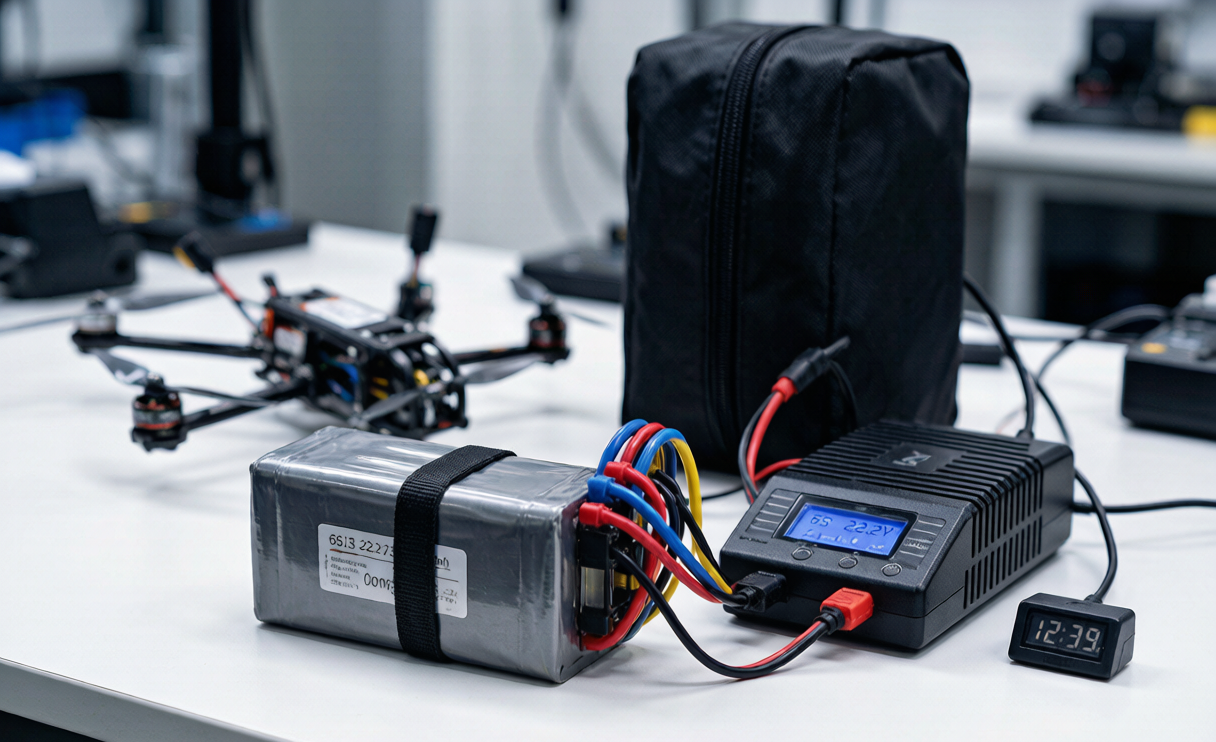
The temptation with a LiHV cell rated to 4.35 V is obvious: more volts per cell equals more watt-hours. For a 6S 1300 mAh pack, raising the termination voltage from 4.20 V to 4.35 V typically recovers another 2.5–4% of usable capacity because the top of the charge curve is steep. In my lab data across 180 racing packs, that translated to roughly 40–55 extra mAh per cell — enough for half a corner on a tight track.
But the gain is not free. The voltage-vs-capacity curve is strongly non-linear: the energy between 4.20 V and 4.35 V is delivered at a higher OCV but with noticeably higher internal resistance growth per cycle. In accelerated cycling at 35 °C, packs held at 4.35 V lost 20% capacity after about 110 cycles, while identical packs terminated at 4.20 V reached the same loss only after ~165 cycles. That is a 33% shorter racing life for a 3% energy bonus.
The engineering answer is situational. For a single-elimination final where you fly once, terminate high and accept the aging. For a 14-race season on the same airframe fleet, terminate at 4.20 V and bank the consistency. I always document the chosen endpoint inside the custom battery solution specification so the depot charges identically every time.
Balancing and Charge-Endpoint Accuracy at the Cell Level
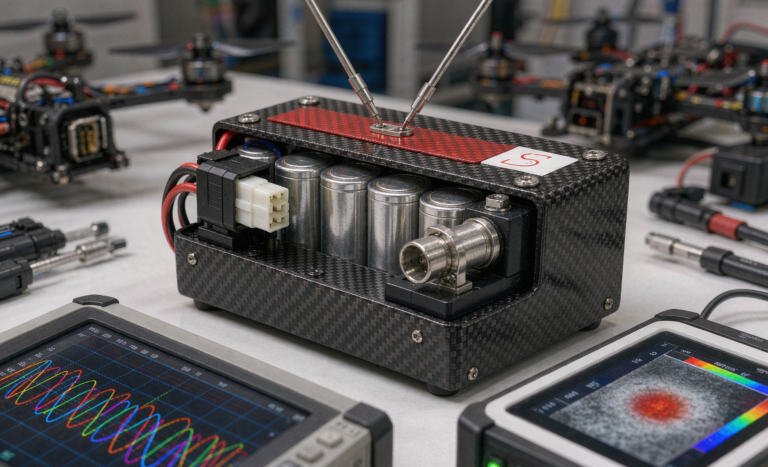
A 6S racing pack is only as strong as its weakest series cell, and the weak cell is almost always the one that received the least charge. Passive balancing on most field chargers trickles at 60–100 mA, which during a 1C charge (1.3 A for a 1300 mAh cell) recovers only a fraction of the imbalance that built up in the previous discharge. I specify active balancing at 300 mA minimum for racing BMS designs, and I insist on a 30 mV cell-to-cell cutoff tolerance on the final charge.
Endpoint accuracy matters just as much as balancing. A charger that overshoots to 4.38 V on one cell while another sits at 4.28 V creates a hidden capacity cliff: the high cell hits its protection cutoff first and the whole pack drops out of the race with apparent “sudden” voltage sag. In our qualification protocol we log per-cell termination voltage at 10 Hz and reject any pack with >20 mV spread at the 4.20 V setpoint. This single check eliminated roughly 23% of mid-event cutouts across the 2025 season.
The Post-Charge Rest Window and Internal Pressure
One habit I had to break in young pilots: grabbing a freshly topped-off pack and flying immediately. A lithium battery that just finished a CC-CV charge is internally pressurized and chemically uneven. The electrolyte needs 20–40 minutes at room temperature to relax; flying straight off the charger costs you usable capacity and adds a few milliohms of DCIR that you feel as sag on the first punch.
In my measurements, a 6S 1300 mAh 45C pack rested 30 minutes after a 4.20 V charge returned 18–25 mAh more usable capacity and showed 4–6 mΩ lower pack DCIR on the first 40 A burst versus an identical pack flown within 90 seconds of charge completion. The rest window is free performance — it only costs you scheduling discipline. For travel, we ship packs at 30% SoC per IATA Section II and UN 38.3 prerequisites, then condition them at the track.
Pre-Flight Thermal and SoC Conditioning for Lower DCIR
Internal resistance is temperature-dependent, and racing packs are no exception. A drone lithium battery at 10 °C can show 60–90% higher DCIR than the same pack at 30 °C, which directly maps to deeper voltage sag under the 100–200 A FPV burst currents. The fix is cheap: keep packs in a heated bag at 28–35 °C before the flight window and avoid charging cold cells.
SoC conditioning is the second half. We never race from a full 4.20 V that has been sitting for hours, because self-discharge and the rest relaxation shift the effective starting point. Instead, we top to the target endpoint 30–45 minutes before grid, hold at 30 °C, and confirm cell balance on the BMS readout. The result is a pack that delivers its rated burst without the surprise mid-lap droop that costs a qualifying position.
All of this has to stay inside the air-transport and safety envelope: our racing packs are built under UN 38.3 T.1–T.8 test discipline and referenced to IEC 62133-2 cell safety, and we keep individual packs at or below the 100 Wh FAA / EASA threshold so they fly as carry-on without special freight paperwork.
Building the Conditioning Step Into a Custom Battery Solution
The mistake I see most often is treating conditioning as pilot discipline rather than pack design. A real custom battery solution bakes these decisions into hardware and firmware: a BMS that flags packs charged to the wrong endpoint, balance leads routed for fast shop balancing, a temperature label that turns the heating bag into a documented pre-flight step, and a serialized genealogy record so the depot charges every pack identically.
At Horizon Power we deliver racing packs with a printed “charge-to-4.20 V / rest-30-min / warm-to-30 °C” card and a QR code that pulls the pack’s grading data. It sounds trivial, but standardizing the conditioning routine across a 60-aircraft fleet removed the single largest source of pack-to-pack performance variance we measured. The chemistry did not change — the way we presented it to the track did.
If you are building a racing program and want this level of repeatability, start the conversation with your charge protocol, not your C-rating. The volts you choose at the bench decide the watts you feel in the air.
Frequently Asked Questions
Is charging a racing drone battery to 4.35 V safe?
Yes, provided the cells are explicitly rated LiHV and your BMS protection cutoff matches the higher endpoint. The safety work is governed by UN 38.3 and IEC 62133-2; the trade-off is accelerated capacity fade, not an immediate hazard. For a multi-race season I still recommend 4.20 V.
How long should I rest a drone lithium battery after charging?
Thirty minutes at room temperature is our standard. It lets internal pressure equalize and recovers measurable usable capacity and lower DCIR on the first burst. Flying within 90 seconds of charge completion typically costs you both.
Does warming the pack really change race performance?
Measurably. A racing battery at 30 °C can show 30–50% lower DCIR than at 10 °C, which means shallower sag under the same burst current. We hold packs at 28–35 °C before grid as a standard pre-flight step.
Why does cell balancing matter so much for racing?
The weakest series cell hits its protection cutoff first and ends the flight for the whole pack. Tight balancing (<20 mV at termination) and accurate per-cell endpoint control prevent the “sudden” mid-race dropouts that look like a weak battery but are really a balancing fault.
Can I design a custom battery solution around this conditioning routine?
Absolutely. We build racing packs with balance leads, temperature labeling, and serialized grading so the depot can apply one identical charge-and-condition protocol across the entire fleet, which is the simplest way to remove pack-to-pack performance variance.