Drone Battery Testing for Racing Drones: An Accelerated
Why Racing Drone Batteries Age Differently Than the Datasheet Implies
When a pilot hands me a fresh set of racing packs and asks how many race weekends they will survive, I never reach for the manufacturer’s cycle-life number. A lithium-ion cell rated for 500 cycles at 1C tells you almost nothing about a 6S 1300 mAh pack that is pulsed to 150 A for 210 ms, rests for 900 ms, then repeats for eight minutes of qualifying. The damage drivers in FPV racing are instantaneous current, surface heating between bursts, and depth-of-discharge swings that are shallow in amp-hours but brutal in C-rate. That gap between the datasheet and the track is exactly why a dedicated drone battery testing protocol for racing drones has to be built from real flight data rather than copied from consumer electronics validation.
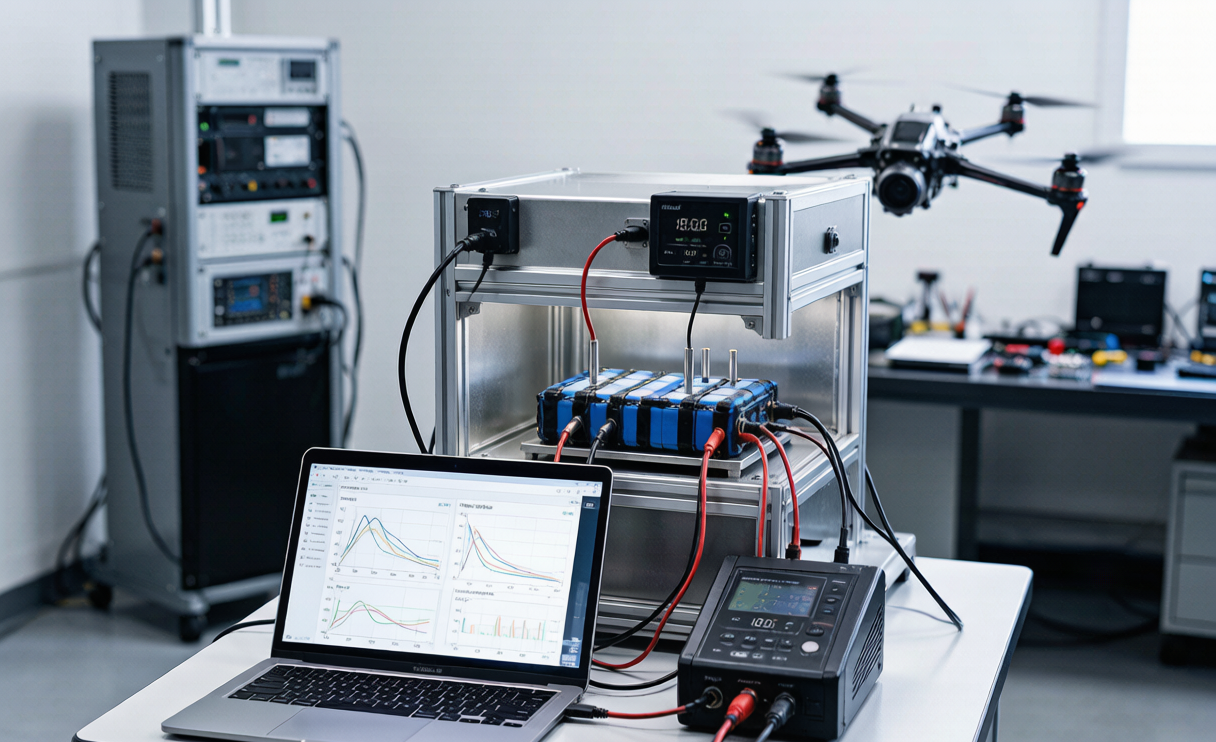
In my lab at Horizon Power we treat every new racing cell chemistry and every new pack construction as guilty until proven durable. The proof comes from an accelerated life test (ALT) that reproduces the actual racing duty cycle, not a textbook constant-current discharge. The objective is simple to state and hard to do well: compress a full competitive season into a few weeks of bench time while keeping the failure physics identical to what a pilot experiences on race day.
Synthesizing an Accelerated Test Loop From Real Lap Data
The first step in any honest drone battery testing racing drones program is to stop inventing the load profile. We instrument a race quad with a 100 Hz current shunt and a per-cell voltage DAQ, then record three to five representative qualifying laps at the venue. A typical 6S racing trace shows a 40–80C instantaneous burst during punch-out, a 25C average across the lap, and a full-throttle straight that holds 60C for nearly a second. We resample that logged trace into a repeatable loop of roughly 90 seconds, then chain it end to end.
The clever part is what we do next. To accelerate without distorting, we raise the loop repetition rate but cap the per-pulse C-rate at the true recorded value. In other words, we let the pack rest less between laps rather than forcing it to deliver more current than it ever sees on the track. A custom battery solution I qualified last season used a synthesized loop of 110 laps per 24-hour bench day, which compressed a 14-race season into 19 days. Because the per-pulse current and the state-of-charge window matched the logs within 3%, the wear mechanisms the bench produced were the same ones that ended packs mid-season on the field.
We run the loop at the race-day starting voltage, 4.20 V/cell, because that is where racing packs live. Testing at a calmer 3.70 V/cell would hide the calendar and surface-oxidation stress that high-voltage lithium chemistry actually experiences during a hot qualifying session.
Temperature Acceleration and the Arrhenius Model
Current alone does not set the pace of aging; temperature does. Lithium-ion side reactions roughly double for every 10 °C of cell-surface rise, which is the Arrhenius relationship every battery engineer learns and too many racers ignore. Our drone lithium battery ALT deliberately controls pack temperature rather than letting it wander. We hold the cell surface at a scripted profile: 35 °C during the “practice” portion of the loop, spiking toward 48 °C during repeated punch-outs, then a forced cool-down to mimic the bench between heats.
To accelerate calendar and SEI growth without cooking the pack into unrealistic failure modes, we apply a modest temperature acceleration factor of roughly 2.2x at 45 °C versus the 30 °C a pack sees on a mild race day. We refuse to push beyond 55 °C surface because above that the failure physics tips from gradual aging into thermal runaway territory, which is a different test entirely. The result is an ALT that is faster than real life but still valid: the cells lose capacity and gain DCIR for the same reasons they would on the track.
This temperature discipline is also why we validate every racing pack against IEC 62133-2 for cell safety and UN 38.3 T.1–T.8 for transport before it ever enters the accelerated loop. A pack that cannot survive a 1.2 m drop or a 15 min external-short precondition has no business in a racing qualification program.
Sample Size, Cells-Out and the Weibull View
An accelerated test with a sample size of one tells you nothing about a fleet. For a production racing pack I specify a minimum of 12 units per candidate chemistry, drawn from at least two manufacturing lots. We log each pack to a lithium battery genealogy record so that when a unit fails we know its weld batch, cell grade, and formation date. The “cells-out” metric, the number of packs that cross a retirement threshold before the target season length, is the headline result.
We fit the time-to-threshold data to a two-parameter Weibull distribution. In a recent qualification of a 6S 1300 mAh 45C pack, the shape parameter beta landed at 3.8 and the characteristic life at roughly 540 accelerated laps, which mapped to about 300 real race laps. A beta above 1 means wear-out dominates rather than random early failure, which is the healthy signature of a mature pack design. If beta had come in below 1 we would have suspected lot-to-lot variation and triggered a supplier corrective action before a single pack reached a customer.
From Test Data to a Qualification and Retirement Gate
The whole point of the ALT is to produce numbers a pilot can act on. We translate the Weibull result into a simple, conservative retirement gate that mirrors what our track-side testing already enforces: retire a pack when its direct-current internal resistance (DCIR) measured at 10 s and 1C rises above 0.4 mΩ per cell, when usable capacity falls below 80% of the label, or when per-cell divergence under burst exceeds 60 mV. The accelerated data also feeds our custom battery solution telemetry, so a pilot’s live pack health estimate is anchored to a qualification we actually ran rather than to a hopeful specification.
For air transport to race venues, every pack we ship stays under the 100 Wh FAA and EASA threshold per cell block, and we pre-condition to roughly 30% state-of-charge for shipping in line with IATA Section II. That compliance envelope is frozen at qualification and re-verified on the first production lot, so what we test is what the pilot flies.
Used honestly, an accelerated life and degradation protocol turns “this pack feels slower than last month” into a measured statement: this pack has consumed 78% of its qualified life and should be rotated to practice duty. That is the difference between guessing and engineering, and it is the standard I hold every racing drone battery to at Horizon Power.
Frequently Asked Questions
How is accelerated life testing different from normal cycle testing for racing drones?
Normal cycle testing discharges a cell at a steady 1C to a fixed cutoff and counts repetitions. That misses the punch-and-rest burst pattern of FPV racing entirely. Accelerated life testing for racing drones replays a synthesized lap-current loop at the true recorded C-rate, so the pack ages from the same instantaneous-current and heating spikes it meets on the track, just on a compressed calendar.
Does raising the temperature to speed up the test change the failure mode?
It can, which is why we cap acceleration. We hold cell-surface temperature in the 35–48 °C band and apply only a modest Arrhenius factor of about 2.2x. Above roughly 55 °C the dominant failure switches from gradual SEI growth to thermal runaway, so we stay well below that line to keep the accelerated wear physically identical to real racing wear.
How many packs do you test to qualify a new racing chemistry?
A minimum of 12 packs drawn from at least two production lots. Fewer samples cannot reveal lot-to-lot variation or give a meaningful Weibull fit. Each unit carries a genealogy record so a failure can be traced to its weld batch and cell grade, and the cells-out count across that sample becomes the qualification verdict.
What retirement threshold do you set from the ALT data?
We retire a pack when DCIR at 10 s and 1C exceeds 0.4 mΩ per cell, capacity drops below 80% of label, or burst per-cell divergence exceeds 60 mV. These gates come directly from the accelerated life distribution and match the go/no-go checks we already use at the track, so qualification and field use speak the same language.
Why start the accelerated loop at full 4.20 V/cell charge?
Because racing packs race at full charge. Testing at a calmer mid-state-of-charge hides the high-voltage stress and surface oxidation that actually end packs during a hot qualifying session. Starting the loop at 4.20 V/cell keeps the accelerated chemistry honest to real race-day conditions.