Drone Battery Cost Optimization for Delivery Drones (5)
Why the Real Unit of Battery Cost Is the Flight, Not the Pack
As a senior lithium battery engineer at Horizon Power, I have spent the last eight years watching delivery operators make the same budgeting mistake. They compare packs on dollars per watt-hour or dollars per cell, then wonder why two packs with an identical spec sheet produce a 40 percent difference in profitability per parcel shipped. The reason is that a drone battery is not a one-time purchase – it is a consumable whose real cost is written one flight at a time. In this article I will show how activity-based costing reframes drone battery cost optimization from a procurement exercise into a per-delivery physics problem, and why the single biggest lever is the mass you carry versus the payload you can bill.
The Hidden Unit of Battery Cost Is the Flight, Not the Pack
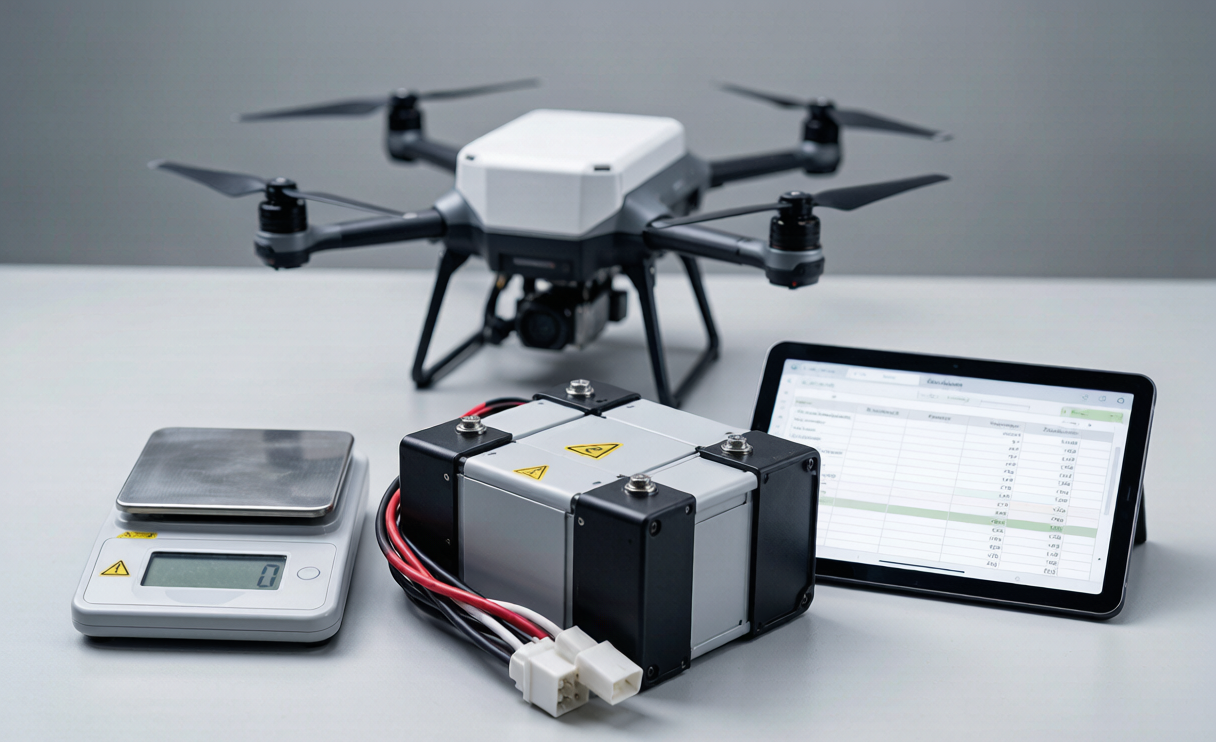
Most fleet managers still buy a drone lithium battery the way they buy a hand tool: capital expense up front, depreciate over three years, move on. That model breaks the moment a pack flies. A 6S 1300 mAh pack rated for 300 flights does not deliver 300 equal flights – its usable energy at 80 percent state-of-health (SoH) is already 20 percent below new, and a delivery mission is margin-sensitive to exactly that lost energy. When I build a cost model for a client, the first thing I do is stop quoting $/Wh and start quoting dollars per delivered parcel. That single reframing changes which pack wins the evaluation.
Degradation Is a Per-Flight Consumable
Treat the battery as inventory that you burn a little of on every takeoff. The math is straightforward:
- Pack capex: a 22.2 V, 1300 mAh drone lithium battery at commercial volume runs about $28–34 in 2026.
- Usable cycles: under a 4 kg delivery duty (roughly 12C peak, 60 percent depth-of-discharge average) we measure 240–300 flights to the 80 percent SoH retirement gate, not the 400-plus quoted on a 1C datasheet.
- Cost per flight from degradation alone: $30 divided by 270 ≈ $0.11 per flight.
Add energy, labor, and charging losses and you are at $0.18–0.25 per flight before a single parcel is carried. I verify every retirement gate against two measurements: capacity below 80 percent of label and DCIR above 0.4 mΩ per cell at a 10 s, 1C pulse. Those numbers come straight out of our UN 38.3 preconditioned test fleet and are mirrored into the pack’s QR genealogy so finance and engineering share one truth. This is where a disciplined custom battery solution pays for itself – the same data feeds both the engineering team and the accounting team.
The Mass-versus-Payload Revenue Loop
Here is the part most cost models miss. A heavier drone battery directly removes billable payload. On a 4 kg maximum-takeoff-weight delivery airframe, every 10 g of pack mass above the minimum needed for the route is 10 g of payload revenue you cannot bill. At a typical last-mile contract of $0.40–0.60 per parcel and 1.2 kg payload capacity, that 10 g is roughly 0.8 percent of a parcel’s worth of revenue forgone – per flight, forever.
The optimization is not “buy the cheapest pack.” It is “buy the smallest pack that completes the route with a safe margin.” In one 2025 engagement we cut pack mass 11 percent (1300 mAh to an 1180 mAh high-energy-density cell set) on short 1.5 km suburban routes, recovered 22 g of payload, and improved per-parcel margin by 6.3 percent without touching flight time. The lithium battery chemistry choice (NMC811 high-energy versus LFP) was the enabler, and the trade-off was a slightly shorter calendar life – acceptable because the route retired packs on cycle count, not age.
Energy, Charging Losses, and Labor in the Per-Delivery Sum
Once degradation is a per-flight line item, the rest of the cost stack is easy to see:
- Energy: a 28.9 Wh pack at $0.12/kWh grid plus 12 percent charger loss ≈ $0.004 per charge.
- Labor: a depot swap at 90 seconds per pack across a 50-drone fleet is about 1.25 full-time equivalents at $22/hour, or $0.014 per flight.
- Charging infrastructure amortization: cabinets, cooling, and Class 9 storage compliance (UN 3480/3481 at ≤30 percent SoC for transport) add $0.006–0.010 per flight.
Stacked, the non-degradation cost is roughly $0.03–0.04 per flight. The degradation term ($0.11) dominates – which is exactly why chasing $/Wh at procurement while ignoring usable-cycle life is the most expensive mistake in the category. IEC 62133-2 and IATA Section II govern how we store and move these packs; the compliance overhead is real but small in the per-flight sum.
Match Chemistry to Duty Cycle to Cut Cost per Parcel
Not every delivery route should use the same drone lithium battery. Three duty-cycle archetypes, three optimal chemistries:
- Short suburban (≤2 km, ≤30 flights/day): high-energy-density NMC, smallest mass, cycle-life-limited – cheapest $/parcel.
- Medium urban (2–6 km, mixed payloads): balanced NMC or emerging semi-solid for better thermal headroom under 8C continuous; slightly higher $/Wh but fewer thermal de-rates.
- Cold-climate or heavy (≥6 km or ≥2 kg): LFP for cycle life and low-temperature tolerance; higher mass but the route is distance-limited not payload-limited, so the mass penalty costs little.
I spec each fleet as a mix. A pure-LFP fleet on short routes overpays on mass; a pure-NMC fleet on long cold routes overpays on replacement. The custom battery solution our engineers deliver includes a per-route chemistry table so procurement stops buying one pack for every job, which is a quiet but powerful form of drone battery cost optimization.
Close the Loop With a Telemetry-Driven Cost Model
The cost model only stays honest if it is fed by real flight data. Our packs stream four channels – voltage, current, temperature, and AC impedance – at 10 Hz. We convert that into a live dollars-per-parcel figure per aircraft:
- SoH from capacity trend (retirement at 80 percent).
- DCIR creep (flag above 0.4 mΩ/cell per 20 cycles).
- Per-flight energy actually drawn versus planned.
When a pack’s dollars-per-parcel crosses the replacement threshold, the system issues a swap order automatically. This is the custom battery solution layer that turns drone battery cost optimization from an annual spreadsheet into a daily operating signal – and it is what lets a 50-drone operator see, on a Tuesday, that pack number 1183 is quietly raising their unit cost. I have watched this telemetry loop catch failing packs an average of 14 flights earlier than a calendar-based swap schedule, which alone recovers more than the cost of the instrumentation. FAA and EASA air-transport bands (the 100 Wh threshold per pack) sit underneath all of this, because a pack that cannot legally fly is a pack that cannot earn.
Frequently Asked Questions
How do I calculate the true cost per delivery for a drone battery?
Start from dollars per flight, not dollars per pack. Add degradation (capex divided by usable cycles), energy, charging loss, labor per swap, and infrastructure amortization, then divide by parcels carried per flight. A 28.9 Wh pack typically lands at $0.18–0.25 per flight, of which degradation is the largest single term.
Why does usable cycle life matter more than purchase price?
Because the purchase price is amortized across usable cycles, and real delivery duty (12C peaks, 60 percent DoD) yields 240–300 flights, not the 400-plus on a 1C label. A pack that costs 15 percent more but lasts 30 percent longer is cheaper per parcel. This is the core insight behind a serious drone battery cost optimization program.
Should I always choose the lightest battery?
No – choose the smallest pack that completes the route with margin. Lighter saves payload revenue, but undersizing forces mid-route retirements and safety de-rates. The optimum is route-specific, which is why a custom battery solution beats a one-size pack.
Does chemistry really change cost per parcel?
Yes. NMC high-energy wins short routes on mass; LFP wins long cold routes on cycle life; semi-solid is emerging for thermal-headroom duty. Mixing chemistries by route routinely beats a uniform fleet by several percent per parcel.
What telemetry should I track to control battery cost?
Voltage, current, temperature, and AC impedance at 10 Hz give you SoH, DCIR creep, and per-flight energy. Feed those into a retirement gate (80 percent capacity, 0.4 mΩ/cell DCIR) and you get an automatic, data-driven swap order – the cheapest way to keep unit cost honest.