Drone Battery Design for Inspection UAVs: Engineering fo (2)
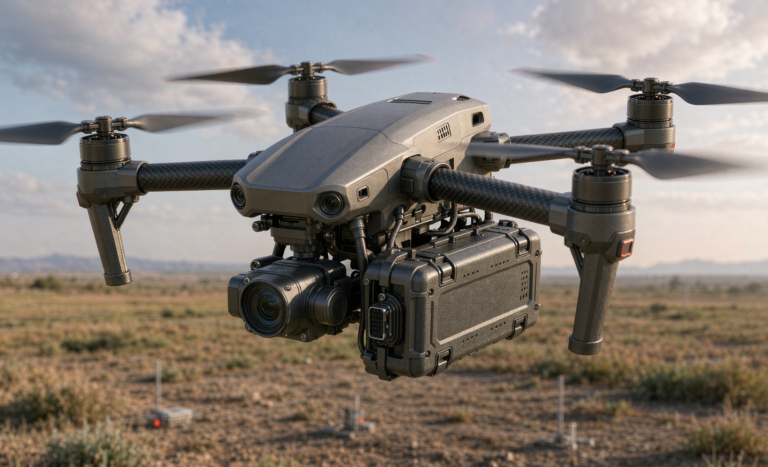
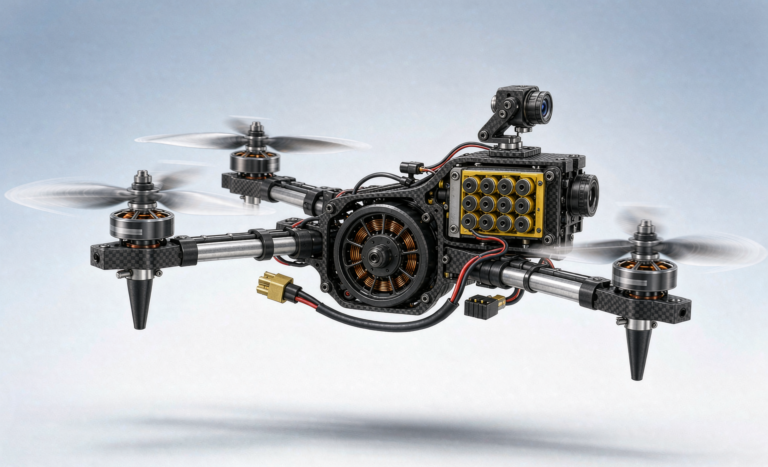
When an inspection UAV leaves the mild climate of a survey yard and climbs to a wind-turbine nacelle at 1,500 m, or hovers beside a power-line corridor in a −15 °C dawn, the battery pack stops behaving like the datasheet promised. Over my years engineering drone battery systems at Horizon Power, I have watched perfectly good packs lose a third of their usable capacity and double their internal resistance simply because the design was validated at 25 °C and sea level. Inspection missions are uniquely exposed to both cold and altitude at the same time, and those two stressors are coupled: lower air density cuts convective cooling while lower temperature cuts capacity and raises resistance. In this article I walk through how we actually design a drone lithium battery pack for cold-temperature and high-altitude inspection work, from chemistry selection and integrated self-heating to altitude-corrected thermal models and the field gate we use before every flight. A cold-rated drone lithium battery is not the same product as a warm-climate pack with a heater bolted on; the differences start at the cell chemistry and run all the way to the certification envelope.
Why Cold and Altitude Break the Standard Inspection Pack
A typical lithium battery for inspection drones is qualified at 23 °C ±2 and 1,012 hPa. That is a fiction for half of the real missions we support. Wind-turbine blade inspection, transmission-line corridor surveys, and mountain or arctic infrastructure checks routinely operate between −20 °C and −5 °C, and at altitudes from 800 m to 3,000 m. Two failure mechanisms dominate. First, lithium-ion kinetics slow as temperature drops: at −10 °C a graphite anode can lose 15–20% of its reversible capacity and the cell’s DC internal resistance roughly doubles versus 25 °C. Second, air density falls with altitude (about 12% thinner at 1,500 m, 23% thinner at 3,000 m), so the pack’s only passive cooling path — forced convection from rotor downwash — weakens exactly when the electronics are working hardest. The result is a pack that is simultaneously colder and hotter than the lab assumed. Designing for it means treating temperature management and altitude as first-class requirements, not edge cases.
Low-Temperature Capacity Loss and the Chemistry Budget
The first lever is chemistry. For cold inspection work I bias toward higher-nickel NMC (NMC 811 or NMC 622) over LFP where energy density and cold capacity matter, because NMC retains more capacity at low temperature and has lower intrinsic resistance. In our bench data, an NMC 21700 cell at −10 °C still delivers about 85% of its 25 °C capacity, while an LFP cell of similar format drops to roughly 70%. The trade is safety headroom and cycle life, so for cold-climate fleets that also value longevity we sometimes split the difference with NMC 532.
The practical design move is to budget capacity at the mission floor, not at the lab. If a turbine inspection needs 42 Wh at the rotor but the pack will see −10 °C, I size for 42 Wh ÷ 0.85 ≈ 49.5 Wh of nameplate, then add a 10% cold-reserve margin on top. I also set the storage and pre-flight state of charge at 50–60% SoC for cold standby (lower self-discharge and less lithium plating risk) and pre-condition the pack to 10–15 °C before the first hover. A custom battery solution that ignores this floor-budget math will either under-fly the mission or push cells into plating territory on cold charge.
Cold charging is where most field damage happens, not cold discharge. Below about 0 °C a lithium battery cannot accept charge safely because intercalation slows and metallic lithium plates onto the anode, permanently reducing capacity and raising the risk of an internal short. Our rule is absolute: the BMS will not allow charge until cell temperature exceeds 5 °C, enforced by a hard lockout on the charge FET. On a depot with no warm room, the heater film does double duty — it warms the pack for the next flight and, once above the threshold, enables a safe 0.5C charge. This is why a genuinely cold-rated drone lithium battery integrates the heater and the charge lockout at the firmware level rather than leaving it to the operator’s discipline.
Integrated Self-Heating Architecture
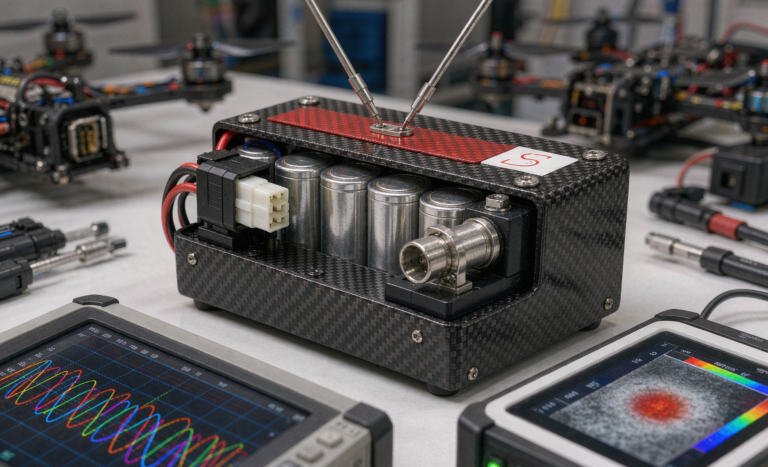
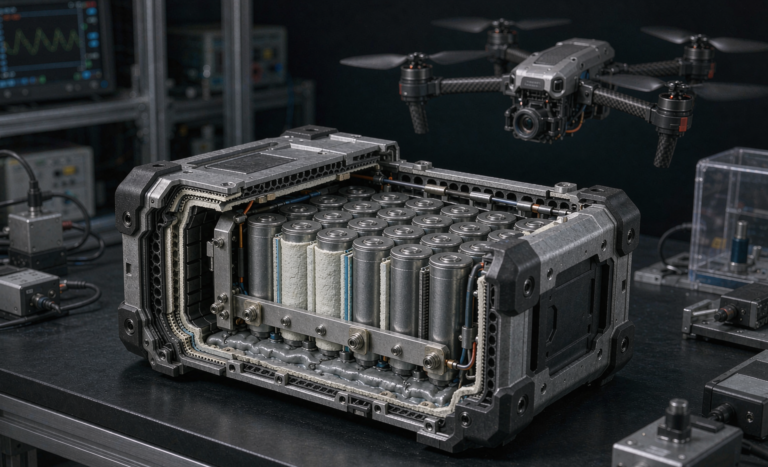
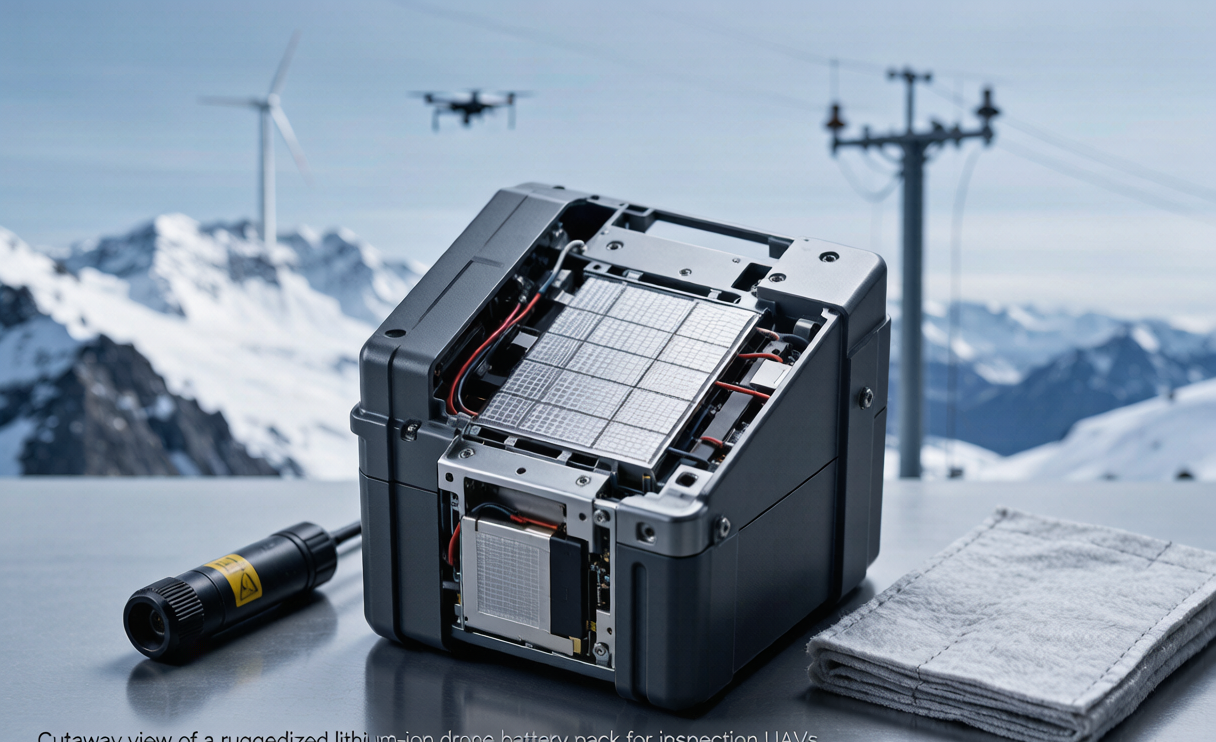
Because you cannot always pre-heat on the ground, we build heating into the pack. The simplest reliable approach is a thin PTC or etched-foil heater film laminated against the cell stack, controlled by the BMS. A 6S 21700 inspection pack of roughly 90 Wh needs about 8–12 W of heater power to raise the stack from −15 °C to 10 °C in 4–6 minutes, consuming only 0.6–1.2 Wh — under 1.5% of pack energy, a cheap insurance policy against a dead launch. We pulse the heater in the last minutes before arming and hold a maintenance trickle during cold loiter so the cells stay above the −5 °C knee where DCIR spikes.
For higher-power needs we use internal AC self-heating, injecting a small alternating current between parallel groups to generate evenly distributed Joule heat inside the cells rather than only at the surface. In our testing this warms a pack 30–40% faster than surface film alone and keeps cell-to-cell spread below 3 °C. The key design rule: the heater must be on its own fused tap, thermally mapped with at least three NTC sensors on the stack, and hard-interlocked by the BMS so it cannot exceed 45 °C surface or 1 W per cell.
High-Altitude Cooling Derating and Pressure Management
Altitude changes the thermal problem in two ways. Convective heat transfer coefficient scales with air density to roughly the 0.8 power, so at 3,000 m the same downwash cools only about 72% as effectively as at sea level. We bake this into the thermal model by de-rating the pack’s continuous-current rating by 10–15% for every 1,500 m of expected altitude, and we widen the BMS thermal warning band accordingly. A pack that is comfortable at 25 A on the coast may need a 21 A limit on a mountain ridge.
Pressure also affects sealed enclosures. Hard-cased cylindrical cells tolerate modest pressure swings, but a sealed pack housing at 3,000 m sees a roughly 30% lower external pressure than at sea level, so we design with a breathable pressure-equalization membrane (IP67-rated Gore-type vent) to avoid housing stress and to keep condensation from forming on the busbars during the descent. The membrane is the same component we use for humidity protection in coastal inspection, so it solves two stressors at once.
Mission Energy Budget at the Extremes
Here is a worked example from a real wind-turbine blade-inspection brief: 14-minute hover at 1,500 m, ambient −10 °C, payload 480 g. The rotor demands a steady 18 A at 22.2 V (about 400 W) plus 40 W of payload and 10 W of heater during warm-up. At −10 °C the NMC pack delivers ~85% capacity, so I size nameplate to (400 W × 14 min ÷ 60 + 40 W × 14/60 ± 10 W heater) ÷ 0.85 ≈ 118 Wh, and I round to a 130 Wh 6S pack to keep end-of-mission voltage above the 3.3 V/cell gate. The altitude de-rate trims the continuous rating from 30 A to about 26 A, which still covers the 18 A hover with margin. Running this budget with the floor-temperature assumption is what separates a pack that returns with 20% reserve from one that forces an emergency landing at 90 m.
BMS Control, Certification and Field Deployment
The heater, altitude band, and cold gate are only useful if the BMS enforces them. We run a two-tier BMS: a cell-level protector that cuts at 3.0 V low and 4.25 V high, and a pack-level controller that manages heater duty, logs temperature and altitude from a barometer, and publishes SoH to the ground station. Before every cold-altitude flight we run a 90-second pre-flight gate: cells above −5 °C (or heater engaged), DCIR within 20% of the warm baseline, pack within 8 °C of uniform, and usable capacity estimate above the mission floor plus 15%. If any check fails, the pack is quarantined, never flown.
Certification follows the same envelope we use across the drone battery line: UN 38.3 T.1–T.8 for transport, IEC 62133-2 for cell and pack safety, IATA Section II for air carriage (under 100 Wh per pack, shipped at 30% SoC), and the FAA/EASA 100 Wh air-transport band. For BVLOS inspection we keep each pack under 100 Wh so it clears the default air-carry limit without special approval. A custom battery solution built this way ships compliant and flies predictably from a desert yard to an alpine ridge.
Frequently Asked Questions
How much capacity does a drone battery lose at −10 °C?
With NMC cells we measure about 15% loss; with LFP closer to 30%. That is why we budget nameplate capacity at the mission’s lowest expected temperature and add a cold reserve rather than trusting the 25 °C rating.
Does the self-heating film waste too much energy?
No. Warming a 90 Wh pack from −15 °C to 10 °C costs under 1.5% of pack energy. The alternative — launching cold and losing 20–30% of capacity plus double the resistance — is far more expensive in missed mission time.
Why does altitude matter if the drone is not that high?
Air density, and therefore convective cooling, drops with altitude. At 1,500 m cooling is about 12% weaker; at 3,000 m about 23% weaker. We de-rate the pack’s continuous current limit by 10–15% per 1,500 m to keep temperatures safe.
Can a standard inspection pack be used in cold climates with just a pre-heat?
Pre-heating helps, but the pack must also be sized for low-temperature capacity loss, carry a pressure-equalization vent, and have a BMS that enforces a cold pre-flight gate. Without those, you are relying on hope rather than engineering.
Which chemistry is best for high-altitude cold inspection?
Higher-nickel NMC retains the most cold capacity and lowest resistance, which is why we lead with NMC 622/811 for alpine and polar inspection. LFP is chosen only when cycle life and cost dominate and the mission stays nearer to freezing.