Drone Battery Performance for Racing Drones: Engineering
As a senior lithium battery engineer at Horizon Power, I get asked the same question by almost every FPV pilot who walks into our lab: “what is the best drone battery for racing?” After more than a decade of building custom battery solution packs for everything from indoor tiny-whoop classes to 12S X-Class monsters, my honest answer is that “best” is not a single number. Drone battery performance for racing drones is discipline-specific, and the pack that wins a 5-inch freestyle gate is the wrong pack for a 7-inch long-range bando run. In this article I will show how we translate a race class into a precise pack configuration — and why the spec sheet alone will mislead you.
When we talk about drone battery performance for racing drones, we are really talking about how the pack behaves under the exact throttle profile of your class — not the average current a datasheet quietly assumes. Getting that match right is the difference between a podium and a mid-pack finish, and it starts with understanding the two axes every racing pack trades against. Most pilots shop by a single number and never see the mismatch until they are three corners behind.
Performance Is Specific Power, Not Just Capacity
The word “performance” gets reduced to milliamp-hours on every product page, but capacity is only half the story. A drone lithium battery delivers two independent quantities: specific energy (Wh/kg, how far you can go) and specific power (W/kg, how hard you can punch). For racing, power density usually dominates. A 6S 1300 mAh pack at 4.20 V/cell holds about 29 Wh and ~22.2 V nominal; at a 45C label that is a theoretical 58 A continuous and 100–150 A burst. But the number that decides whether you win the corner is the pack’s DCIR — direct current internal resistance — because that is what turns available voltage into heat and sag.
Worked example: a typical 6S 1300 mAh pack built from six 1300 mAh cells in series has a cell-level DCIR around 4 mΩ each. Series resistance simply adds, so the cells alone contribute ~24 mΩ. Add busbar and tab-weld losses (~2 mΩ) and harness/connector (~1–2 mΩ) and you land near 27–28 mΩ pack DCIR. Pull a 100 A burst through that and you drop 2.7 V instantly — your 22.2 V pack reads 19.5 V at the ESC. That sag, not the rated capacity, is the real performance limit. This is why I tell pilots: read DCIR, not just “C-rating.”
The Four Racing Disciplines and Their Power Signatures
Before we select a pack, we profile the discipline. Each race class has a distinct current-versus-time signature, and drone battery performance for racing drones has to be matched to it.
- Tiny whoop (1S–2S, 250–450 mAh): Short, explosive, indoor. Bursts are high relative to capacity, but absolute current is low (20–40 A). The pack needs low DCIR and good voltage retention under repeated micro-bursts, not raw capacity.
- 5-inch freestyle (4S–6S, 1300–1800 mAh): The classic. Hard collective punches of 80–150 A for 100–300 ms, separated by 1–4 s of cruise. Peak specific power, not endurance, wins. This is where a 45–75C drone lithium battery earns its keep.
- 7-inch long-range (4S–6S, 1800–3000 mAh): Lower burst (60–100 A) but sustained cruise at 20–40 A for minutes. Here specific energy matters more; we trade a little C-rating for higher capacity and lower mass-per-Wh.
- X-Class / mega-class (8S–12S, 3000–5000 mAh+): Enormous absolute current — 150–250 A bursts, 80–120 A sustained. These packs need parallel cell groups and reinforced busbars; DCIR control across a high parallel count is the real engineering challenge.
Turning a Discipline Signature Into a Pack Configuration
Once we have the current signature, we design the pack. The lever is series/parallel topology against a fixed cell, plus cell grade and mass budget.
For a 5-inch freestyle target (6S, ~1400 mAh, 120 A burst budget, <150 g), we start from a 1300–1500 mAh high-rate cell with DCIR ~3.5–4 mΩ. Six in series gives 6S at 22.2 V; pack DCIR ~24–27 mΩ. At 120 A that is a 3.0–3.2 V sag — acceptable because the ESC holds regulation down to ~16 V. Mass lands ~135 g, leaving airframe margin. For a 7-inch long-range build we keep 6S but move to a 2500 mAh cell at slightly higher DCIR (~5 mΩ); the pack sags more under burst but the extra 70% capacity extends flight from ~4 min to ~9 min. That is a lithium battery trade-off you only see when you design to the mission, not the marketing sheet.
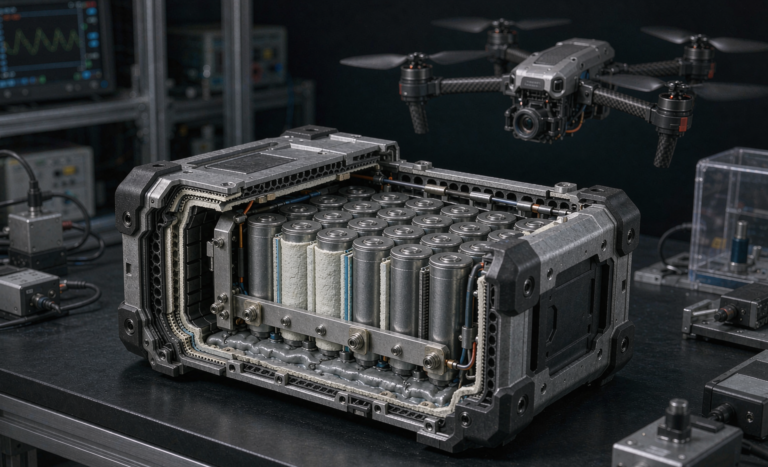
X-Class is the interesting case: a single 6S string cannot carry 200 A without melting tabs, so we parallel two 6S blocks (2P) to split current 100 A per block while keeping busbar cross-section manageable. The custom battery solution here is a parallel-block architecture with matched DCIR between the two halves — a 10% imbalance doubles sag on the weaker block and the quad yaws mid-corner.
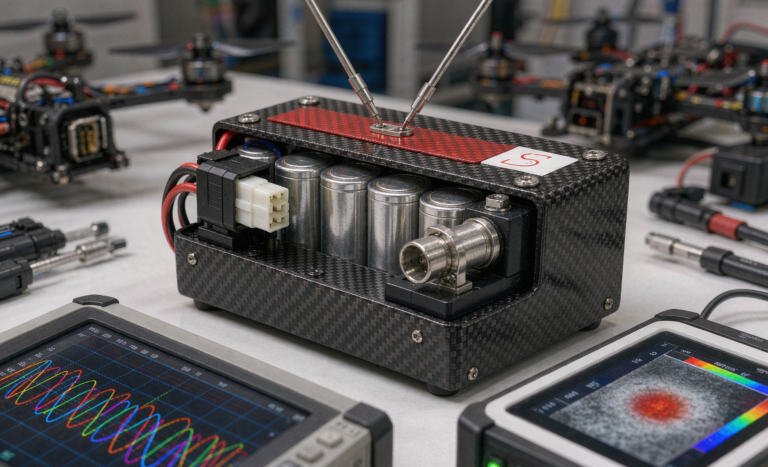
Cell grade is the quiet lever inside every one of these configurations. Two packs can share the same 1300 mAh cell model yet deliver完全不同 punch because one was built from a tight DCIR bin and the other from mixed stock. We sort every racing cell to a ±0.5 mΩ DCIR window and a ±2% capacity window before it ever reaches a weld fixture; that single discipline is what makes a Horizon Power pack repeatable lap after lap instead of varying quad to quad.
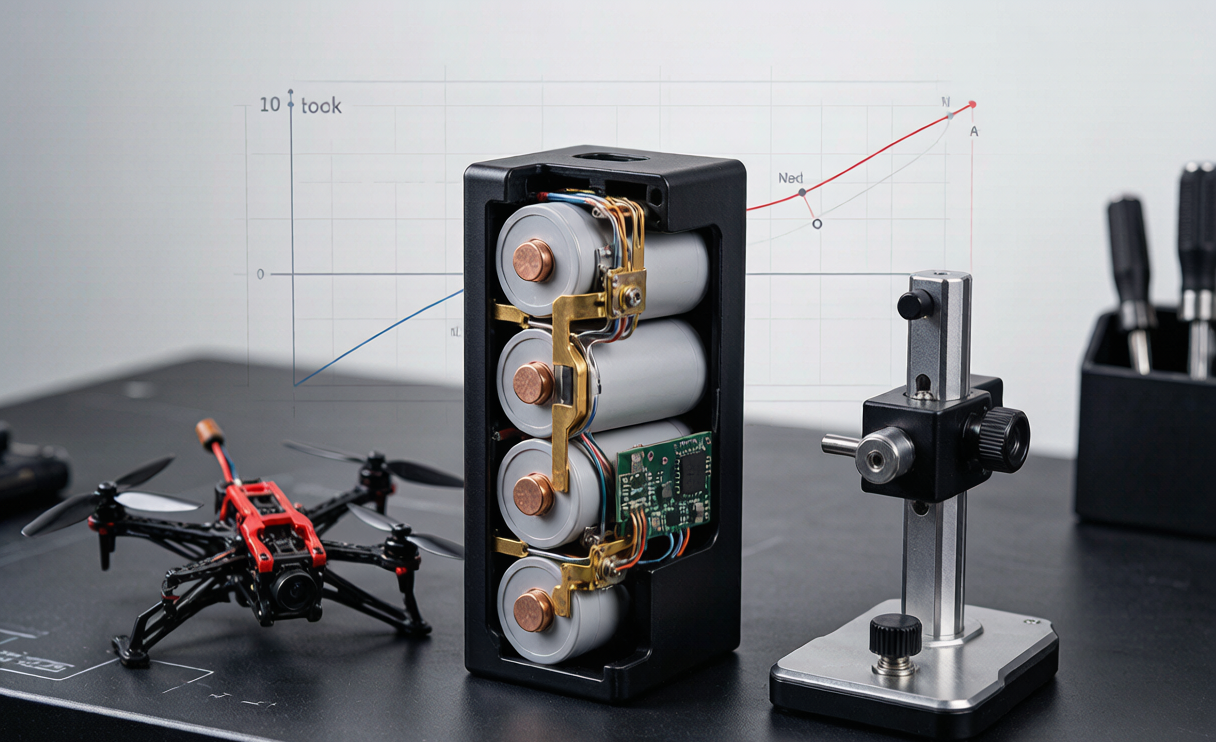
The cell choice itself sits on a trade-off curve that decides the whole build: push toward higher power density and you give up energy density. NMC lithium battery cells we use for racing sit around 220–250 Wh/kg and can deliver 1500–3000 W/kg instantaneously, while LFP sits lower on both axes (140–170 Wh/kg, ~1000 W/kg) — fine for cinematic, wrong for racing. Semi-solid and high-silicon formulations push the curve outward, which is why we prototype them for the 7-inch class where a few extra Wh/kg extend range without adding mass. The practical read: pick the cell whose position on the curve matches your discipline’s burst-to-cruise ratio, then bin it tightly. A 5-inch racer lives at the high-power end; a long-range cruiser moves toward the energy end. Chasing the highest mAh on a freestyle quad just adds mass that costs you the same thrust you were trying to buy.
Throttle-Band Voltage Sag and Where Thrust Actually Comes From
Pilots feel performance as “punch,” but punch is a voltage story. Motor thrust scales roughly with the square of applied voltage, so a 10% sag (22.2 → 20.0 V) is a ~19% thrust loss at the prop — before the ESC even compensates by raising current, which worsens the sag. This feedback loop is why DCIR control beats capacity for racing.
We validate throttle-band behaviour on a thrust stand: command 25/50/75/100% and log pack terminal voltage, phase current and thrust. A healthy 6S racing drone battery holds ≥18.5 V at 100% for the first 30 s of a fresh charge; if it dips below 17 V we know a cell group is aging or mismatched. This bench number is far more predictive of race-day feel than the “45C” printed on the wrap, and it is the metric we feed into every custom battery solution we ship.
Co-Engineering the Pack With Motor, ESC and Propeller
Battery performance is never isolated — it is the bottom of a powertrain chain. A high-KV motor pulls more phase current for the same thrust; an aggressive prop (high pitch/large diameter) loads the pack harder; ESC PWM switching at 8–24 kHz adds its own ripple that the pack must absorb. We co-specify these together.
Concrete example: a 5-inch build on 6S with a 1750 KV motor and a 5×4.3×3 prop pulls ~95 A at full collective. Drop to a 1550 KV motor and the same prop pulls ~78 A — the same pack now sags 22% less and runs cooler, gaining more race pace than a “higher C” battery would. That is the lesson: a custom battery solution is only optimal when the rest of the drivetrain is specified around it. We hand pilots a matched motor/prop/ESC table with every racing pack we release.
From Bench Spec to Race-Day Performance Scorecard
We close the loop with a delivered-performance scorecard, not a spec sheet. Each Horizon Power racing pack ships with a measured DCIR, capacity, and a 6-point burst-sag curve at 50% SoC. Pilots log their own lap data (voltage min, current peak, pack temp) and we compare it to the scorecard. If a pack delivers 5% less punch than its card after 40 cycles, it is flagged for retirement before it costs a race. This is the same UN 38.3 T.1–T.8 and IEC 62133-2 discipline we apply to every lithium battery we build, scaled to the FAA/EASA 100 Wh air-transport band that keeps these sub-100 Wh racing packs shippable worldwide.
Frequently Asked Questions
What C-rating should I look for in a racing drone battery?
Look at the burst C-rating in the context of your discipline’s current signature, not the headline number. A 5-inch freestyle quad pulling 120 A from a 1300 mAh pack is drawing ~92C instantaneously regardless of the “45C” label. Match the pack’s measured DCIR and burst-sag curve to your actual amp draw; a lower-C pack with tighter DCIR often outperforms a higher-C pack with sloppy busbars.
Is a higher mAh always better for racing?
No. On a freestyle quad, extra mAh usually means extra mass, and mass costs the same thrust you were trying to buy. Endurance classes (7-inch long-range) benefit from higher capacity, but punch-focused classes win with a lighter, lower-DCIR pack. Performance is a mass-and-power balance, not a capacity contest.
How does pack voltage (4S vs 6S vs 8S) change performance?
Higher series count raises nominal voltage, which raises motor RPM and thrust for the same KV, and reduces current for the same power (lower sag). But it also adds cells and mass. We pick series count from the motor/prop combo first, then size capacity and C-rating around it — the drone battery is specified last, not first.
Why does my brand-new pack feel weaker in cold weather?
Lithium cell DCIR roughly doubles between 25 °C and 0 °C, so a cold pack sags harder and the ESC pulls more current to compensate — which heats it up and recovers performance after a minute. Store packs at 50–60% SoC in a warm case and do a short warm-up hover before a timed run; that alone restores several percent of usable punch.
When should I retire a racing drone battery?
Retire when the pack’s burst-sag curve falls more than 5% below its shipped scorecard, when any cell group diverges by >60 mV under load, or when resting voltage after a hard run drops below 3.0 V/cell. A racing drone lithium battery that sags into the ESC’s low-voltage cutoff mid-corner is a lost heat and a fire risk — retire it before that happens.